
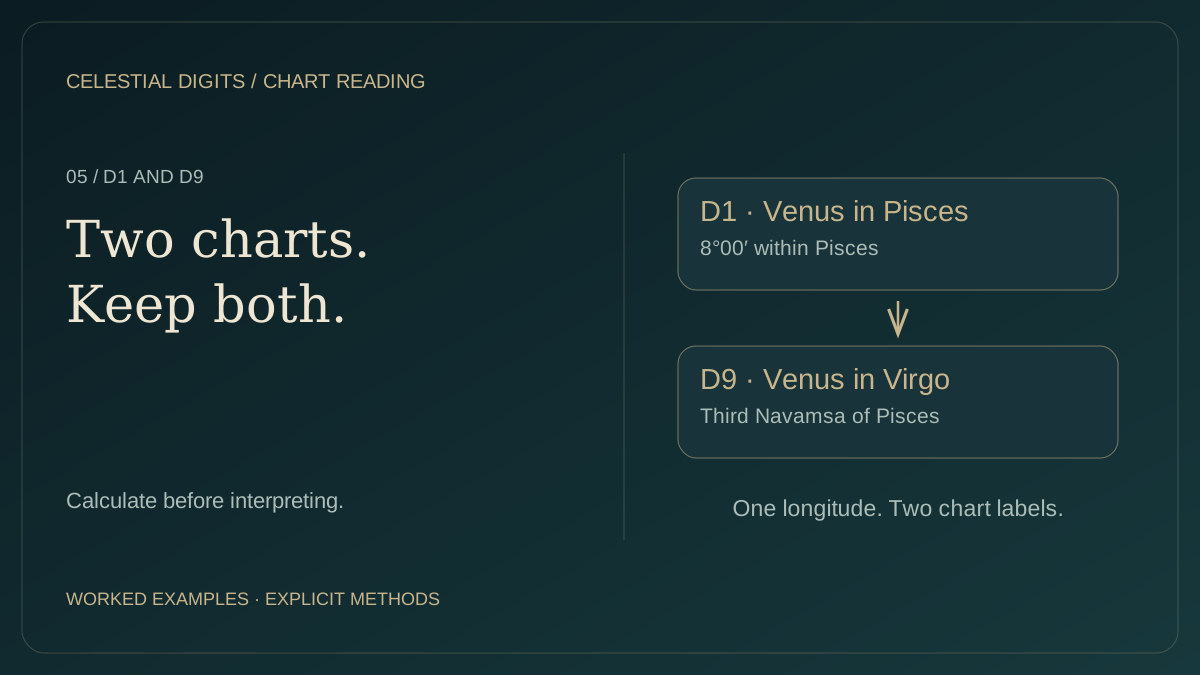
When D1 and D9 Disagree: A Worked Navamsa Example
Follow Venus from Pisces in D1 to Virgo in D9 using exact degrees. Learn how to combine differing dignities without declaring a marriage verdict.
Venus is exalted in your birth chart but debilitated in Navamsa. Which chart should you believe?
Both placements can be calculated correctly. D1 and D9 describe different divisions of the same longitude. The disagreement begins when we treat a dignity label as a complete prediction and expect both charts to deliver an identical verdict.
Here is an example you can reproduce without somebody else's private birth details. These are invented longitude inputs for teaching, not a full historical horoscope or a documented marriage outcome.
Start with the inputs, not the interpretation#
Use the conventional Parashari Navamsa mapping and whole-sign houses in each chart. Assume these sidereal positions are already calculated:
| Point | D1 sign | Degree within that sign |
|---|---|---|
| Ascendant | Aries | 12°00′ |
| Venus | Pisces | 8°00′ |
We are not calculating the sky from a date and location here. We are converting two supplied longitudes into Navamsa positions. For a real birth chart, zodiac, ayanamsha and birth inputs must be settled before this step.
Calculate the D9 ascendant#
Each 30° sign contains nine equal parts of 3°20′. Under the rule described in Brihat Parashara Hora Shastra, chapter 6, counting begins from the same sign for movable signs, the ninth sign for fixed signs and the fifth sign for dual signs.
Aries is movable. Its first four parts map as follows:
| Aries degree interval | D9 sign |
|---|---|
| 0°00′ to before 3°20′ | Aries |
| 3°20′ to before 6°40′ | Taurus |
| 6°40′ to before 10°00′ | Gemini |
| 10°00′ to before 13°20′ | Cancer |
The input Aries 12°00′ falls in the fourth interval, so the example's D9 ascendant is Cancer. The boundaries are start-inclusive and end-exclusive: an exact 10°00′ enters the fourth interval.
Calculate Venus's D9 sign#
Pisces is dual, so its first Navamsa begins from the fifth sign from Pisces: Cancer. Its first four parts are Cancer, Leo, Virgo and Libra.
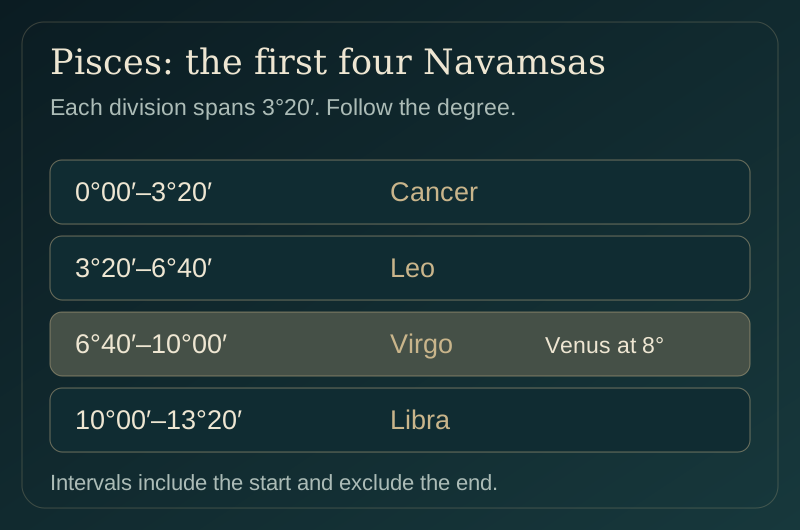
| Pisces degree interval | D9 sign |
|---|---|
| 0°00′ to before 3°20′ | Cancer |
| 3°20′ to before 6°40′ | Leo |
| 6°40′ to before 10°00′ | Virgo |
| 10°00′ to before 13°20′ | Libra |
Venus at Pisces 8°00′ therefore maps to Virgo in D9. From Cancer, Virgo is the third whole-sign house. From Aries, Pisces is the twelfth whole-sign house.
We now have a complete audit trail for this fragment:
| Field | D1 | D9 |
|---|---|---|
| Ascendant | Aries | Cancer |
| Venus sign | Pisces | Virgo |
| Venus house | 12th | 3rd |
| Sign dignity | Exaltation sign | Debilitation sign |
| Houses owned by Venus | 2nd and 7th | 4th and 11th |
“Exaltation sign” here does not mean Venus is at its exact degree of maximum exaltation. Likewise, this table is not a Shadbala calculation.
What a careful interpretation would say#
The calculation establishes differing dignity conditions in two charts. A traditional reader would retain both when assessing Venus, rather than deleting the less convenient one.
A useful provisional note is: “Venus has favourable sign dignity in D1, with a different dignity condition in D9; inspect the rest of both charts before interpreting the contrast.” That statement is less dramatic than “a wonderful marriage that later collapses,” but it actually fits the evidence supplied.
We do not know the condition of the seventh houses, their lords, the Moon, Jupiter, other associations or the active periods. We also know nothing about a person's real relationship. The two Venus labels cannot establish a spouse's character, fidelity or the survival of a marriage.
Do not invent a cancellation rule from this fragment either. If a reading claims cancellation of debility, it needs to state the rule, the chart in which it is being applied and all the required placements.
A four-degree change illustrates the sensitivity#
Keep the ascendant at Aries 12° but change the illustrative Venus input to Pisces 12°. Venus remains in Pisces in D1, yet now falls in the fourth Pisces Navamsa: Libra, its own sign, in the fourth house of this Cancer D9.
This is a comparison of two chosen Venus longitudes. It is not a claim that correcting a birth time by a few minutes moves Venus four degrees. The ascendant generally changes much faster than the planets; the effect of a time correction depends on the actual sky and proximity to a division boundary. See our separate birth-time sensitivity experiment.
Which chart should be read first?#
For the workflow used in these guides, begin with D1 and the question being asked, examine relevant D9 factors, then inspect the actual dasha and transit context. Record agreement and disagreement explicitly. This is a reading method, not a rule that every tradition phrases identically.
D9 does not switch on at marriage or on a universal birthday. Its calculated placements already follow from the natal longitudes. Claims about how those placements manifest with maturity are interpretations and should be labelled accordingly.
Compare your own charts#
Open D1 and D9 in the chart report. Write the chart name beside every sign and house. When copying chart data into Astra or another assistant, retain the actual degrees and both ascendants so it can distinguish a calculation from a guess.
For broader background, read Navamsa for beginners. To follow a planet's ruler, use the dispositor-chain exercise separately for each chart.
Verification note: The division boundaries, sign mappings and house counts above were checked arithmetically. That verifies the example's calculations, not the predictive accuracy of astrology. Our editorial policy explains that distinction.
Related Posts
Divisional Charts Guide: How to Read D1 to D60 Without Confusion
Complete guide to Vedic divisional charts: all 16 shodashavarga with their purpose, the practical big five, D1-to-varga reading method, and birth time limits.
Navamsa for Beginners: What D9 Can and Cannot Tell You
A beginner-safe but serious guide to the Navamsa chart in Jyotish: what D9 reveals, where people misuse it, and how to combine it with the natal chart.
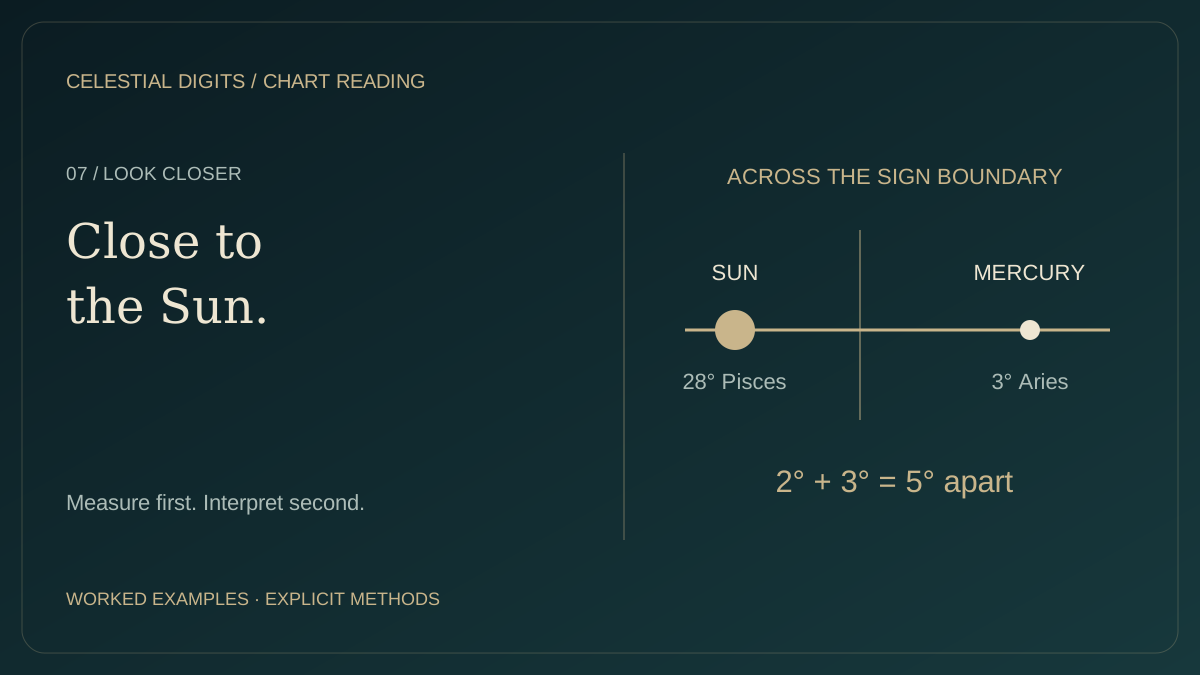
Combust Planets: Does Being Close to the Sun Always Mean Weakness?
Measure a planet's distance from the Sun with worked examples. Understand combustion, sign boundaries, retrograde motion and differing software rules.
A little more perspective.
Keep discussions respectful. No harassment, hate, sexual content or spam. Comments are reviewed before publication. Report concerns from a comment menu, or contact [email protected].
Checking your session…