
Can Five Minutes Change Your Birth Chart? We Compared the Results
A reproducible five-minute birth-time experiment with backend-generated D1 and D9 charts: what changes, what stays stable, and why boundaries matter.
Five minutes can change part of a chart, but it does not always change the ascendant sign or every planetary placement. The useful question is whether a relevant boundary lies inside those five minutes.
We ran a small, reproducible calculation using Celestial Digits' Python chart engine. These are synthetic teaching inputs, not a customer's birth record. The SVGs below come from the same backend renderer used by the app; they were not redrawn to illustrate a desired result.
The experiment#
We held the date and location constant: 1 January 2000, Bengaluru, latitude 12.9716° N, longitude 77.5946° E, UTC+05:30. The setup uses Lahiri ayanamsa and whole-sign D1 houses. We compared two pairs of local times.
| Local time | D1 ascendant | D9 ascendant |
|---|---|---|
| 12:00 | Pisces 12°35′09″ | Libra 23°16′28″ |
| 12:05 | Pisces 14°05′55″ | Scorpio 6°53′22″ |
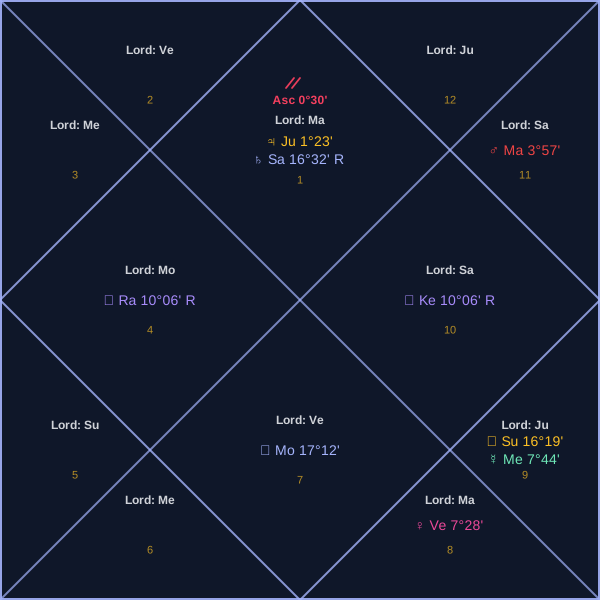
| 12:55 | Pisces 29°02′21″ | Pisces 21°21′14″ |
| 13:00 | Aries 0°30′24″ | Aries 4°33′40″ |
The reported positions are rounded for display. This is a selected illustration of boundary behavior, not a study of how often five-minute errors change charts across a population.
Pair one: D1 looks stable while D9 changes#
Between noon and 12:05, Pisces remains the D1 ascendant. In this pair, all nine grahas retain their D1 signs and whole-sign houses. Their exact longitudes still move; “same placement” does not mean “identical coordinates.”
The D9 ascendant changes from Libra to Scorpio. Divisional calculations partition a sign into smaller intervals, so a boundary can be crossed without leaving the D1 sign.
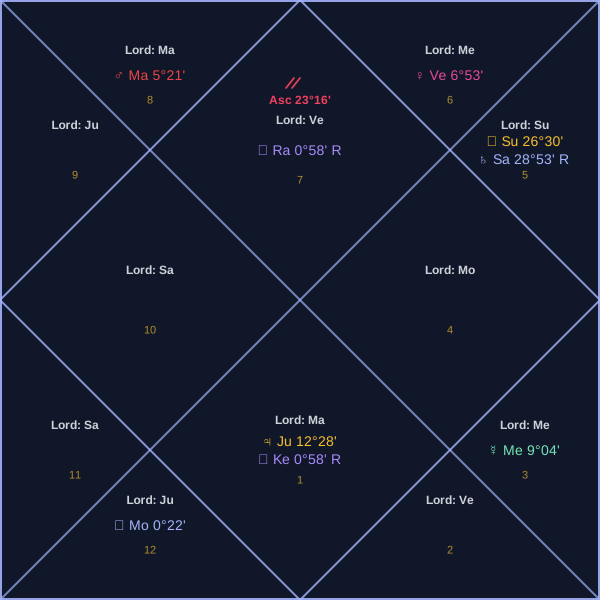
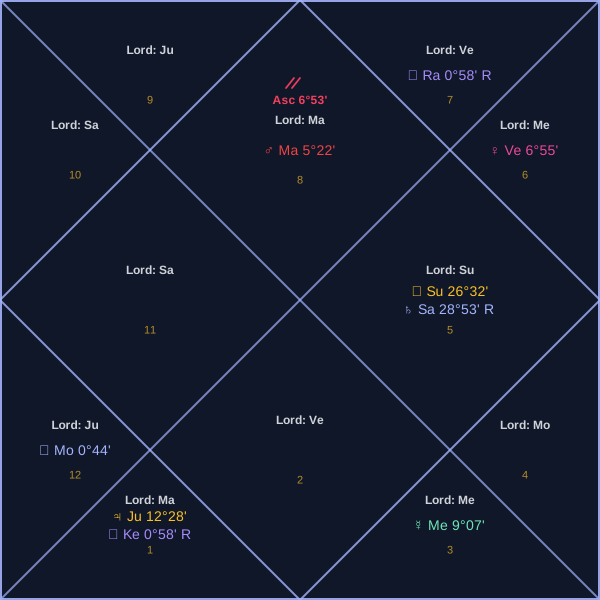
That does not prove a marriage outcome changes within five minutes. It shows why a detailed D9 interpretation should acknowledge uncertainty in the underlying time.
Pair two: the D1 ascendant crosses a sign boundary#
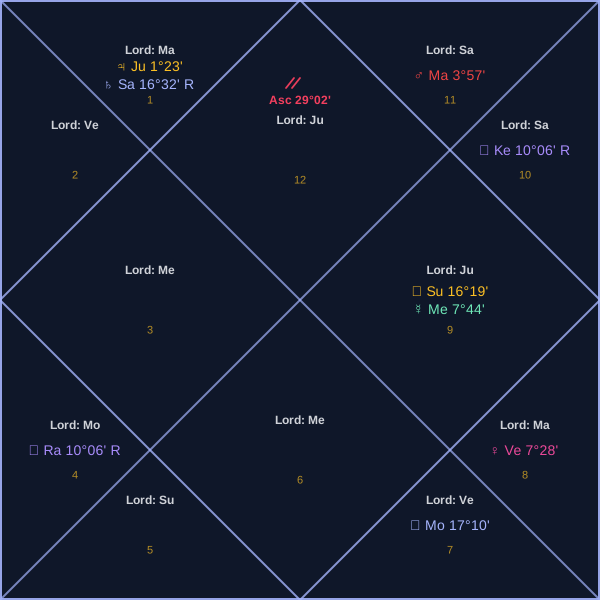
At 12:55, the ascendant is late Pisces. By 13:00, it has entered Aries. With whole-sign houses, that also changes the sign assigned to each house. A reader who relies on house lordships would now be interpreting a materially different setup.
How to use an uncertain birth time#
If the family remembers “around noon,” do not silently treat 12:00:00 as a measured time. Record an honest interval. Compare its endpoints and relevant intermediate boundaries, then separate stable facts from time-sensitive ones.
A twenty-minute uncertainty does not mean every possible interpretation is worthless. It means you should avoid presenting a boundary-dependent feature as certain. Conversely, a chart that looks unchanged in D1 does not validate every higher divisional detail.
Do not pick the time whose personality description feels nicest. That is not independent birth-time rectification. Start with documentary evidence and clearly distinguish a recorded time from an inferred one.
Reproduce it#
The frontend repository includes the editorial experiment script and its JSON observations. It calls the existing backend calculations and renderer without storing profiles or changing API behavior. Software revisions can alter output, so retain the settings with any comparison.
Open the birth-chart form to try the synthetic inputs yourself, or read what to do when the birth time is unknown. This experiment demonstrates calculation sensitivity, not scientific validation of astrological predictions.
Discussion: Which part surprised you—the stable D1 in the first pair or the changed D9? No personal birth data is needed to discuss the example.
Related Posts
Don't Know Your Birth Time? What You Can—and Can't—Read
An honest guide to birth-time uncertainty: which chart features need a precise time, how to compare a possible interval, and why noon is not a recovered birth time.
Twins, Similar Charts, Different Lives: What Can Astrology Explain?
A careful look at twins and astrology: small calculation differences, shared chart features, environmental factors and why a persuasive story is not proof.
Why Is My Kundli Different on Different Websites?
Compare birth inputs, ayanamsa, house systems and chart layouts before deciding which kundli is wrong. A practical troubleshooting checklist.
A little more perspective.
Keep discussions respectful. No harassment, hate, sexual content or spam. Comments are reviewed before publication. Report concerns from a comment menu, or contact [email protected].
Checking your session…