
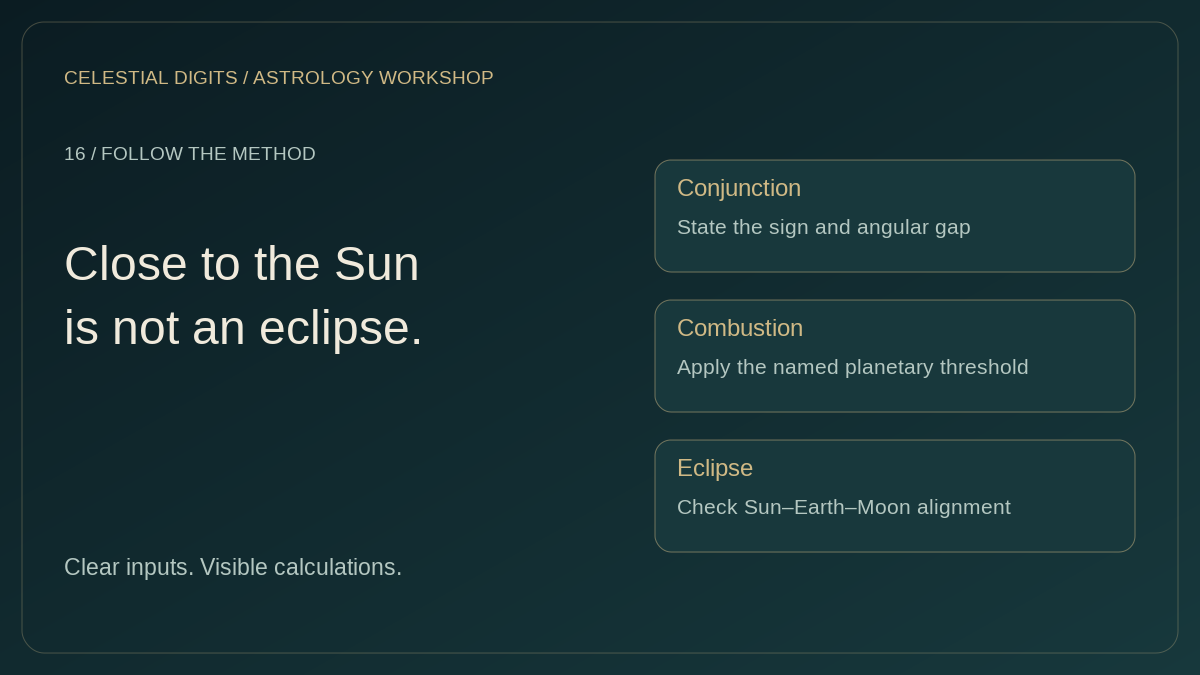
Combustion, Conjunction and Eclipse Are Not the Same
Separate a shared sign, angular closeness to the Sun and eclipse geometry, using three examples that test different conditions.
“Conjunct the Sun,” “combust” and “eclipsed” are sometimes used as if they describe the same condition. They do not. Each term asks a different question, and a chart can meet one condition without meeting the others.
Keeping the definitions separate prevents a routine close planetary placement from becoming an exaggerated claim about an eclipse or a person's future.
Conjunction: how close, under which convention?#
A sign-based reading may describe two planets in one sign as associated. A degree-based conjunction asks about their angular separation and the chosen tolerance. Those are related observations, but they should be labelled.
Take fictional Sun at 28° Pisces and Mercury at 3° Aries. They are in different signs yet only 5° apart across the zodiac boundary. Calling them unrelated because their signs differ misses the degree relationship. Conversely, two planets at 1° and 29° of one sign are 28° apart.
Our conjunction-degree guide develops this pairwise check.
Combustion: a traditional solar-proximity rule#
Combustion applies a traditional threshold to a planet's proximity to the Sun. The threshold can depend on the planet and convention, and some methods distinguish motion states. State the adopted rule before declaring a result.
The five-degree Sun–Mercury example provides the measured gap. To flag combustion, compare it with the chosen Mercury threshold. The measurement and the classification are separate steps. An eclipse calculation is not required to perform that comparison.
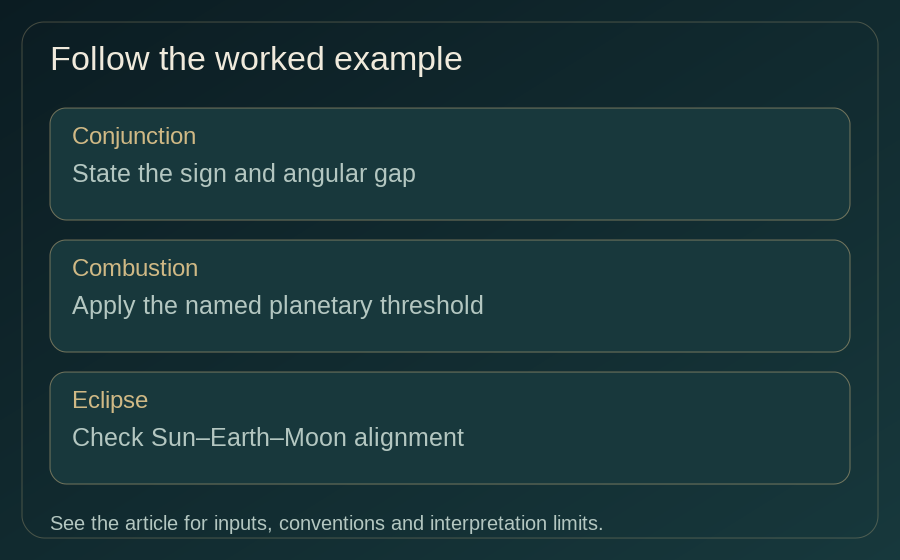
Do not infer that a planet ceases to exist or that the person loses the human ability associated with it. A traditional condition belongs in context with the rest of the chart. See combustion with measured distances for that context.
Eclipse: a physical alignment involving the Moon#
A solar eclipse occurs when the Moon passes between Earth and the Sun with the necessary alignment; a lunar eclipse occurs when the Moon passes into Earth's shadow. Because the lunar orbit is tilted, most new and full moons do not produce eclipses. NASA's eclipse explanation describes this geometry.
Thus a new Moon is not automatically a solar eclipse. A Sun–Moon longitude relationship alone does not provide every geometric condition. Likewise, Mercury being close to the Sun is not a lunar or solar eclipse.
Three questions to ask of a screenshot#
| Statement | Information needed to test it |
|---|---|
| These planets are closely conjunct | Their longitudes and the adopted tolerance |
| This planet is combust | Its Sun separation and the relevant combustion rule |
| This birth occurred during an eclipse | A reliable eclipse calculation for the instant; location for visibility |
A drawing that places several symbols in one diamond or square does not supply all this information. Read the degrees and timestamp. If visibility matters to the claim, verify it for the location rather than assuming an event visible elsewhere was visible at the birth site.
Keep lore, astronomy and interpretation in separate layers#
Rahu and Ketu have a rich traditional relationship with eclipse stories. That mythology can be explored without treating a nodal conjunction as a substitute for physical eclipse geometry. Our Rahu story is a retelling; the node-setting guide explains a calculation convention.
When sharing a chart, write the observed condition first and the interpretation second. “Mercury is five degrees from the Sun” is a measurement. “This proves the person cannot communicate” is an unsupported leap. The useful distinction is not whether a label sounds serious, but whether the data actually establish the condition being named.
Related Posts
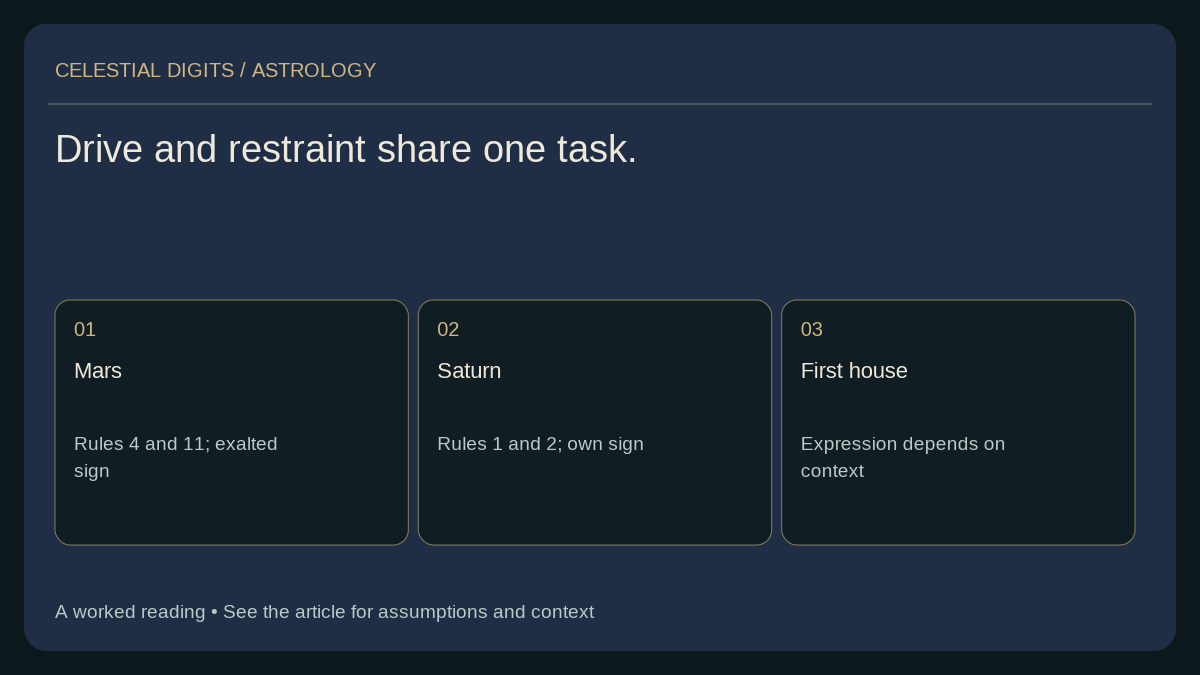
Mars–Saturn Conjunction: Reading Drive and Restraint Together
Use a Capricorn ascendant example to distinguish Mars–Saturn symbolism, dignity, house ownership and practical expressions of effort.
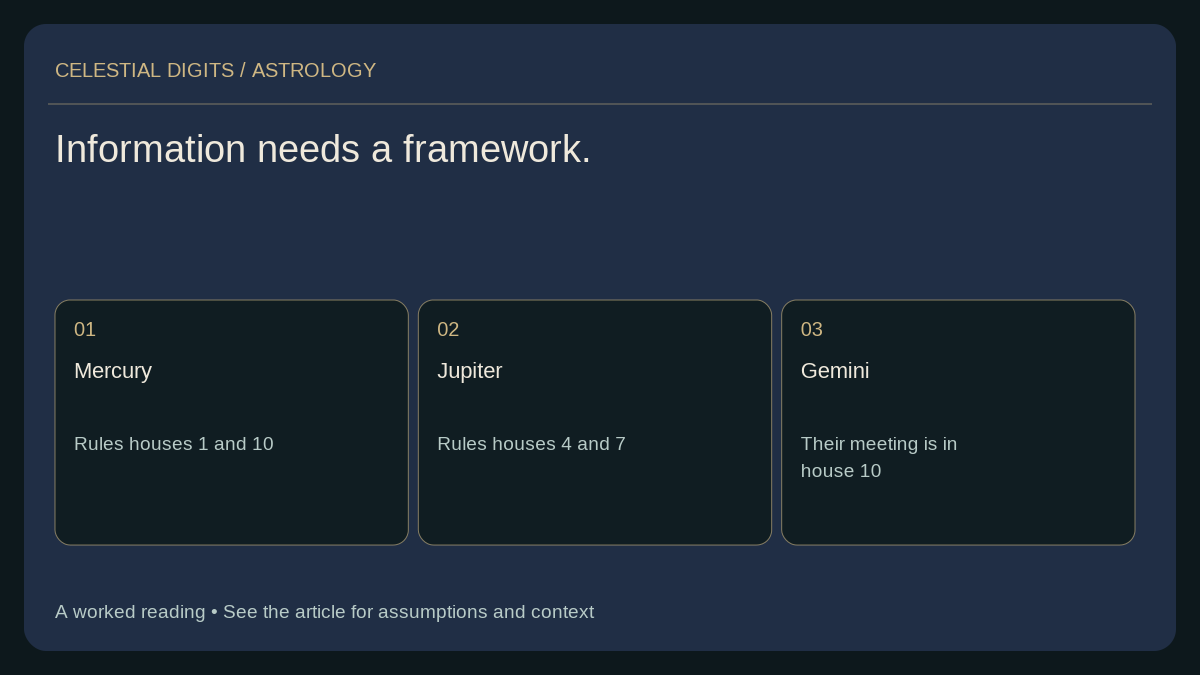
Mercury–Jupiter Conjunction: Information, Judgement and Learning
Read Mercury and Jupiter together through a Virgo ascendant example, distinguishing communication, judgement, house ownership and planetary condition.
Moon–Saturn Conjunction: Emotional Reserve Without Diagnosing a Person
Read Moon–Saturn with house ownership, degree and context, avoiding mental-health labels or assumptions about family relationships.
A little more perspective.
Keep discussions respectful. No harassment, hate, sexual content or spam. Comments are reviewed before publication. Report concerns from a comment menu, or contact [email protected].
Checking your session…