
Mean vs True Rahu and Ketu: Why Two Charts Can Disagree
Compare mean and true lunar nodes with a sign-boundary example, an opposite Ketu calculation, and a checklist for matching chart settings.
Two calculators agree on your Sun and Moon but put Rahu on opposite sides of a sign boundary. Before changing your birth time, check their node setting. Mean Rahu and true Rahu are different ways of representing a lunar node; the names do not mean “fake chart” and “correct chart.”
This matters most near a sign or nakshatra boundary. A modest difference in longitude can change a categorical label even though the two positions remain close together. Here is a worked example you can use to check the geometry before interpreting the chart.
What does the setting describe?#
Rahu and Ketu are the ascending and descending lunar nodes, not physical planets. The mean node smooths out short-period variation. The true node follows the osculating, or momentary orbital, node; it retains variations that the mean representation smooths away. Both are defined astronomical quantities.
The Swiss Ephemeris documentation, sections 2.2.1–2.2.2 explains these conventions. “True” is the name of a calculation model, not proof that interpretations using it have superior predictive accuracy. Choose a convention explicitly and keep it consistent across comparisons.
Celestial Digits' current birth-chart calculation uses the Swiss Ephemeris true node for Rahu, with Ketu opposite it. This describes the implementation checked for this article on 18 November 2026; it is not an instruction to change another practitioner's established method.
A small gap can cross a large-looking boundary#
The following positions are invented arithmetic examples, not an ephemeris result for a particular birth or transit date:
| Setting | Rahu | Ketu, 180° opposite |
|---|---|---|
| Mean-node example | 29°50′ Aquarius | 29°50′ Leo |
| True-node example | 0°20′ Pisces | 0°20′ Virgo |
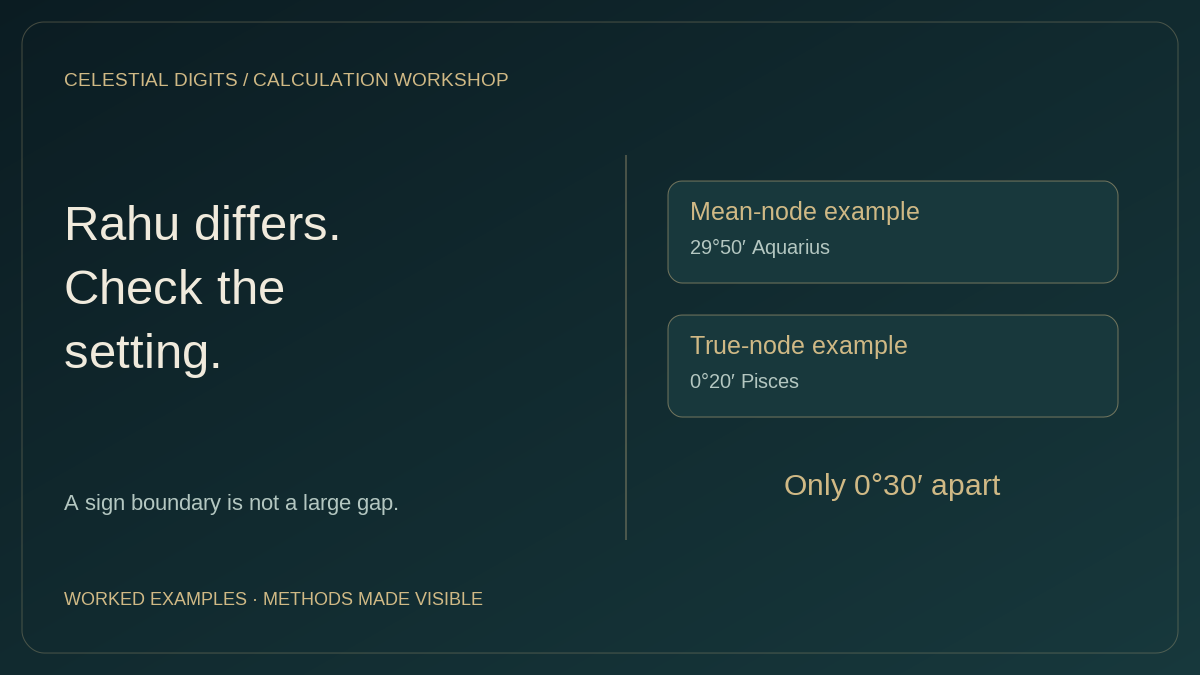
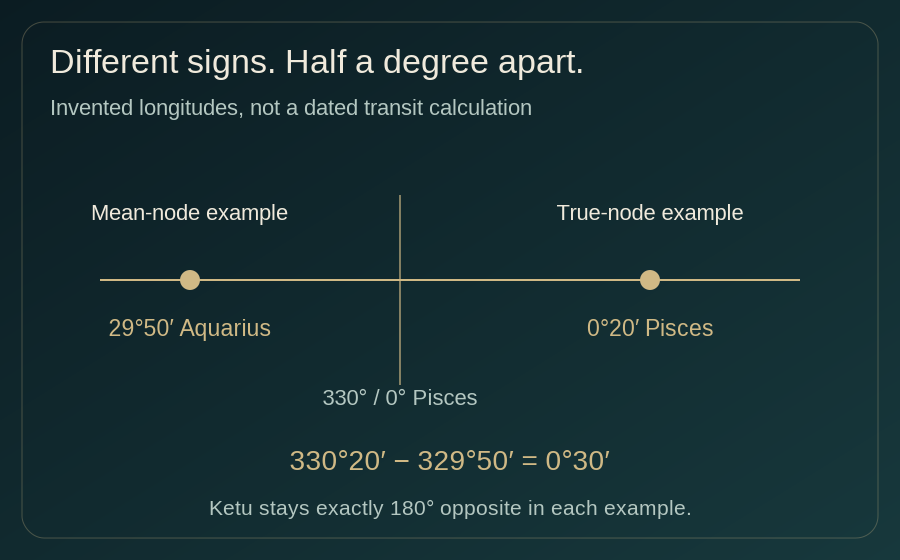
Measured from 0° Aries, Aquarius begins at 300° and Pisces at 330°. Our two Rahu positions are therefore 329°50′ and 330°20′. Subtract them: the difference is 0°30′, or half a degree. It is not a thirty-degree jump.
For the mean-node row, add 180° to 329°50′ and wrap around the 360° circle: 509°50′ − 360° = 149°50′, which is 29°50′ Leo. For the true-node row, 330°20′ + 180° − 360° = 150°20′, which is 0°20′ Virgo.
What changes for a Virgo ascendant?#
With whole-sign houses, Aquarius is the sixth sign from Virgo and Pisces is the seventh. In our illustration, changing the node representation moves Rahu's whole-sign house label from six to seven, and Ketu's from twelve to one.
That changes the starting point of a traditional house interpretation. It does not justify announcing that someone's health, marriage or identity has suddenly changed. First establish which calculation each report uses. Then keep that convention attached to the interpretation rather than combining whichever labels seem most dramatic.
House systems are a separate setting. A bhava-based house number can differ from a whole-sign house number even when both calculators return exactly the same Rahu longitude. Compare the longitude first, then the house assignment.
What should remain unchanged?#
If the birth instant, location, zodiac and other settings stay fixed, switching only the node representation does not move the Sun, Moon or ascendant. It changes the node calculation and values derived from it.
Similarly, a Moon-based Vimshottari starting balance should not change solely because mean Rahu was exchanged for true Rahu. Rahu's role as a dasha lord is not the same as using Rahu's longitude to calculate the natal Moon's nakshatra. If the dasha dates also differ, investigate the Moon longitude, ayanamsha, starting balance and year convention independently.
A node near a nakshatra boundary may acquire a different nakshatra or pada label. Do not confuse that with the Moon's birth nakshatra or the ascendant nakshatra. Each refers to the position of a different point in the chart.
A comparison worksheet that isolates the disagreement#
Record these fields from both reports before judging either result:
- Birth date, local time, time zone and the resulting UTC instant.
- Birth coordinates and whether both reports use geocentric positions.
- Sidereal or tropical zodiac, and the ayanamsha if sidereal.
- Mean or true node.
- Rahu's exact longitude, including minutes; Ketu's opposite position.
- House system and whether the displayed house is whole-sign or bhava-based.
Change one setting at a time. If longitudes agree but house numbers differ, investigate house assignment. If only the nodes differ, node representation is a candidate explanation—not a diagnosis until you inspect the settings. If most planetary signs differ, look beyond the nodes.
Does this also affect transit dates?#
Yes: different node trajectories can cross a sign boundary at different times. A transit article should identify its node convention alongside the zodiac and time zone. Do not combine the ingress date from one convention with positions from another and present the mixture as one calculation.
For a personal comparison, begin with why kundli websites disagree. For the labels around the positions, read sign lord, nakshatra lord and deity. The useful outcome is a reproducible chart configuration, not choosing whichever chart gives the preferred prediction.
Related Posts
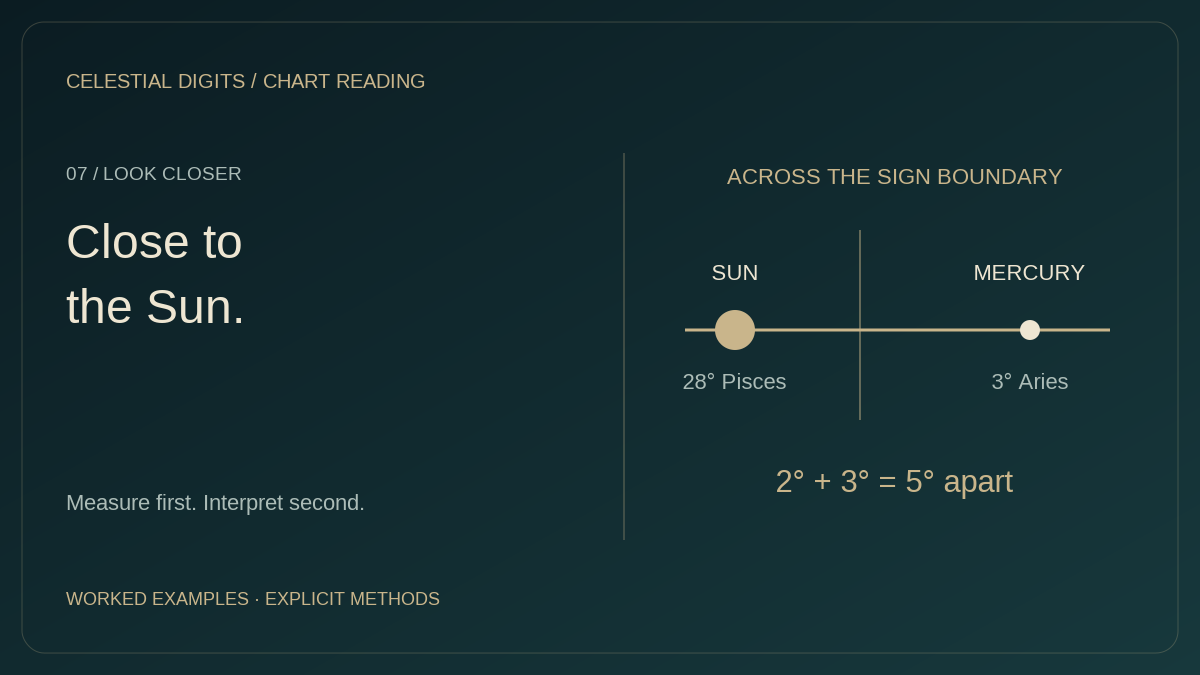
Combust Planets: Does Being Close to the Sun Always Mean Weakness?
Measure a planet's distance from the Sun with worked examples. Understand combustion, sign boundaries, retrograde motion and differing software rules.
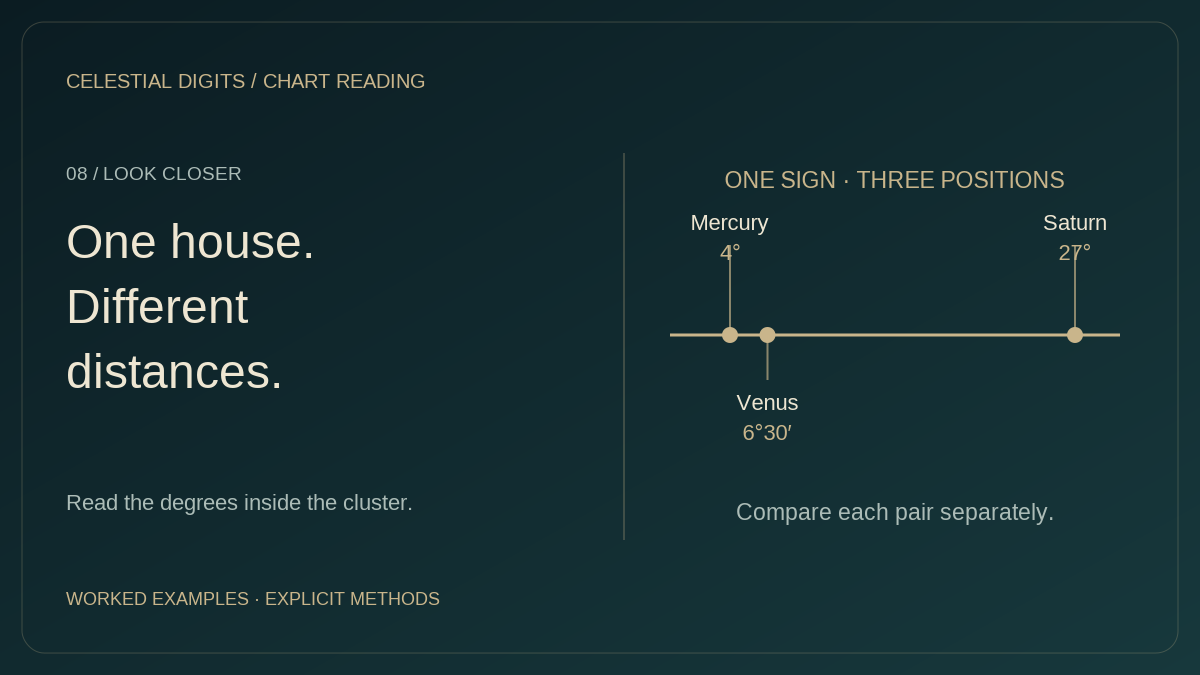
Same House, Different Degrees: How Close Is a Planetary Conjunction?
Compare same-sign conjunctions with actual degree gaps. Work through a three-planet cluster, cross-sign proximity and applying versus separating motion.
Foreign Travel, Work or Permanent Settlement? Read the Question First
Separate a foreign trip, overseas employment and a lasting change of home. Use a Virgo-ascendant worksheet to read houses, lordships and timing together.
A little more perspective.
Keep discussions respectful. No harassment, hate, sexual content or spam. Comments are reviewed before publication. Report concerns from a comment menu, or contact [email protected].
Checking your session…