
Rahu’s Stolen Immortality: The Story Behind Eclipses
Rahu stole a taste of immortality. Discover the ocean-churning story, why he pursues the Sun and Moon, and what the Rahu–Ketu symbolism means.
Stories Behind the Grahas · Chapter 3
The ocean · The stolen sip · Where is Ketu? · Your chart
Rahu almost got away with it.
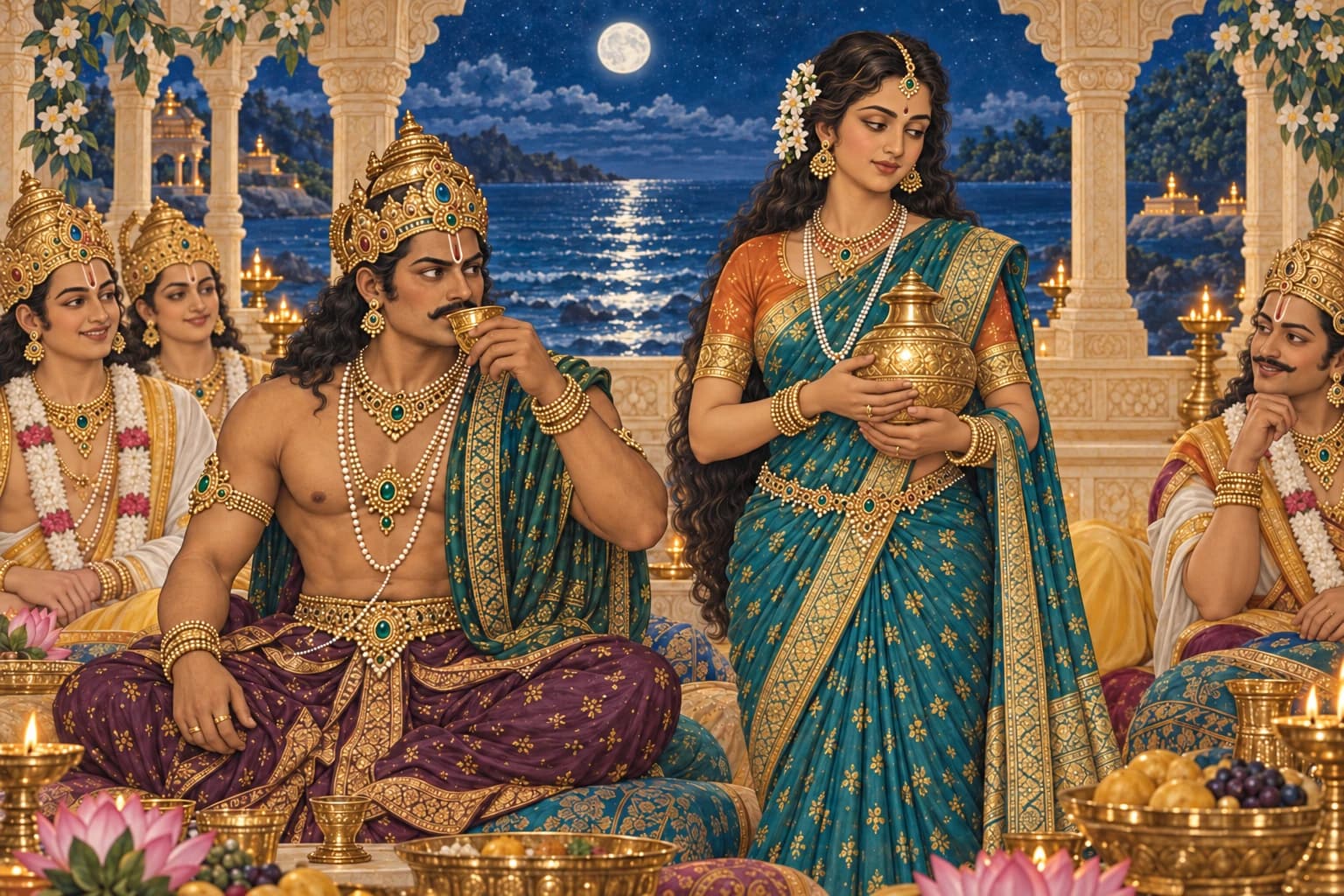
The gods were drinking amrita, the nectar they had worked so desperately to obtain. Among them sat someone who looked as though he belonged. He lifted the nectar to his lips.
The Sun and Moon recognised him. Vishnu’s discus followed. But the nectar had already reached Rahu’s throat.
His head survived. And the two witnesses gained an enemy who would pursue their light across the sky.
This is the story behind the eclipse-devourer: a being who achieved what he wanted, yet did not emerge whole. It offers a memorable way into Rahu’s astrological symbolism—but first, the story deserves to be told on its own terms.
An ocean of effort, a vessel of nectar#
Our main retelling follows the Mahabharata, Adi Parva, sections 18–19, in K. M. Ganguli’s translation. The Bhagavata Purana also tells the nectar episode; we will identify one important detail from that account below.
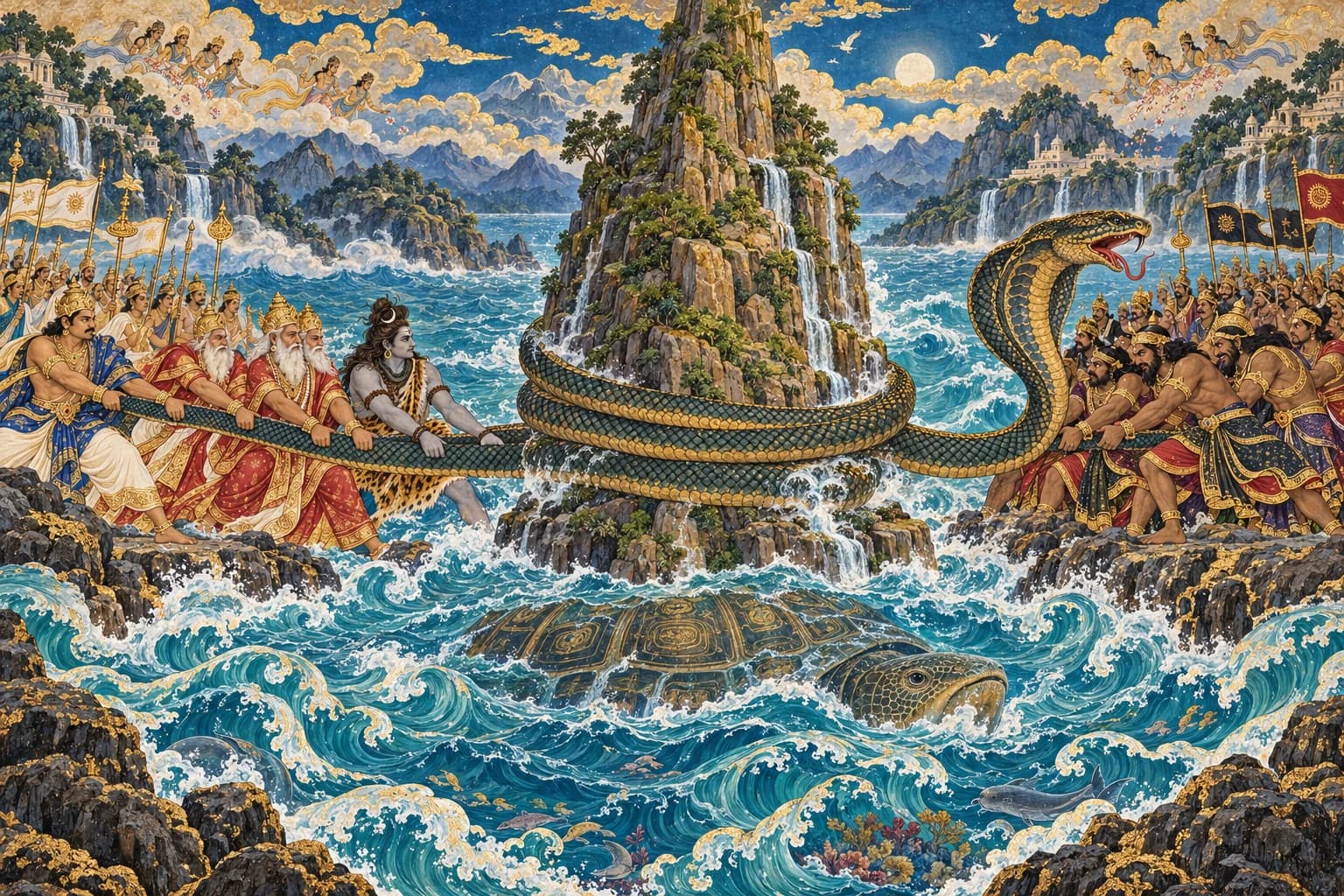
The devas and asuras churn the ocean in pursuit of amrita. Mount Mandara becomes the churning staff. Vasuki, the great serpent, becomes the cord. The asuras hold the serpent’s hood end, the gods his tail. The mountain rests on the tortoise-king, and the waters surge around it.
The effort is enormous. Even the gods become exhausted and ask for strength to continue. The nectar does not appear simply because they desire it.
Extraordinary beings and treasures emerge. Eventually Dhanvantari appears carrying a vessel of nectar, and the asuras claim it. Cooperation has brought them this far; possession now threatens to divide them.
Vishnu assumes an enchanting female form, widely known as Mohini. The asuras, captivated, entrust the nectar to her. In the ensuing episode, Vishnu distributes it to the gods. Mahabharata, Adi Parva 18.
There is already a difficult question inside the tale: who gets access to something everyone helped obtain? The epic tells it within a conflict between divine and asuric powers. A modern reader can notice the struggle over access without pretending the ancient narrative is a simple workplace parable.
The guest who did not belong#
Rahu finds another way into the distribution. He disguises himself as a god and sits among the devas.
He does not ask for permission. He relies on appearance: if he looks like one of them, perhaps the nectar will reach him before anyone asks who he is.
Surya and Soma—the Sun and Moon—recognise him. They alert the gods when the nectar has reached only his throat. Narayana, Vishnu, cuts off Rahu’s head with his discus.
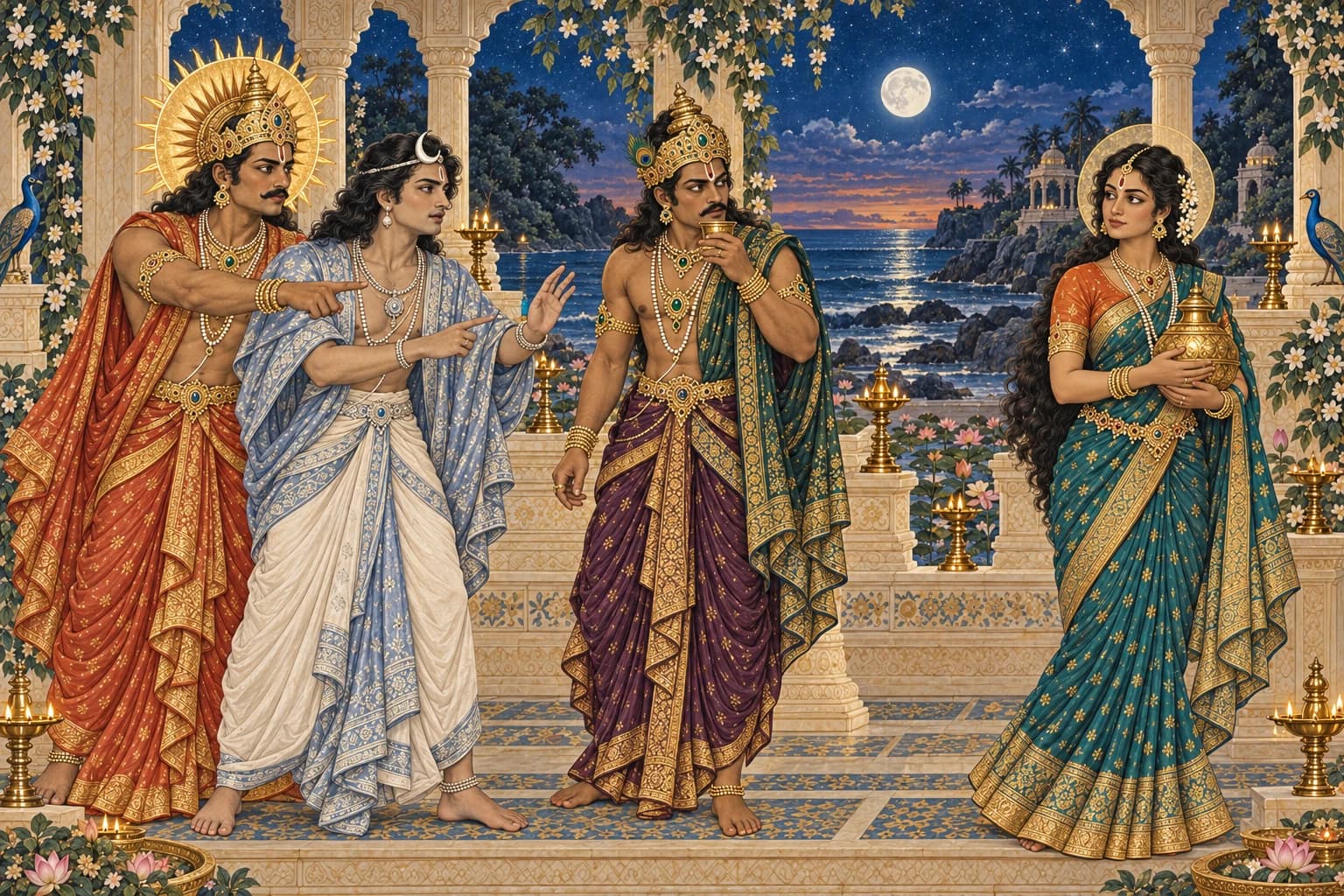
It is too late to undo the sip. The head rises into the sky; the body falls. From that moment, the Mahabharata describes hostility between Rahu’s head and the two luminaries, expressed in his swallowing them during eclipses. Mahabharata, Adi Parva 19.
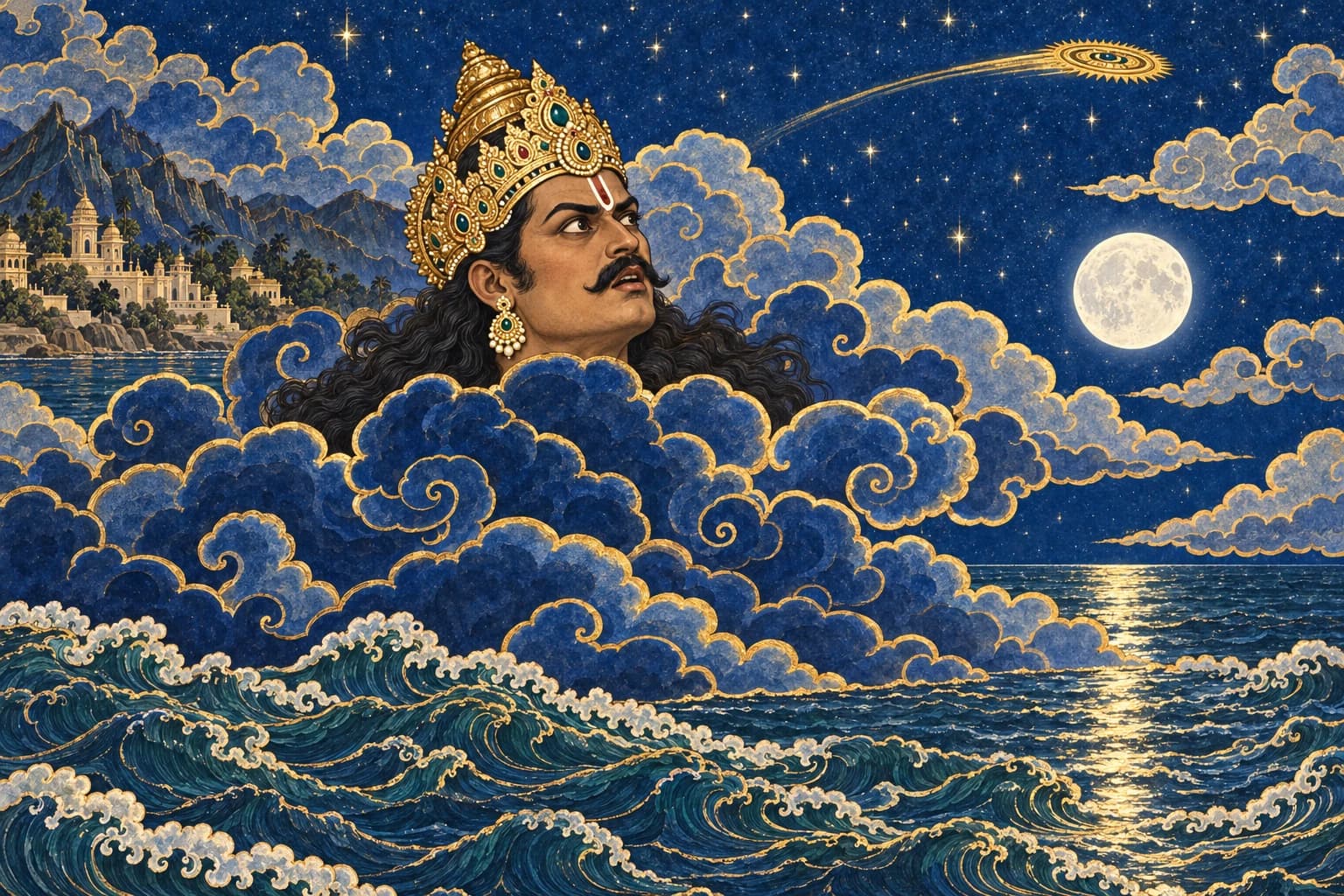
The victory is unsettling. Rahu reaches immortality, but the act also creates a permanent conflict. He has acquired the prize and lost the life in which he meant to enjoy it.
That tension makes the story more interesting than “desire is bad”. Desire drives the entire churning. What sets Rahu’s episode apart is the crossing of a boundary through disguise, followed by an outcome no disguise can repair.
But did the body become Ketu?#
Many familiar retellings identify Rahu as the head and Ketu as the headless body or tail. That imagery is widely used to explain the paired lunar nodes. It is recorded, for example, in the Monier-Williams dictionary entry for Rahu.
However, Bhagavata Purana 8.9.24–26 says that the nectar had not reached the body, which died; the head became immortal and received planetary status from Brahma. It does not say in those verses that the body survived as Ketu. Read Bhagavata Purana 8.9.
These are details to preserve, not quietly smooth over. We can discuss the head-and-tail symbolism while being clear that it is not the wording of every account. Nor should an illustration of two immortal halves be presented as a literal depiction of those Bhagavata verses.
The eclipse in the story, and the eclipse in the sky#
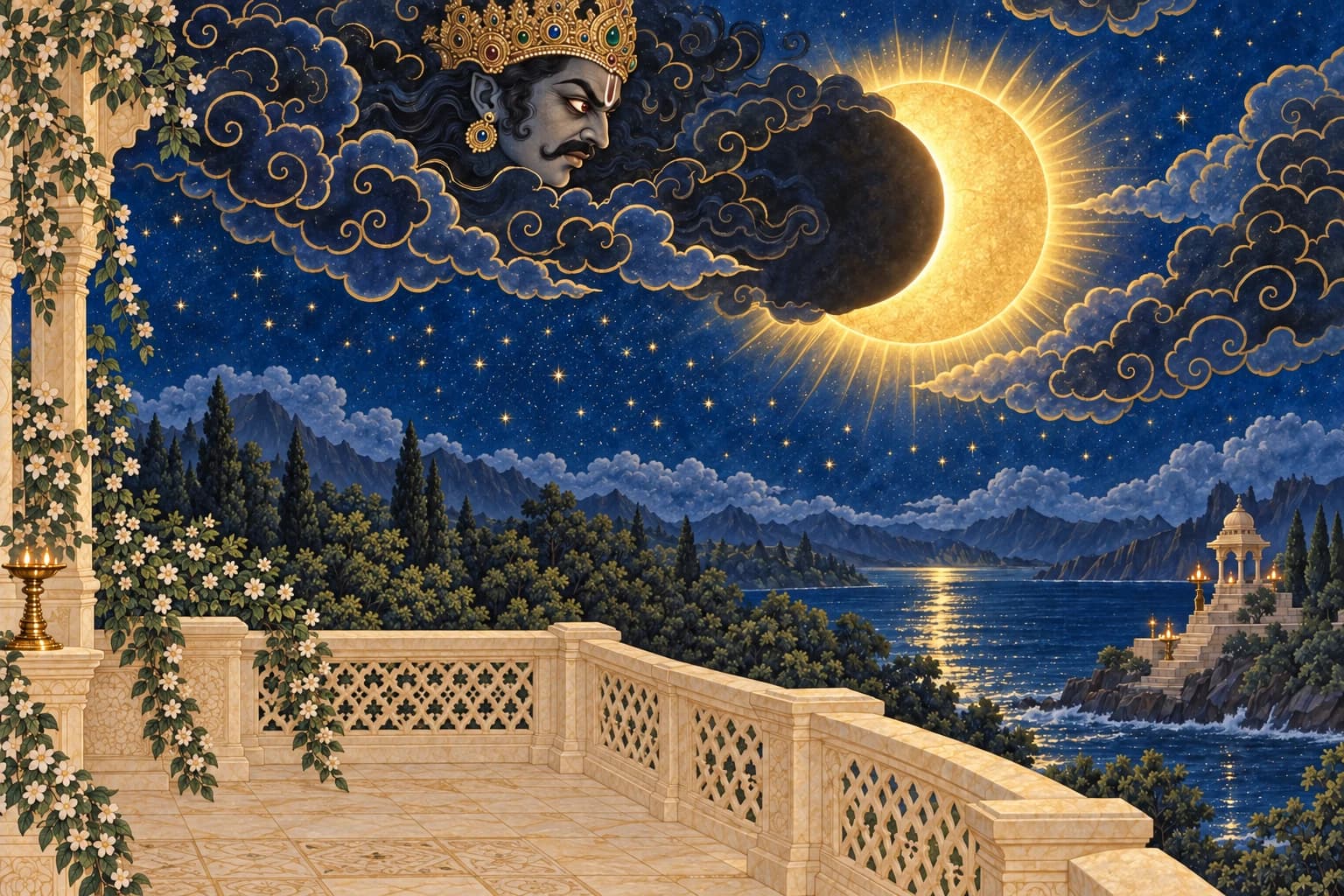
Astronomically, a solar eclipse happens when the Moon passes between Earth and the Sun; a lunar eclipse happens when the Moon passes through Earth’s shadow. The Moon’s orbit is tilted relative to Earth’s orbital plane, so the necessary alignment does not occur at every new or full moon. NASA’s eclipse explanation.
The two intersections of those orbital planes are the lunar nodes. In chart terminology, Rahu is the ascending or north node and Ketu the descending or south node. They are calculated points, not two unseen material planets. They lie opposite each other in zodiacal longitude.
The physical explanation does not make the old story uninteresting. The story gives an experience of sudden darkness a face, a memory and a motive. The geometry tells us when and where that darkness can occur.
Why astrologers connect Rahu with appetite#
In contemporary Jyotisha interpretation, Rahu is often associated with hunger for experience, status, novelty and what lies beyond familiar limits. The image of a head that can consume but has no stomach becomes a metaphor for wanting without feeling finished.
That metaphor is an interpretation. The nectar episode does not contain a ready-made textbook of career, marriage or house predictions.
Still, it gives us useful questions. What happens when the next achievement is expected to settle every insecurity? When belonging depends on maintaining an appearance? When getting access becomes more important than understanding what we are entering?
Someone can recognise those patterns without believing that a planet made them behave that way.
Ambition can build—or keep moving the finish line#
Learning a difficult skill, leaving a familiar environment or pursuing an unusual career can require a willingness to cross boundaries. The problem begins when the prize changes every time it is reached, leaving no space to enjoy or integrate the experience.
A practical reflection is: what would count as enough, and have I ever defined it? Without an answer, success can become another reason to feel behind.
Appearance and belonging are different things#
Rahu enters through disguise. Read symbolically, the scene asks whether we want the work, relationship or community itself—or only the status of appearing to belong there.
This is not an accusation attached to anyone with a prominent Rahu. It is a question about the difference between recognition and connection.
Ketu gives the symbolism its other pole#
Ketu is commonly read through release, withdrawal and the limits of satisfaction with familiar achievements. Alongside Rahu’s reaching, it creates a language for the tension between wanting more and wanting to let go.
Neither side is automatically wise. Constant pursuit can exhaust us; withdrawal can also become avoidance. A useful interpretation asks how both tendencies are being lived rather than labelling Rahu “bad” and Ketu “spiritual”.
Reading Rahu and Ketu in your chart#
Start by locating both nodes, their signs and their houses. Then keep the categories separate:
| Detail | What you are identifying |
|---|---|
| Rahu or Ketu | The node whose placement you are reading |
| Sign lord | The ruler of the zodiac sign containing that node |
| Nakshatra lord | The planetary ruler of its lunar mansion |
| House | The chart area occupied by the node |
A node’s name is not automatically its sign lord or nakshatra lord. For example, Rahu placed in Taurus occupies a Venus-ruled sign; that does not make Rahu and Venus the same planet.
Within astrology, a fuller reading also considers the sign ruler’s condition, other planetary connections and the timing system being used. A single node placement cannot establish addiction, dishonesty, relationship failure or an inevitable crisis. These interpretations are traditional symbolism, not scientifically established predictions.
You can open your birth chart, explore Rahu through the houses, or read why Ketu mahadasha is not automatically bad.
Rahu’s question remains sharp even without a prediction: if the thing you are chasing finally became yours, would you know how to live with it?
Sources: Mahabharata, Adi Parva 18–19, K. M. Ganguli translation; Bhagavata Purana 8.9.24–26 for the separately identified variant. Illustrations are original artistic interpretations. Series order is editorial, not a universal chronology.
Previous: Chandra, Rohini and Daksha’s Curse · Next: Shani, Son of the Sun and Shadow · All illustrated stories
Related Posts
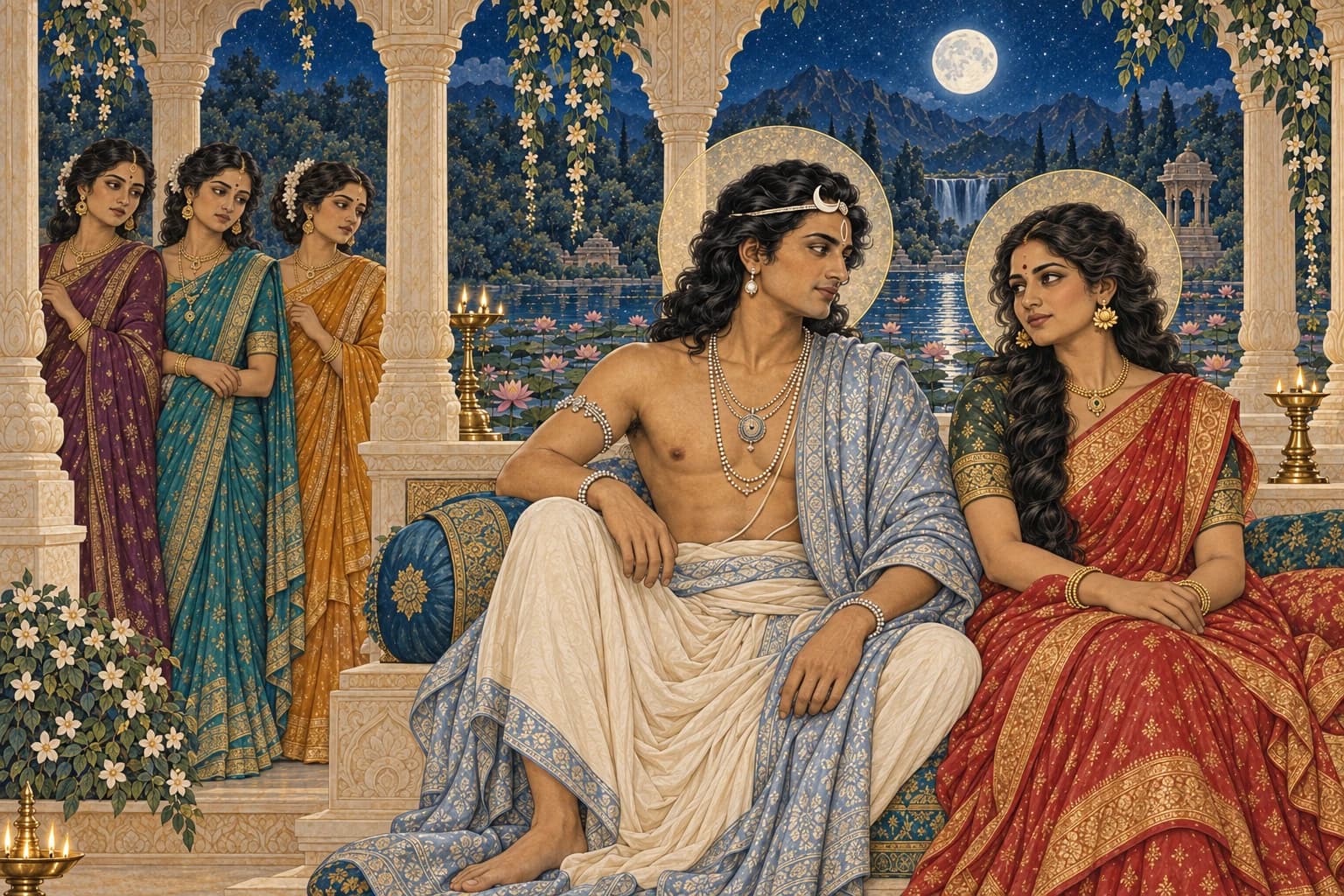
Chandra, Rohini and Daksha’s Curse: Why the Moon Waxes and Wanes
Why did Daksha curse the Moon? Explore Chandra and Rohini’s story, the renewal at Prabhasa, the Somnath tradition, and its meaning in astrology.
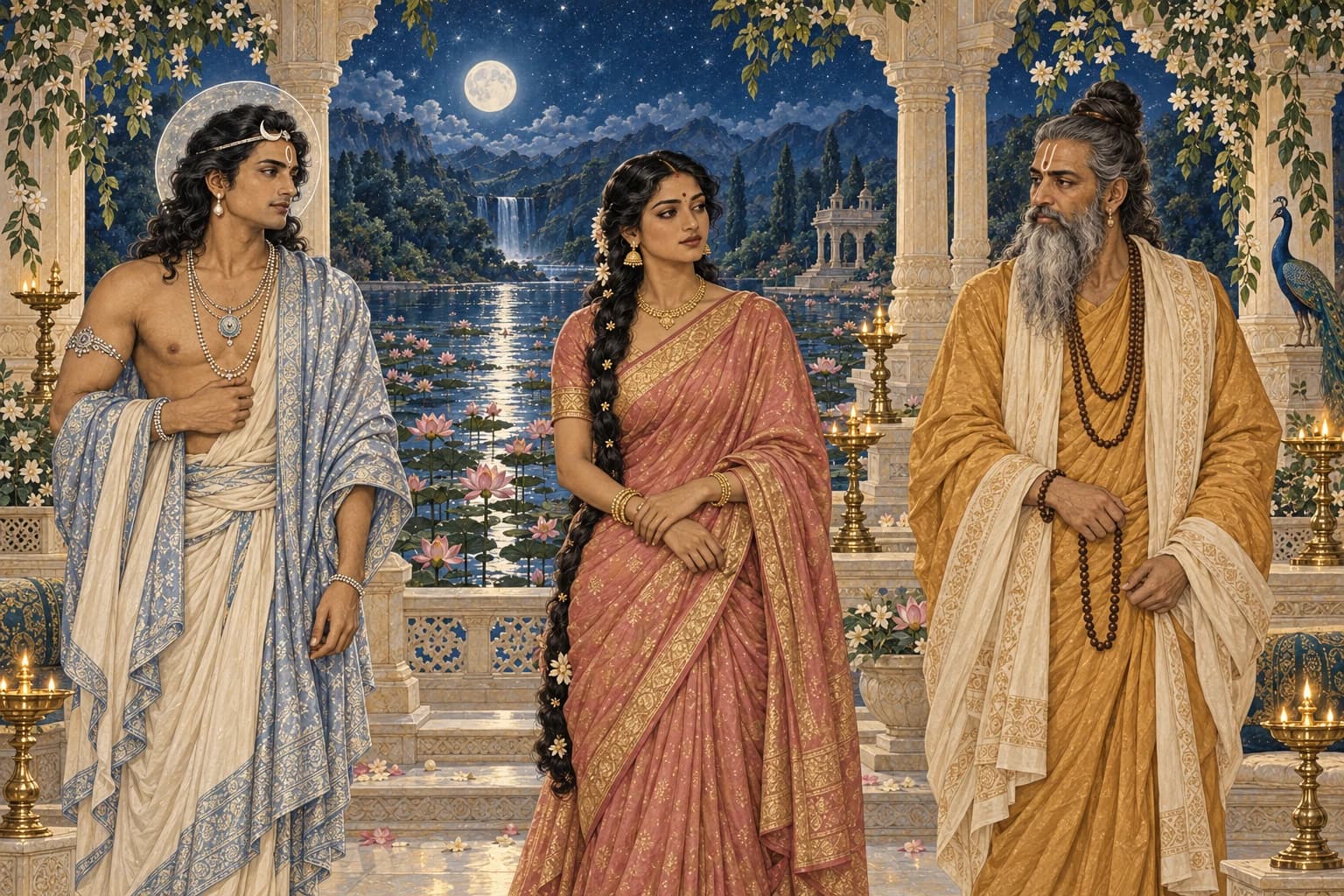
Chandra, Tara and the Birth of Budha: The Conflict Behind Mercury
The story of Chandra, Tara and Budha: a celestial conflict, the birth of Mercury, and what its symbolism says about emotion, wisdom and clear thinking.
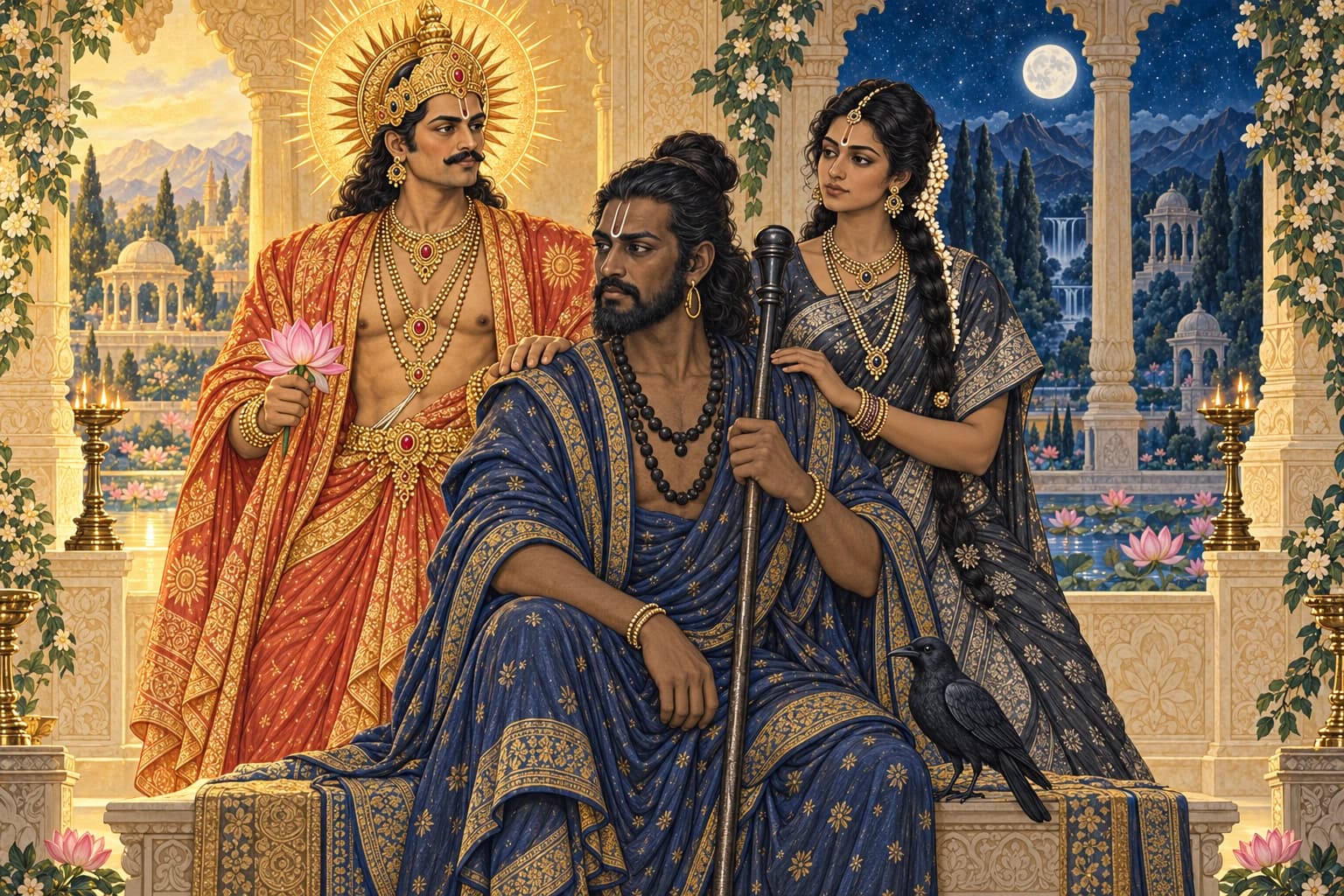
Shani, Son of the Sun and Shadow: The Family Story Behind Saturn
Meet Sanjna, Chhaya and Surya in the story of Shani’s birth, and explore Saturn’s symbolism of responsibility, limits and recognition without fear.
A little more perspective.
Keep discussions respectful. No harassment, hate, sexual content or spam. Comments are reviewed before publication. Report concerns from a comment menu, or contact [email protected].
Checking your session…