

North Indian vs South Indian Birth Charts: Same Sky, Different Map
Read the same backend-generated birth chart in North and South Indian layouts. Learn what stays fixed and how to find the ascendant, signs and houses.
Changing from a North Indian chart to a South Indian chart should change the drawing, not your planetary positions. They are two ways of displaying the same data. Confusion usually begins when a reader carries the layout rules of one diagram into the other.
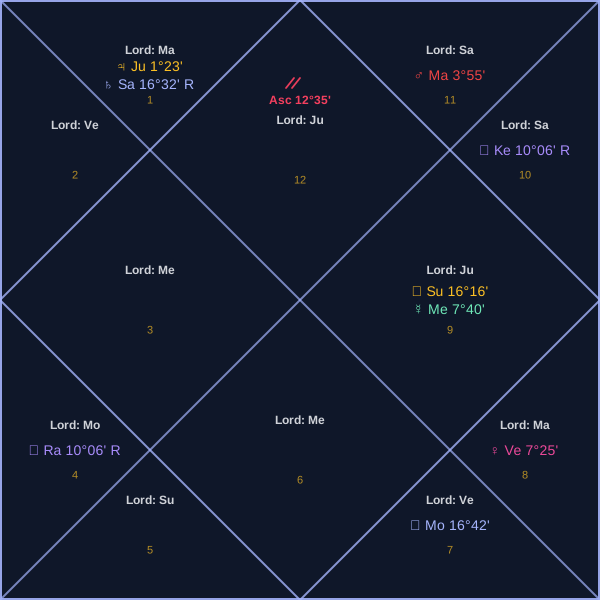
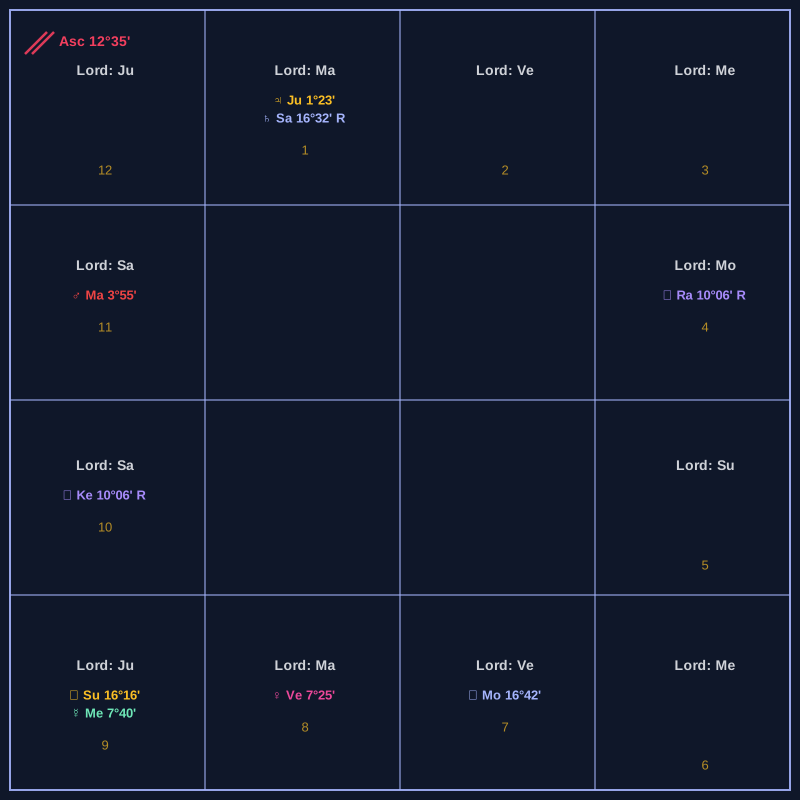
The examples below use one synthetic calculation: 1 January 2000 at 12:00 in Bengaluru, UTC+05:30, Lahiri ayanamsa and whole-sign houses. Both images were generated by Celestial Digits' backend from the same D1 payload.
North Indian: start with the houses#
The familiar diamond-style North Indian chart keeps the house positions fixed. The sign associated with a house changes with the ascendant. Numbers inside the cells commonly identify zodiac signs, not an instruction to renumber the house itself.
In this example the ascendant is Pisces. Pisces is zodiac sign number 12, but it occupies the first house. Treating “12” as “the twelfth house” would invert the meaning before you even start reading planets.
South Indian: start with the signs#
The conventional South Indian grid keeps the zodiac signs in fixed positions. Locate the ascendant marker first, then count houses from that sign around the grid. A planet in a familiar cell is not always in the same house for every person.
For Pisces ascendant under whole-sign houses, Pisces is house one, Aries is house two, Taurus is house three, and so on. The order is the same in the North Indian display; only the arrangement on the page differs.
A side-by-side reading checklist#
| Check | What should agree between these two images? |
|---|---|
| Ascendant | Pisces, at the same precise longitude |
| Planet sign | Each planet remains in the same zodiac sign |
| Planet house | Each planet retains its whole-sign house |
| Retrograde status | A layout switch does not change motion |
| D1 versus D9 | Both images here are D1, not different divisions |
Use the planet table beneath your chart as the tie-breaker when a compact diagram is difficult to read. Abbreviations such as Su, Mo and Me are labels, not additional planets. Read the legend supplied by the renderer instead of assuming all sites abbreviate identically.
What a layout switch does not fix#
If two diagrams contain different longitudes, switching their visual styles will not reconcile them. Check the input and settings using why kundlis differ between websites.
Likewise, Bhava Chalit versus Rashi is a different question: that comparison concerns house assignment, not merely the way cells are drawn. A D9 chart is another calculation, not a South Indian version of D1.
Which layout should you choose?#
Use whichever lets you reliably identify the ascendant, sign and house without guessing. There is no need to switch systems to make a chart look more auspicious. Learning to translate between the two is useful when a teacher, relative or report uses the other convention.
In the birth-chart workspace, switch North Indian and South Indian views while keeping one chart selected. Then follow the beginner reading walkthrough. The purpose of this exercise is accurate reading of a diagram, not proof of predictive accuracy.
Discussion: Which layout did you learn first, and which sign-versus-house confusion took the longest to resolve?
Related Posts
Bhava Chalit vs Rashi Chart: Why Did My Planet Change Houses?
Understand sign placement versus house assignment, why Rashi and Bhava Chalit can disagree, and how to compare them without mixing interpretive rules.
Don't Know Your Birth Time? What You Can—and Can't—Read
An honest guide to birth-time uncertainty: which chart features need a precise time, how to compare a possible interval, and why noon is not a recovered birth time.
Can AI Read Your Kundli? How to Catch a Confidently Wrong Answer
Check AI astrology answers against chart data: invented placements, confused D1 and D9, unsupported yoga claims, wrong dasha dates and privacy risks.
A little more perspective.
Keep discussions respectful. No harassment, hate, sexual content or spam. Comments are reviewed before publication. Report concerns from a comment menu, or contact [email protected].
Checking your session…