
Bhagyank 1 to 9: Calculate Your Number and Read It Carefully
Calculate Bhagyank with two worked birth-date examples, compare it with Moolank and explore number meanings without treating them as destiny.
Bhagyank uses every digit of your birth date; Moolank uses only the day. That difference explains why two people born on the 24th can share a Moolank but have different Bhagyank numbers. This guide shows the arithmetic first, then separates it from the meanings assigned to the result.
Celestial Digits uses a single-digit reduction from 1 to 9, including when an intermediate sum is 11 or 22. Other numerology systems preserve some compound numbers. A different result may therefore reflect a different convention, not an addition error.
Calculate Bhagyank step by step#
Take the fictional birth date 24 August 1994. Using the month name avoids confusion between day/month and month/day formats.
| Step | Calculation | Result |
|---|---|---|
| Add every digit | 2 + 4 + 0 + 8 + 1 + 9 + 9 + 4 | 37 |
| Reduce the total | 3 + 7 | 10 |
| Reduce again | 1 + 0 | 1 |
The original compound total is 37 and the reduced Bhagyank is 1. The same person's Moolank is 6, because 2 + 4 = 6. There is no conflict: the calculations use different inputs.
Now change only the birth year to 1995. The total becomes 38, then 11, then 2. Under this site's convention, we do not stop at 11. Moolank remains 6 because the day has not changed. This small example is also a way to check whether a calculator has updated after you edit a saved birth date.
Birth time, birthplace and time zone do not enter this particular calculation. Use the person's recorded civil birth date; do not convert it into a different date in UTC. Those details matter for a birth chart, which is a separate calculation.
What numbers 1 to 9 mean in this guide#
The following are traditional symbolic themes, offered as reflection prompts. The arithmetic is reproducible; the personality and life-path interpretations are not established scientific predictions. A number does not demonstrate a person's abilities, intentions or future.
| Bhagyank | Theme used in this guide | A useful question | What it does not establish |
|---|---|---|---|
| 1 | Initiative and independence | Where would taking responsibility help more than waiting for permission? | That you must lead or work alone |
| 2 | Cooperation and sensitivity | Which agreement needs clearer expectations? | That you are weak or dependent |
| 3 | Expression and communication | What idea needs to be explained or completed? | Creative talent or professional success |
| 4 | Structure and consistency | Which routine works, and which has become inflexible? | That change will be harmful |
| 5 | Variety and exchange | Which opportunity deserves focus rather than another fresh start? | A profitable business or investment |
| 6 | Care and responsibility | Where can you help without taking over someone else's choices? | Marriage timing or family happiness |
| 7 | Inquiry and reflection | What evidence would change your present understanding? | Spiritual superiority or a need for isolation |
| 8 | Responsibility and sustained effort | Which obligation needs a realistic schedule or limit? | Bad luck, punishment or guaranteed wealth |
| 9 | Action and service | What practical action would serve the purpose you care about? | Aggression, heroism or another person's character |
These questions can be useful even if the assigned theme does not fit you. Do not force an experience into a number description. Broad themes overlap, and people with the same number can have very different lives.
Bhagyank, Moolank and Namank use different inputs#
| Label | Input | In the worked example |
|---|---|---|
| Bhagyank | Full birth date | 24 August 1994 gives 1 |
| Moolank | Day of birth | 24 gives 6 |
| Namank | Name and a stated letter-value system | Cannot be calculated without the name |
A name spelling change can change a Namank calculation. It does not change the birth-date sum. Combining several labels creates a more elaborate interpretation, but does not prove greater predictive accuracy. Compare methods before comparing reports.
Try a small, reviewable exercise#
Suppose the person in the first example is deciding whether to start a project independently. The Bhagyank 1 theme suggests asking about initiative. It does not settle whether leaving a job is affordable. A useful note would contain the actual project, available hours, a budget and one small trial. After the trial, record what happened, including evidence against the original expectation.
This keeps a symbolic prompt separate from the decision. Education, experience, responsibilities and the available opportunity are stronger grounds for choosing a career than a birth-date number alone. Nor should a number decide whether a partner is suitable.
Check a result on Celestial Digits#
Open the numerology report, check the date and compare its Bhagyank with the addition above. If a result differs, first check the entered year, then whether the calculator preserves compound numbers. Send a reproducible mismatch through contact, rather than sharing unnecessary personal details in a public comment.
For related reading, see nakshatra versus Moolank. A nakshatra is calculated from a celestial longitude; a birth-date digit sum cannot replace it.
Method note: the worked sums and the reduction of 11 to 2 were checked against Celestial Digits' current Bhagyank calculation on 7 November 2026. This verifies the arithmetic convention, not the predictive validity of numerology.
For the next step, follow the Moolank 8–Bhagyank 1 worked comparison. It keeps the day and full-date calculations separate while reading their symbolic themes together.
Read Moolank and Bhagyank together#
- Moolank 4 and Bhagyank 8: Making room for change and structure
- Moolank 2 and Bhagyank 7: Connection without losing privacy
- Moolank 3 and Bhagyank 6: When teaching becomes an act of care
- Moolank 5 and Bhagyank 9: Turning fast ideas into deliberate action
Compare two birthdays with the same Bhagyank and different Moolanks to see why one root does not describe the whole profile.
Related Posts
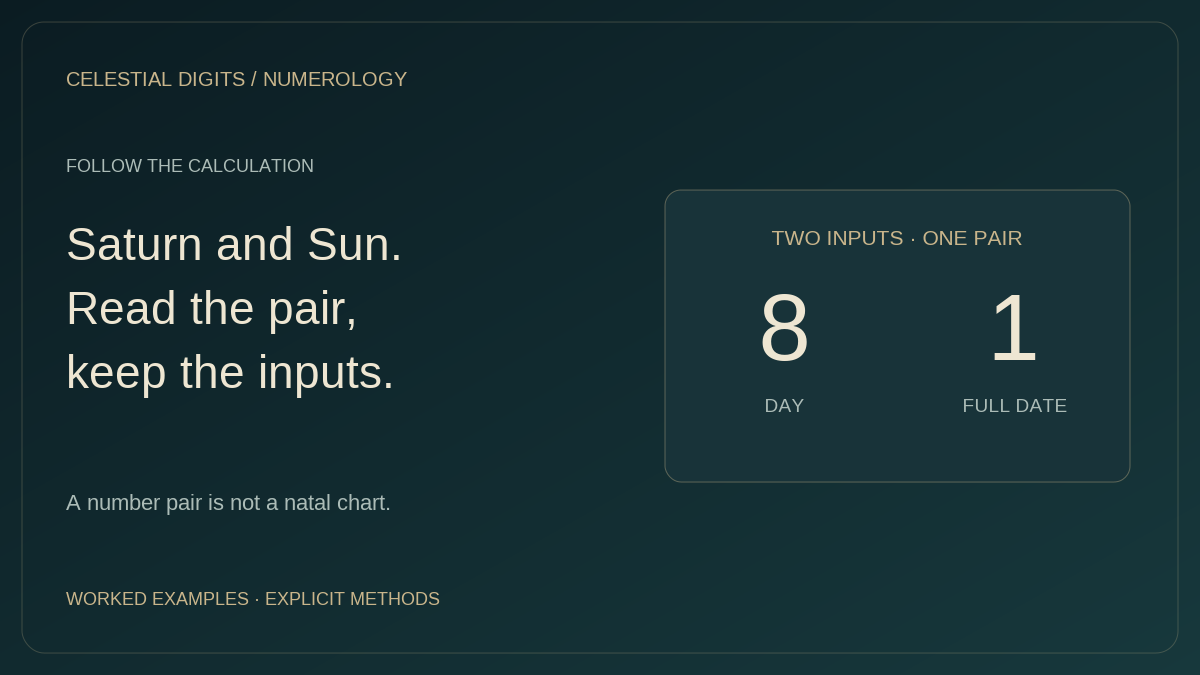
Moolank 8, Bhagyank 1: Reading the Saturn–Sun Combination
Read Moolank and Bhagyank together with three birth-date examples. Explore the 8–1 Saturn–Sun symbolism without confusing it with a natal chart.
Karmic Debt Numbers 13, 14, 16, 19 in Vedic Numerology: Patterns and Practical Upaya
Understand karmic debt numbers 13, 14, 16, and 19 in Vedic numerology with real-life patterns, strengths, and practical remedies you can follow daily.
How to Calculate Your Vedic Numerology Numbers in 5 Minutes
Step-by-step guide to calculating your Moolank, Bhagyank, and Namank using Vedic numerology. Learn the Chaldean system with examples and free calculator method.
A little more perspective.
Keep discussions respectful. No harassment, hate, sexual content or spam. Comments are reviewed before publication. Report concerns from a comment menu, or contact [email protected].
Checking your session…