
Same Bhagyank, Different Moolank: Two Numerology Profiles Compared
Two fictional birthdays produce Bhagyank 3 but different birth-day numbers. Follow the arithmetic and compare the readings.
A full-date total compresses many different birthdays into one digit. Sharing Bhagyank therefore does not mean sharing a complete numerology profile, much less a life story. To understand the difference, keep the day number beside the full-date number instead of allowing one result to replace the other.
We will compare fictional birthdays using single-digit reduction. Dates are written in words so there is no ambiguity between day-first and month-first formats.
Calculate the two profiles#
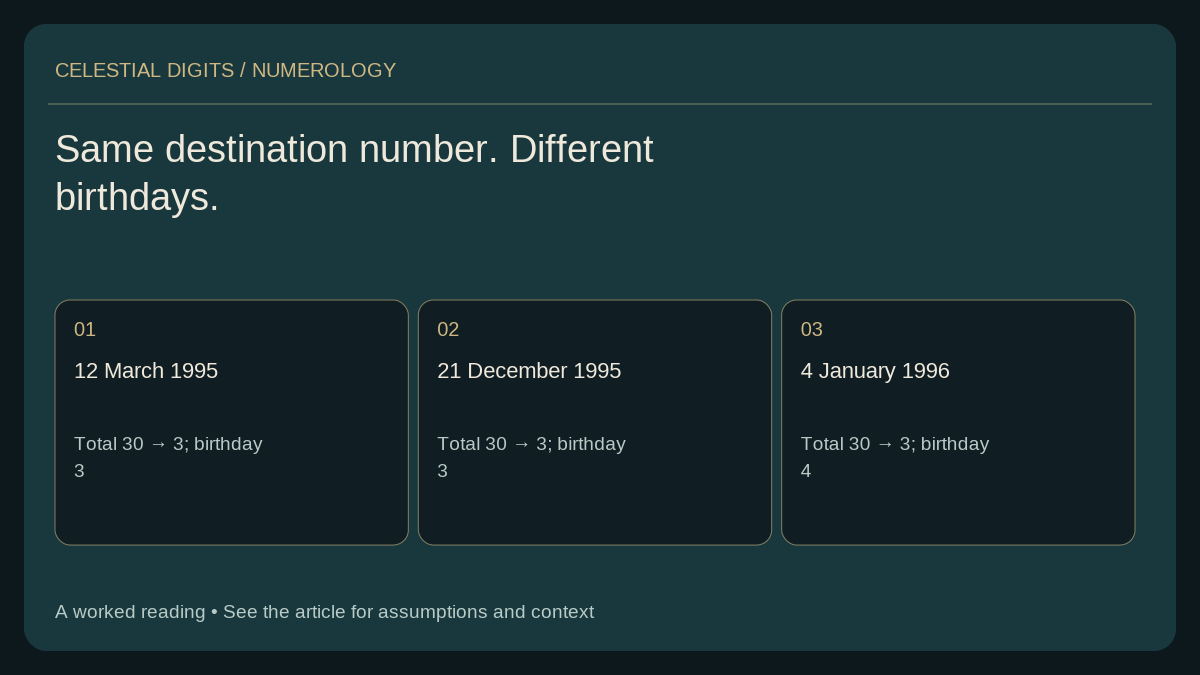
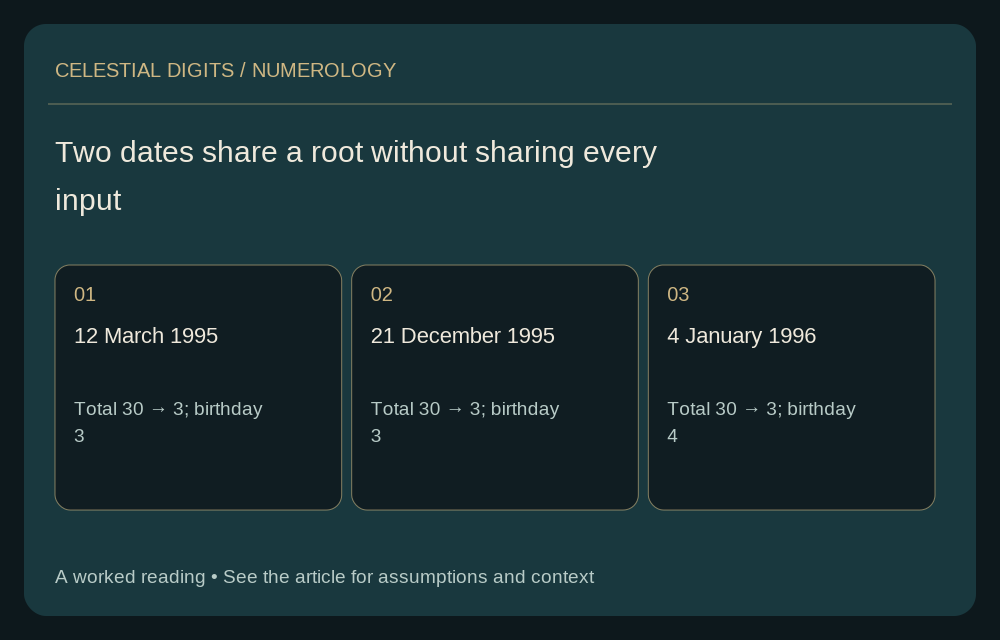
Profile A: 12 March 1995. The full-date digits are 1 + 2 + 0 + 3 + 1 + 9 + 9 + 5 = 30, reducing to 3. The birth day is 12, reducing to 3.
Profile B: 4 January 1996. The full-date digits are 0 + 4 + 0 + 1 + 1 + 9 + 9 + 6 = 30, also reducing to 3. The birth day is 4 and needs no further reduction.
| Field | Profile A | Profile B |
|---|---|---|
| Recorded birthday | 12 March 1995 | 4 January 1996 |
| Day number | 12/3 | 4 |
| Full-date total | 30/3 | 30/3 |
| Name number | Not supplied | Not supplied |
Both people have Bhagyank 3 in this method. Only Profile A also has Moolank 3. A third date, 21 December 1995, totals 30 and has day root 3 too; that shows how much information a root can compress.
Compare one situation rather than two personality lists#
Suppose each person is preparing a workshop. In the Indian planetary-number vocabulary, 3 is linked with Jupiter. A reflective reading might explore learning, explanation and the responsibilities of teaching.
For Profile A, the repeated root could prompt a question about consistency between the wish to understand a subject and the wish to explain it. Does the person spend so long improving the lesson that it never gets delivered? Or do they enjoy testing an idea by teaching it?
For Profile B, the additional 4 theme could prompt questions about experimentation and changing established formats. Does the person want to redesign the workshop before learning why the original structure existed? Can an unusual approach still be made understandable to beginners?
These are possible discussion prompts, not outcomes deduced from the dates. Actual teaching ability requires subject knowledge, preparation and feedback. Neither profile is automatically the better teacher.
Why the name still matters to the comparison#
If the method you follow includes Namank, a complete comparison needs the selected names, spellings and letter table. Without them, this remains a two-number comparison. Do not silently invent a third number or borrow one from an unrelated Western calculator.
Similarly, a shared Bhagyank does not establish shared natal Jupiter placements. Their birth years differ, and exact birth charts would need time and place. Numerology's planetary correspondence is not an astronomical calculation.
Try the comparison with your own records#
Write the birthday in words, show the unreduced total, keep the day number in its own column and list any missing inputs. Choose one practical situation—giving feedback, finishing a course or planning a project—and ask how each person actually responds.
Record differences as well as similarities. If two people with the same number have different habits, you do not need to invent hidden karmic explanations to preserve the original description.
For terminology, see the publisher's introduction to Johari's three-number approach. Continue with our Bhagyank calculation guide and numerology journal to separate arithmetic from personal interpretation.
Related Posts
Build a Complete Numerology Reading: Inputs to Interpretation
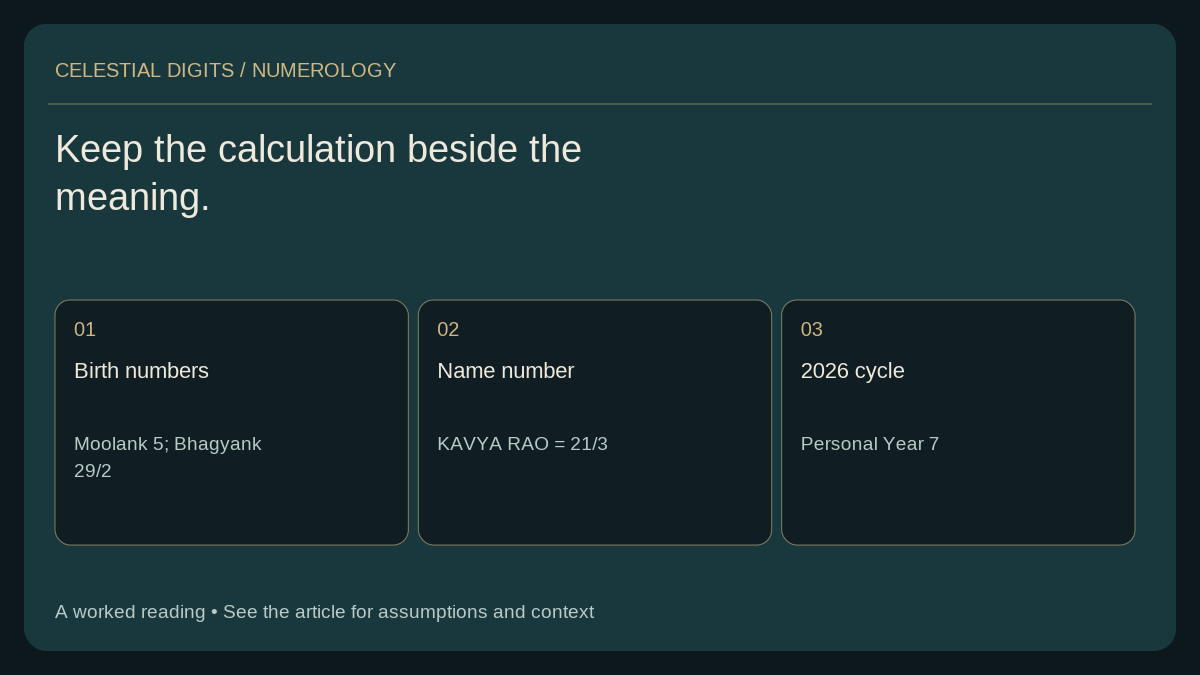
Follow one fictional profile through Moolank, Bhagyank, Namank and Personal Year, with explicit arithmetic and a balanced interpretation.
Are Master Numbers 11, 22 and 33 Part of Every Numerology System?
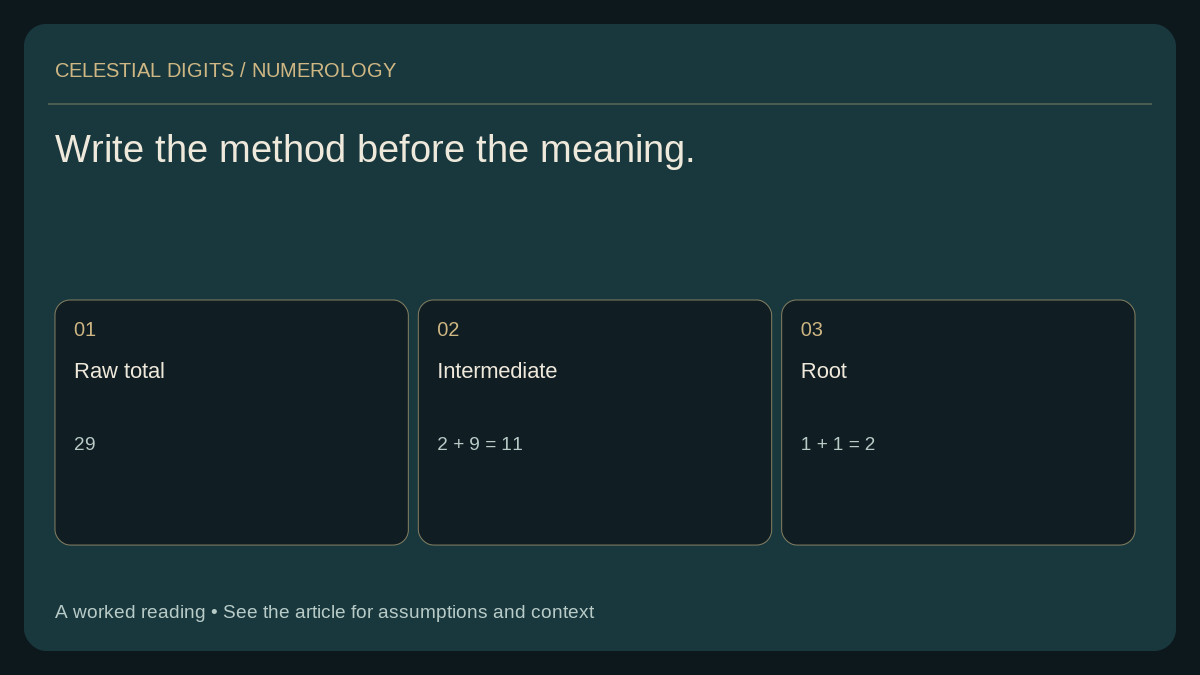
Learn when a method retains 11, 22 or 33, why reduction rules differ, and how to record a calculation without changing methods halfway.
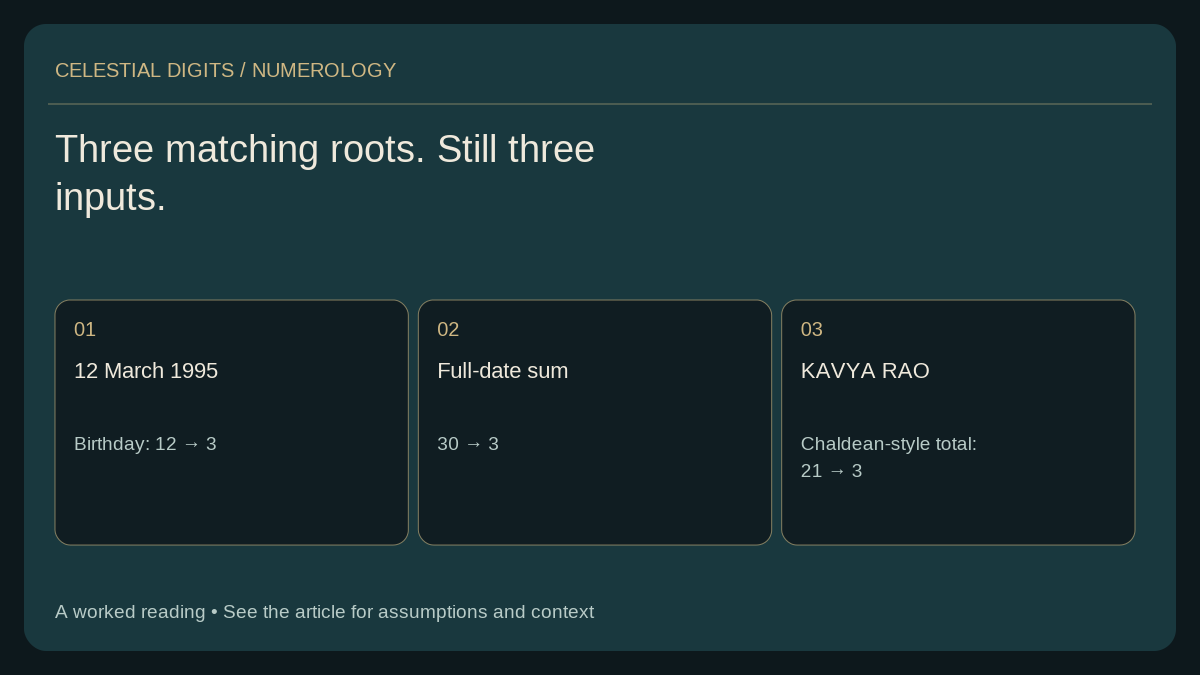
When Moolank, Bhagyank and Namank Are All the Same
Calculate a complete fictional 3–3–3 profile and examine what agreement across three numerology fields does and does not establish.
A little more perspective.
Keep discussions respectful. No harassment, hate, sexual content or spam. Comments are reviewed before publication. Report concerns from a comment menu, or contact [email protected].
Checking your session…