
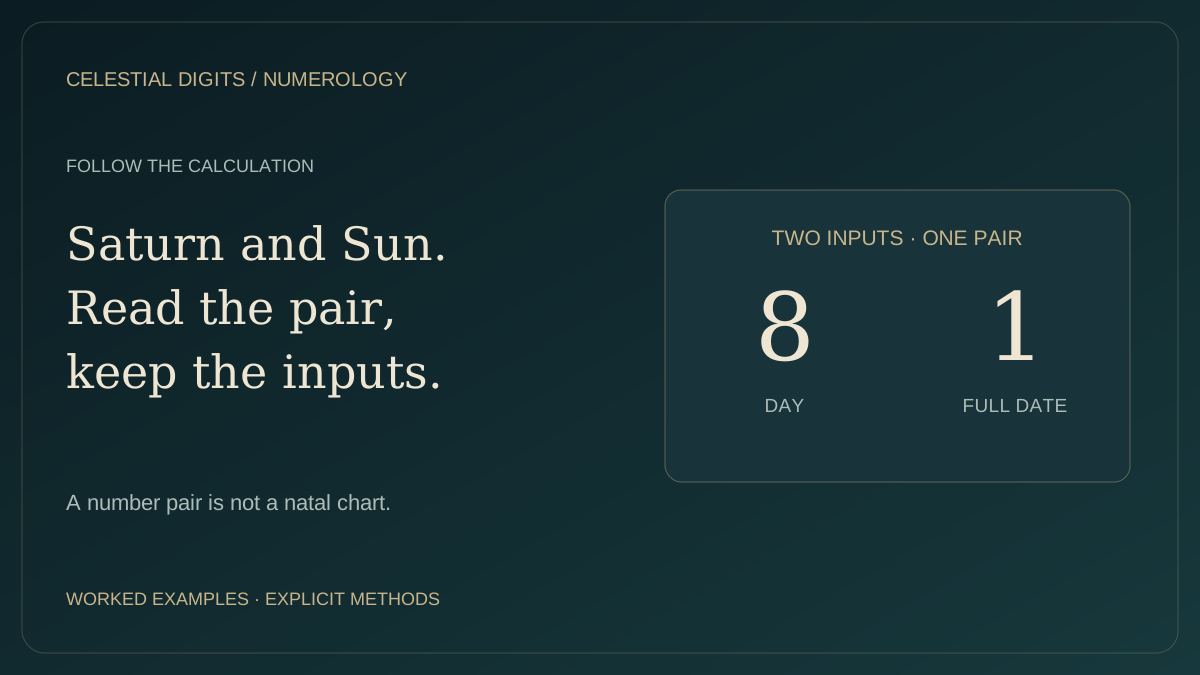
Moolank 8, Bhagyank 1: Reading the Saturn–Sun Combination
Read Moolank and Bhagyank together with three birth-date examples. Explore the 8–1 Saturn–Sun symbolism without confusing it with a natal chart.
Moolank 8 and Bhagyank 1 can occur together. They come from different parts of the same birth date: the day supplies Moolank, while the full date supplies Bhagyank. The pairing is often described through Saturn and Sun symbolism. It does not mean Saturn and the Sun are conjunct, weak or fighting in your actual birth chart.
Let's work through the numbers before interpreting the combination. All dates and scenarios below are fictional teaching examples, using Gregorian civil dates and reduction to a single digit.
Three birth dates, two different comparisons#
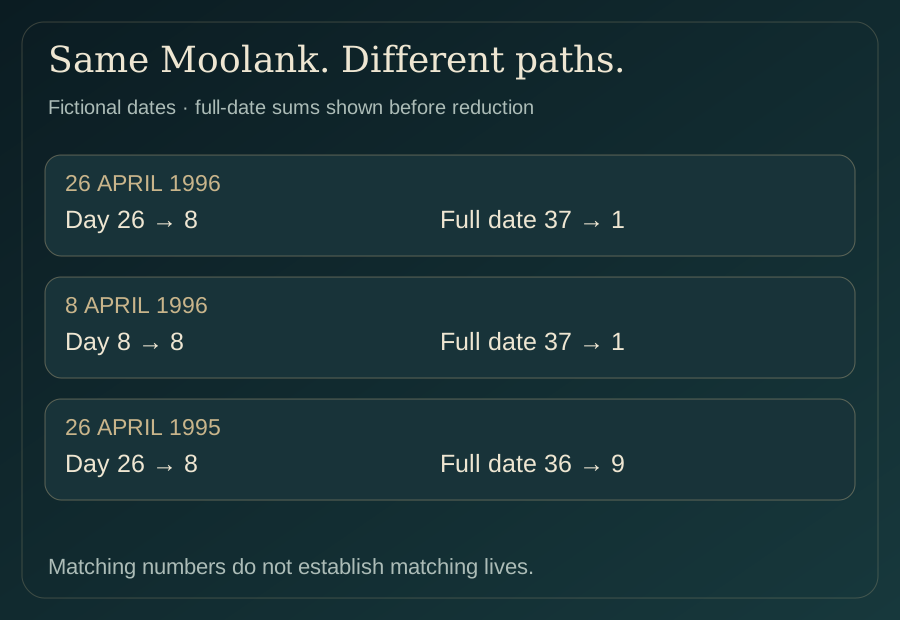
For 26 April 1996, the day reduces as 2 + 6 = 8. Add every digit of the full date: 2 + 6 + 0 + 4 + 1 + 9 + 9 + 6 = 37, then 3 + 7 = 10, then 1 + 0 = 1. The result is Moolank 8 and Bhagyank 1.
Compare that with 8 April 1996. Moolank is already 8. The full-date sum is 8 + 0 + 4 + 1 + 9 + 9 + 6 = 37, again reducing to 1. Both dates produce the same pair, although their day numbers are different before reduction.
Now keep the day and month of the first example but change the year to 1995. Moolank stays 8. The full-date sum becomes 36, reducing to 9. A list that groups everyone born on the 8th, 17th or 26th under one description misses this second input.
| Fictional birth date | Day calculation | Full-date sum | Moolank / Bhagyank |
|---|---|---|---|
| 26 April 1996 | 26 → 8 | 37 → 10 → 1 | 8 / 1 |
| 8 April 1996 | 8 | 37 → 10 → 1 | 8 / 1 |
| 26 April 1995 | 26 → 8 | 36 → 9 | 8 / 9 |
What Saturn and Sun mean in this reading#
In the planetary correspondences used by our numerology reports, 8 is associated with Saturn and 1 with the Sun. These are symbolic assignments to numbers. They are not measurements of where either planet was when you were born.
A useful traditional reading places Saturn's themes of responsibility, persistence and limits alongside the Sun's themes of initiative, visibility and direction. The tension is easy to recognise: wanting authority or independence while feeling that work must be earned, structured and sustained. That is a possible reflection theme, not a personality diagnosis.
Imagine someone who is comfortable doing careful work but hesitates to present it publicly. An 8–1 interpretation might invite them to connect competence with visibility: document the result, explain the contribution and make a specific proposal. It should not tell them that recognition is guaranteed after a certain age.
The reverse scenario also matters. Someone may want to lead before a project has enough structure to survive. In that case, the same symbolism suggests defining responsibilities, deadlines and a realistic scope. An interpretation that only says “you are a born leader” misses the work required to lead well.
A worked decision: accepting a team-lead role#
Suppose the person in the first example has been offered a team-lead role. The role requires approving work, handling disagreements and reporting to a director. Here is an original worksheet for using the symbolic pairing without letting it make the decision:
| Reading layer | Reflection prompt | Evidence to collect |
|---|---|---|
| 8: responsibility | What am I agreeing to maintain? | Team size, workload and support available |
| 1: direction | What decisions will I actually own? | Written authority and escalation boundaries |
| The combination | Can I lead without carrying every task myself? | Delegation plan and realistic review schedule |
| Outside numerology | Is this role suitable now? | Pay, hours, skills, preferences and family commitments |
The last row can overturn an appealing reading. If the role has no authority but unlimited accountability, a favourable number description does not fix the arrangement. Equally, a clear and worthwhile opportunity does not become unsuitable because someone calls Saturn and Sun “enemies.”
Are 8–1 and 1–8 interchangeable?#
No: retain the labels. In an 8–1 pair the day reduces to 8 and the full date to 1. In a 1–8 pair those inputs are reversed. A report that presents only “1 and 8” has discarded information about how it obtained the numbers.
For example, 19 April 1992 gives Moolank 1 and a full-date sum of 35 → 8. That is a separate calculation from the first example. The number meanings can be considered in their assigned roles, but there is no validated formula saying one arrangement is superior or predicts a specific career.
Does the compound day still matter?#
You can retain 26/8 instead of writing only 8. This preserves the input and allows a practitioner to explain a compound-number convention if they use one. It does not justify inventing a universally agreed fate for everyone born on the 26th.
The first two people also share Bhagyank's compound total, 37. The arithmetic has now compressed very different birth dates into the same pair. That is a useful reminder of the method's limits: adding more confident adjectives cannot recover information the calculation never used.
What this pair cannot tell you about your chart#
A number-to-planet association does not reveal Saturn's sign, the Sun's house, either planet's Shadbala, or the running mahadasha. Birth time and location, which are absent from this digit-sum calculation, are needed to calculate a fuller astrological chart.
Nor does an 8–1 pair establish difficult relations with a parent, delayed marriage or guaranteed government employment. Those claims reach far beyond the inputs. Compare the birth chart separately if you want to explore astrological placements.
Read your own combination in order#
Use the numerology report to record the birth date, day total, full-date total and reduced pair. Read Bhagyank 1–9 for the full-date calculation and the number 8 myth check if the Saturn association is causing anxiety.
Write one concrete question before reading a description. Afterwards, note which parts fit, which do not, and what real evidence changes your decision. That produces a more useful comparison than trying to prove that every experience was caused by the pair.
Method and reading note: the sums and planetary labels were checked against Celestial Digits' calculation and number table. Modern Indian numerology writing, including Harish Johari's Numerology, distinguishes psychic, destiny and name numbers. That framework is interpretive; our scenarios are original illustrations, not client case studies or evidence of predictive accuracy.
Related Posts
Is Number 8 Really Unlucky? A Vedic Numerology Myth Check
A grounded look at number 8 in Indian numerology, why it gets feared, what Saturn actually signifies, and how to judge it without superstition.
Karmic Debt Numbers 13, 14, 16, 19 in Vedic Numerology: Patterns and Practical Upaya
Understand karmic debt numbers 13, 14, 16, and 19 in Vedic numerology with real-life patterns, strengths, and practical remedies you can follow daily.

Understanding Vedic Numerology: A Beginner's Guide to Moolank, Bhagyank & Namank
Discover the ancient Indian science of numerology and learn how to calculate your Moolank (birth number), Bhagyank (destiny number), and Namank (name number) for deep spiritual insights.
A little more perspective.
Keep discussions respectful. No harassment, hate, sexual content or spam. Comments are reviewed before publication. Report concerns from a comment menu, or contact [email protected].
Checking your session…