
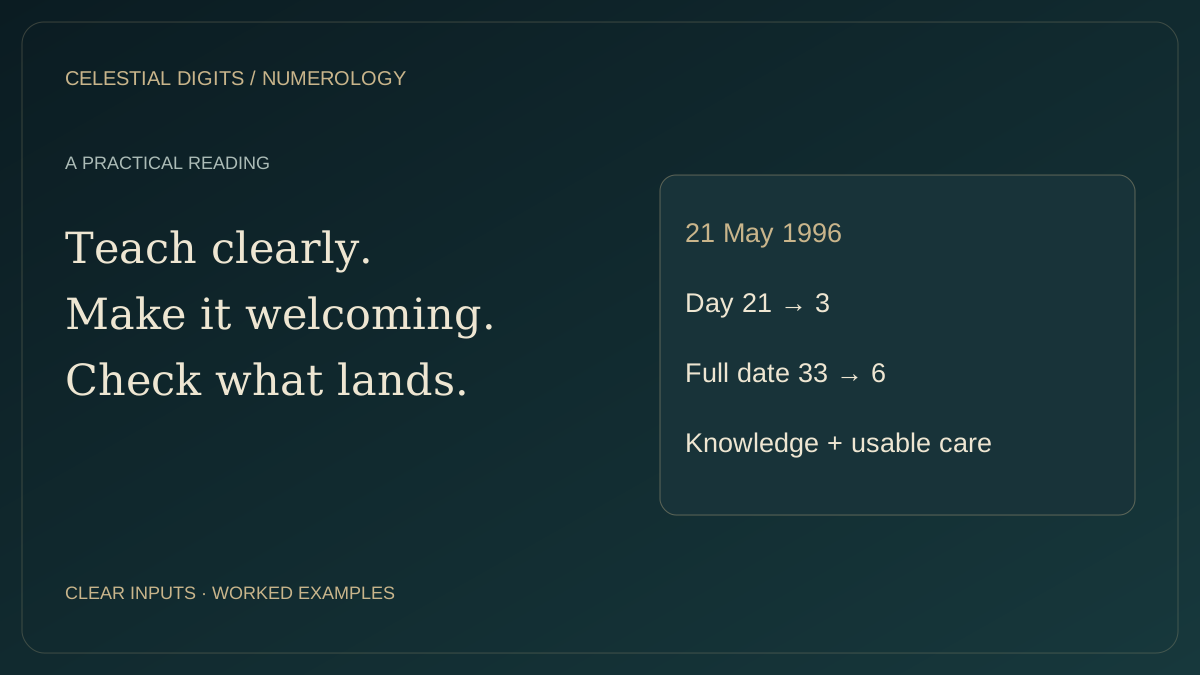
Moolank 3 and Bhagyank 6: When teaching becomes an act of care
Work through a 3–6 birthday calculation and explore how knowledge, taste and care can support a useful learning experience.
A Moolank 3, Bhagyank 6 reading brings Jupiter's teaching symbolism together with Venus's themes of relationship, beauty and care. This does not make someone a born counsellor or guarantee an artistic career. It offers a question: how can useful knowledge be made easier for another person to receive?
The calculation comes first#
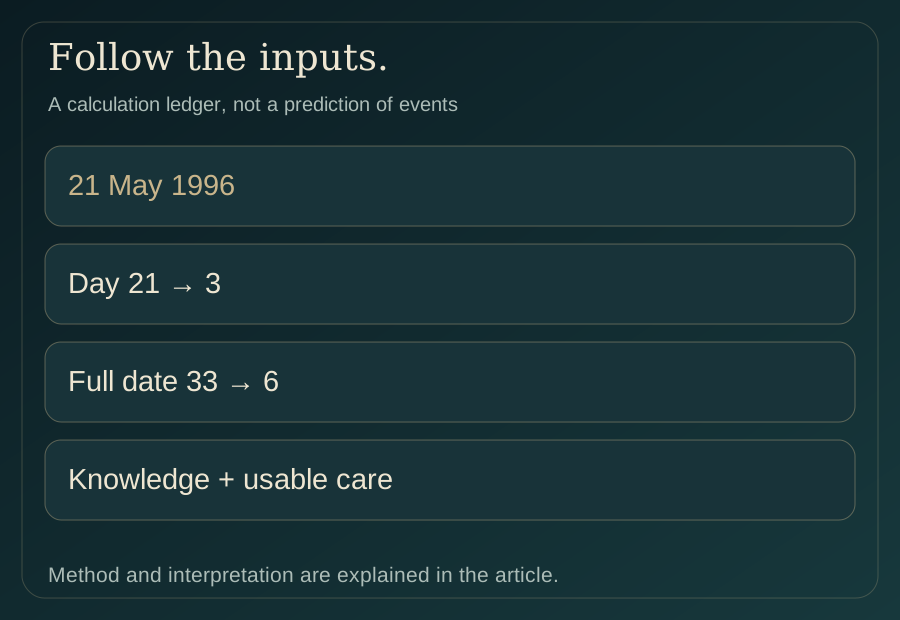
For the fictional birthday 21 May 1996, the day gives 2 + 1 = 3. The full date gives 2 + 1 + 0 + 5 + 1 + 9 + 9 + 6 = 33, then 3 + 3 = 6. Our method reduces 33; interpretations that retain it as a master number use a different convention.
This pair does not locate Jupiter or Venus in a birth chart. It also does not prove that the planets are in conflict or cooperation for this person. We are interpreting day and full-date numbers, not calculating planetary aspects.
Worked situation: a beginner's workshop#
Imagine a fictional organiser teaching neighbours how to maintain balcony plants. The first draft has beautiful slides and a long explanation of soil chemistry. Beginners leave unsure how often to water their own pots.
The problem is not a lack of knowledge or effort. The lesson has not connected the information to the learner's next action. Jupiter symbolism can ask whether the explanation is sound. Venus symbolism can ask whether the learning experience is welcoming and usable.
| Part of the workshop | Useful question | A concrete revision |
|---|---|---|
| Opening | What can a beginner do by the end? | State one skill: assess whether a pot needs water |
| Explanation | Which facts support that skill? | Explain soil moisture before advanced chemistry |
| Demonstration | Can everyone see the difference? | Use two contrasting pots |
| Practice | Can learners try without embarrassment? | Let pairs practise and ask questions |
| Handout | Will this help tomorrow? | Provide a short observation checklist |
These changes can be evaluated by watching what learners can do. Applause for attractive slides is not enough evidence that the lesson worked.
Care does not require endless availability#
People who enjoy helping can gradually become the default answer desk. A useful boundary says when questions can be asked, what the workshop covers and which problems need someone else's expertise.
If you promise more support than you can provide, the experience may become less caring despite good intentions. A clear follow-up page or a scheduled question session can be more dependable than “message me anytime.”
Taste should serve the purpose#
Beauty can make a lesson inviting. It can also hide a confusing sequence. Before adding another illustration, ask what it helps the learner notice. An attractive diagram with unreadable labels is not an improvement.
The same principle applies outside teaching: a proposal, recipe, welcome note or family plan benefits when its presentation helps the recipient act. Do not assume that everyone shares your preferred visual style or level of detail.
Check whether advice was requested#
Knowing an answer does not automatically create an invitation to give it. Ask whether someone wants information, practical help or simply to be heard. This is particularly important when a symbolic reading tempts you to identify as a permanent guide for others.
For an experiment, revise one explanation for a specific beginner. Ask them to describe the next step in their own words. Their response is more useful than a claim that a 3–6 pair is naturally good at teaching.
Explore Moolank 3 and Moolank 6 separately, then compare the role each theme played. Keep the person and their actual feedback at the centre.
Related Posts
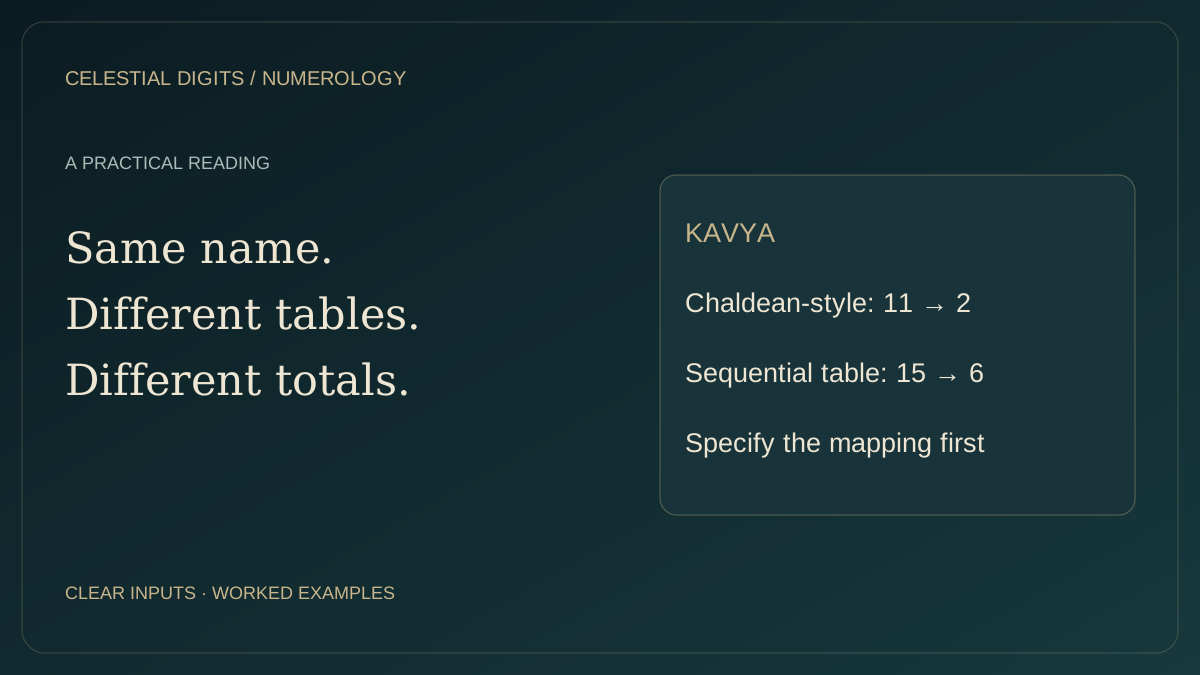
Why Two Name Calculators Disagree: Chaldean and Pythagorean Tables
Compare KAVYA letter by letter under two common tables and see why equal labels can conceal different calculation methods.
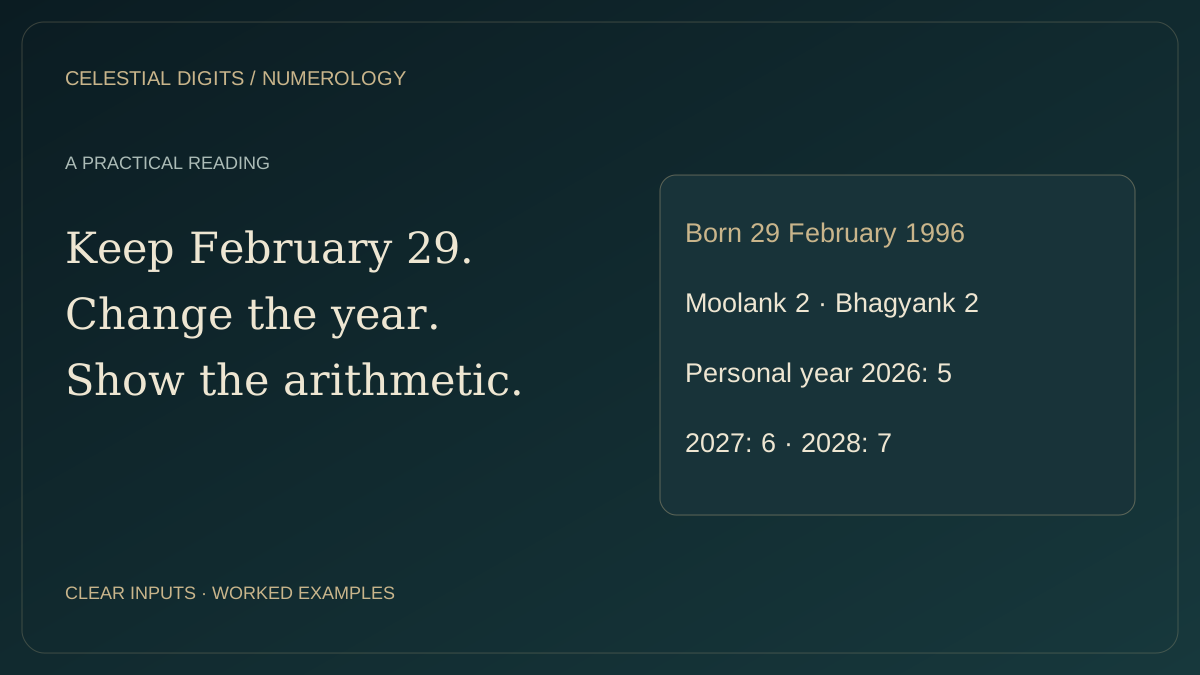
Born on 29 February: Numerology in Leap and Non-Leap Years
Calculate a leap-day Moolank, Bhagyank and personal year without inventing a 29 February date in a non-leap year.
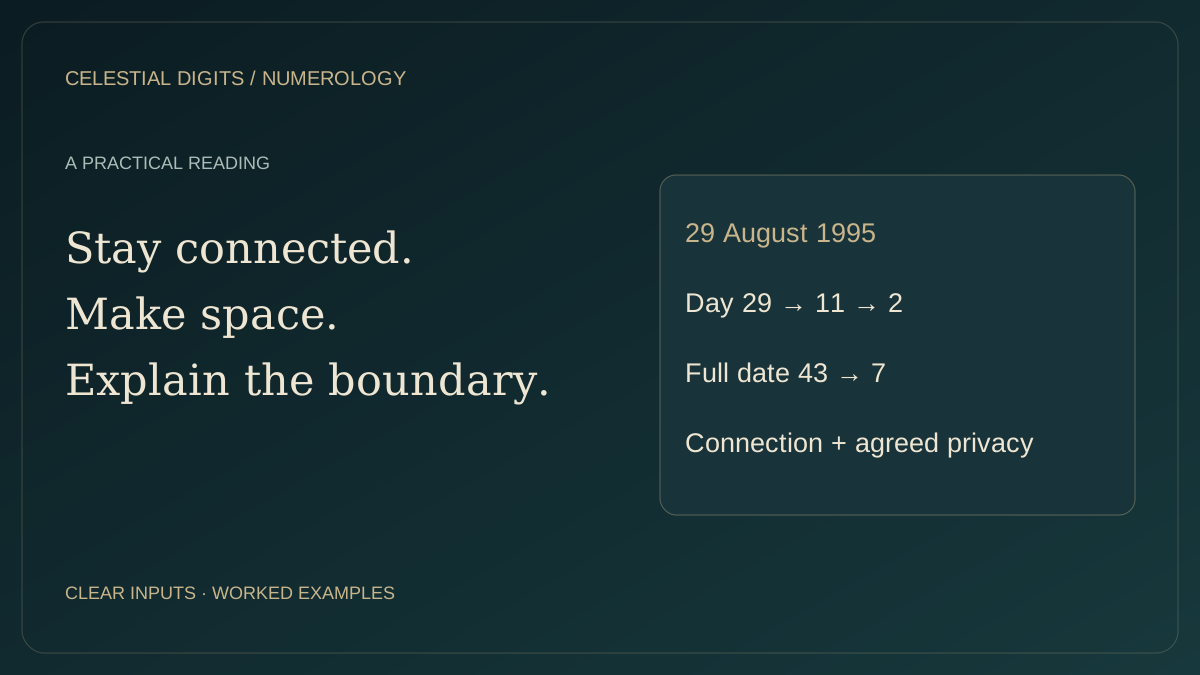
Moolank 2 and Bhagyank 7: Connection without losing privacy
A worked 2–7 calculation and a practical example of asking for space without turning a number pair into a relationship verdict.
A little more perspective.
Keep discussions respectful. No harassment, hate, sexual content or spam. Comments are reviewed before publication. Report concerns from a comment menu, or contact [email protected].
Checking your session…