
Are Master Numbers 11, 22 and 33 Part of Every Numerology System?
Learn when a method retains 11, 22 or 33, why reduction rules differ, and how to record a calculation without changing methods halfway.
No: 11, 22 and 33 are not treated as master numbers in every numerology system. Some modern Western methods retain them in selected positions. A single-digit Indian reading may reduce them to 2, 4 and 6 while preserving the original total as a compound number.
Neither approach should be introduced halfway through a calculation just because one result sounds more impressive. The method must be stated before the interpretation.
Work through one complete date#
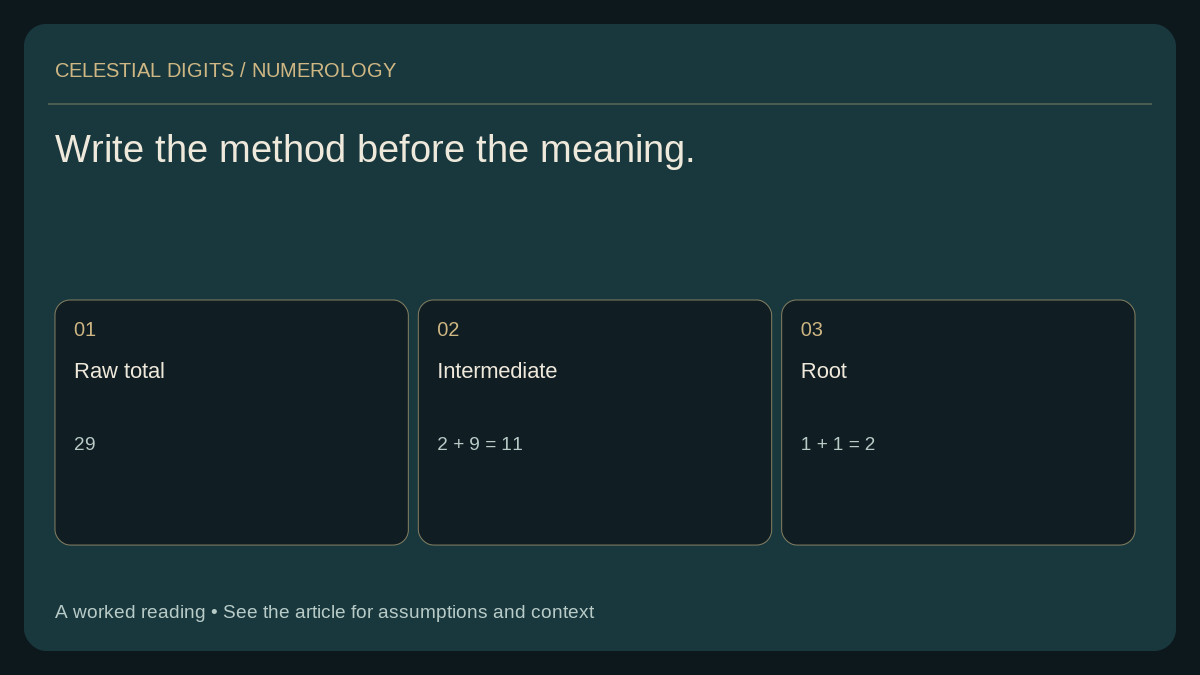
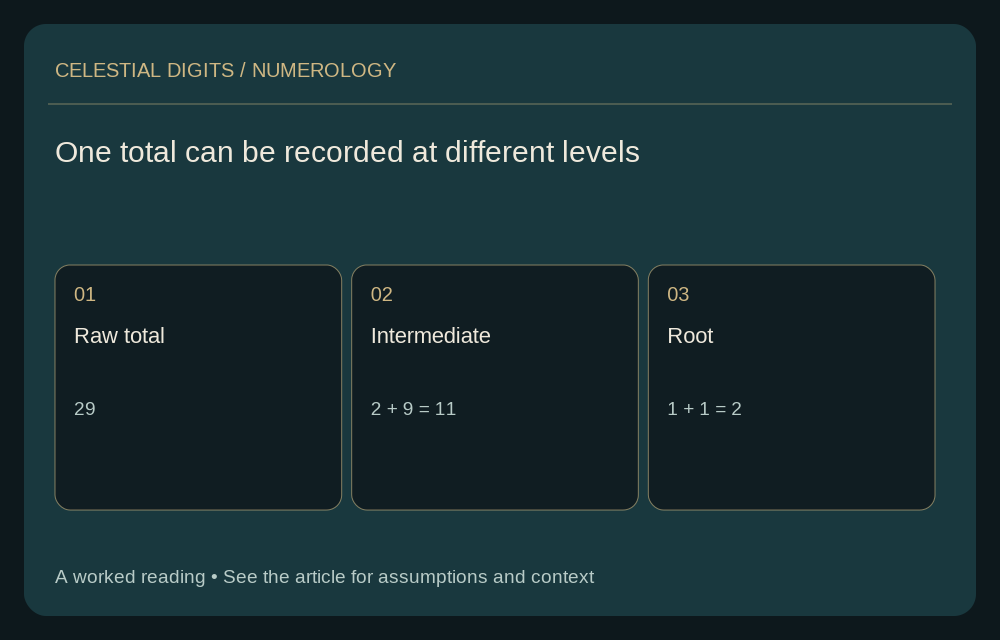
Take the fictional birth date 14 February 1993. Adding every digit gives 1 + 4 + 0 + 2 + 1 + 9 + 9 + 3 = 29. The next reduction is 2 + 9 = 11, followed by 1 + 1 = 2.
| Stage | Result | Meaning of the notation |
|---|---|---|
| Full digit total | 29 | Original sum under this method |
| Intermediate reduction | 11 | A retained value in some systems |
| Single-digit root | 2 | Final digit under full reduction |
A transparent record is 29 → 11 → 2. A method that retains 11 might write 11/2. A method that always reduces the final root can report 2. Neither record should pretend that the other arithmetic never occurred.
The position matters as well as the number#
A rule for a Life Path or full-date number may not apply to a Personal Year, a house number or a minute on a clock. Numerology.com's published method, for example, treats 11, 22 and 33 as master numbers in certain chart positions but reduces year, month and day cycles to single digits.
That is a description of its method, not proof that all practitioners agree. Some systems preserve only 11 and 22; others use additional conventions. Ask which positions qualify and whether intermediate totals are retained.
Why two calculators can disagree#
Calculators may sum all date digits directly or reduce day, month and year separately before combining them. Ordinary digital roots agree, but retained intermediate values can differ. A useful comparison therefore needs the steps, not merely two final labels.
The same issue occurs with names. Changing the letter-value table changes the raw total before any master-number rule is applied. A disagreement caused by spelling or a Chaldean versus Pythagorean table cannot be resolved by debating the meaning of 11.
Read the result without creating a hierarchy#
Suppose the fictional person in our example recognises a theme of sensitivity and cooperation. They can examine how that appears in meetings, close relationships or creative work. Adding a master-number label does not establish superior intuition, exceptional destiny or a duty to rescue other people.
A grounded journal entry might say: “I noticed tension in the group, but I will ask what people need instead of assuming I can read their thoughts.” That action remains useful whether the report is labelled 2 or 11/2.
Avoid explaining distress as the price of having a special number. A numerical label is not a diagnosis, and it should not discourage ordinary support or practical problem-solving.
A comparison checklist#
Record the exact date or spelling, letter table if applicable, reduction order, retained-number rule and chart position. Only then compare the interpretation. This small audit often explains a dramatic-looking disagreement.
Read three number-profile checks and what happens when the core numbers match.
Source and scope#
Numerology.com's master-number explanation supplies one contemporary convention. Our date example and comparison procedure are original; the article describes symbolic systems rather than a scientifically established ranking of people.
Related Posts
Build a Complete Numerology Reading: Inputs to Interpretation
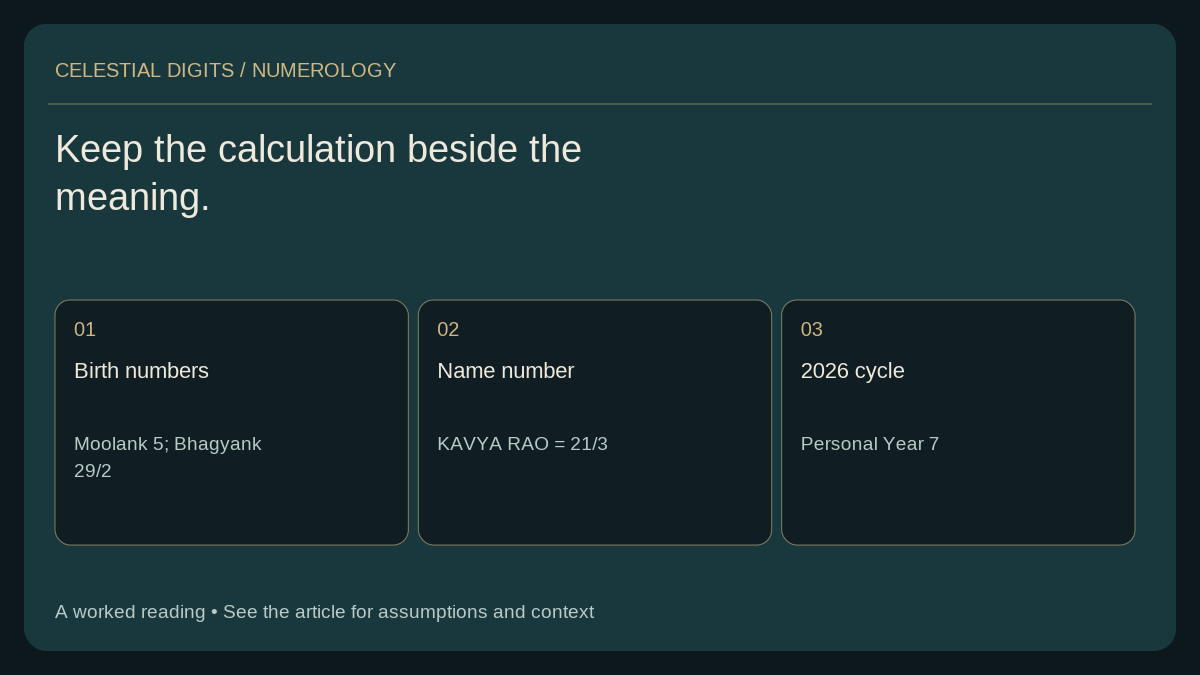
Follow one fictional profile through Moolank, Bhagyank, Namank and Personal Year, with explicit arithmetic and a balanced interpretation.
When Moolank, Bhagyank and Namank Are All the Same
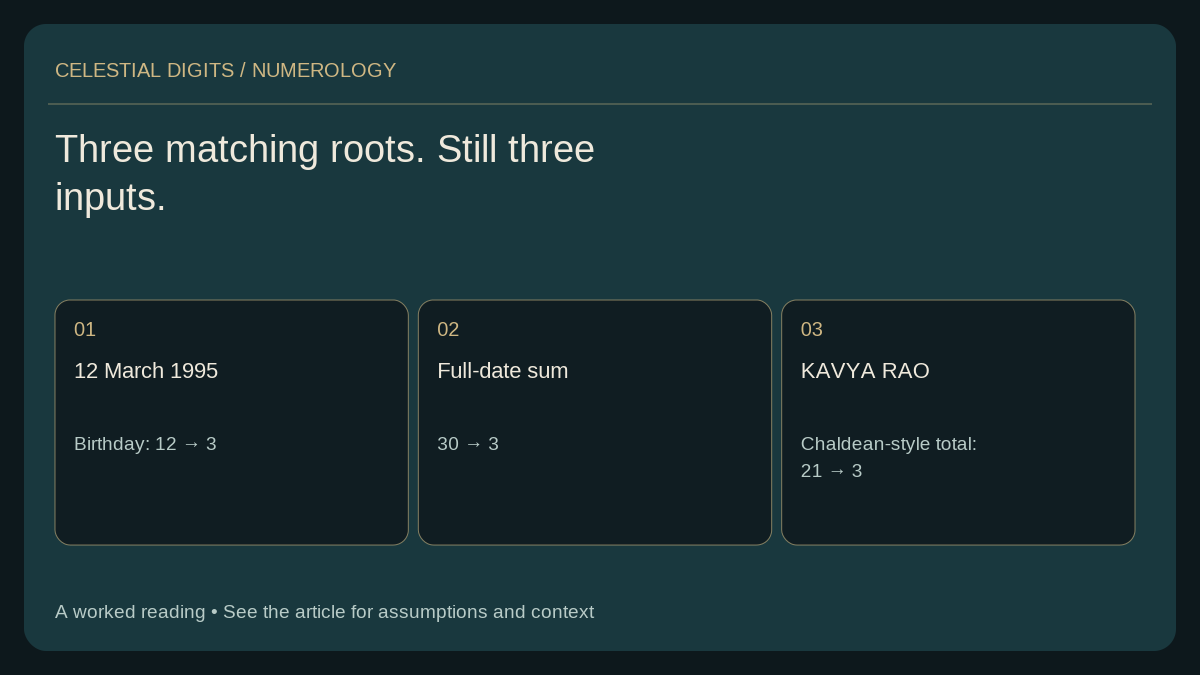
Calculate a complete fictional 3–3–3 profile and examine what agreement across three numerology fields does and does not establish.
Does a Repeated Number Make Its Influence Stronger? Three Profile Checks
Separate repeated birth-date digits, repeated calculated roots and the same input counted twice through three explicit examples.
A little more perspective.
Keep discussions respectful. No harassment, hate, sexual content or spam. Comments are reviewed before publication. Report concerns from a comment menu, or contact [email protected].
Checking your session…