
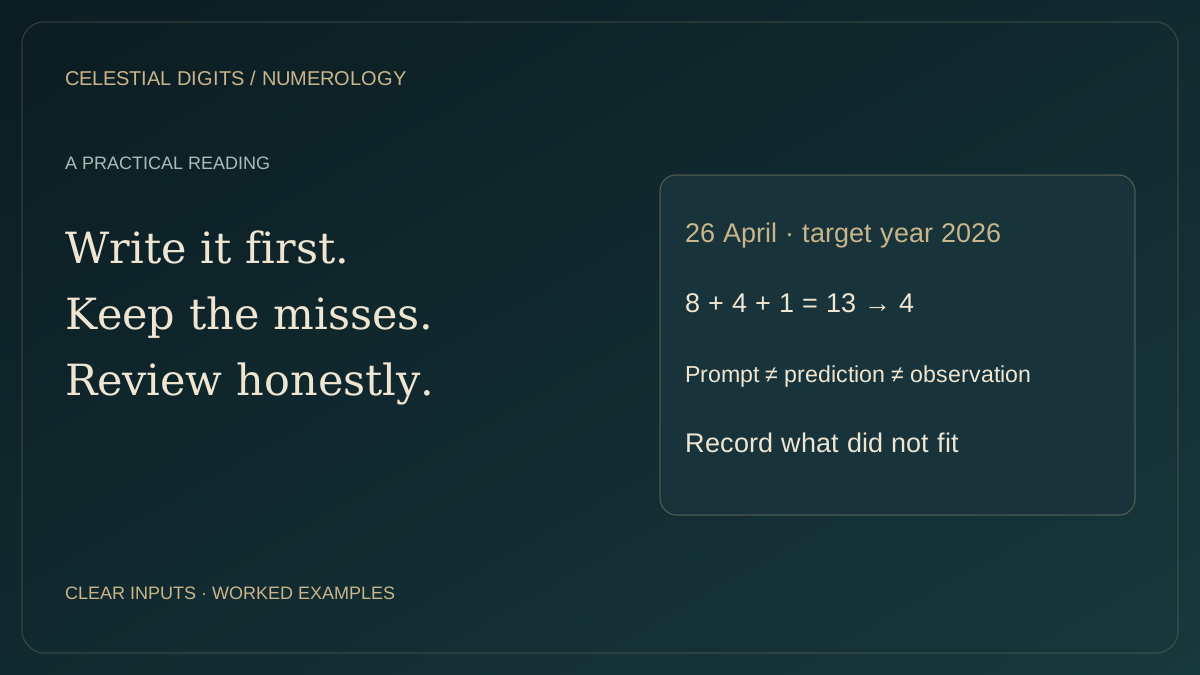
A Numerology Journal That Records Misses as Well as Matches
Use a practical worksheet to separate a symbolic prompt, a prediction and an observed result without rewriting expectations afterward.
A numerology journal is most useful when it preserves what you thought before an event. If every outcome can be reworded to fit a number, the journal cannot tell you whether the interpretation helped. A good record includes ordinary days, disagreements and missed expectations.
Choose one claim, not a whole life story#
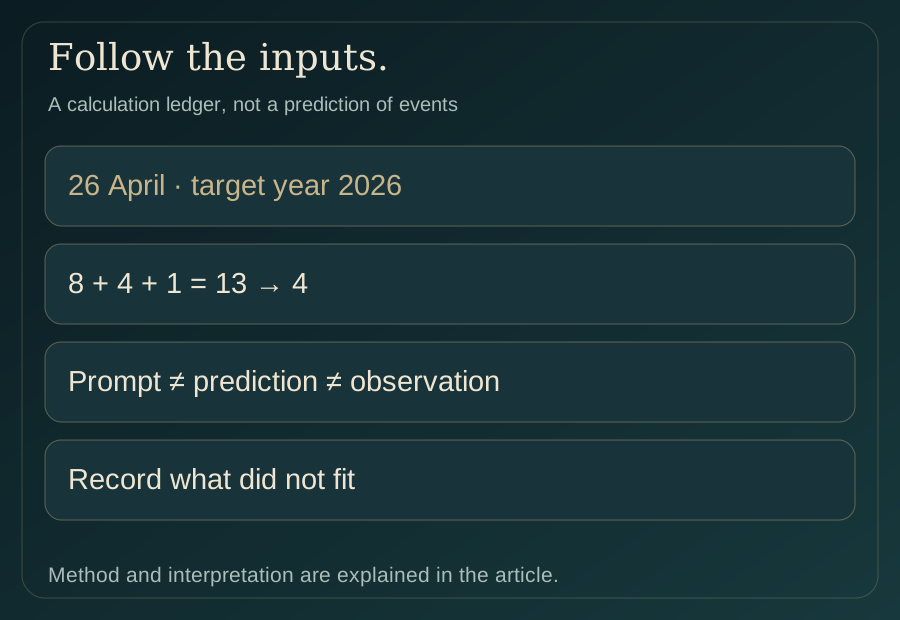
Imagine using a personal year 4 theme of structure. “This year will teach me lessons” is too broad to check. “I will review my unfinished commitments every Friday for four weeks” is a concrete action inspired by the theme, but it is not a prediction made by the number.
Keep those categories separate. A symbolic prompt suggests a question. A plan describes something you intend to do. A prediction claims an outcome will occur. Mixing them can make your own effort look like evidence that a number foretold the result.
The six-column worksheet#
| Field | Example entry |
|---|---|
| Input and method | Birthday 26 April; calendar-year method; 2026 gives 4 |
| Interpretation recorded first | Use “structure” as a prompt to review commitments |
| Action or expectation | Review the list on four Fridays |
| Observation | Completed three reviews; postponed one |
| Other explanations | A quieter workweek made the first two easier |
| What did not fit | The number theme did not predict an unexpected deadline |
The arithmetic is 26 → 8, April → 4, 2026 → 1; 8 + 4 + 1 = 13 → 4. Record this once rather than changing the method when a result feels inconvenient.
Add a comparison that can disappoint you#
Before starting, ask what would count as the exercise not helping. Perhaps the review takes more time than it saves, or you repeatedly avoid the same unresolved task. If the only acceptable conclusion is that numerology worked, the exercise is not an honest comparison.
You can also try the same practical routine without consulting a number theme. If both periods are useful, the routine itself may explain the benefit. One person's journal is not a controlled scientific study, but it can still be more careful than collecting only memorable coincidences.
Record boring and contradictory days#
A dramatic event is easier to remember than an uneventful afternoon. Log at a regular time so your record does not consist solely of surprises. If a description says “communication” and you spent a day working alone, record that without searching for a hidden message that makes it fit.
Keep the original entry visible when adding a later interpretation. Do not silently edit “an important conversation” into “an important internal conversation” after nothing happened. That changes the claim you were supposedly checking.
Protect other people's privacy#
Use initials or fictional labels for people in a private journal, and avoid copying someone's birth details into a public post without permission. Your interpretation of another person's behaviour is not an objective account of their motives.
Do not use this exercise to make medical, financial or relationship decisions on the strength of a pattern in a few entries. The purpose is clearer reflection and honest recordkeeping.
Review the usefulness, not just the matches#
At the end of a month, ask which question led to a helpful action, which description was too broad and which expectation failed. Keep a useful routine even if the numerology explanation did not hold up. Drop an unhelpful prompt without treating that as a personal failure.
For the calculation behind the example, read personal cycles. For a related limit, the twins example shows why matching inputs do not supply an individual life story.
Related Posts
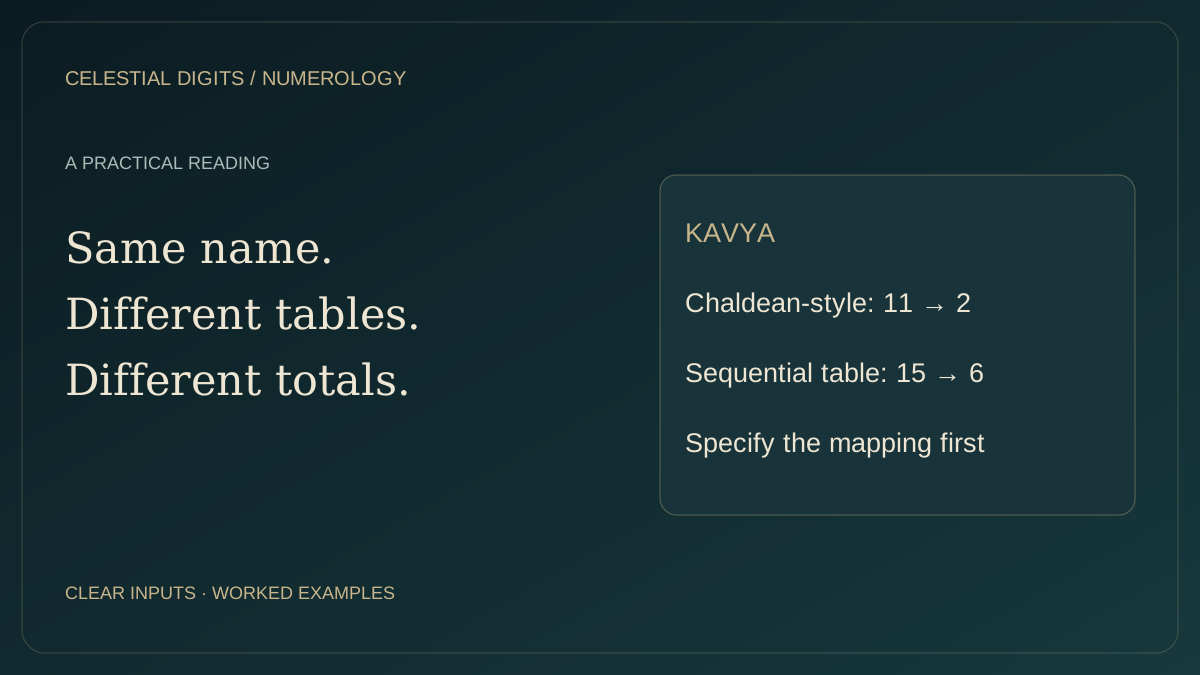
Why Two Name Calculators Disagree: Chaldean and Pythagorean Tables
Compare KAVYA letter by letter under two common tables and see why equal labels can conceal different calculation methods.
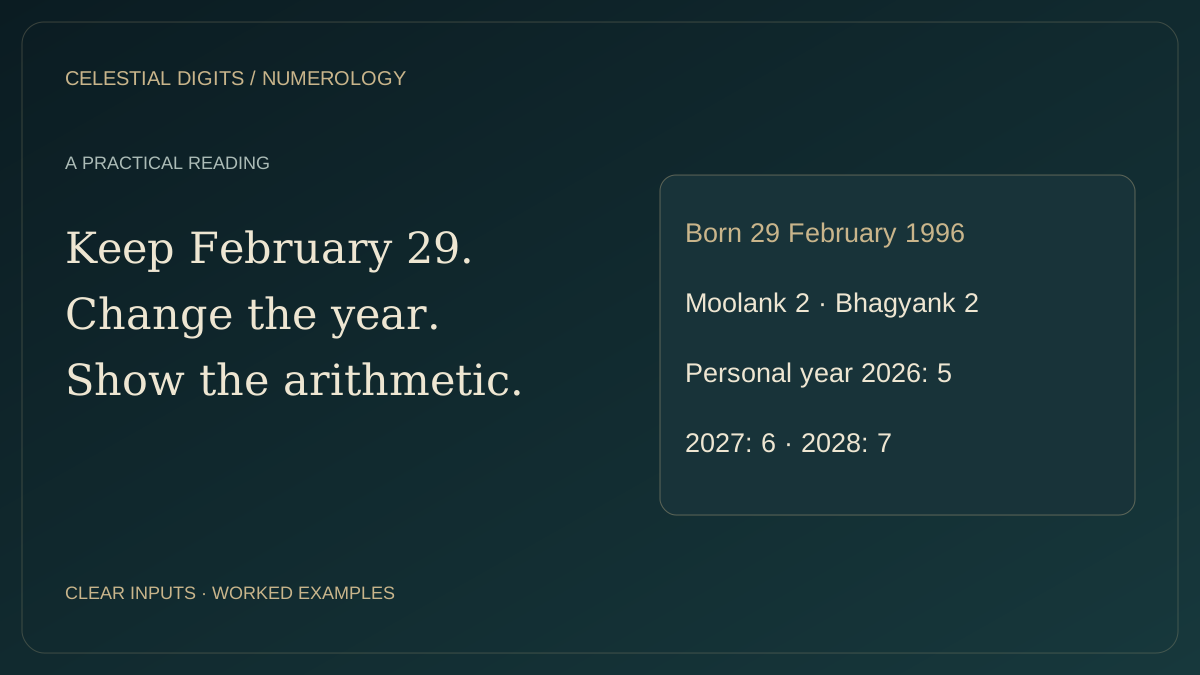
Born on 29 February: Numerology in Leap and Non-Leap Years
Calculate a leap-day Moolank, Bhagyank and personal year without inventing a 29 February date in a non-leap year.
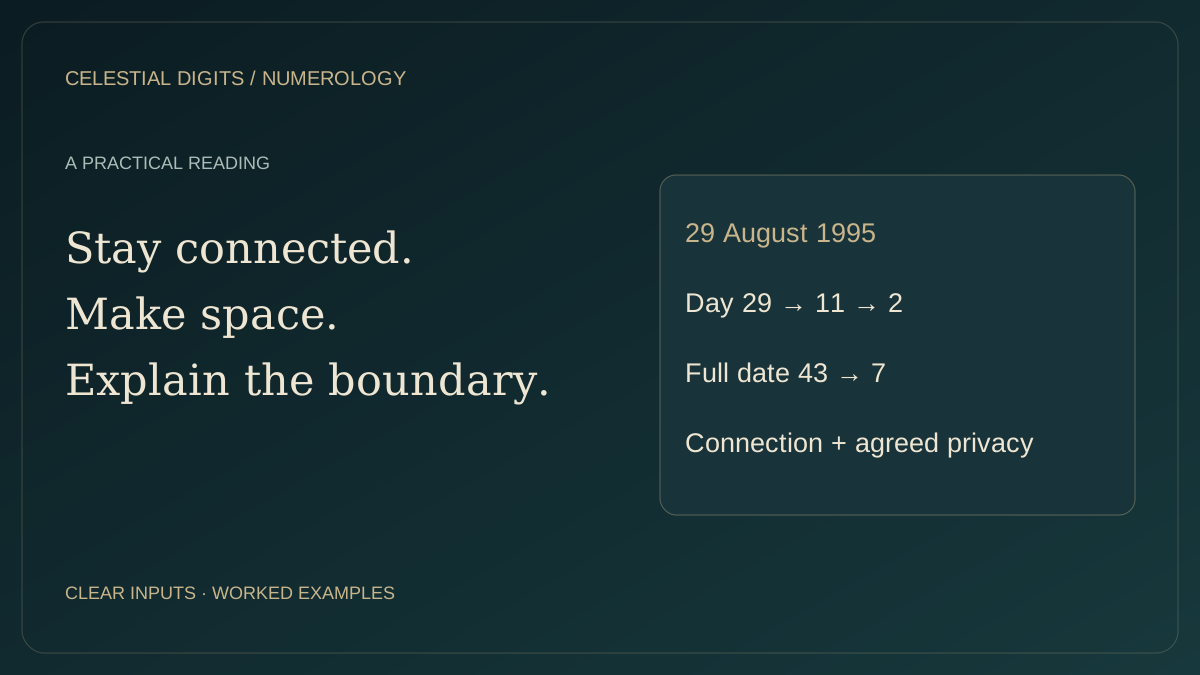
Moolank 2 and Bhagyank 7: Connection without losing privacy
A worked 2–7 calculation and a practical example of asking for space without turning a number pair into a relationship verdict.
A little more perspective.
Keep discussions respectful. No harassment, hate, sexual content or spam. Comments are reviewed before publication. Report concerns from a comment menu, or contact [email protected].
Checking your session…