
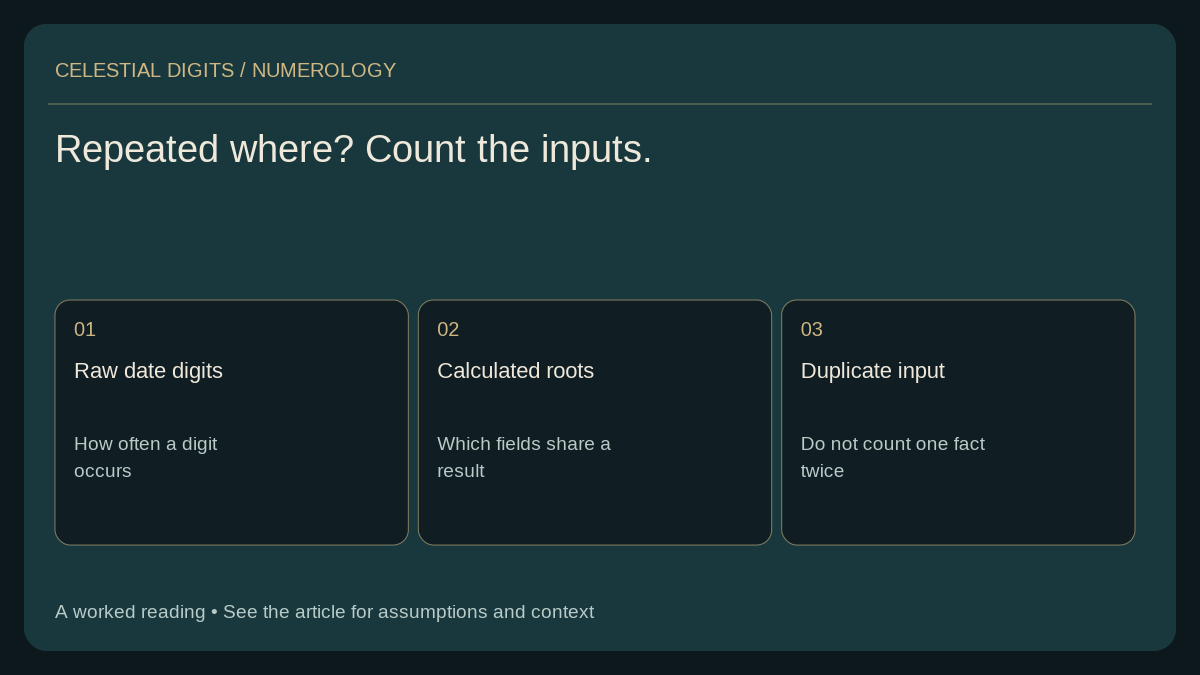
Does a Repeated Number Make Its Influence Stronger? Three Profile Checks
Separate repeated birth-date digits, repeated calculated roots and the same input counted twice through three explicit examples.
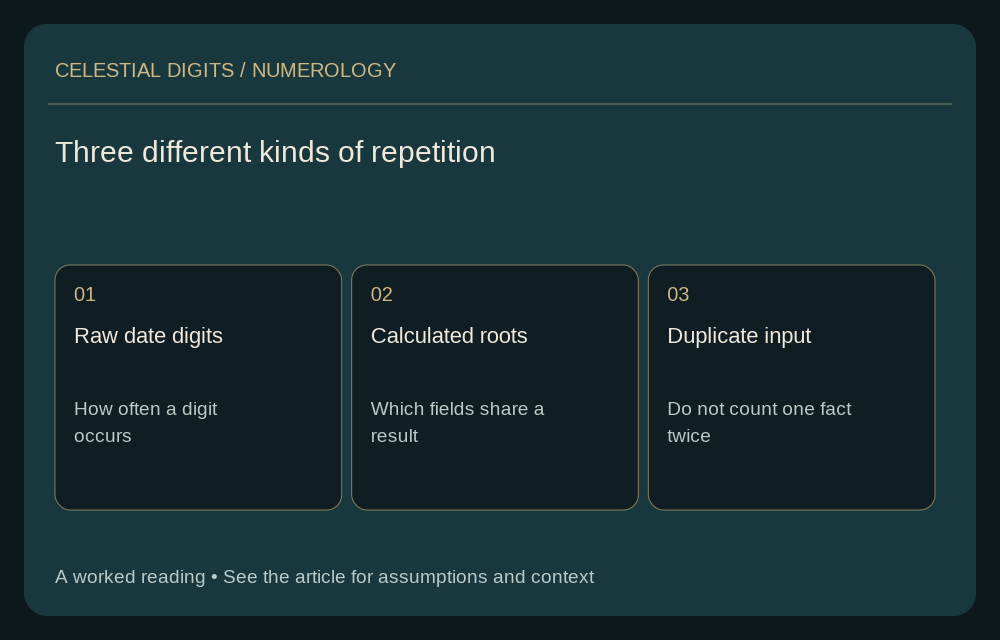
“You have three threes” sounds precise until you ask where the three threes came from. A repeated digit in a date, a repeated root across calculations and the same result displayed in two places are different observations.
Before interpreting repetition as stronger influence, identify what is being counted. Otherwise a report can manufacture emphasis simply by presenting the same birthday calculation under several names.
Example one: repeated digits in the raw date#
Take 3 March 2003, written as 03/03/2003. The digit 3 occurs three times. The full-date sum is 0 + 3 + 0 + 3 + 2 + 0 + 0 + 3 = 11, reducing to 2 under our single-digit convention. Moolank is 3.
So three appearances of the digit 3 do not make Bhagyank 3. Digit-frequency methods and digit-sum methods answer different arithmetic questions. If a grid system interprets the frequency, name that system rather than transferring its result into the full-date calculation.
Example two: repeated roots across fields#
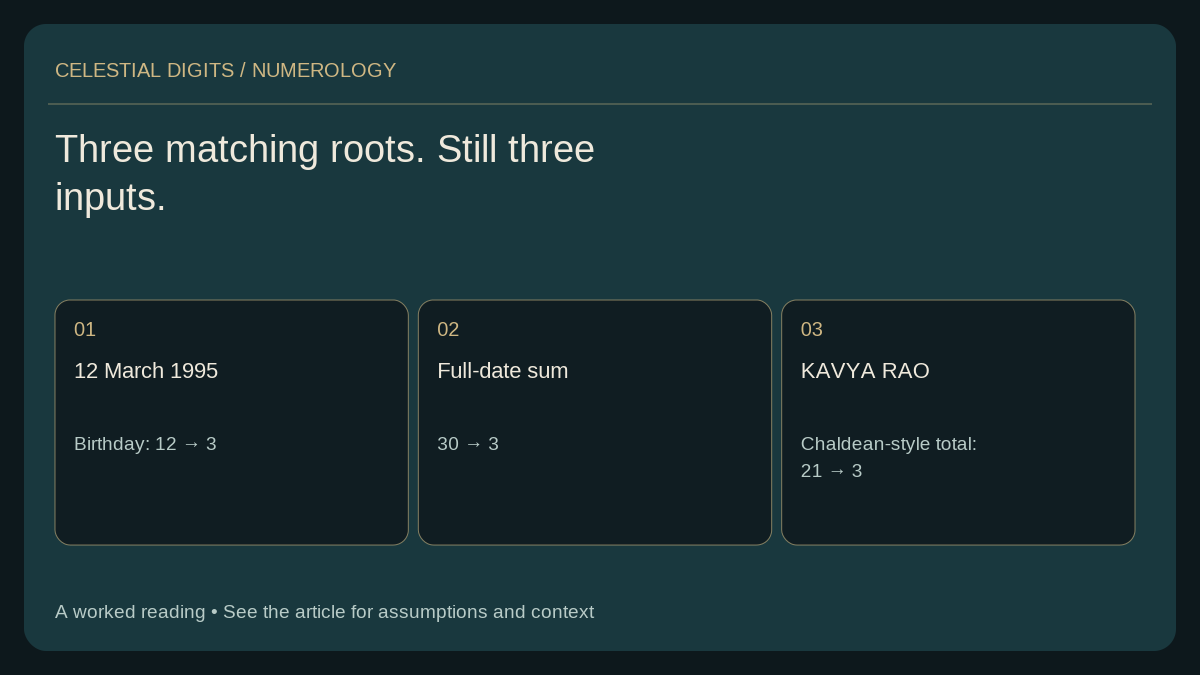
For 12 March 1995, the day reduces to 3 and the full date totals 30, also reducing to 3. Yet the written date 12/03/1995 contains only one digit 3.
This profile repeats a calculated root without repeating the digit three times in the source date. The distinction is small but essential when checking a claim about a “dominant number.”
Example three: one input displayed twice#
Suppose a report lists Moolank 3 and Birthday Number 3, both calculated from the 12th. Those may be two labels for the same field, not independent confirmations. Counting them as two separate pieces of evidence would exaggerate repetition.
| Observation | What it establishes |
|---|---|
| Three raw 3s in 03/03/2003 | A digit-frequency fact |
| Day root 3 and full-date root 3 | Two related calculated fields agree |
| Moolank and Birthday Number from the same day | Possibly one calculation shown twice |
Does repeated agreement prove greater influence?#
Not by itself. These symbolic systems do not provide a validated scale where two matching roots mean twice the effect. Also, the fields are not wholly independent: the birth day is part of the full birth date.
A reflective reading can note recurring themes, but it should avoid mathematical language suggesting measured intensity. “This theme appears in two parts of the chosen method” is more accurate than “Jupiter is three times stronger.”
Use the pattern to ask a narrower question#
If root 3 is being interpreted through learning and explanation, ask about a specific habit: does the person clarify ideas by teaching them, or collect information without applying it? Record an example and a counterexample.
If the person's experience does not fit, the repeated number does not invalidate their account. The interpretation should remain open to correction rather than expanding until it covers every possible behaviour.
Keep a transparent ledger#
Write the original date, digit counts, unreduced sums, final roots and source field for every result. When two labels use the same input, mark that explicitly. This turns an impressive-looking pattern into something a reader can actually audit.
Our missing-digit guide explains why frequency depends on the chosen input. The three-number framework described by Johari's publisher provides background terminology; the arithmetic examples and independence checks here are our own. Continue with the number 9 arithmetic check for another way to detect calculation mistakes.
Related Posts
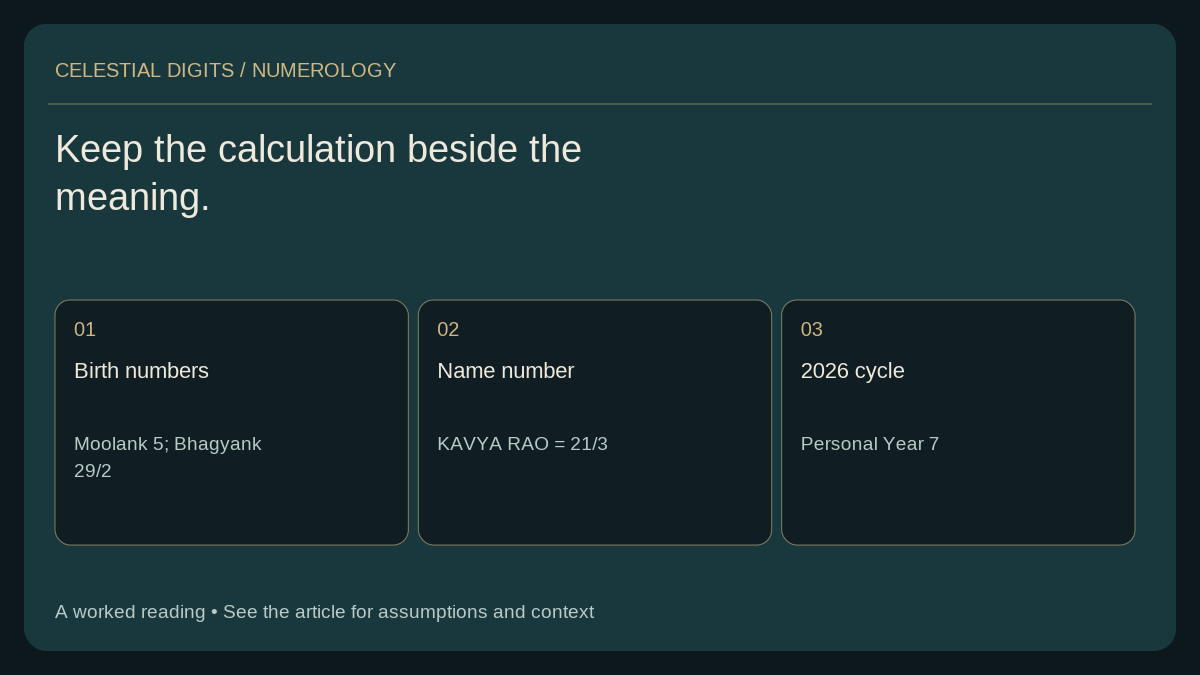
Build a Complete Numerology Reading: Inputs to Interpretation
Follow one fictional profile through Moolank, Bhagyank, Namank and Personal Year, with explicit arithmetic and a balanced interpretation.
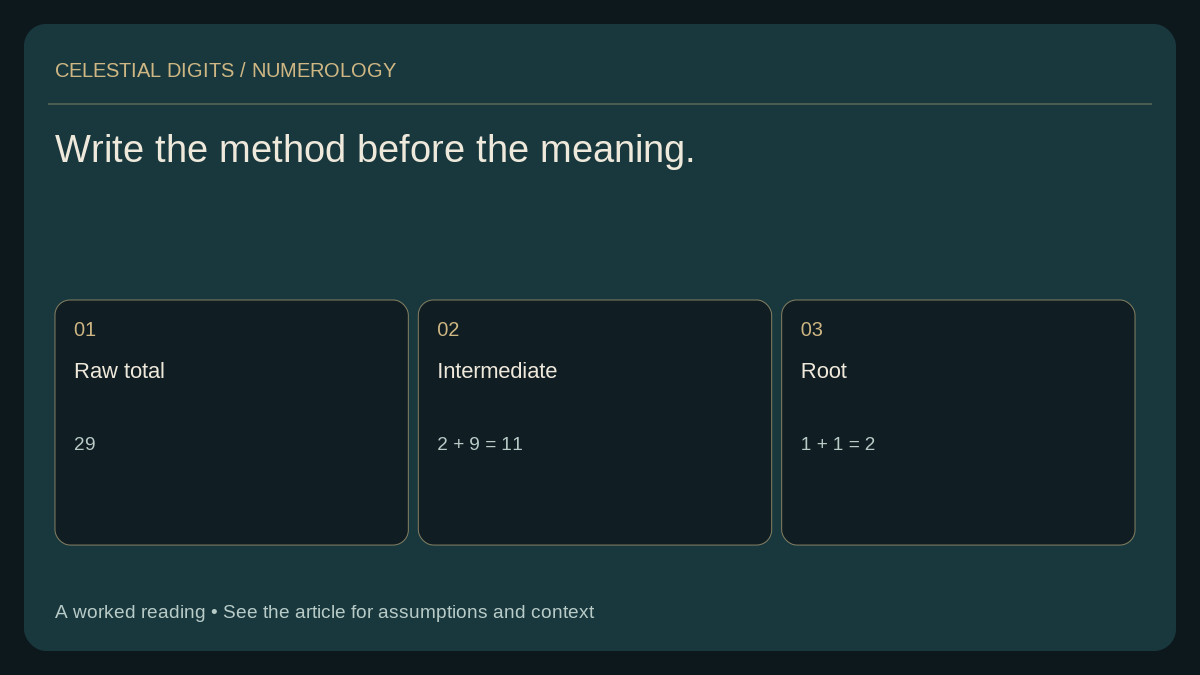
Are Master Numbers 11, 22 and 33 Part of Every Numerology System?
Learn when a method retains 11, 22 or 33, why reduction rules differ, and how to record a calculation without changing methods halfway.
When Moolank, Bhagyank and Namank Are All the Same
Calculate a complete fictional 3–3–3 profile and examine what agreement across three numerology fields does and does not establish.
A little more perspective.
Keep discussions respectful. No harassment, hate, sexual content or spam. Comments are reviewed before publication. Report concerns from a comment menu, or contact [email protected].
Checking your session…