
Missing Numbers: Count the Inputs Before Reading the Pattern
Build separate date-digit and name-value frequency tables, and see why an absent number is a property of the chosen input, not a personal deficiency.
A report says “you are missing 6.” Before interpreting that sentence, ask: missing from what? A birth-date digit grid, a name's letter-value frequencies and a set of reduced core numbers are different datasets.
An absent value in one representation may be present in another. None of these counts, by itself, establishes that a person lacks affection, intelligence, discipline or any other human capacity.
Build a date-frequency record#
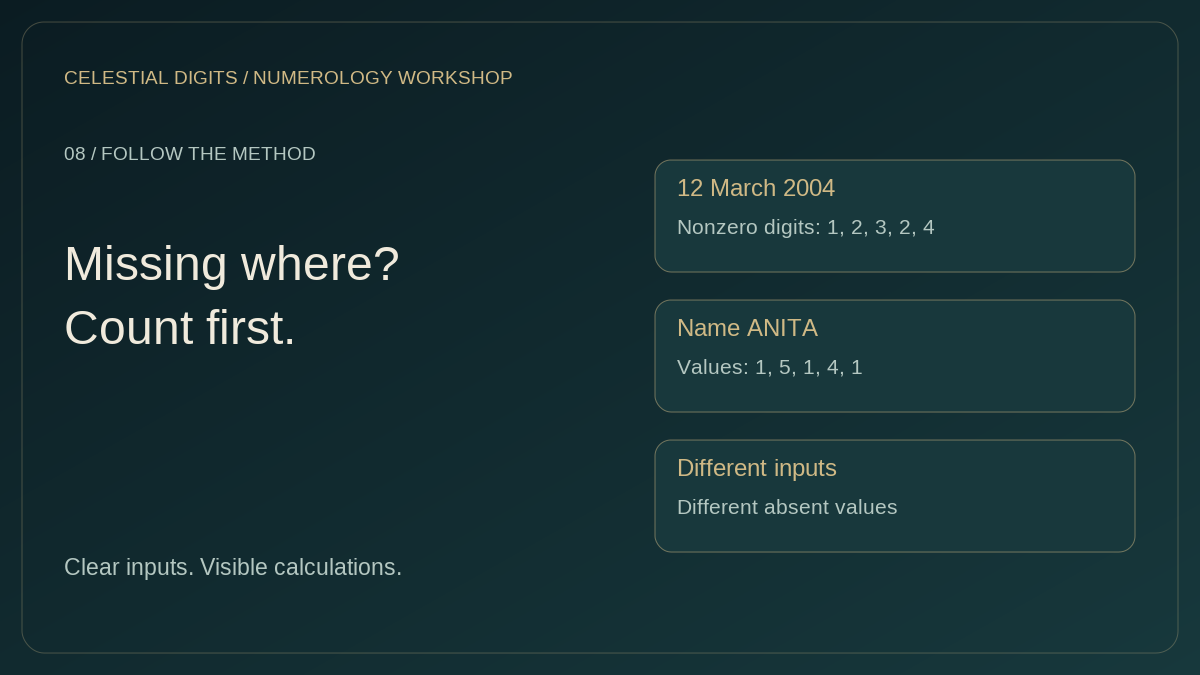
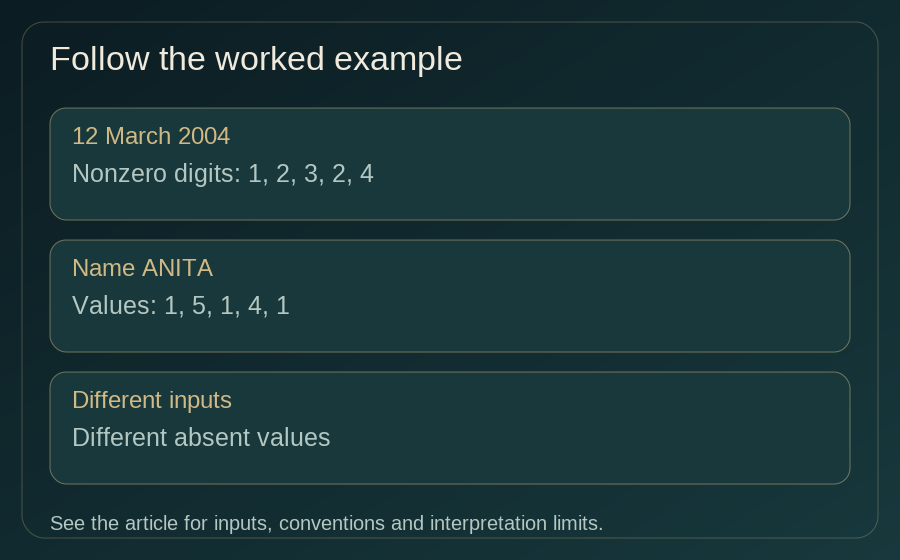
Use the fictional date 12 March 2004, written as 12/03/2004. Excluding zero for a one-to-nine grid, the retained digits are 1, 2, 3, 2, 4.
| Value | Occurrences in the date |
|---|---|
| 1 | 1 |
| 2 | 2 |
| 3 | 1 |
| 4 | 1 |
| 5, 6, 7, 8, 9 | 0 each |
This record contains five nonzero digit occurrences. It does not include the reduced full-date result as an additional occurrence. Adding derived numbers would be a different convention and should be labelled.
Now use a name instead#
For the fictional spelling ANITA, the site's current letter values are A 1, N 5, I 1, T 4, A 1. Value 1 appears three times, 4 once and 5 once. Value 2, which appeared twice in the date, is absent from the name-value list.
The name total is 12 → 3, but that does not mean the original letter-value list contains a 3. A total and a frequency table summarize different properties. Inserting the root into the frequency table without declaring it changes the question.
Why the word “missing” can mislead#
In a finite list, many possible values do not occur. ANITA has only five letters; a nine-value scheme cannot be expected to place every value into a five-item list. Under the site's Chaldean-style alphabet, no letter is assigned 9 at all. Its absence from a name-value frequency list is built into that mapping.
A method that treats every absent 9 as a personal defect would therefore be confusing a property of its own table with a property of the person. Ask whether the interpretation accounts for such structural constraints.
The letter-table comparison shows why changing the alphabet mapping also changes the frequency pattern, even without changing the name.
Keep the grid's rules attached#
Before comparing two charts, establish whether zeros are excluded, whether repeated digits are retained, whether the full birth year is included, and whether Moolank or Bhagyank are added as extra entries. For names, record the exact spelling, table and treatment of unsupported characters.
If one report counts only the birth date and another adds name values, a difference in “missing numbers” is expected. Do not patch the first report by borrowing values from the second unless the declared method actually calls for that combination.
A more useful reflection exercise#
If a tradition associates an absent value with a theme you want to explore, frame it as a question: “Would a clearer routine help me?” Then assess the routine by its practical effect. Avoid converting the prompt into a fixed label such as “I cannot be organized.”
Do not change a child's name or judge a partner's character solely to fill a grid. The numerology journal guide offers a way to record interpretations alongside contrary evidence. Accurate counting is a good starting point; it does not make the resulting personality claim an established fact.
Related Posts

Lo Shu Grid Analysis: The 3×3 Map Hidden in Your Birth Date
Build your Lo Shu Grid from your birth date: rows, planes, repeated and missing numbers 1 to 9, arrows of strength, and combining it with your moolank.
Choosing a Baby Name: Numerology, Pronunciation and Family Meaning
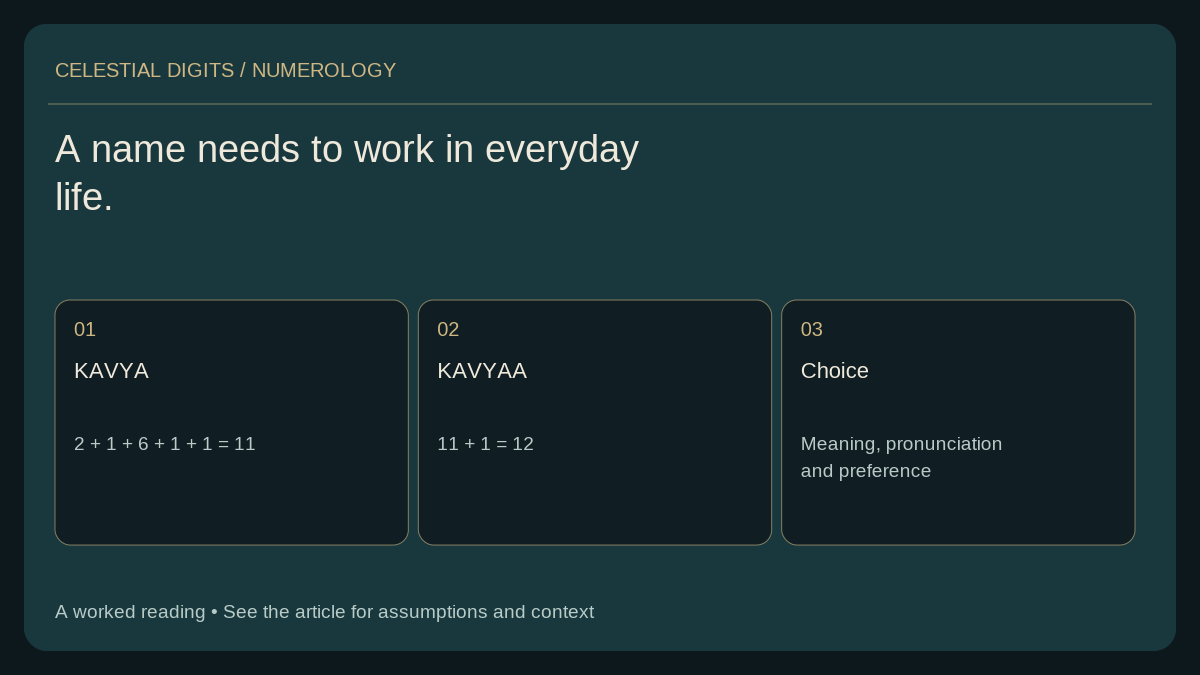
Work through two spelling totals and compare them with pronunciation, cultural meaning and everyday use before choosing a name.
Birth Name, Legal Name or Everyday Name: Which Should You Calculate?
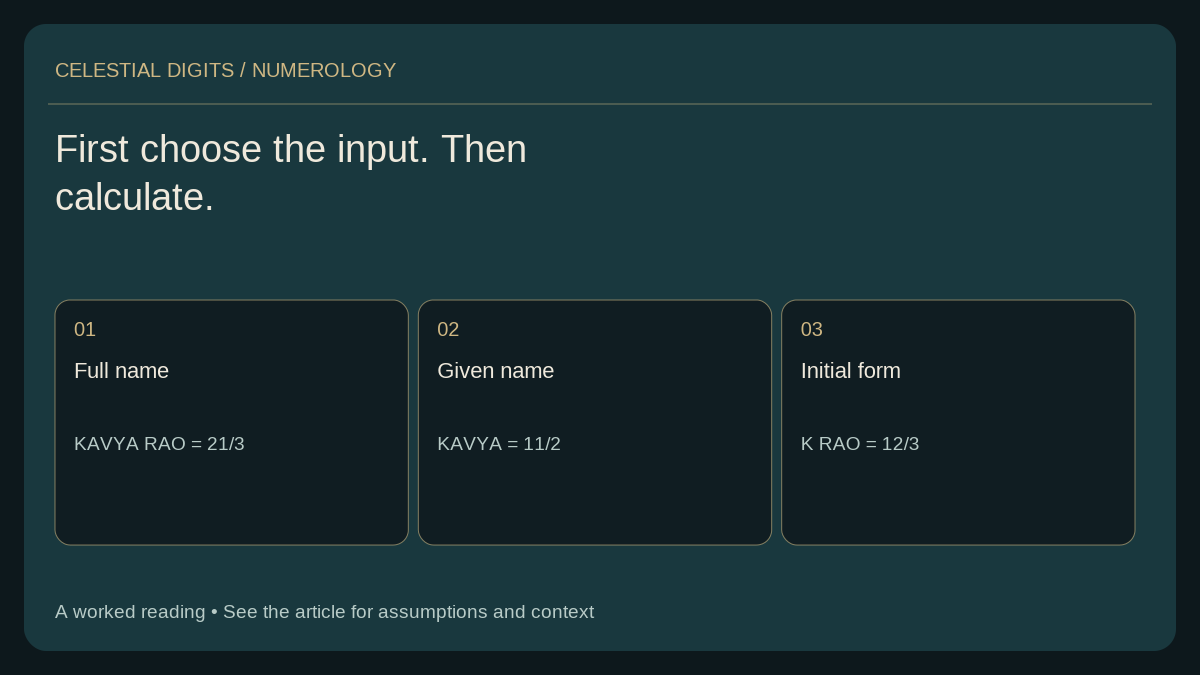
Compare three name inputs under one letter table and learn how to record the purpose, spelling and result without choosing a total after the fact.
A little more perspective.
Keep discussions respectful. No harassment, hate, sexual content or spam. Comments are reviewed before publication. Report concerns from a comment menu, or contact [email protected].
Checking your session…