
The Number 9 Check: Catch Numerology Arithmetic Errors
Use remainders and digital roots to check a numerology total, then learn why this shortcut cannot detect reordered or missing inputs reliably.
You can check a single-digit reduction without repeatedly adding every intermediate result. For a positive whole number, its digital root corresponds to its remainder after division by nine, with a remainder of zero represented by nine.
This is a property of decimal arithmetic, not a special numerological prediction. It is useful precisely because it lets you test one calculation independently of an interpretation.
Work through 38 two ways#
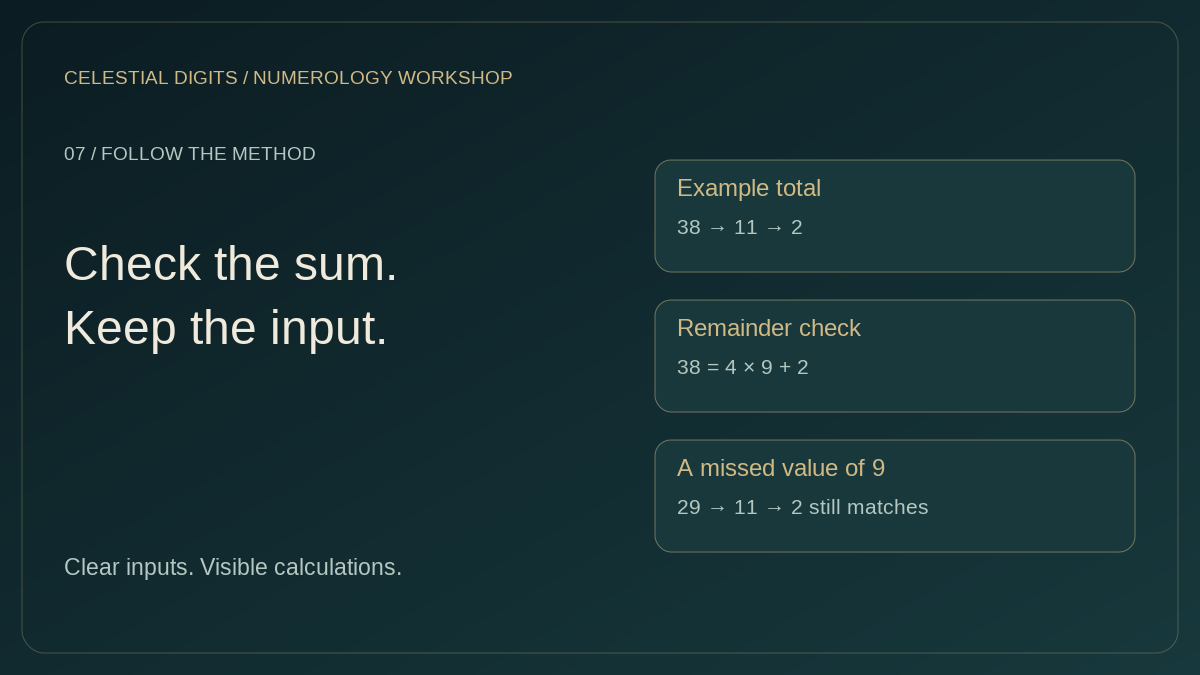
Repeated digit addition gives 3 + 8 = 11, then 1 + 1 = 2. Division gives 38 = 4 × 9 + 2, so the remainder is 2. Both methods arrive at the same root.
For 45, repeated addition gives 4 + 5 = 9. Division gives 45 = 5 × 9 + 0. Under the positive-number digital-root convention, the zero remainder maps to 9, not to a new root called zero.
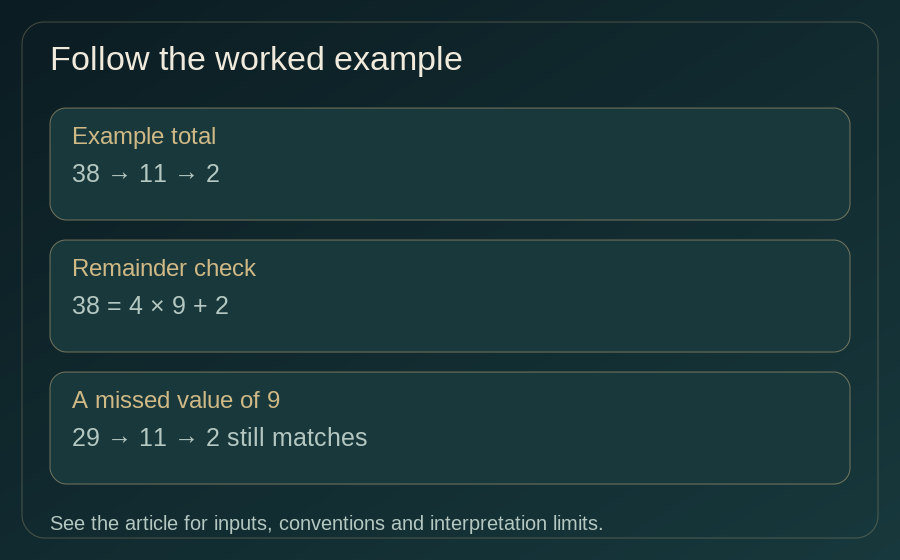
The compact formula is 1 + ((n − 1) remainder 9) for a positive integer n. Zero needs separate handling; do not feed an empty or invalid name into a positive-number shortcut and present the output as meaningful personal information.
Why nine appears in the calculation#
In base ten, 10 is one more than 9. So 10, 100 and 1,000 each leave the same remainder as 1 when divided by 9. Replacing each decimal place value by 1 therefore preserves the remainder.
For 38, this means 3 × 10 + 8 and 3 + 8 differ by 27, a multiple of nine. The reasoning applies to longer numbers too. It explains the shortcut without requiring a belief about planetary rulership or the symbolic meaning of 9.
What the check can catch#
Suppose a reported total is 38 but its displayed root is 4. Under single-digit reduction, those two fields disagree. Either the total, the root or the stated reduction rule needs correction.
Likewise, if independently recomputing a date gives 37 rather than 38, the roots differ: 1 versus 2. This flags a problem worth investigating. It does not identify which digit was entered incorrectly.
What it cannot catch#
A missing contribution of 9 leaves the root unchanged: 38 and 29 both reduce to 2. Reordering letters or date digits also leaves their sum unchanged. A name can therefore be wrong while its root looks right.
Our date-format example demonstrates a practical version: swapping 7 September with 9 July preserves the full-date digit sum. The check cannot reconstruct the original order because that information was discarded by addition.
This is why a matching digital root is a weak verification of identity. It checks a numerical relationship; it does not confirm that the name, date or letter table belongs to the intended person.
Apply it without mixing conventions#
If a report stops at 11 or 22, it is preserving an intermediate value under a different rule. The digital-root shortcut will still produce 2 or 4. That is not automatically a software defect; first confirm what the column is supposed to represent.
For a reliable record, keep the exact input, individual contributions, total and reduction path. Use the number-nine shortcut as a second arithmetic check. For the meaning of intermediate totals, read compound numbers with the same root. The shortcut is most useful when it exposes an inconsistency, and most misleading when treated as proof that every earlier step was correct.
Related Posts
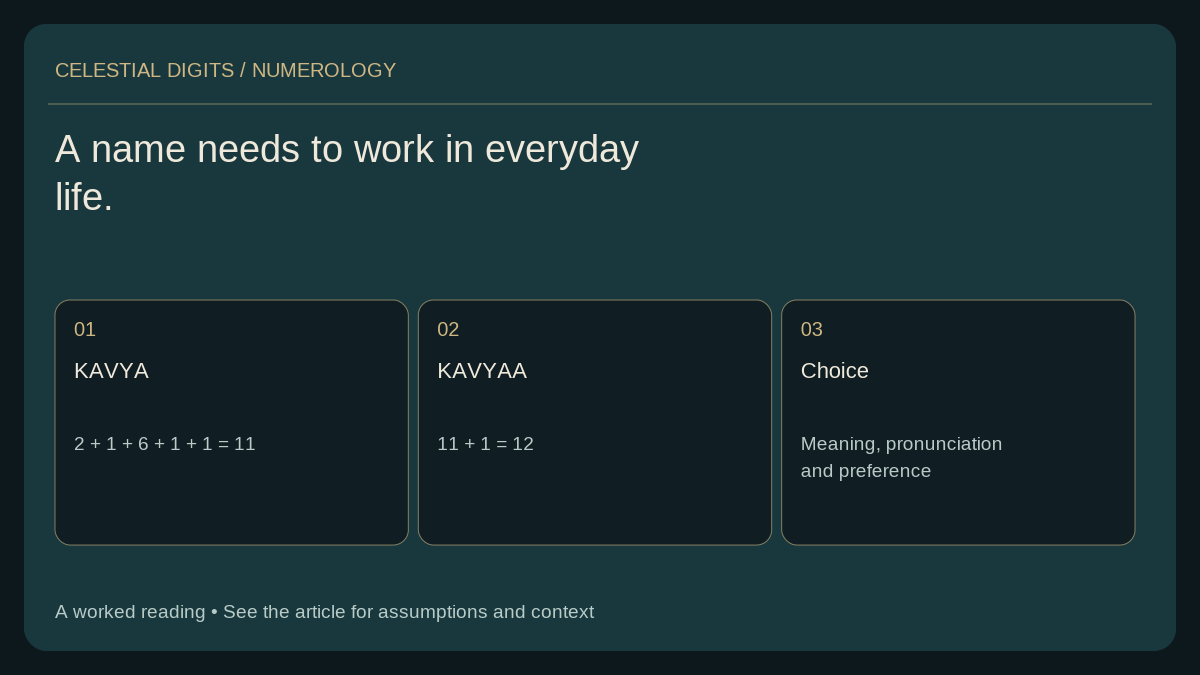
Choosing a Baby Name: Numerology, Pronunciation and Family Meaning
Work through two spelling totals and compare them with pronunciation, cultural meaning and everyday use before choosing a name.
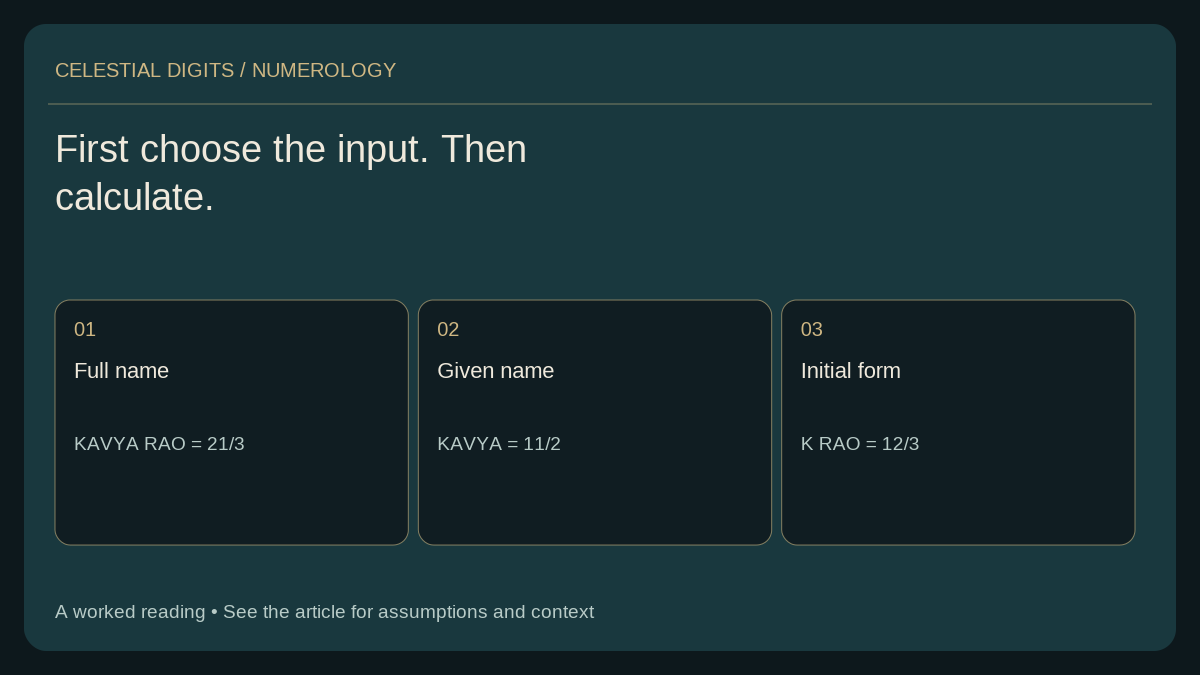
Birth Name, Legal Name or Everyday Name: Which Should You Calculate?
Compare three name inputs under one letter table and learn how to record the purpose, spelling and result without choosing a total after the fact.
Can Your Birth Number Describe Your Career? Symbolism vs Actual Skills
Use birth-number themes as reflection prompts while assessing career fit through skills, experience, working conditions and real opportunities.
A little more perspective.
Keep discussions respectful. No harassment, hate, sexual content or spam. Comments are reviewed before publication. Report concerns from a comment menu, or contact [email protected].
Checking your session…