
Planetary Hora: Why an Hour Is Not Always 60 Minutes
Divide daylight and night separately, follow the weekday lord sequence, and calculate a winter-day example without assuming equal clock hours.
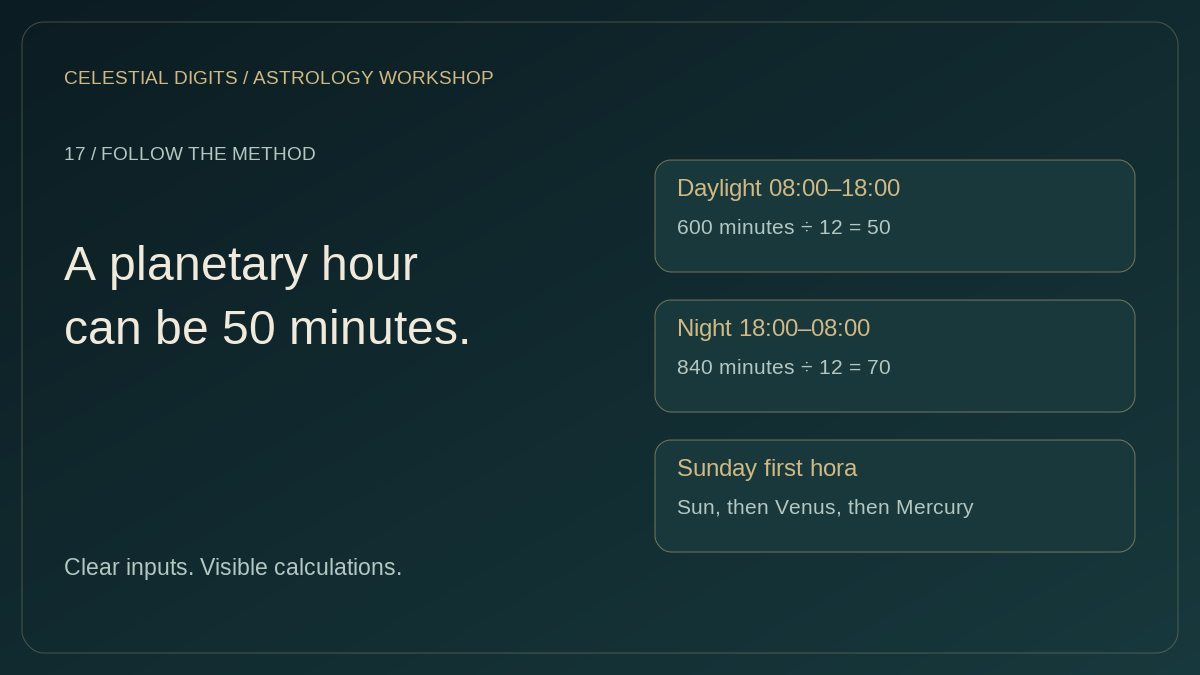
A planetary hora is not necessarily a standard clock hour. Under the unequal-hour convention, the interval from local sunrise to sunset is divided into twelve parts, and sunset to the next sunrise is divided into another twelve.
The divisions are equal within each half, but daytime and nighttime divisions need not have the same duration. That is why a table generated for another city or season may not fit your clock.
Start from the solar events#
Use a fictional Sunday with sunrise at 08:00, sunset at 18:00, and the next sunrise at 08:00. These times are teaching inputs, not a calculation for a named place.
Daylight lasts ten hours, or 600 minutes. Each daytime hora lasts 600 ÷ 12 = 50 minutes. Night lasts fourteen hours, or 840 minutes. Each nighttime hora lasts 840 ÷ 12 = 70 minutes.
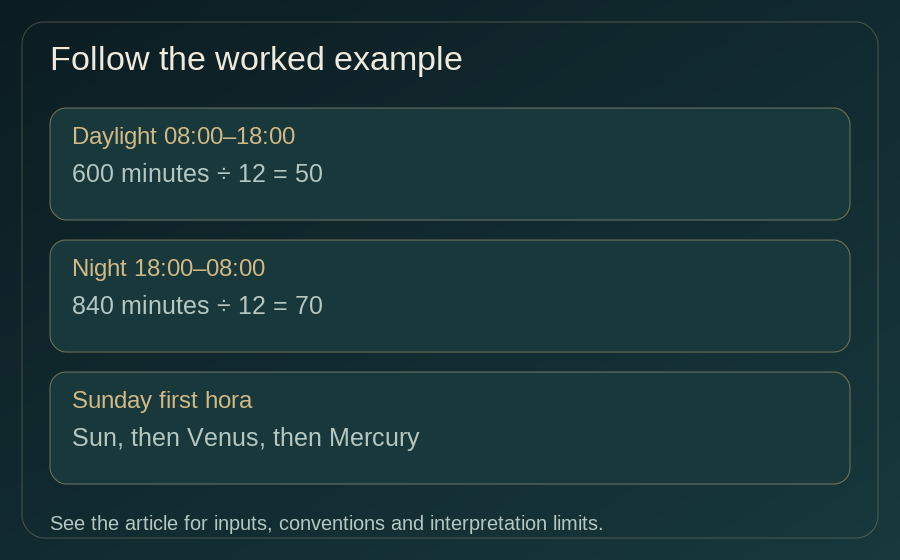
This unequal-hour definition is described in Astrodienst's planetary-hour reference. The schedule below is our own arithmetic example.
Assign the lords in sequence#
The repeating order is Saturn, Jupiter, Mars, Sun, Venus, Mercury, Moon. Begin the first daytime hora with the weekday's lord. For Sunday, begin with the Sun, then continue through the same cycle.
| Sunday daytime hora | Lord | Local interval in this example |
|---|---|---|
| First | Sun | 08:00–08:50 |
| Second | Venus | 08:50–09:40 |
| Third | Mercury | 09:40–10:30 |
| Fourth | Moon | 10:30–11:20 |
| Fifth | Saturn | 11:20–12:10 |
| Sixth | Jupiter | 12:10–13:00 |
| Seventh | Mars | 13:00–13:50 |
The eighth returns to Sun, and the twelfth is Saturn. At sunset, the sequence continues with Jupiter; it does not restart with Sun. The first nighttime interval is therefore 18:00–19:10, followed by Mars from 19:10–20:20.
Midnight does not restart this sequence#
The planetary day in this convention begins at sunrise. A civil clock changing date at midnight does not make the next hora the new weekday lord's first daylight hour. Continue the night sequence until the next local sunrise.
After twenty-four horas, the following daytime sequence begins with the next weekday lord. In this Sunday example, Monday sunrise begins with Moon. The unequal durations affect the clock boundaries, not the seven-lord order.
Why a copied table can be wrong#
A table based on 06:00 sunrise and 18:00 sunset has sixty-minute daylight divisions. Applying it to our 08:00 sunrise example moves the boundaries and may assign the wrong lord at a chosen time.
For a real calculation, use the location, date, timezone, sunrise, sunset and next sunrise together. Clock changes and unusual high-latitude solar conditions require explicit handling. If the relevant sunrise or sunset does not occur, do not invent a normal twelve-hour day to fill the table.
What the hora can and cannot decide#
Traditional timing practices associate planetary hours with different activities. Those associations are not proof that an application, negotiation or appointment will succeed in a selected interval. Availability, preparation and the other person's consent remain practical constraints.
A broader muhurta discussion considers more than one time factor. A hora label should not be used to cancel an urgent responsibility or override professional advice.
When comparing tools, ask whether both use unequal solar hours or a different convention. Then compare the underlying solar-event times before interpreting the lord labels. This article explains the method; it does not claim the website currently provides a dedicated hora scheduler.
Related Posts
Marriage Astrology: A Study Guide to Partnership and Timing
Explore 56 marriage guides: Venus and Mars placements, seventh-house planets, combinations, Darakaraka, synastry and timing with worked examples.
Marriage Timing Through Mahadasha, Antardasha and Pratyantar
Read the full Vimshottari hierarchy, compare planetary roles across ascendants and work through sub-period durations without inventing a wedding date.
Navamsa in Marriage Timing: Cross-Checking the Dasha Lords
Follow the same dasha lords from D1 into D9, calculate two Navamsa examples and see why a conjunction or uncertain ascendant needs careful interpretation.
A little more perspective.
Keep discussions respectful. No harassment, hate, sexual content or spam. Comments are reviewed before publication. Report concerns from a comment menu, or contact [email protected].
Checking your session…