
Personal Year vs Mahadasha: Why the Two Timelines Do Not Match
Calculate a personal year and a sample birth-dasha balance. See why calendar numbers, mahadasha and antardasha use different inputs and boundaries.
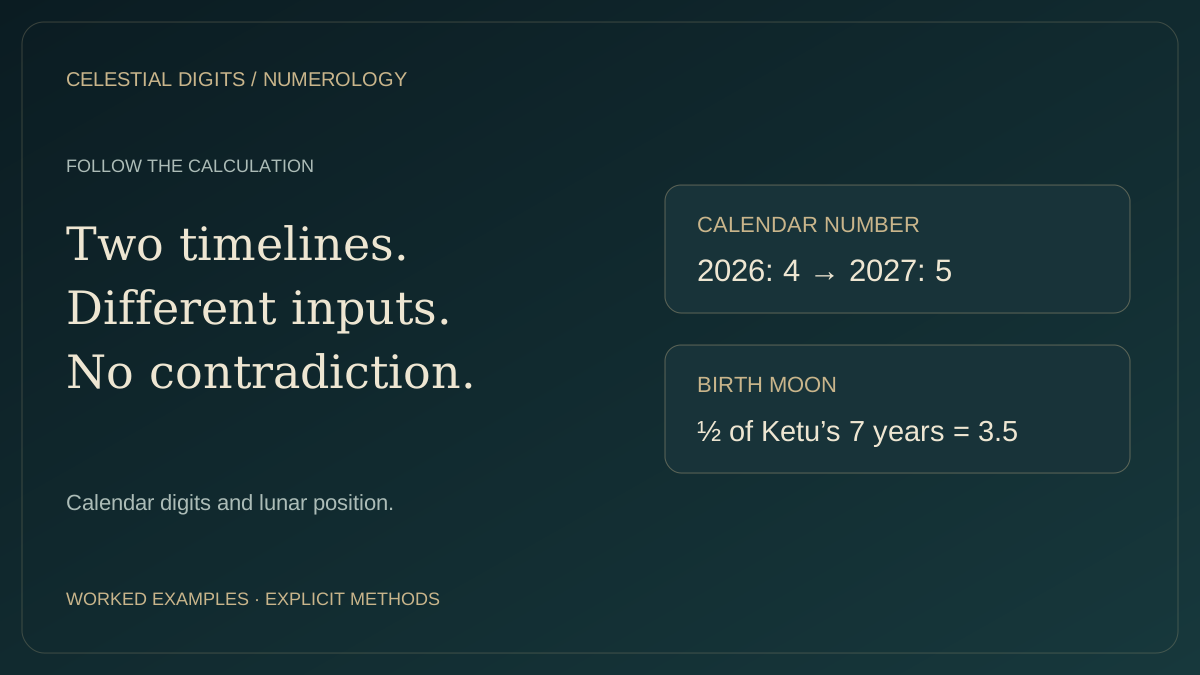
You can enter a new personal year on January 1 while remaining in the same mahadasha and antardasha. Those results do not need to match. A personal year is derived from calendar numbers; Vimshottari dasha starts from the Moon's position at birth. Giving both a planetary label does not turn them into the same calculation.
This guide compares their inputs, boundaries and uses. We use the calendar-year numerology convention, with reduction to 1–9, and the standard 120-year Vimshottari sequence. The examples demonstrate the methods; they are not forecasts for a real person.
First calculate the personal year#
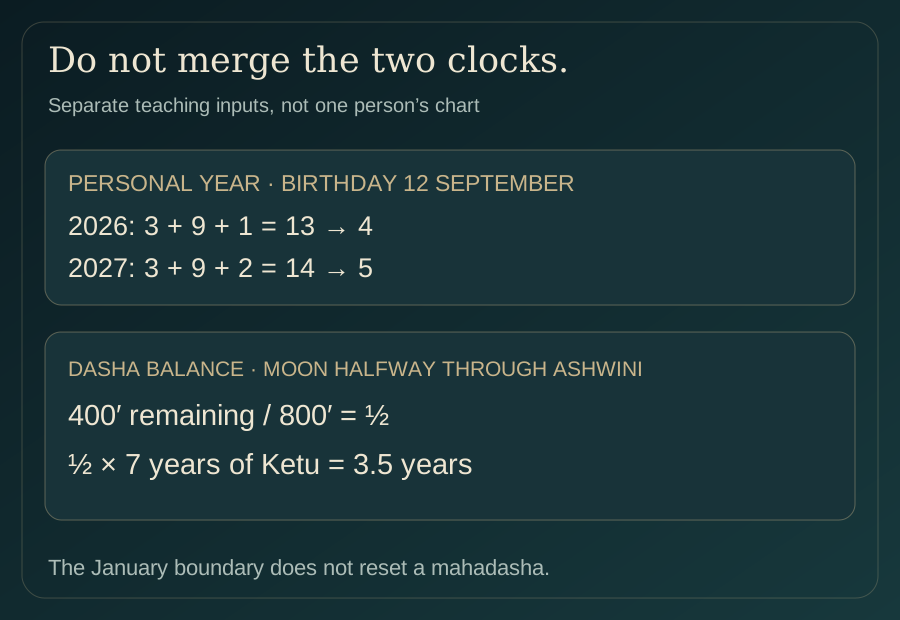
Take a fictional birthday of 12 September and calculate for 2026. Reduce the birth day, birth month and target year:
- Day: 1 + 2 = 3.
- Month: September = 9.
- Target year: 2 + 0 + 2 + 6 = 10 → 1.
- Total: 3 + 9 + 1 = 13 → personal year 4.
For 2027, the year reduces to 2. The new total is 3 + 9 + 2 = 14 → personal year 5. The birth year did not enter either calculation. It would enter Bhagyank, which is a different number.
| Date being considered | Birthday used | Target year | Personal year in this convention |
|---|---|---|---|
| 31 December 2026 | 12 September | 2026 | 4 |
| 1 January 2027 | 12 September | 2027 | 5 |
| 12 September 2027 | 12 September | 2027 | Still 5 |
The birthday does not restart the personal year in the January-to-December method. Some practitioners use a birthday-based cycle; that needs its own stated boundaries. Do not use the calculation from one convention and the dates from another.
What starts a Vimshottari mahadasha?#
The starting lord comes from the Moon's birth nakshatra. How far the Moon has already travelled through that nakshatra determines how much of the first mahadasha remains at birth. The date's digit sum cannot supply that longitude.
Each of the 27 nakshatras spans 13°20′, or 800 arcminutes. In the following isolated arithmetic example, suppose the Moon is halfway through Ashwini, at 6°40′ Aries in the chosen sidereal zodiac. Ashwini's Vimshottari lord is Ketu, whose full period is seven years.
The remaining arc is 400 of 800 arcminutes. The remaining fraction is therefore one-half, giving 7 × 1/2 = 3.5 years of the initial Ketu period. A second hypothetical Moon position at 10° Aries leaves 200 arcminutes, or one-quarter, giving 1.75 years.
| Hypothetical Moon in Ashwini | Arc remaining | Fraction remaining | Ketu balance |
|---|---|---|---|
| 6°40′ Aries | 400′ | 1/2 | 3.5 years |
| 10°00′ Aries | 200′ | 1/4 | 1.75 years |
These Moon positions are standalone teaching inputs. We have not calculated either one for the September birthday above. Converting a balance into exact calendar dates also requires a birth instant and the calculator's year-length convention. The table is deliberately not an invented personal dasha schedule.
Why the same planet name can mislead#
In the number associations used by Celestial Digits, 4 is linked with Rahu. That does not mean the person in the personal-year example enters Rahu mahadasha in 2026. The number table supplies a symbolic association; the dasha calculation supplies a dated period from a lunar starting point.
Similarly, Moolank 8's Saturn association does not establish Saturn mahadasha. A reader can have a Saturn-associated birth number, a different personal-year number and a Venus mahadasha without any calculation being inconsistent.
Ask what the label refers to before combining descriptions: a number's ruler, the current mahadasha lord, an antardasha lord or a transiting planet. “Rahu is active” is too ambiguous to audit by itself.
Antardasha is not another name for personal month#
An antardasha is a subdivision within a mahadasha. In the Vimshottari framework, durations are proportional to the subperiod lord's allotted years in the 120-year cycle. They are not obtained by adding the calendar month to a personal year.
For example, the full Saturn–Mars antardasha has a conventional duration of 19 × 7 / 120 = 1.10833… years. That calculation uses Saturn's 19 years and Mars's seven years. It does not say when the subperiod begins for a particular person. If birth occurs partway through a period, the portion experienced after birth may be shorter.
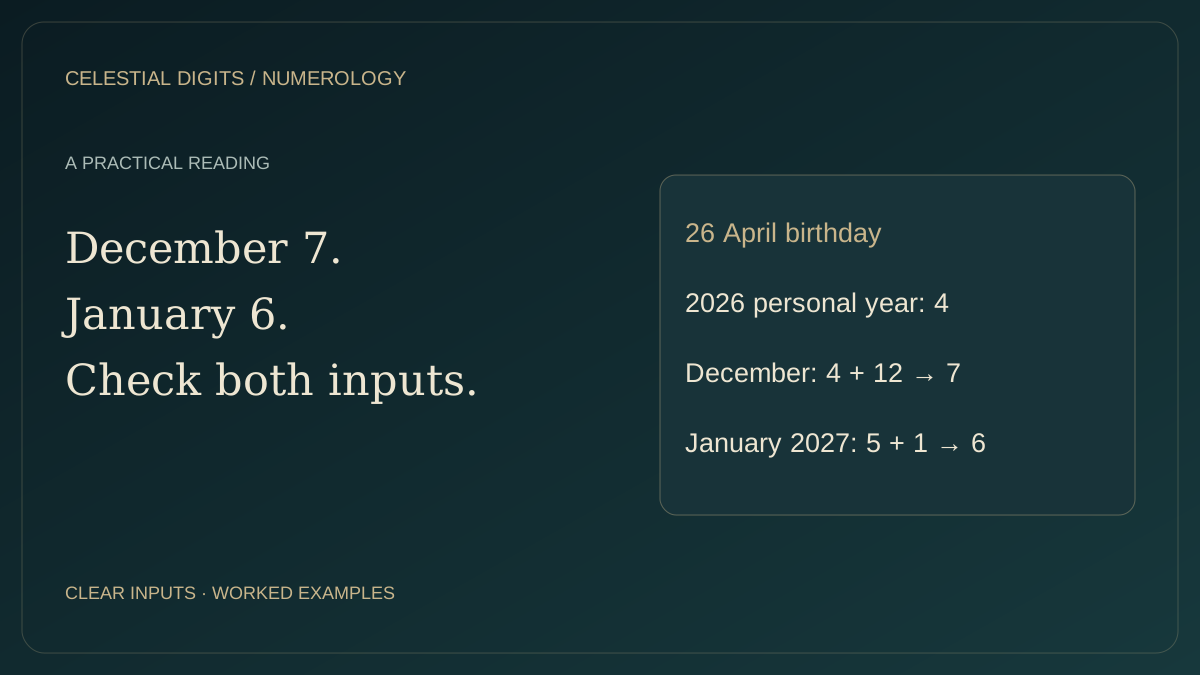
A personal month, by contrast, is a calendar-number calculation under the numerology method. For personal year 4, January gives 4 + 1 = 5. Calling both a “subcycle” does not make their dates or meanings interchangeable. See the pratyantardasha worked example for the next level within the dasha hierarchy.
A practical comparison worksheet#
Suppose you are reviewing a study plan for the coming year. Keep two labelled notes:
| Note | Record | Question it can organise |
|---|---|---|
| Numerology | Target year, calculation and chosen calendar convention | Which broad theme would I like to reflect on? |
| Astrology | Birth inputs, zodiac settings, current mahadasha and antardasha with dates | How does this period fit the natal houses relevant to study? |
| Actual plan | Course requirements, available time, costs and support | Can I make this commitment work? |
If one reading suggests preparation and another suggests expansion, do not average the labels into a prediction. Define what either interpretation would mean in practice. Preparation might be completing prerequisites; expansion might be applying to a wider range of courses. Neither removes the need to meet a deadline or assess affordability.
Check the date before interpreting the period#
A saved report can describe the date when it was generated. When asking what is active now, check the reference date and the displayed period boundaries in your birth chart's dasha section. A change of calendar year should not, by itself, reset that timeline.
For numerology, use the intended target year rather than your birth year. Our personal year, month and day guide explains that calculation in more detail. The dasha-and-transit guide covers a third timing layer: actual planetary movement relative to a chart.
Sources and method: the calendar formula was checked against Celestial Digits' yearly numerology calculation. Jyotish Global's Vimshottari teaching notes, calculation section, describe the birth-Moon starting point and proportional balance. The fractions above are original worked examples. Reproducible arithmetic does not establish the scientific validity of event predictions.
Related Posts
Why Your Personal Month Can Go Backward in January
Work through December 2026 and January 2027 for a 26 April birthday and see why the monthly number need not advance by one.
Moolank 1 (Sun): Initiative without taking over
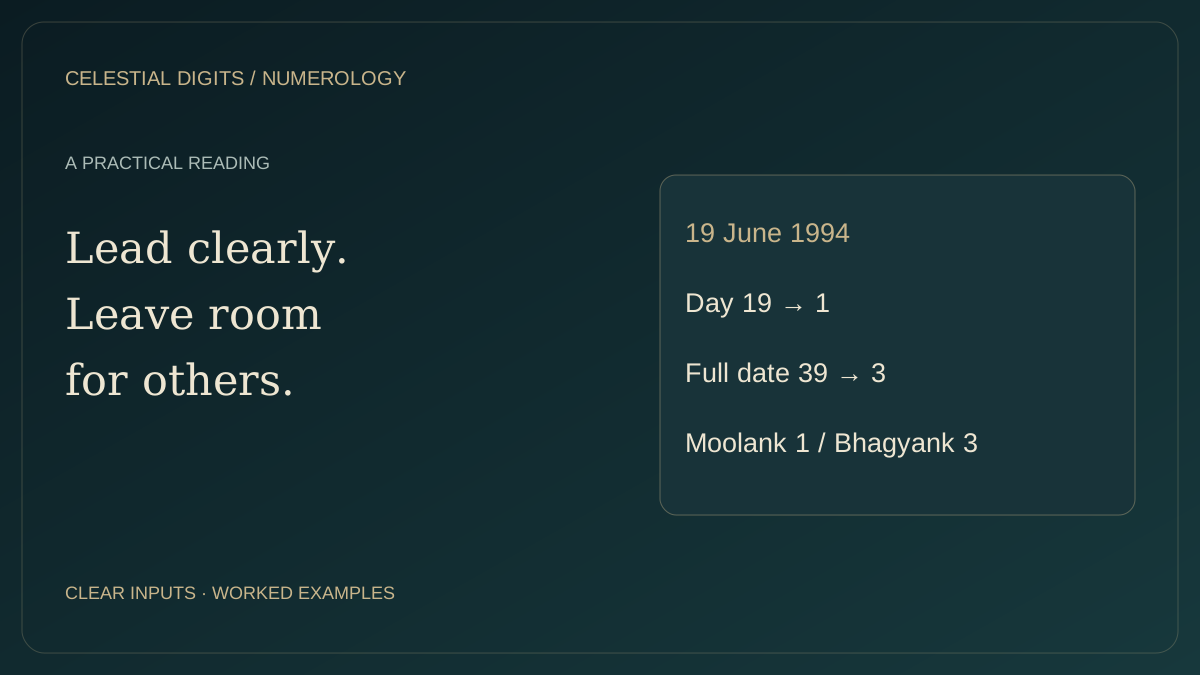
Calculate Moolank 1, separate it from Bhagyank and explore Sun symbolism through a worked situation and practical reflection.
Moolank 2 (Moon): Cooperation with a clear decision
Calculate Moolank 2, separate it from Bhagyank and explore Moon symbolism through a worked situation and practical reflection.
A little more perspective.
Keep discussions respectful. No harassment, hate, sexual content or spam. Comments are reviewed before publication. Report concerns from a comment menu, or contact [email protected].
Checking your session…