
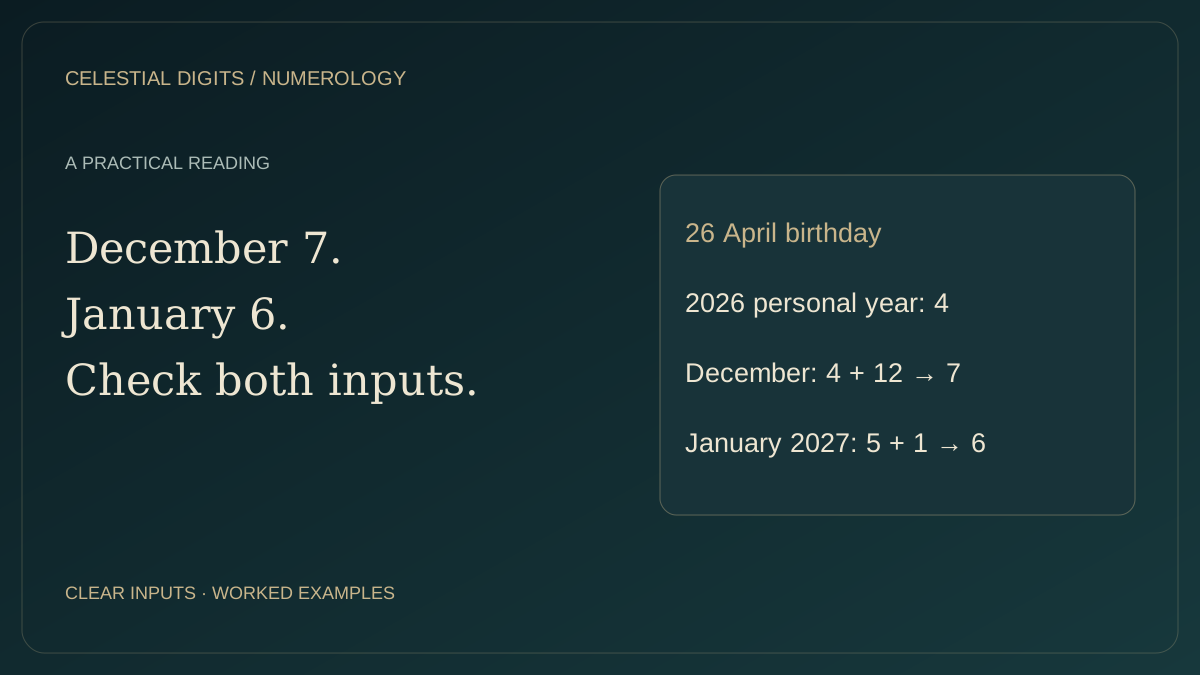
Why Your Personal Month Can Go Backward in January
Work through December 2026 and January 2027 for a 26 April birthday and see why the monthly number need not advance by one.
A personal-month sequence usually moves forward as calendar months advance. At January, however, both the calendar month and the personal year change in the calendar-year convention. A result such as December 7 followed by January 6 can therefore be correct.
Begin with the personal year#
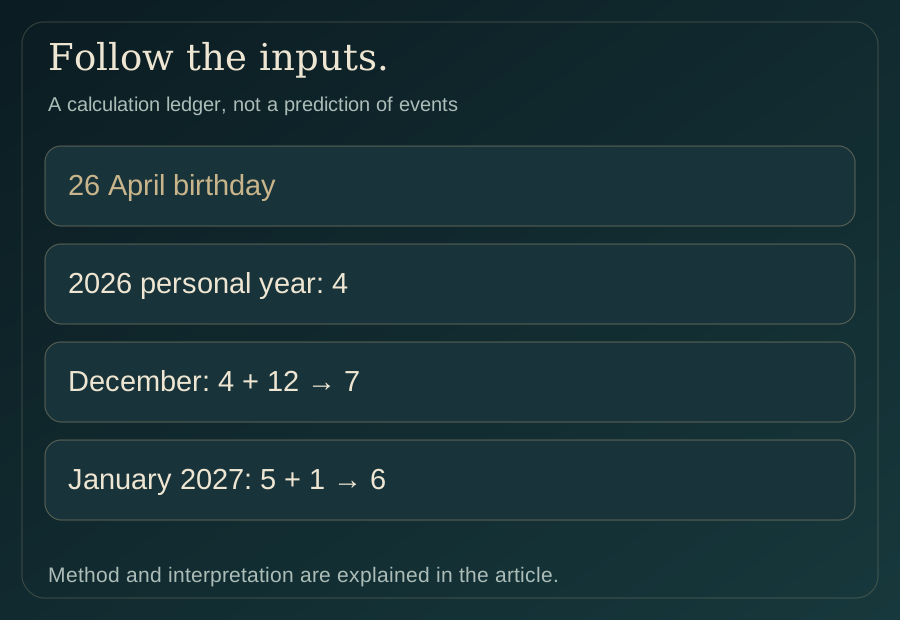
Use a fictional birthday of 26 April. The day reduces to 8 and the month is 4. For 2026, the year digits reduce to 1, so 8 + 4 + 1 = 13 → 4. For 2027, the year reduces to 2, so 8 + 4 + 2 = 14 → 5.
The personal-month formula used here adds the personal year to the calendar month and reduces the result. It is not a counter that simply continues from the previous month's answer.
Follow the boundary step by step#
| Month | Personal year used | Month calculation | Result |
|---|---|---|---|
| November 2026 | 4 | 4 + 11 = 15 | 6 |
| December 2026 | 4 | 4 + 12 = 16 | 7 |
| January 2027 | 5 | 5 + 1 = 6 | 6 |
| February 2027 | 5 | 5 + 2 = 7 | 7 |
| March 2027 | 5 | 5 + 3 = 8 | 8 |
The 7-to-6 transition does not mean time runs backward. It reflects two inputs resetting at a calendar boundary. A symbolic cycle is being recalculated, not a chronological month count being continued.
Two common calculation mistakes#
Keeping the old personal year in January produces 4 + 1 = 5 in this example. Under the calendar-year method, that uses the wrong year's input.
Adding one to December's answer produces 8. That would continue a sequence but would not implement the stated personal-year-plus-month formula. The result must be calculated from the inputs for January itself.
A calculator should make the target year visible. Otherwise a reader can correctly enter “January” while unknowingly viewing a result from the previous year.
What if a practitioner uses birthday-to-birthday years?#
Then the boundary convention differs. A practitioner may keep a year's interpretation active until a birthday, and should explain how monthly values are assigned within it. Do not mix that interval with our January-to-December formula and call the discrepancy an arithmetic error.
When comparing tools, write down the exact target date, the personal year used, the month input and the reduction rule. Agreement on a final number without agreement on those details may be accidental.
Repeated monthly numbers are not repeated events#
November 2026 and January 2027 both produce 6 here. That does not predict that the same relationship event, purchase or family discussion will recur. The month label is a broad symbolic prompt; the surrounding circumstances differ.
If you use the 6 theme to review responsibilities, ask what actually needs attention in each month. Avoid importing an old interpretation just because the number matches. A review can be useful without predicting an event.
Build an auditable calendar#
Calculate each month from its own year and month inputs, keep unreduced sums in a column and label the convention at the top. This makes a year-boundary surprise easy to explain.
The leap-day example covers another calendar edge case. The journal worksheet shows how to use a monthly theme without mistaking a broad description for evidence of a forecast.
Related Posts
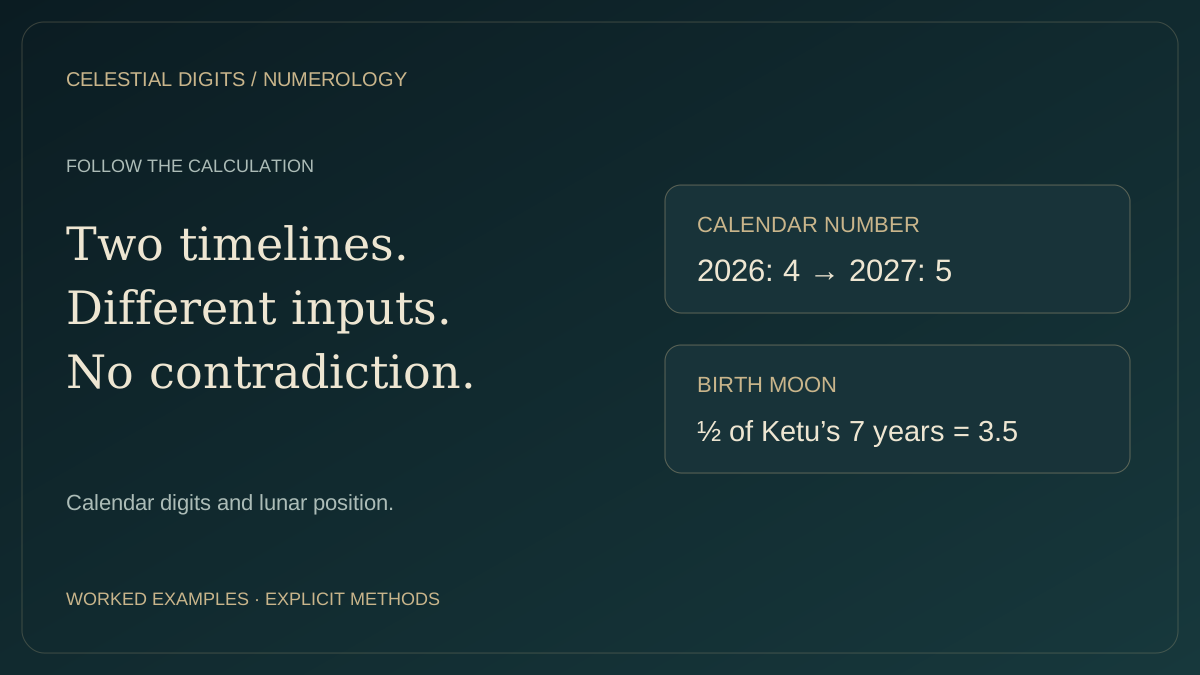
Personal Year vs Mahadasha: Why the Two Timelines Do Not Match
Calculate a personal year and a sample birth-dasha balance. See why calendar numbers, mahadasha and antardasha use different inputs and boundaries.
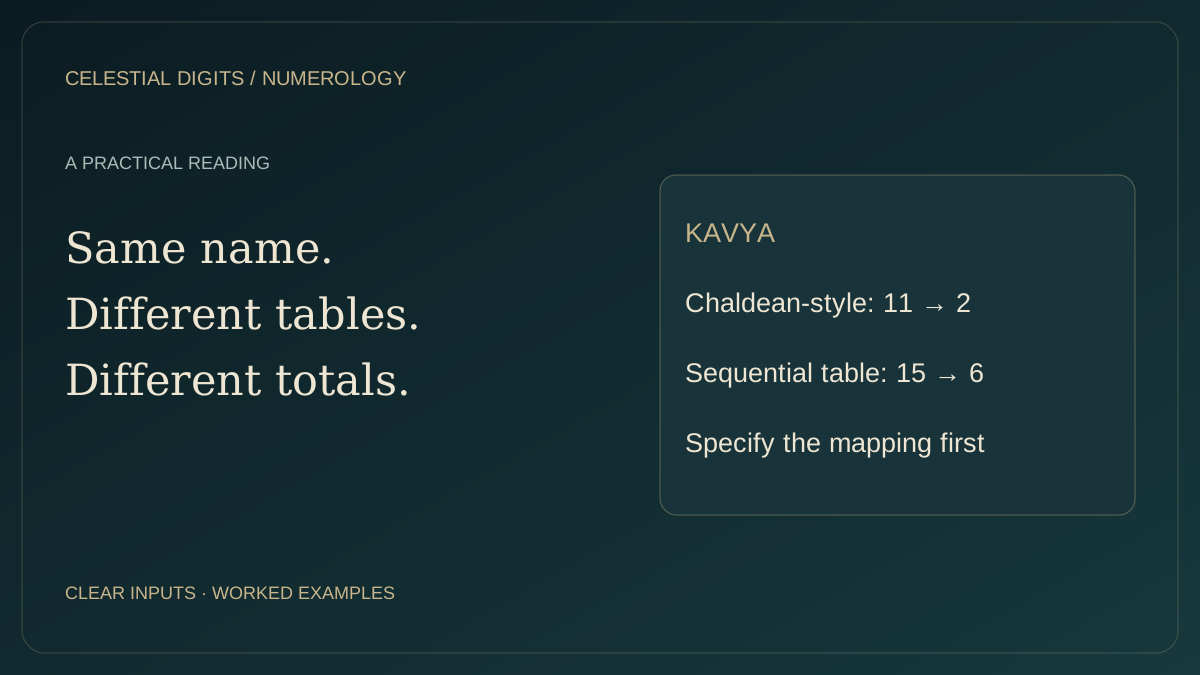
Why Two Name Calculators Disagree: Chaldean and Pythagorean Tables
Compare KAVYA letter by letter under two common tables and see why equal labels can conceal different calculation methods.
Born on 29 February: Numerology in Leap and Non-Leap Years
Calculate a leap-day Moolank, Bhagyank and personal year without inventing a 29 February date in a non-leap year.
A little more perspective.
Keep discussions respectful. No harassment, hate, sexual content or spam. Comments are reviewed before publication. Report concerns from a comment menu, or contact [email protected].
Checking your session…