
Personal Year, Month and Day Numbers: Using Numerology Without False Certainty
Calculate calendar cycles with a worked example and understand the limits of number-based marriage dates, mantras, gemstones and health claims.
A personal-year number is a calculation made under a chosen calendar convention. It is not a measurement of what will happen during that year. Keeping that distinction visible makes it possible to explore numerology without turning a symbolic theme into a deadline or a warning.
This guide uses a January-to-December calendar-year convention with reduction to a single digit. Some practitioners use a birthday-to-birthday cycle or preserve master numbers. Compare methods before comparing answers.
A complete year, month and day example#
Take a fictional birthday of 26 April and calculate for 29 October 2026. The birth year is not used in this particular personal-year method; it is used in Bhagyank, a different calculation.
- Reduce the birth day: 26 → 8.
- Use the birth month: April → 4.
- Reduce the target year: 2 + 0 + 2 + 6 = 10 → 1.
- Add these: 8 + 4 + 1 = 13 → personal year 4.
- Add the target month: 4 + 10 = 14 → personal month 5.
- Add the target day: 5 + 29 = 34 → personal day 7.
Reducing each input first or reducing the total at the end gives the same final digit under ordinary single-digit reduction. Preserving 11 or 22 along the way is a different convention and must be labelled.
The result describes the chosen date for this example. Tomorrow's personal day changes; the personal month and year do not both change with it. A calculator showing the same “today” result indefinitely may be using a saved date rather than the current date.
Turning themes into questions#
The following are reflection prompts, not predictions or requirements. Their value depends on whether they help you think, not on an assumption that the calendar causes events.
| Number | A useful question |
|---|---|
| 1 | What do I want to start, and what is the smallest first step? |
| 2 | Which conversation needs patience or cooperation? |
| 3 | What would I like to express or learn? |
| 4 | Which process would benefit from clearer structure? |
| 5 | What change am I considering, and what information is missing? |
| 6 | Which commitments have I actually agreed to? |
| 7 | What deserves closer study before I decide? |
| 8 | What responsibilities and resources need a realistic review? |
| 9 | What unfinished work could I complete? |
You can ask any of these questions on any day. Numerology does not grant or remove permission to act.
Financial planning and calendar numbers#
A personal-year number does not calculate income, affordability, investment risk or the likelihood that a business will succeed. Calling a year “an 8 year” does not supply a reason to borrow, speculate or make a purchase.
If you use cycles in a journal, keep the symbolic note separate from actual amounts, commitments and evidence. Do not interpret a delayed payment as confirmation of a prediction after the fact while ignoring all the payments that arrived normally. Recording expectations before events occur helps reveal how broad interpretations can fit many outcomes.
Marriage dates and relationship difficulties#
Adding the digits of a proposed wedding date is a numerology exercise. A traditional muhurta assessment uses additional astrological factors; the two should not be presented as interchangeable.
Start with both partners' agreement and practical constraints. A number is not a reason to pressure someone into a date, cancel a relationship or label a couple incompatible. For recurring conflict, discuss the actual issue and each person's boundaries rather than assuming one partner's birth number caused it.
A voluntary weekly check-in can be worthwhile because it creates time for conversation. Assigning that check-in to a “compatible” weekday does not demonstrate a planetary mechanism. Keep the practice only if both people find it helpful.
Mantras, weekdays and upaya#
Mantra, prayer and seva belong to living religious and cultural traditions. They should not be packaged as a universally guaranteed fix for a number. Traditions differ in wording, pronunciation, initiation and practice; a nine-row list cannot responsibly settle all of those differences.
If a practice is meaningful to you, learn it in an appropriate tradition and choose something sustainable and voluntary. Avoid claims that a missed day causes harm or that a fixed number of repetitions guarantees a job, marriage or recovery. A devotional choice is different from a promise of a measurable result.
For example, setting aside a regular time for quiet reflection is a scheduling decision. Saying it “corrects a missing 5” is a symbolic interpretation. The second statement does not follow from the first.
Gemstones and health claims#
A Moolank or Bhagyank is not a medical test. It cannot diagnose a condition, identify a nutrient deficiency or determine which treatment a person needs. We do not provide a birth-number table of disease predictions or prescribe gemstones as treatment.
Likewise, a gemstone purchase should not be justified by a promise that it will cure an illness or remove an unavoidable misfortune. If you enjoy jewellery or its cultural symbolism, that is a different reason for choosing it. A calculator cannot authenticate a stone or establish that wearing it changes a planetary outcome.
Use a journal that can disagree with you#
Write down the date, calculation convention, symbolic theme and your expectation before the day begins. Later, record what happened, including events that did not fit the theme. Avoid editing the original expectation to match the outcome.
After several entries, ask whether the exercise helped you clarify priorities or merely encouraged you to reinterpret ordinary events. It is acceptable to stop using a method that makes you anxious or less confident in everyday decisions.
For the arithmetic behind birth and name numbers, see Moolank, Bhagyank and Namank. For naming choices, see our comparison worksheet. These guides document conventions and limits rather than promising a remedy for every difficulty.
If a yearly number seems to conflict with your astrological period, compare personal year versus mahadasha. It works through the separate calendar and lunar inputs, including the balance of the first dasha.
Related Posts
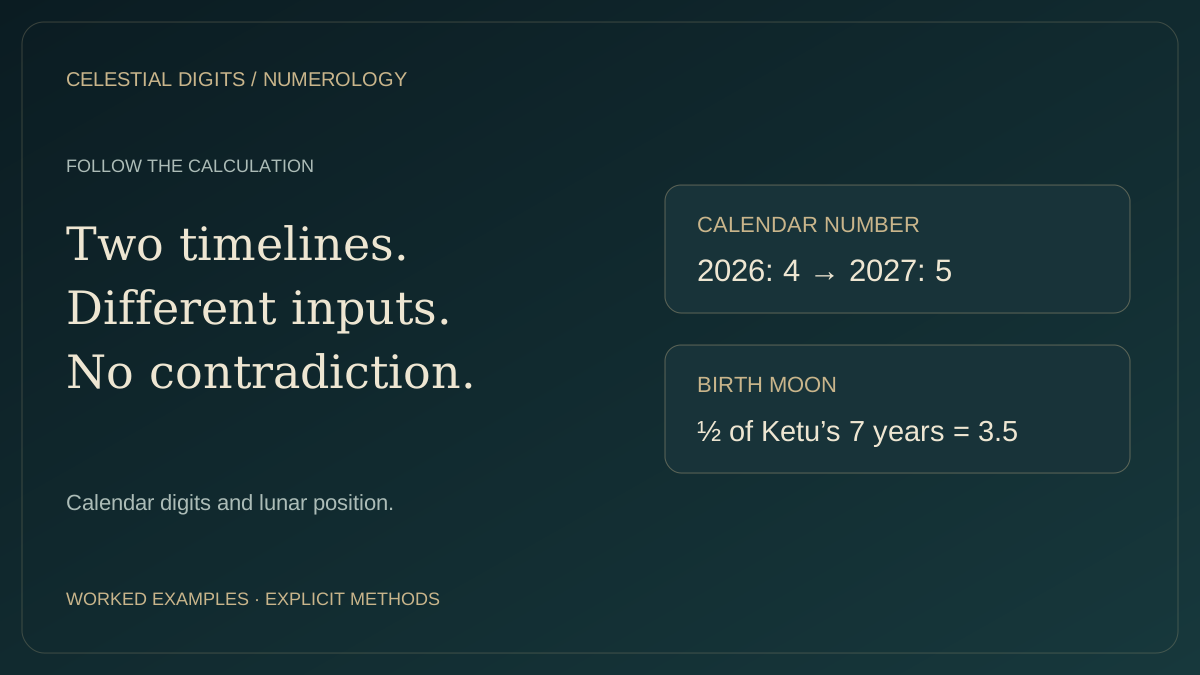
Personal Year vs Mahadasha: Why the Two Timelines Do Not Match
Calculate a personal year and a sample birth-dasha balance. See why calendar numbers, mahadasha and antardasha use different inputs and boundaries.
Names, Businesses and Numerology: A Practical Comparison Worksheet
Compare baby names, brand names and domains with transparent name-number examples, while keeping pronunciation, usability and real decisions in view.
Moolank, Bhagyank and Namank: Calculate Your Numbers Without Mixing Systems
Worked birth-date and Chaldean name examples, the exact letter table used by Celestial Digits, and how to distinguish arithmetic from interpretation.
A little more perspective.
Keep discussions respectful. No harassment, hate, sexual content or spam. Comments are reviewed before publication. Report concerns from a comment menu, or contact [email protected].
Checking your session…