
A Mahadasha Lord with Empty Signs: How Does It Deliver Results?
Learn why empty houses remain active through their rulers, using a Virgo ascendant Mercury-period example with a clear ownership and placement map.
An empty house is not an inactive house. In a standard Parashari reading, a sign retains its planetary ruler whether or not a planet occupies it. The ruler's placement and condition remain relevant during its period.
This is why a mahadasha can involve areas of life represented by apparently empty signs. Occupancy is one connection; ownership is another.
Draw the ownership map first#
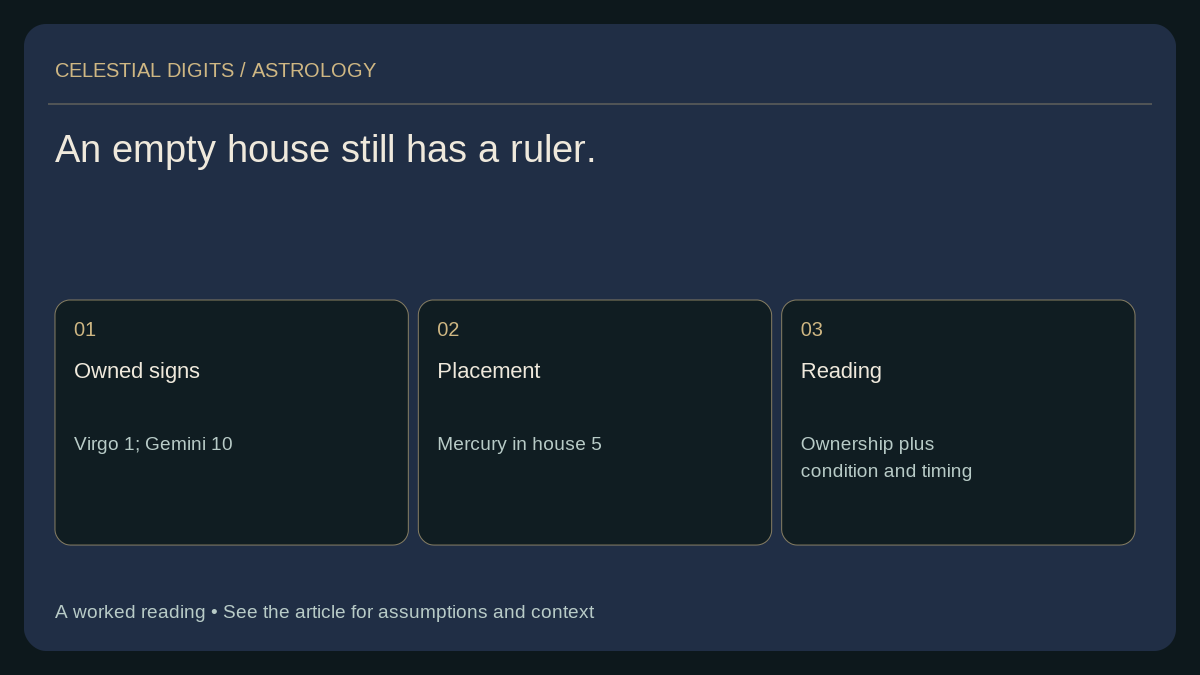
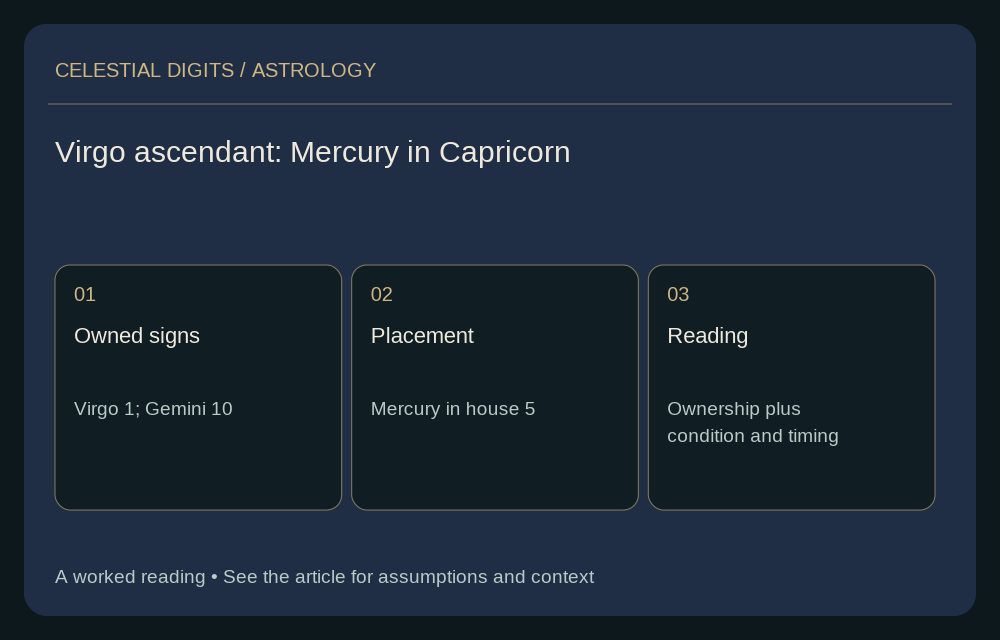
Use a fictional Virgo ascendant with Mercury in Capricorn, the fifth whole-sign house. Assume Virgo and Gemini contain no planets in this example. Mercury still rules Virgo, the first house, and Gemini, the tenth.
| Relationship | What the example shows |
|---|---|
| First-house ownership | Mercury rules Virgo even though it is empty |
| Tenth-house ownership | Mercury rules Gemini even though it is empty |
| Occupied house | Mercury is placed in Capricorn, house 5 |
A Mercury mahadasha can therefore be examined through identity, professional direction and fifth-house matters such as learning, judgement and creative development. Empty owned signs do not delete those links.
Follow the dispositor without losing the original lord#
Because Mercury occupies Capricorn, Saturn is its sign dispositor. Saturn's condition becomes relevant to how Mercury is situated. That does not transfer Mercury's ownership of the first and tenth to Saturn.
Keep the chain explicit: Mercury owns certain houses, occupies another and depends on the condition of the sign ruler where it sits. If you continue following dispositors, avoid turning the exercise into an endless chain that obscures the question.
Examine aspects and occupants separately#
An empty sign may still receive planetary aspects under the system being used. State whether you are using Parashari planetary aspects or another framework; do not combine aspect rules silently.
Conversely, a house with several occupants is not necessarily more important for every question. The relevant ruler may be more directly involved in the active period or in the topic being discussed.
Apply the map to a learning question#
Imagine the person is considering training that could support their work. The first/tenth ruler in the fifth makes learning and professional development a coherent topic to examine within this fictional chart.
It does not guarantee admission, completion or promotion. Check Mercury's dignity, conjunctions, aspects, relevant divisional context and the antardasha lord. Then compare the interpretation with the person's actual qualifications, available time and goals.
Why the antardasha still matters#
A mahadasha is a broad period. Different subperiods can emphasise different relationships within the chart. A useful reading does not repeat the same paragraph for every antardasha simply because the main lord remains Mercury.
Look for the subperiod lord's own houses and its relationship with Mercury. Then ask which part of the larger period is being emphasised, while keeping uncertainty and real circumstances in view.
Continue with fifth-house learning and judgement and relative period-lord positions.
Traditional basis and limits#
Ownership, placement and period analysis follow the framework in Brihat Parashara Hora Shastra. The empty-sign example is original. Astrology is interpretive; an ownership map helps organise a reading but does not establish a certain event.
Related Posts
Marriage Astrology: A Study Guide to Partnership and Timing
Explore 56 marriage guides: Venus and Mars placements, seventh-house planets, combinations, Darakaraka, synastry and timing with worked examples.
Marriage Timing Through Mahadasha, Antardasha and Pratyantar
Read the full Vimshottari hierarchy, compare planetary roles across ascendants and work through sub-period durations without inventing a wedding date.
Navamsa in Marriage Timing: Cross-Checking the Dasha Lords
Follow the same dasha lords from D1 into D9, calculate two Navamsa examples and see why a conjunction or uncertain ascendant needs careful interpretation.
A little more perspective.
Keep discussions respectful. No harassment, hate, sexual content or spam. Comments are reviewed before publication. Report concerns from a comment menu, or contact [email protected].
Checking your session…