
High Shadbala, Difficult Results: Strength to Do What?
Compare Shadbala totals and required ratios, then connect planetary capacity with house ownership and the actual question.
A planet at the top of a Shadbala table is not automatically the planet that will make life easiest. The table measures strength within a traditional calculation system. Interpreting that strength requires a second question: which houses and responsibilities does the planet carry in this chart?
That distinction explains why a demanding period can coincide with a high score. Capacity and comfort are different ideas.
Start by reading the units correctly#
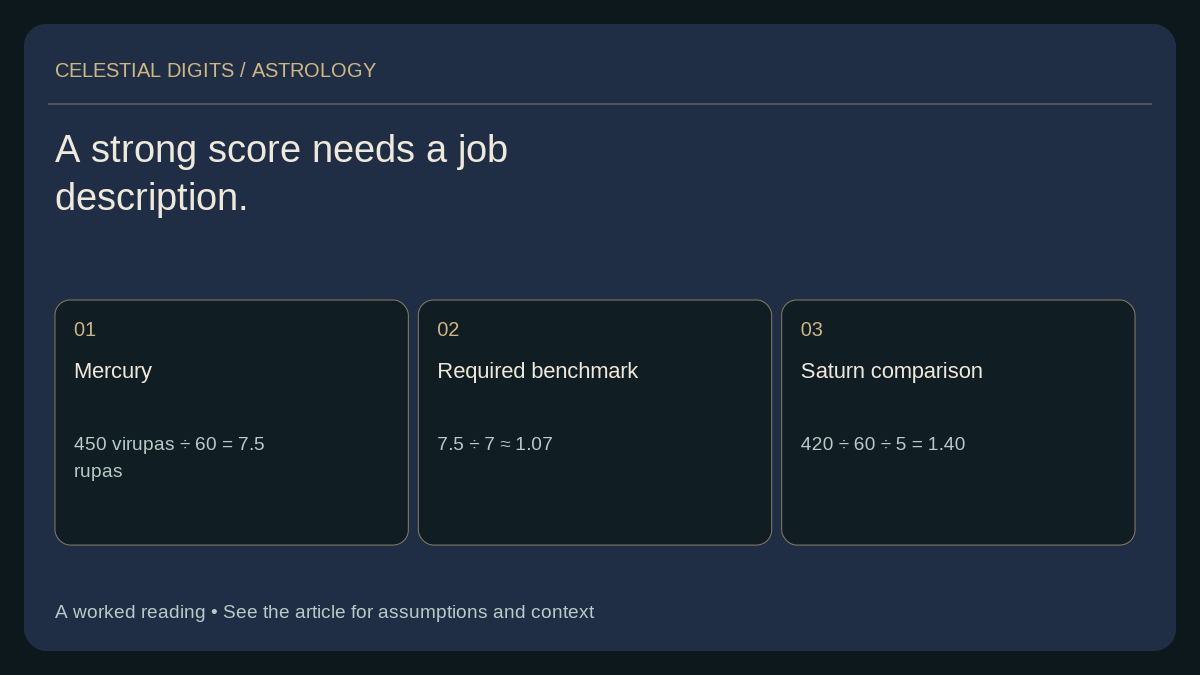
Shadbala is commonly displayed in virupas and rupas, with 60 virupas making one rupa. A required-strength ratio compares the calculated total with a planet-specific benchmark. Those three columns should not be treated as interchangeable rankings.
| Hypothetical total | Rupas | Benchmark used here | Ratio |
|---|---|---|---|
| Mercury: 450 virupas | 7.5 | 7 rupas | About 1.07 |
| Saturn: 420 virupas | 7 | 5 rupas | 1.40 |
Mercury has the larger raw total. Saturn has the larger ratio to its benchmark. Neither comparison alone predicts which planet will deliver a promotion, a relationship or a restful month.
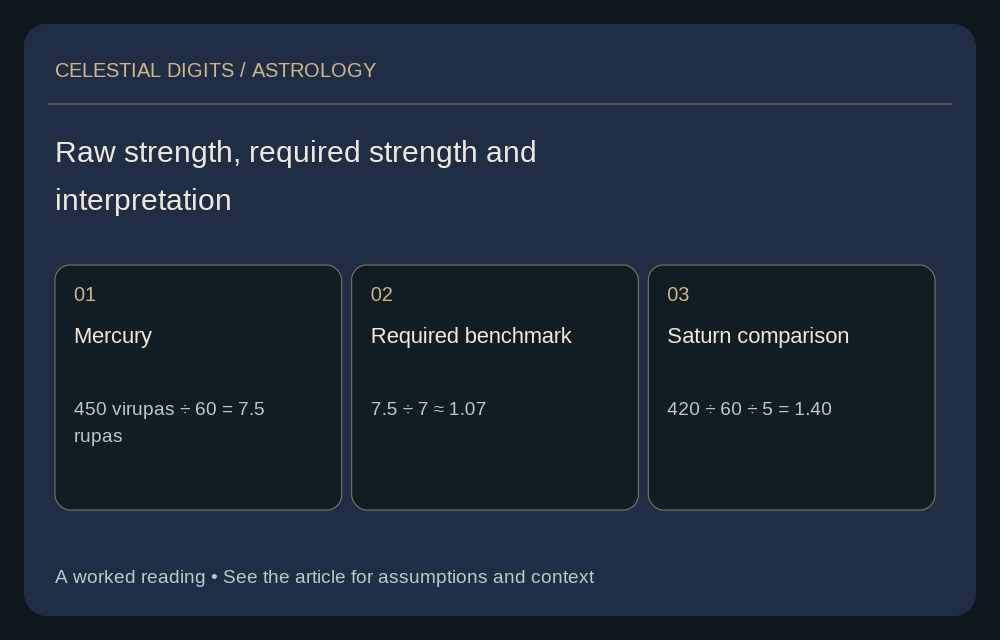
The numbers are illustrative, not taken from a customer's chart. If another program uses different conventions or component formulas, compare those inputs before comparing the final ratio.
Give the planet its chart responsibilities#
For a Virgo ascendant, Mercury rules the first and tenth houses. For Pisces ascendant, it rules the fourth and seventh. The same hypothetical score would therefore enter different house narratives.
Suppose a Virgo-ascendant reading concerns professional responsibility. A strong Mercury might be considered capable of expressing first- and tenth-house matters. That could support competence while also bringing decisions, communication and accountability. It does not imply that every day of the period feels easy.
Without Mercury's placement, associations and timing, even that interpretation remains incomplete. A numerical strength total does not supply the missing chart.
Inspect the components before explaining the outcome#
The six categories concern position, direction, time, motion, natural strength and aspects. A total can conceal an uneven distribution. Two planets with similar totals may have very different component profiles.
Ask whether a striking total comes largely from one component, whether negative aspect contributions were handled consistently and whether both reports use the same birth details. Do not treat a discrepancy between websites as evidence that the higher number is more favourable or more accurate.
Timing is another separate step#
A natal strength table is not a current-period table. A high-scoring planet does not automatically become the active mahadasha lord. To discuss a particular month, first establish the relevant dasha sequence and then assess the planets involved.
The person's circumstances also matter. A period of increased responsibility can be welcome to someone seeking advancement and exhausting to someone already overcommitted. A chart label cannot decide which description fits without context.
A useful reading order#
Write the units and ratio, identify the strongest and weakest components, map house ownership, examine placement, and only then connect the result with the actual timing question. This order prevents the score from doing interpretive work it was never designed to do alone.
For the full component framework and benchmark table, see our Shadbala guide, which links the traditional source. Compare it with natural versus functional benefics and a strong mahadasha lord in a difficult period. Shadbala is an internal astrological measure, not a scientifically established probability of a life event.
Related Posts
Natural vs Functional Benefic: Why a Good Planet Can Give Mixed Results
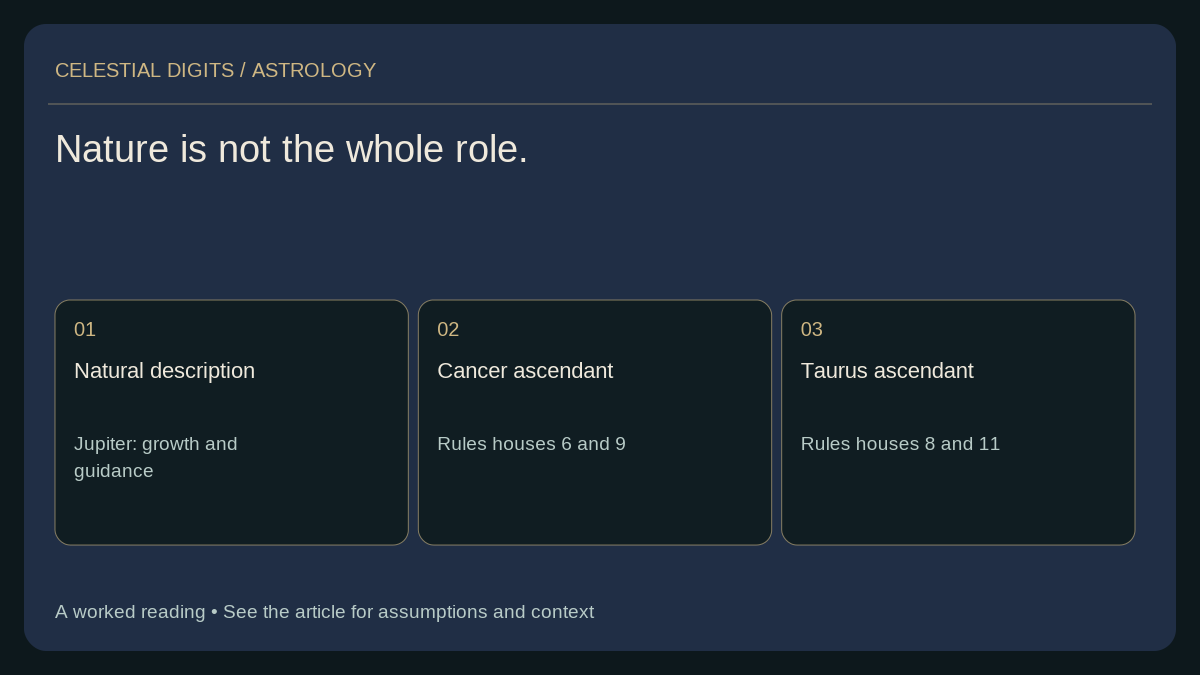
Compare a planet’s natural symbolism with its house ownership, using Jupiter for Cancer and Taurus ascendants.
Jupiter in the Seventh House: Shared Values and Functional Lordship
Read Jupiter in the seventh without a blanket good-marriage promise, using Gemini, Virgo and Capricorn examples and explicitly counted aspects.
Mars–Mercury in Relationships: Speech, Action and Chart Context
Work through Mars–Mercury in Gemini for Gemini and Sagittarius ascendants, checking degrees, aspect directions and the difference between decisiveness and disagreement.
A little more perspective.
Keep discussions respectful. No harassment, hate, sexual content or spam. Comments are reviewed before publication. Report concerns from a comment menu, or contact [email protected].
Checking your session…