
Darapada (A7) vs Upapada Lagna (UL): Relationship Indicators Explained
Understand Darapada, Upapada Lagna, the seventh house and Darakaraka with a worked arudha calculation and clear limits on relationship predictions.
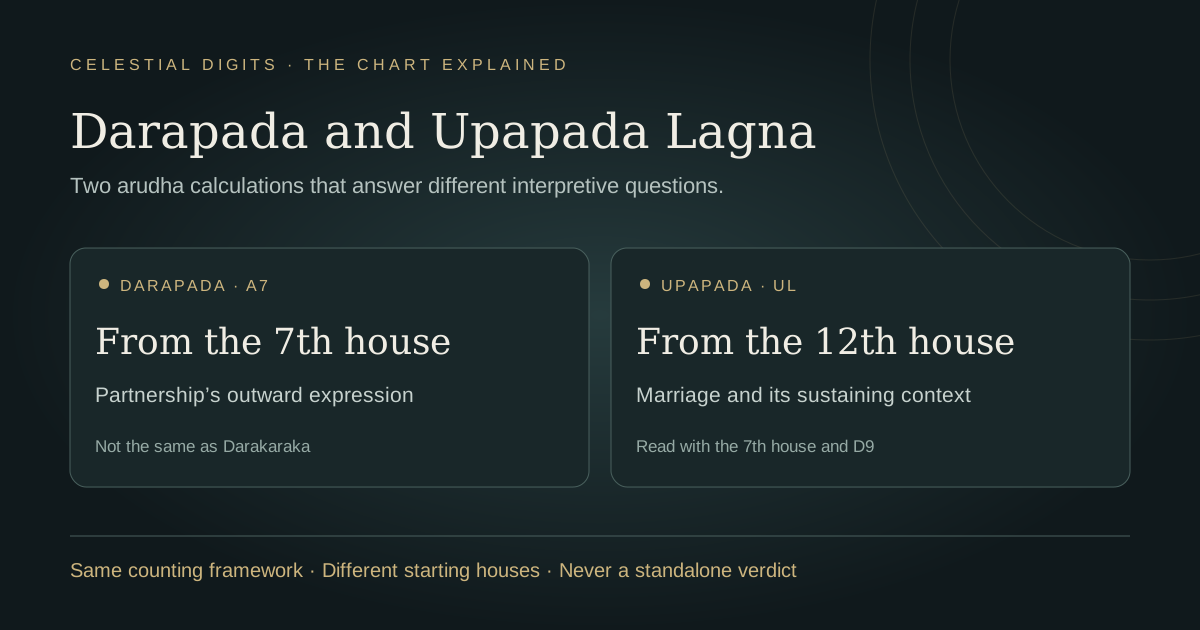
Darapada, or A7, is the arudha of the seventh house. Upapada Lagna, or UL, is the arudha of the twelfth house. They are calculated signs. Neither is a planet, and neither is simply another name for your seventh house.
You may also see Darakaraka, a planet assigned a relationship-related role through a separate degree-ranking method. The names sound similar, but the calculations are not interchangeable.
This guide separates the four ideas and shows how two arudhas can be calculated from the same hypothetical chart.
Four labels, four jobs#
| Indicator | What it is | Common traditional use |
|---|---|---|
| Seventh house and its lord | A natal house and its sign ruler | Partnerships and one-to-one relationships |
| Darapada, Dara Pada or A7 | Arudha of the seventh house | How partnership or association becomes visible in the world |
| Upapada Lagna, UL or A12 | Arudha of the twelfth house | Marriage, its social setting and factors interpreted as sustaining it |
| Darakaraka | A chara-karaka planet | An additional spouse or relationship significator in Jaimini practice |
These summaries describe common interpretive uses, not a universal agreement among all schools. A7 is not a detector of affairs. UL is not a certificate that a marriage will last.
For a broader introduction to arudhas, read Arudha Lagna and public image. AL is the first house's arudha; A7 and UL apply the projection idea to different starting houses.
How the ordinary arudha count works#
In a basic sign-based calculation:
- Identify the sign of the house being studied.
- Locate that sign's lord.
- Count signs forward from the original sign to the lord's sign, including both endpoints.
- Count the same number forward from the lord's sign, again inclusively.
- Apply the arudha exception if the result falls in the original sign or its seventh.
The exception convention used in the examples and our current Jaimini calculation moves such a result to the tenth sign from the initially calculated position. Different schools discuss arudha exceptions and co-lord choices differently, so document the convention before comparing reports.
The result is a sign. Its house number relative to the natal ascendant is a second piece of information.
Worked example: calculating A7#
Suppose a hypothetical chart has Virgo ascendant, Jupiter in Capricorn and the Sun in Gemini. These are teaching placements, not a claim about a particular person's birth chart.
The seventh sign from Virgo is Pisces. Its lord is Jupiter, placed in Capricorn.
Count Pisces → Aries → Taurus → Gemini → Cancer → Leo → Virgo → Libra → Scorpio → Sagittarius → Capricorn. That is 11 signs.
Now count 11 signs from Capricorn: Capricorn → Aquarius → Pisces → Aries → Taurus → Gemini → Cancer → Leo → Virgo → Libra → Scorpio.
Scorpio is neither Pisces nor Virgo, the seventh from Pisces, so no exception applies. A7 is Scorpio, which is the third sign from the natal Virgo ascendant.
Notice the labels: A7 was calculated from the seventh house, but it occupies the third house from lagna in this example. “A7” does not mean the result must remain in house seven.
Worked example: calculating UL#
The twelfth sign from Virgo is Leo. Its lord, the Sun, is in Gemini in our example.
Count Leo to Gemini inclusively: 11 signs. Count 11 from Gemini and you reach Aries. Aries is neither Leo nor Aquarius, the seventh from Leo, so no exception applies.
UL is Aries, which falls in the eighth sign from Virgo. That house number describes its location; it is not, by itself, a verdict about the person's marriage.
| Result | Calculated from | Resulting sign | House from Virgo |
|---|---|---|---|
| A7 | Seventh house, Pisces | Scorpio | 3 |
| UL | Twelfth house, Leo | Aries | 8 |
For a simple exception example, place the Sun in Leo while calculating Leo's arudha. The initial result is Leo itself. Under the convention above, move to the tenth from Leo: Taurus.
Why A7 and UL can describe different themes#
One relationship can have several dimensions: private experience, social recognition, family involvement, practical commitment and the public identity of being a couple. Arudha-based readings try to distinguish some of those layers.
An astrologer may examine A7 for the visible expression of association and UL for the marriage framework. That does not mean A7 describes “fake love” while UL describes “true love”. The distinction is about the question being asked, not the moral worth of the relationship.
A fuller reading may consider the signs, their lords, planets influencing them and, in commonly taught UL methods, the second from UL. Those factors need context. A single difficult placement cannot establish divorce, dishonesty or a partner's intentions.
Where Darakaraka fits#
Darakaraka is found through planetary degree ranking, not the arudha count above. In the seven-planet method, it is the eligible planet with the lowest degree within its sign. Eight-karaka methods handle the node differently and must be named explicitly.
A person may therefore have Mars as Darakaraka, Scorpio as A7 and Aries as UL without any contradiction. Read Darakaraka vs the seventh house before treating one of these as a replacement for the rest.
Compare reports carefully#
Check the ascendant, house-sign convention, planetary signs and arudha exceptions. Scorpio and Aquarius can involve different co-lord choices in Jaimini software. A difference in the chosen lord can change an arudha even when the visible planetary positions agree.
In Celestial Digits' birth-chart report, open Jaimini and compare A7, UL and the full arudha list. Keep the result's sign separate from its house from lagna when exporting data.
For a real relationship decision, communication, consent, safety and shared expectations are more direct evidence than any one chart factor. These traditional methods can be studied without using them to label a stranger or decide a partner's character.
Further reading: P. V. R. Narasimha Rao's freely available Vedic Astrology: An Integrated Approach, particularly its arudha discussion. The arithmetic examples here are independently constructed and state their counting convention.
Related Posts

Upapada Lagna in Marriage Astrology: Commitment, Family Dynamics, and Stability
Practical Vedic astrology guide with chart checks, timing filters, and usable upaya for clear decisions.
How You'll Meet Your Spouse: The 7th Lord Sign Technique
A Vedic technique to preview the scene where you meet your spouse: the 7th sign from your 7th lord's sign leaves its symbols at the first meeting.
Age Gap Marriage in Vedic Astrology: Saturn, Rahu, and Real Indicators
A practical Jyotish guide to age-gap marriage patterns, including where Saturn, Rahu, maturity, and unconventional pairing logic actually show up.
A little more perspective.
Keep discussions respectful. No harassment, hate, sexual content or spam. Comments are reviewed before publication. Report concerns from a comment menu, or contact [email protected].
Checking your session…