
Jupiter Return: What Changes When Jupiter Reaches Its Natal Position?
Understand a Jupiter return, distinguish a sign passage from an exact contact, and interpret it through natal ownership rather than guaranteed luck.
A Jupiter return occurs when transiting Jupiter returns to its natal longitude in the zodiac system being used. It is often discussed as a cycle of growth, learning or renewed perspective, but the return itself is a positional relationship—not a guarantee of good fortune.
To interpret it carefully, separate the astronomical timing from the symbolic meaning and from the circumstances of the person whose chart is being read.
Define what counts as the return#
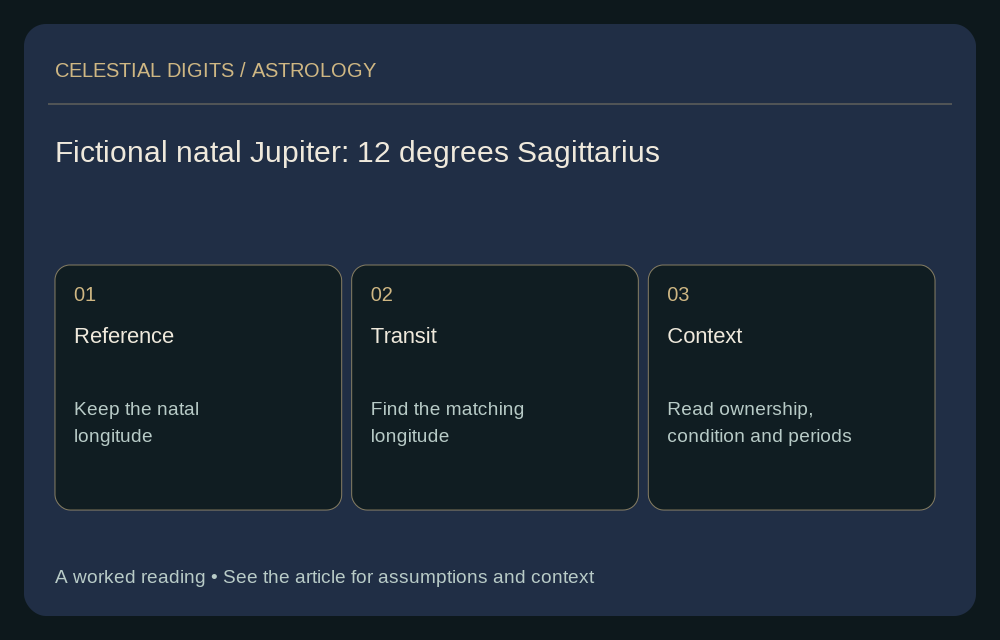
Suppose a fictional chart has Jupiter at 12 degrees Sagittarius in a specified sidereal zodiac. The exact return concerns transiting Jupiter reaching that longitude. Jupiter entering Sagittarius begins a broader sign passage, but it is not automatically the exact return.
| Term | What it describes |
|---|---|
| Sign return window | Jupiter travelling through its natal sign |
| Exact return | Jupiter reaching its natal longitude |
| Interpretive period | A reader's explicitly stated wider window |
These definitions help explain why two reports may give different dates without necessarily calculating the same event incorrectly.
Why the cycle is approximately twelve years#
NASA describes Jupiter's orbit as about 12 Earth years, more precisely around 11.9 years. That provides the broad astronomical rhythm. Exact geocentric return dates still require an ephemeris and consistent zodiac settings.
Retrograde motion can create multiple contacts with a natal longitude. Do not obtain an exact date simply by adding twelve calendar years to the previous one. Record whether a report lists the first contact, all contacts or a wider sign-based interval.
Read the natal Jupiter that is being revisited#
For a fictional Sagittarius ascendant with Jupiter in Sagittarius, Jupiter rules the first and fourth and occupies the first. A return might prompt examination of personal direction, foundations or the relationship between the two within the astrological framework.
For another ascendant, Jupiter owns different houses. Its sign dignity, aspects and conjunctions also differ. The phrase “Jupiter return” does not erase those natal responsibilities and replace them with a universal promise of expansion.
Growth can mean choosing limits#
A person considering further study may use the cycle as a prompt to review learning goals, teachers and long-term commitments. Growth might involve taking a course; it might also involve declining an unrealistic programme and concentrating on one subject.
The useful question is what kind of development fits the person's circumstances. A larger workload, expense or ambition is not automatically beneficial merely because Jupiter is associated with expansion.
Combine timing without multiplying certainty#
Dasha context, relevant houses and actual opportunities can help organise an astrological reading. They do not turn a return into proof that a marriage, job offer or financial gain must occur.
If a reader proposes an event, ask what specifically supports that topic and what alternative expressions are possible. Keep the real decision grounded in available information rather than an expectation that the cycle will supply the outcome.
Read Saturn return versus Sade Sati and Mercury–Jupiter in a chart.
Sources and scope#
Orbital context comes from NASA's Jupiter facts. Ownership and natal condition use the framework of Brihat Parashara Hora Shastra. The example is original; astrological meanings are traditional interpretations rather than demonstrated effects of a return.
Related Posts
Saturn Return vs Sade Sati: Two Different Saturn Cycles
Distinguish a return to natal Saturn from Saturn’s passage around the natal Moon sign, with a reference-point example and clear timing limits.
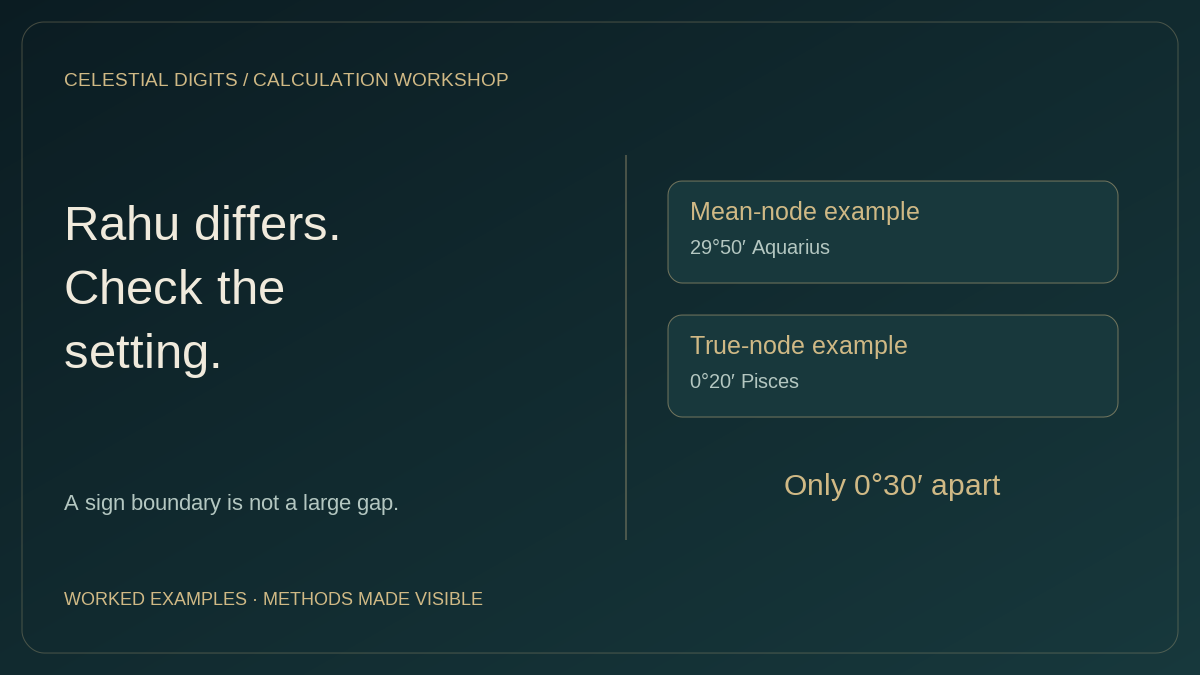
Mean vs True Rahu and Ketu: Why Two Charts Can Disagree
Compare mean and true lunar nodes with a sign-boundary example, an opposite Ketu calculation, and a checklist for matching chart settings.
How to Read Planetary Transits: Houses, Reference Signs and Retrograde Returns
Count transit houses correctly from ascendant or Moon, separate natal lordship from placement, and understand Jupiter, Saturn, Rahu and Ketu without one-size-fits-all predictions.
A little more perspective.
Keep discussions respectful. No harassment, hate, sexual content or spam. Comments are reviewed before publication. Report concerns from a comment menu, or contact [email protected].
Checking your session…