
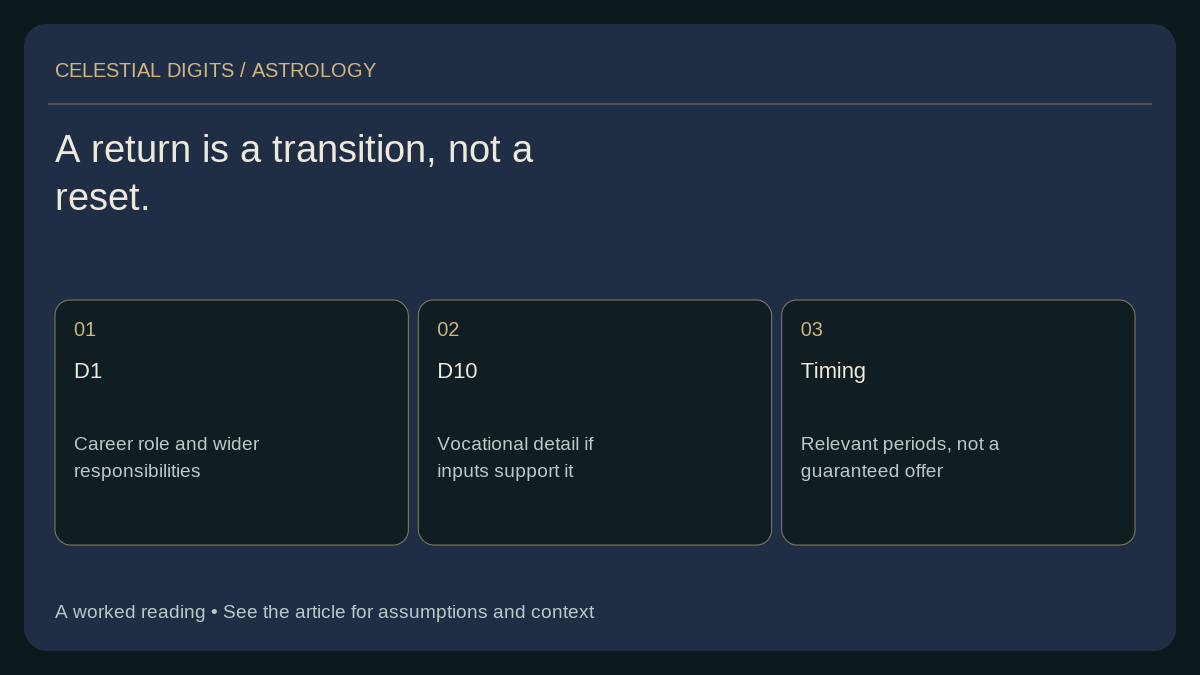
Returning to Work After a Career Break: D1, D10 and Timing
Frame a return-to-work reading around role, readiness and timing while checking birth-time sensitivity before relying on D10.
Returning to work after a break is not necessarily a return to the same role, hours or priorities. A useful chart discussion should begin with what has changed and what the person wants now. Treating the gap as a failure that astrology must explain misses the actual decision.
The break may have involved care, study, relocation or other circumstances. Its private details do not need to be turned into a dramatic planetary story for the reading to be useful.
Define the intended return#
Consider a fictional professional choosing between three options: return to the old field full-time, take a smaller role while rebuilding confidence, or retrain before applying. Each option requires a different kind of preparation.
| Option | Practical question | Chart-reading focus to investigate |
|---|---|---|
| Full-time return | Are the skills and working arrangements ready? | Career responsibilities and employment conditions |
| Gradual return | What workload is sustainable? | Work alongside home and personal obligations |
| Retraining | What learning supports the intended role? | Education and career connections |
The right-hand column is an interpretive agenda, not a promise that a chart can select the correct option automatically.
Start with D1 before adding D10#
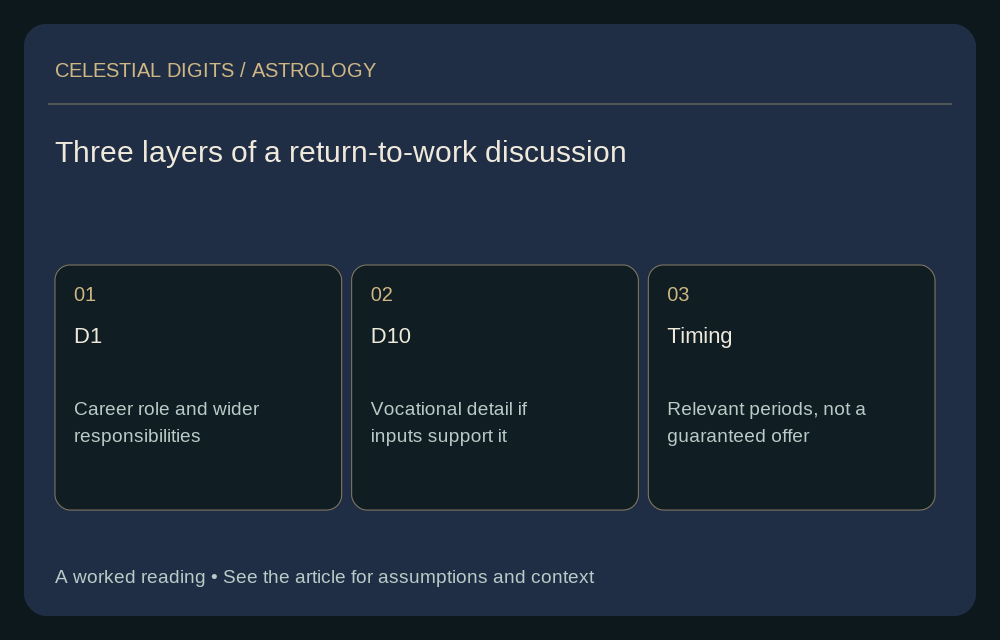
D1 provides the main house context: ascendant, tenth house and lord, relevant work conditions and wider responsibilities. A return-to-work question may also involve home arrangements and available support. Do not read the tenth house as if the rest of the person's life has paused.
D10 adds a vocational divisional perspective. Its usefulness depends on reliable inputs and a consistent calculation. It is not an independent sky chart that can be selected because it gives the more encouraging answer.
Check whether the birth time supports the detail#
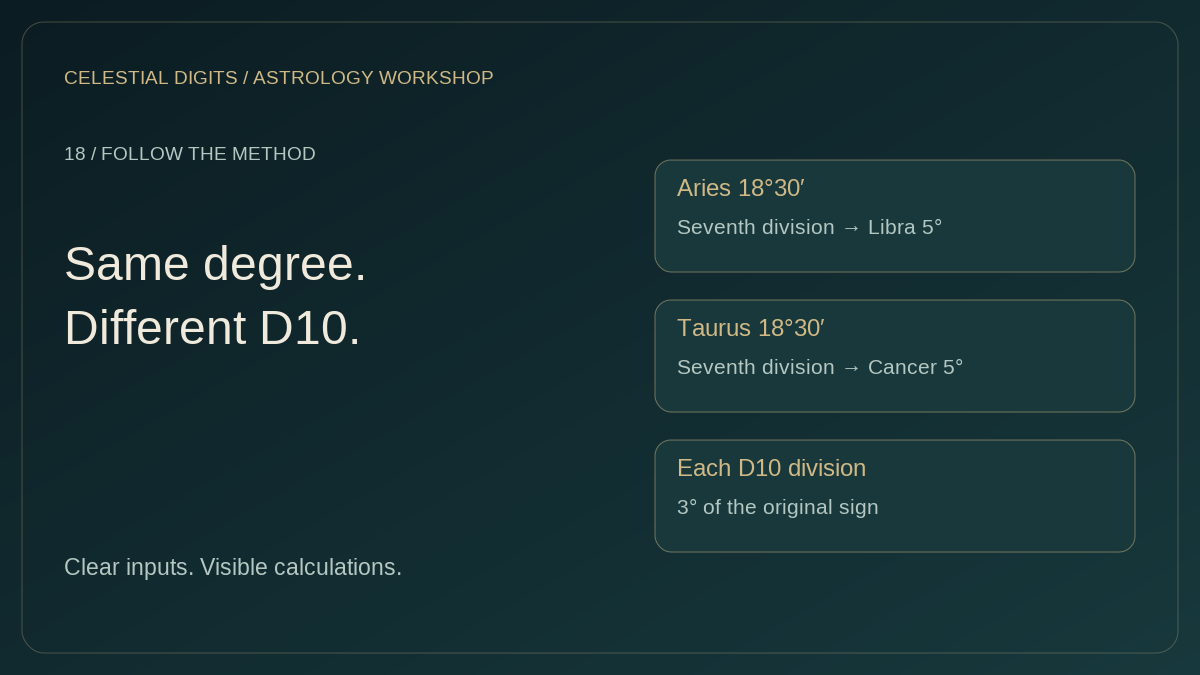
D10 divides each sign into 3° portions. The ascendant's motion means its divisional placement can be sensitive near a boundary. A small time uncertainty does not always change D10, but it can matter when a relevant longitude lies close to a division edge.
If the recorded birth time is rounded, compare plausible input times before making a confident claim from the D10 ascendant. Our D10 calculation example shows the mapping; birth-time sensitivity explains why the actual boundary matters.
Add timing without promising recruitment results#
A reader can examine whether active dashas connect with the houses under discussion and whether transits add relevant context. That does not guarantee an offer by a specified date. Recruitment depends on vacancies, applications, qualifications and decisions made by other people.
A more useful outcome is identifying a period to organise effort while keeping the plan workable if the process takes longer. Timing should not become a reason to postpone every application until a supposedly perfect day.
Translate the reading into a practical checklist#
List the role sought, skills to refresh, available hours, support arrangements and the next application step. Keep the chart interpretation beside those facts. If it suggests a gradual return, ask whether that option actually exists and fits the person's needs.
No placement makes a career break a permanent defect. Nor does a favourable period remove the need to rebuild contacts or update a portfolio.
Continue with promotion versus changing employer and career questions involving property and relocation. The traditional divisional and house frameworks are discussed in Brihat Parashara Hora Shastra; this return-to-work worksheet is a contemporary application.
Related Posts
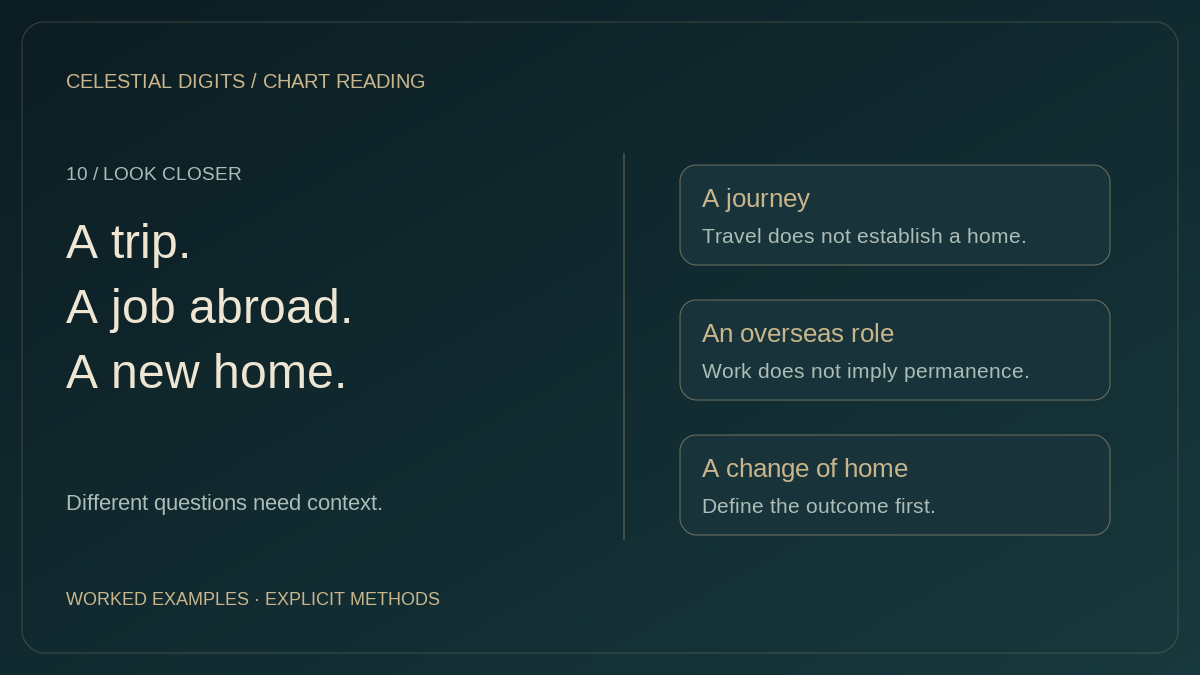
Foreign Travel, Work or Permanent Settlement? Read the Question First
Separate a foreign trip, overseas employment and a lasting change of home. Use a Virgo-ascendant worksheet to read houses, lordships and timing together.
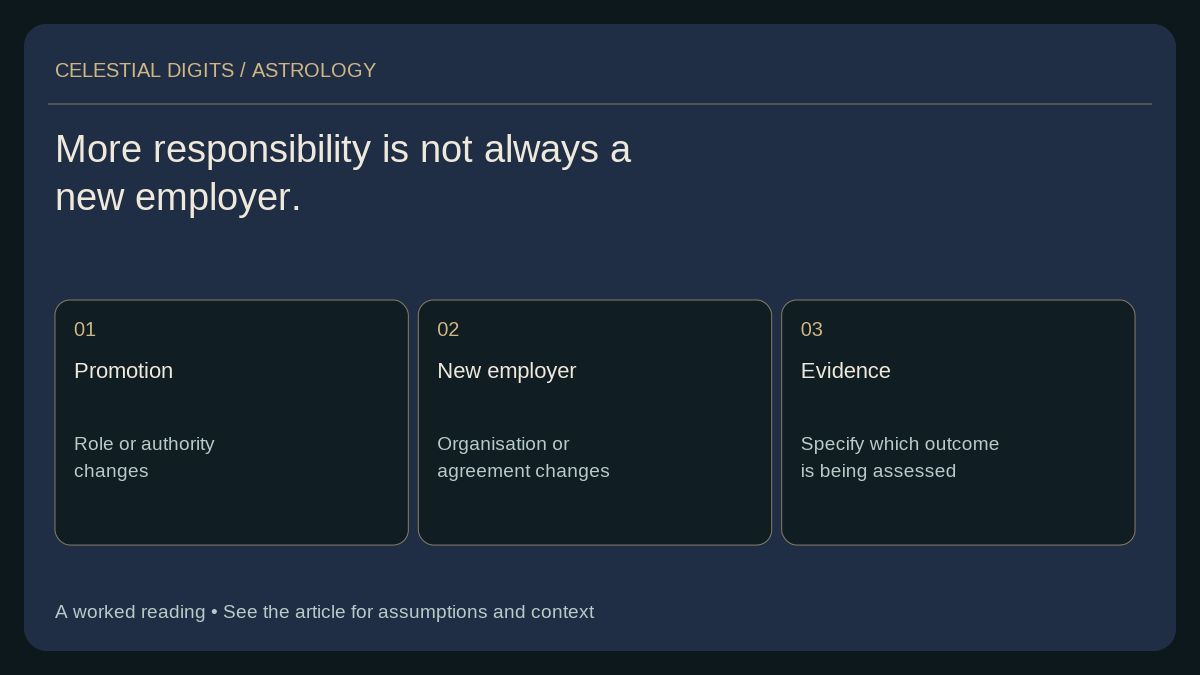
Promotion or a New Employer? Two Different Career Questions
Compare internal promotion and employer change through a structured chart-reading worksheet instead of one generic career-change prediction.
Calculate D10: The Odd–Even Sign Rule with Examples
Map Aries and Taurus 18°30′ into Dasamsa, calculate the resulting degrees, and see why D9 cannot be reused as a career chart.
A little more perspective.
Keep discussions respectful. No harassment, hate, sexual content or spam. Comments are reviewed before publication. Report concerns from a comment menu, or contact [email protected].
Checking your session…