
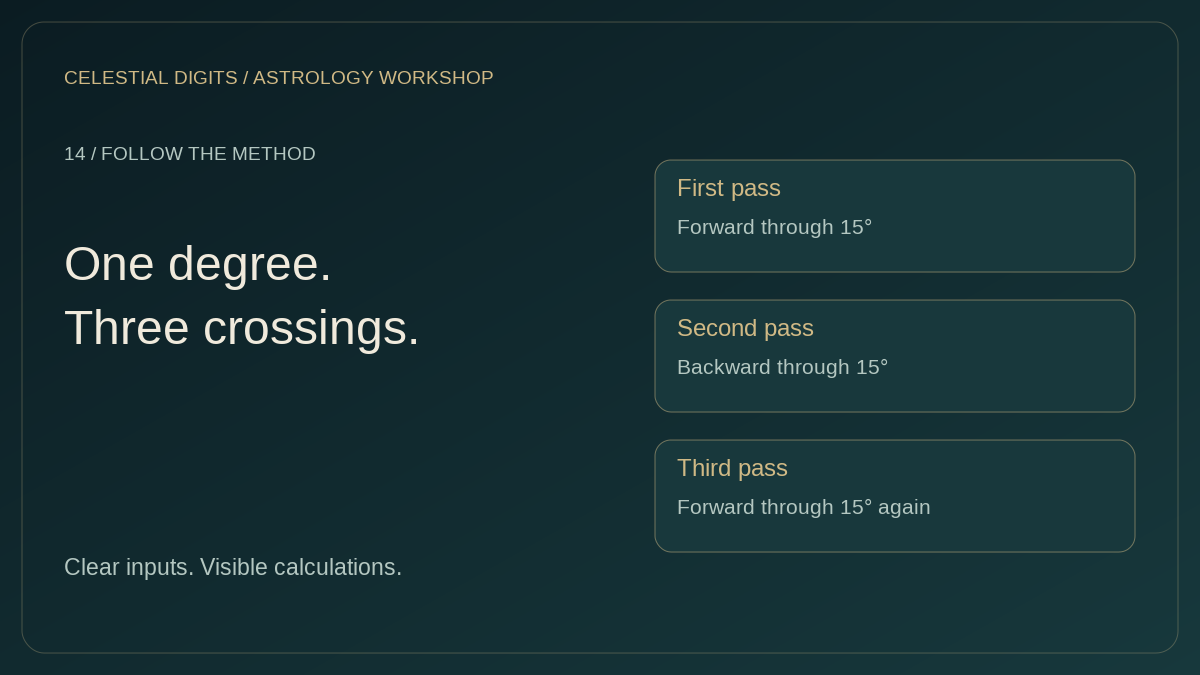
Why a Transit Can Cross Your Natal Degree Three Times
Follow a fictional direct–retrograde–direct path and distinguish exact degree contacts from sign ingresses, stations and interpretive stories.
A transit calendar may list three contacts to the same natal degree over several months. This need not be a duplicate entry. A planet's apparent motion can carry it forward across a degree, backward across it during retrograde motion, and forward across it again after turning direct.
The number of crossings depends on the path. Not every natal degree receives three contacts, and a sign ingress is not the same event as a contact to a particular degree inside that sign.
Trace a fictional path#
Place a fictional natal planet at 15° of a sign. Imagine a transiting planet moving through this sequence, without assigning real calendar dates:
| Stage | Transit position or motion | Contact with 15°? |
|---|---|---|
| First approach | Direct from 12° toward 18° | Crosses 15° once |
| Retrograde station | Turns near 18° | Not itself the 15° contact |
| Return | Retrograde from 18° toward 12° | Crosses 15° again |
| Direct station | Turns near 12° | Not itself the 15° contact |
| Final approach | Direct beyond 18° | Crosses 15° a third time |
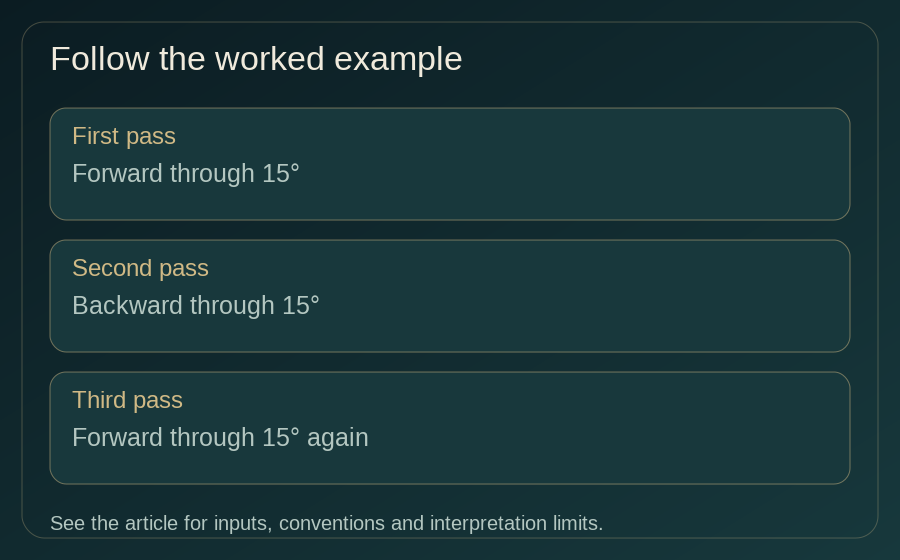
These are invented positions illustrating a path, not an ephemeris prediction. A real transit calendar must calculate the actual motion and crossing times for the selected planet.
Change the natal degree and the pattern changes#
Put the natal planet at 10° instead. In the path described above, the retrograde loop only spans 12° to 18°. It does not return to 10°. You cannot assign three contacts merely because the transiting planet has a retrograde phase somewhere in the sign.
A natal point near a station can produce a more delicate case: the planet may approach very closely, pause and reverse. Whether an exact crossing occurs requires examining the unrounded trajectory, not inferring it from daily positions rounded to whole degrees.
Distinguish four entries in a calendar#
An ingress crosses a sign boundary. A station changes the direction of apparent longitudinal motion. An exact contact reaches the chosen natal degree or specified aspect angle. An orb window marks a range around that contact under a chosen tolerance.
These entries can overlap in time, but they are not interchangeable. “Jupiter enters a sign” does not tell every person with a planet in that sign that an exact conjunction has occurred.
The transit reference-sign guide explains house placement from different references. Degree contacts are an additional measurement that requires the actual natal longitude.
Avoid assigning a compulsory story to each pass#
Some astrologers describe the passes as introduction, revision and resolution. That can be a reflective narrative, but the orbit does not prove that a person must experience exactly those three stages. An event may have ordinary causes and may not align neatly with any pass.
Record the astronomical contacts first, then your observations, including dates when the expected theme did not appear. Do not rewrite the contact dates after an event to force a fit. The calculation should remain stable even when the interpretation is uncertain.
What to retain when sharing the transit#
Include the planet, natal degree, zodiac and ayanamsha, aspect angle if applicable, time zone, exact crossing times and the orb convention. If comparing tools, keep the same inputs. A difference in zodiac settings can shift the apparent relationship before any retrograde logic is considered.
For background on motion, the Swiss Ephemeris documentation describes the astronomical position framework; our natal retrograde article addresses the different question of a planet being retrograde at birth. Neither a natal R symbol nor three transit contacts alone determines the outcome of a relationship or career decision.
Related Posts
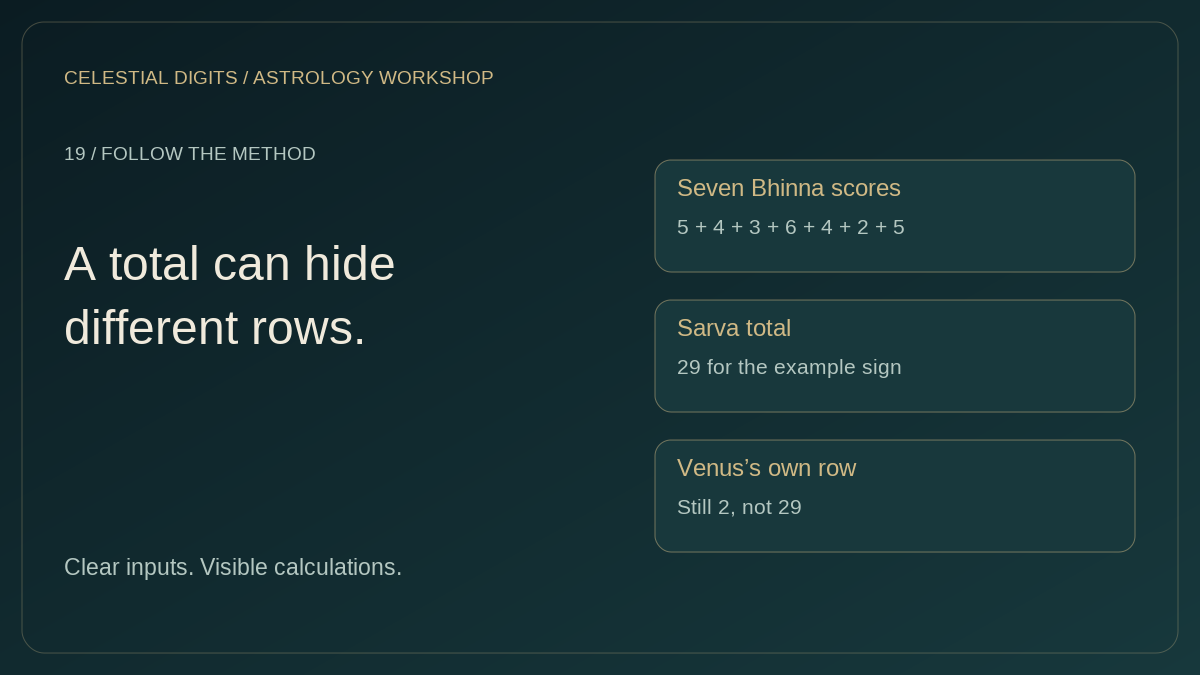
Bhinna vs Sarva Ashtakavarga: Read One Sign Two Ways
Add seven illustrative Bhinna scores into a Sarva total and understand why a strong aggregate does not give every transiting planet the same score.
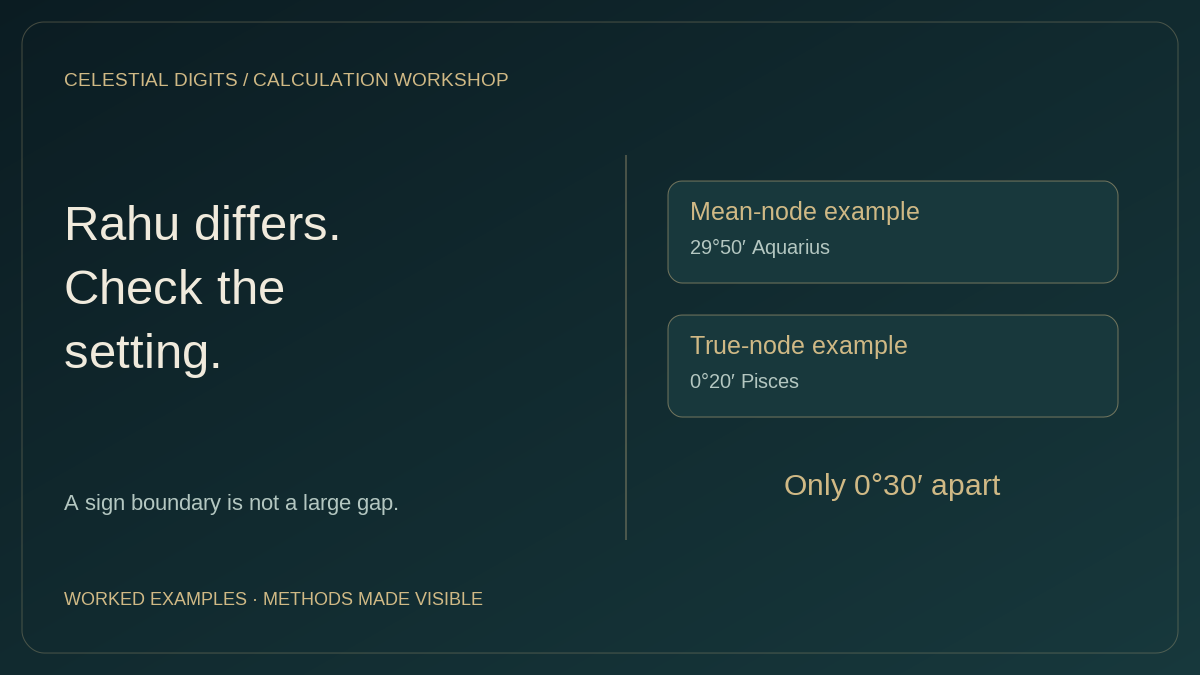
Mean vs True Rahu and Ketu: Why Two Charts Can Disagree
Compare mean and true lunar nodes with a sign-boundary example, an opposite Ketu calculation, and a checklist for matching chart settings.
Jupiter in the Seventh House: Shared Values and Functional Lordship
Read Jupiter in the seventh without a blanket good-marriage promise, using Gemini, Virgo and Capricorn examples and explicitly counted aspects.
A little more perspective.
Keep discussions respectful. No harassment, hate, sexual content or spam. Comments are reviewed before publication. Report concerns from a comment menu, or contact [email protected].
Checking your session…