
Bhinna vs Sarva Ashtakavarga: Read One Sign Two Ways
Add seven illustrative Bhinna scores into a Sarva total and understand why a strong aggregate does not give every transiting planet the same score.
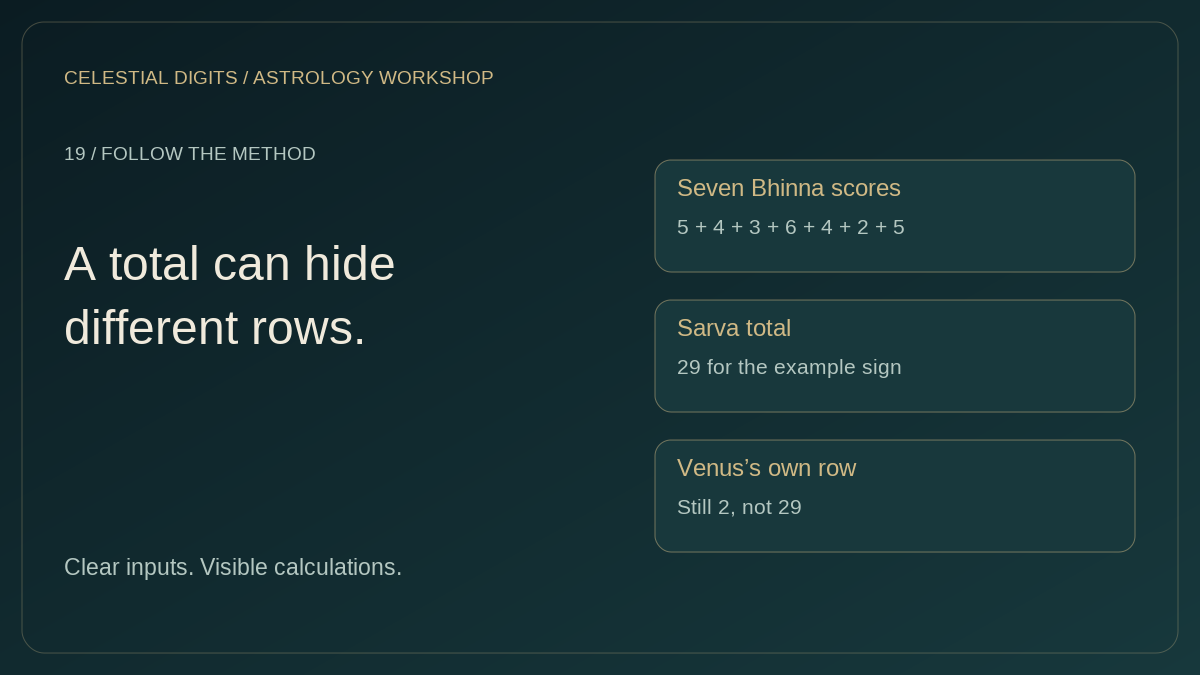
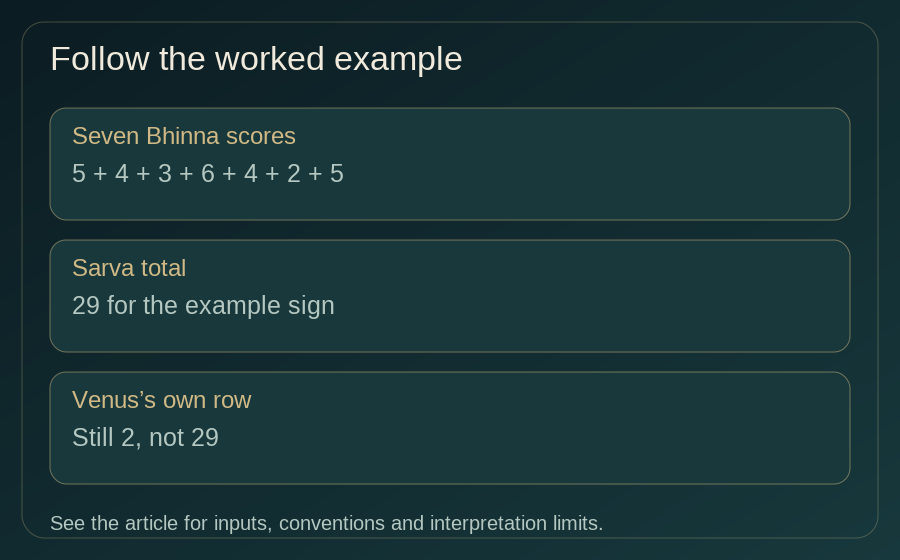
A sign can have a Sarvashtakavarga total of 29 while one planet's Bhinna score for that sign is only 2. Those figures do not contradict each other. One is an aggregate; the other is a planet-specific row.
If a transit reading applies the aggregate as though it were every planet's individual score, it loses a distinction that the table was designed to preserve.
Build one illustrative column#
Suppose a fictional sign has these Bhinna Ashtakavarga scores. They are invented numbers for demonstrating addition, not a calculated column from a real natal chart.
| Planet's Bhinna row | Score for the example sign |
|---|---|
| Sun | 5 |
| Moon | 4 |
| Mars | 3 |
| Mercury | 6 |
| Jupiter | 4 |
| Venus | 2 |
| Saturn | 5 |
| Sarva sum | 29 |
The arithmetic is 5 + 4 + 3 + 6 + 4 + 2 + 5 = 29. In the seven-planet aggregation used here, this column sum is the sign's Sarvashtakavarga score.
A Bhinna row's score is itself produced from traditional contributor rules; it is not the count of planets physically occupying that sign. A score of 5 therefore does not imply five natal planets are there.
Keep the scale attached#
Under this framework, an individual Bhinna sign score ranges from 0 to 8, while summing seven such scores allows a range from 0 to 56. Comparing 29 directly with 2 as though they use the same scale is misleading.
Nor does 29 mean 29 percent luck. These are point totals within a rule-based astrological scheme, not calibrated probabilities. Different reports may include additional tables or reductions, so verify which stage of calculation is displayed before comparing them.
Ask which planet is transiting#
If discussing Venus crossing the example sign, the Venus Bhinna row remains 2 even though the aggregate is 29. If discussing Mercury, its row is 6. A traditional interpretation may consider both the specific row and the broader context, but it should not replace one with the other.
This distinction does not establish that a Mercury transit must be beneficial or a Venus transit must be harmful. The natal chart, house reference, other conditions and actual question still matter. Our transit and dasha guide explains why one timing factor should not carry the entire conclusion.
Sign totals are not fixed house totals for everyone#
For a Virgo ascendant, Aquarius is the sixth whole-sign house. For a Libra ascendant, Aquarius is the fifth. The sign column and the house assigned from the ascendant are different labels.
When reading your own calculated table, retain the sign-to-house map rather than applying a generic “eleventh-house score” from another person's chart. The Bhinna and Sarva values themselves depend on natal inputs; an ascendant alone cannot supply the full table.
A comparison checklist#
Confirm that the reports use the same natal positions and ascendant. Check whether the table is Bhinna or Sarva, which planet's Bhinna row is shown, whether scores are before or after reductions, and which contributors are included. Then compare one sign column at a time.
Our Ashtakavarga introduction provides the broader terminology. The exercise here is narrower: add the seven rows, verify the total and keep the individual row visible. Correct aggregation makes the report easier to audit; it does not turn symbolic points into a guaranteed event forecast.
Related Posts
Mean vs True Rahu and Ketu: Why Two Charts Can Disagree
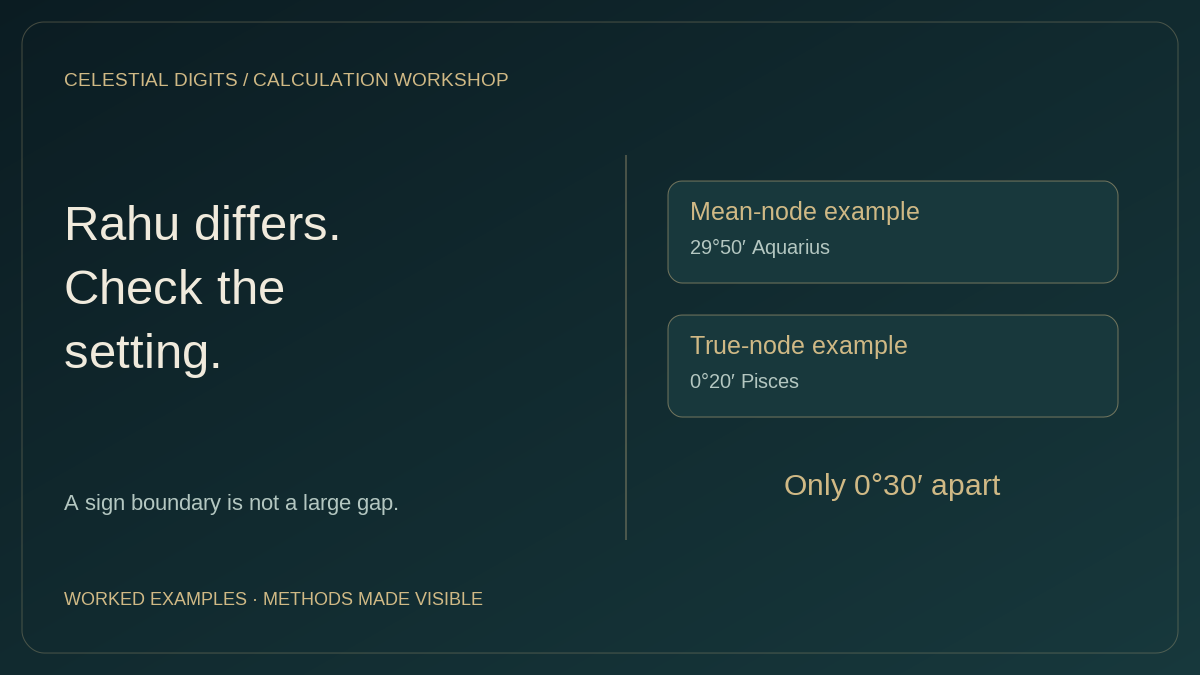
Compare mean and true lunar nodes with a sign-boundary example, an opposite Ketu calculation, and a checklist for matching chart settings.
Why a Transit Can Cross Your Natal Degree Three Times
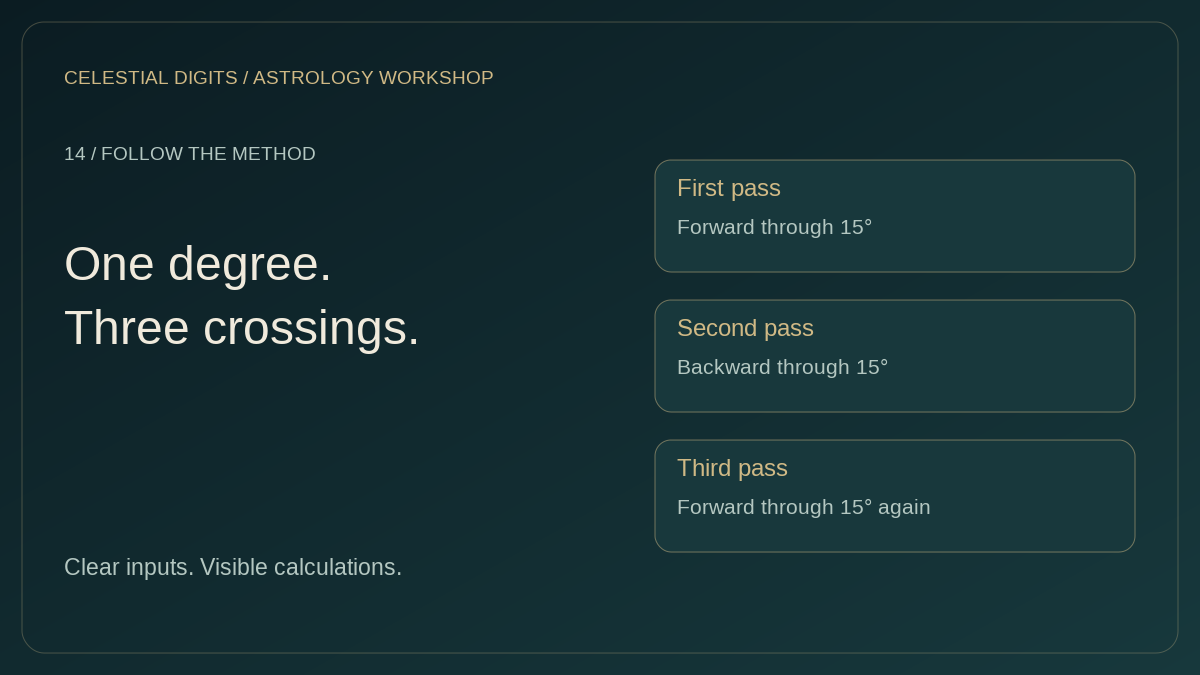
Follow a fictional direct–retrograde–direct path and distinguish exact degree contacts from sign ingresses, stations and interpretive stories.
Jupiter in the Seventh House: Shared Values and Functional Lordship
Read Jupiter in the seventh without a blanket good-marriage promise, using Gemini, Virgo and Capricorn examples and explicitly counted aspects.
A little more perspective.
Keep discussions respectful. No harassment, hate, sexual content or spam. Comments are reviewed before publication. Report concerns from a comment menu, or contact [email protected].
Checking your session…