
How to Read a Vedic Birth Chart: A Beginner's Worked Example
Read a kundli step by step using a backend-generated example: identify the ascendant, separate signs from houses, find planets and lordships, then examine timing.
The fastest way to get lost in a birth chart is to start with a prediction. Start instead with facts you can verify: the inputs, the ascendant, the signs, the houses and the planets. Interpretation comes after you know what the chart actually contains.
This guide uses an original, synthetic calculation example—not a customer's chart or a biography. Astrological interpretations are traditional frameworks, not scientifically established predictions about a person's life.
1. Confirm the inputs and calculation settings#
Our example uses 1 January 2000, 12:00 local time, Bengaluru coordinates 12.9716° N, 77.5946° E, UTC+05:30, Lahiri ayanamsa and whole-sign houses.
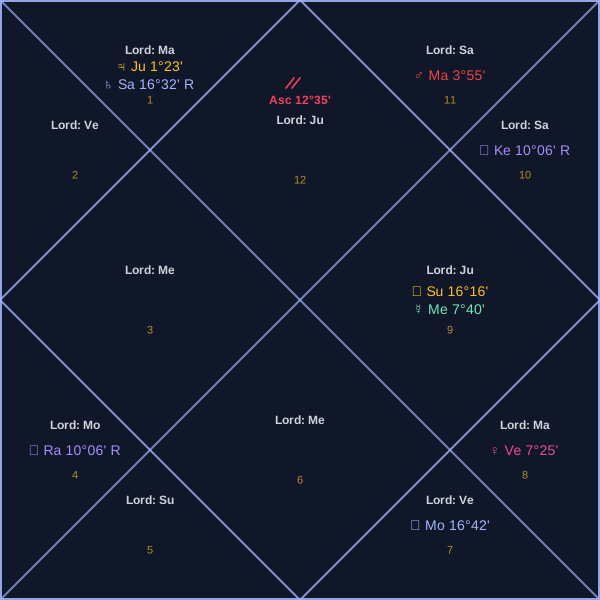
The chart below is an SVG generated by Celestial Digits' Python backend. Its data can be reproduced using the chart-experiment script in the repository.
Do not copy the example's time-zone offset for another birthplace or historical date without checking it. If your birth time is unknown, read what can be read without a birth time before treating an invented noon chart as exact.
2. Find the ascendant before counting houses#
The calculated ascendant in this example is approximately 12°35′ Pisces. In a whole-sign chart, that makes Pisces the first house.
Count forward through the zodiac:
| House | Sign | Traditional sign ruler |
|---|---|---|
| 1 | Pisces | Jupiter |
| 2 | Aries | Mars |
| 3 | Taurus | Venus |
| 4 | Gemini | Mercury |
| 5 | Cancer | Moon |
| 6 | Leo | Sun |
| 7 | Virgo | Mercury |
| 8 | Libra | Venus |
| 9 | Scorpio | Mars |
| 10 | Sagittarius | Jupiter |
| 11 | Capricorn | Saturn |
| 12 | Aquarius | Saturn |
Notice that house 1 contains sign 12, Pisces. A sign number is not a house number. In a North Indian diagram the houses stay in fixed positions while the sign labels change. A South Indian diagram fixes the sign positions instead. Our North versus South Indian guide shows the same backend data in both layouts.
3. Read one planet as a complete entry#
Use the planetary table alongside the drawing. For each planet, distinguish:
- Its sign.
- Its degree within that sign.
- Its house from the ascendant.
- Any separate status or nakshatra information supplied.
A degree such as 12° Pisces is not house 12 and is not 12° measured from the beginning of the entire zodiac. It is the position within Pisces. The zero-degree and 29-degree guide explains boundaries and rounding.
Choose one row and locate that planet in the diagram. Repeat until the table and picture make sense together. There is no need to memorise every symbolic interpretation on your first visit.
4. Distinguish an occupant from a house lord#
In this example, Jupiter rules houses 1 and 10 because it rules Pisces and Sagittarius. That ownership remains true regardless of where Jupiter itself is placed.
A planet occupying the tenth house is an occupant. Jupiter is the tenth lord in this example. They need not be the same planet.
This distinction is essential for reading yogas. A statement about a “fifth lord joining a tenth lord” cannot be checked by merely finding any two planets in those houses.
5. Keep the Moon, ascendant and Sun distinct#
These are different reference points. A Moon-relative yoga counts from the Moon; an ascendant-based house-lord rule starts with the ascendant. Switching reference points without saying so changes the calculation.
Your Sun sign alone cannot stand in for the whole chart. Similarly, a daily zodiac horoscope and a personal birth-chart reading are not the same kind of output.
6. Examine D9 without replacing D1#
The Navamsa, or D9, is a divisional chart used in traditional interpretation. Read it as another specified layer, not a replacement for the original chart or a way to erase an inconvenient placement.
In our reproducible example, changing the time from 12:00 to 12:05 keeps the D1 ascendant in Pisces but changes the D9 ascendant sign. See the five-minute experiment before assuming a precise-looking divisional chart is insensitive to uncertain inputs.
7. Add yogas and timing last#
Once the underlying placements are clear, open the Yogas section and verify one formation explanation. Then examine Dasha to identify the major and sub-period lords.
The Yoga series separates formation, strength and activation. A detected combination is not a promised event, and a matching period is not proof that the event will happen.
Open your own Vedic Birth Chart and work through this sequence using the chart and its table together. You can use saved details or enter new details; neither requires guessing what a symbol means from its position alone.
Discuss: Which part first confused you: sign numbers, house numbers, house lords or the chart layout? Avoid posting identifying birth details publicly.
Related Posts
Nakshatra Padas Explained: Why Pada Changes the Result
Learn what nakshatra padas are, how they connect to navamsha, and why two people with the same nakshatra can express it very differently.
Navamsa for Beginners: What D9 Can and Cannot Tell You
A beginner-safe but serious guide to the Navamsa chart in Jyotish: what D9 reveals, where people misuse it, and how to combine it with the natal chart.
Vimshottari Dasha for Beginners: How to Read Mahadasha and Antardasha Together
Learn how to read Vimshottari Mahadasha and Antardasha together using house activation, lordship, dignity, and timing logic rooted in Jyotish.
A little more perspective.
Keep discussions respectful. No harassment, hate, sexual content or spam. Comments are reviewed before publication. Report concerns from a comment menu, or contact [email protected].
Checking your session…