

Rahu to Jupiter Mahadasha: Does Life Automatically Get Better?
Read a Rahu-to-Jupiter transition through the natal chart and actual sub-period sequence, without promising an instant rescue or a universal difficult phase.
A Rahu-to-Jupiter Mahadasha change is a change in the traditional timing framework, not a guarantee that every problem ends on the boundary date. The story “Rahu creates chaos, Jupiter fixes it” skips the natal condition of both planets, their house relationships and the sub-period actually running.
In standard Vimshottari order, Rahu's eighteen-year allocation is followed by Jupiter's sixteen-year allocation. Those are full period lengths, not the remaining duration everyone has at birth. Your initial balance depends on the Moon's position within its birth nakshatra.
Read the actual handover#
Open your dasha timeline rather than relying on a remembered year. Near the end of a full Rahu Mahadasha, the final antardasha is Rahu–Mars. Jupiter Mahadasha begins with Jupiter–Jupiter. Confusing an antardasha called Jupiter with Jupiter Mahadasha changes the question entirely.
Record the date convention and any birth-time uncertainty. A precise displayed date reflects the calculation inputs; it does not establish a precise date for a promotion, relationship or emotional change.
What belongs to Jupiter in your chart?#
The same planet has different house responsibilities for different ascendants. For Pisces ascendant, Jupiter rules the first and tenth houses. For Gemini ascendant, it rules the seventh and tenth. A single “Jupiter means blessings” paragraph cannot explain both configurations in sufficient detail.
Inspect its sign, placement, associations and relevant divisional context. If Jupiter participates in a detected yoga, read the formation explanation before treating the new period as evidence of a particular outcome. The Yoga activation guide explains how the app's timing labels work.
Two illustrative handovers#
These are teaching scenarios, not customer case histories or verified predictions.
Scenario A: the opportunity already has a foundation. A reader has completed training, built relationships and applied for roles during the late Rahu period. An astrologer interpreting a supportive Jupiter configuration might describe the next period as thematically consistent with teaching or responsibility. If an opportunity arrives, the prior work is still part of its explanation.
Scenario B: the planet's label is doing too much work. Another reader assumes Jupiter will remove debt, restore a relationship and produce a better job simultaneously. Their actual chart has mixed indications, and none of the practical conditions has changed. The boundary date alone cannot support that bundle of promises.
The contrast is not “good person versus bad person.” Outcomes involve circumstances and uncertainty that a planetary label does not capture.
What about Dasha Sandhi?#
Practitioners use the term for transitions, but you should ask what timing window and interpretive rule they mean. There is no reason to treat an arbitrary number of difficult months as a universal law. A personal account can be meaningful without establishing what everybody will experience.
Our general transition article can be used as a reflective planning framework, not a scientifically validated timetable. Do not delay urgent healthcare, essential financial action or personal safety decisions because a dasha is about to change.
A better transition journal#
Before the boundary, write down the specific themes you expect and what would count against that expectation. Record ordinary days as well as memorable events. Revisit the notes without rewriting them to fit the outcome.
This helps distinguish a genuine change in circumstances from the tendency to reinterpret everything through a new label. It also makes a discussion with an astrologer more concrete.
Check your Vimshottari timeline and read Mahadasha and Antardasha together. Astrology remains a traditional interpretive practice, not an established predictor of personal outcomes.
Discussion: Did your transition feel abrupt, gradual or barely noticeable? Describe the experience without claiming it must happen to everyone.
Related Posts
Mahadasha Change in Vedic Astrology: A Practical Guide for the First 180 Days
Understand what to expect in the first six months after a Mahadasha shift, with practical routines, decision filters, and grounded Vedic upaya.
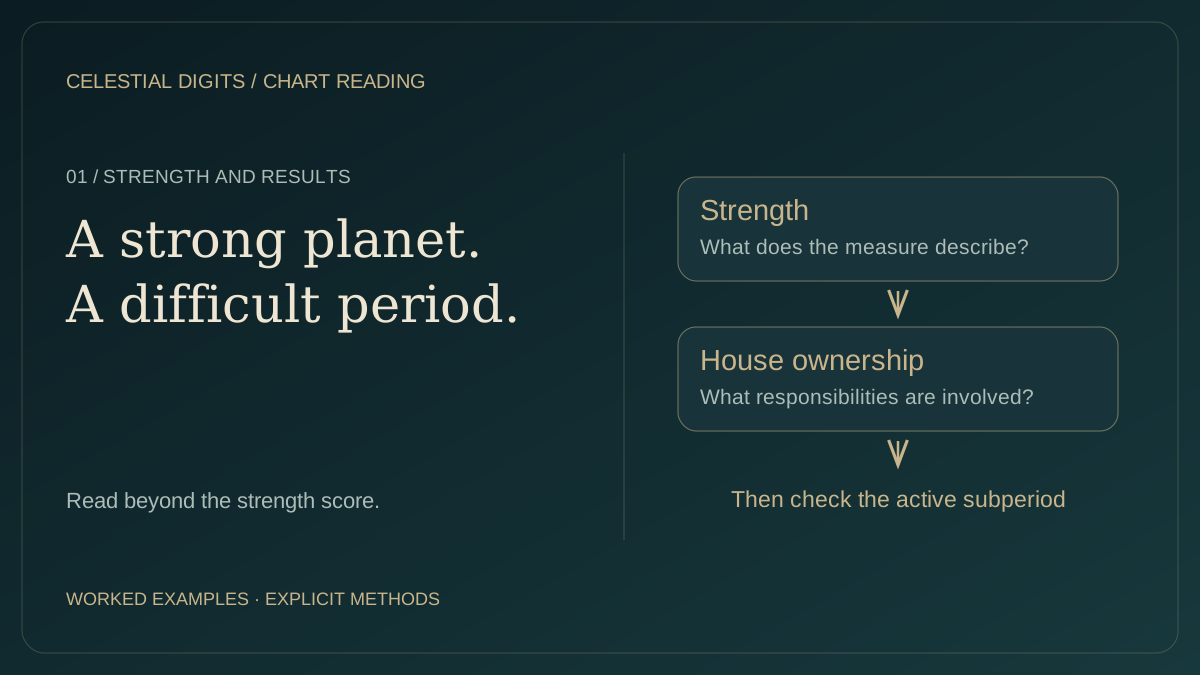
Strong Mahadasha Lord, Difficult Period: What Are You Missing?
A strong planet does not guarantee an easy dasha. Use a worked example to separate strength, house ownership, placement and the current subperiod.
Is Ketu Mahadasha Always Bad? Reading Beyond the Horror Stories
Understand Ketu's seven-year Vimshottari period without fatalism: sub-periods, dispositor context, uncertainty and the limits of frightening online anecdotes.
A little more perspective.
Keep discussions respectful. No harassment, hate, sexual content or spam. Comments are reviewed before publication. Report concerns from a comment menu, or contact [email protected].
Checking your session…