
Parivartana Yoga: Verify the Sign Exchange First
Check a Mercury–Venus exchange for Virgo rising, compare it with a one-way dispositor link, and keep house ownership in the interpretation.
A sign exchange is more specific than two planets being connected. Parivartana requires each planet to occupy a sign owned by the other. A conjunction, mutual aspect or one-way dispositor relationship does not automatically meet that condition.
This distinction matters because a report can attach an impressive yoga label before checking the actual placements. Start with the two arrows and see whether both point back.
A complete exchange#
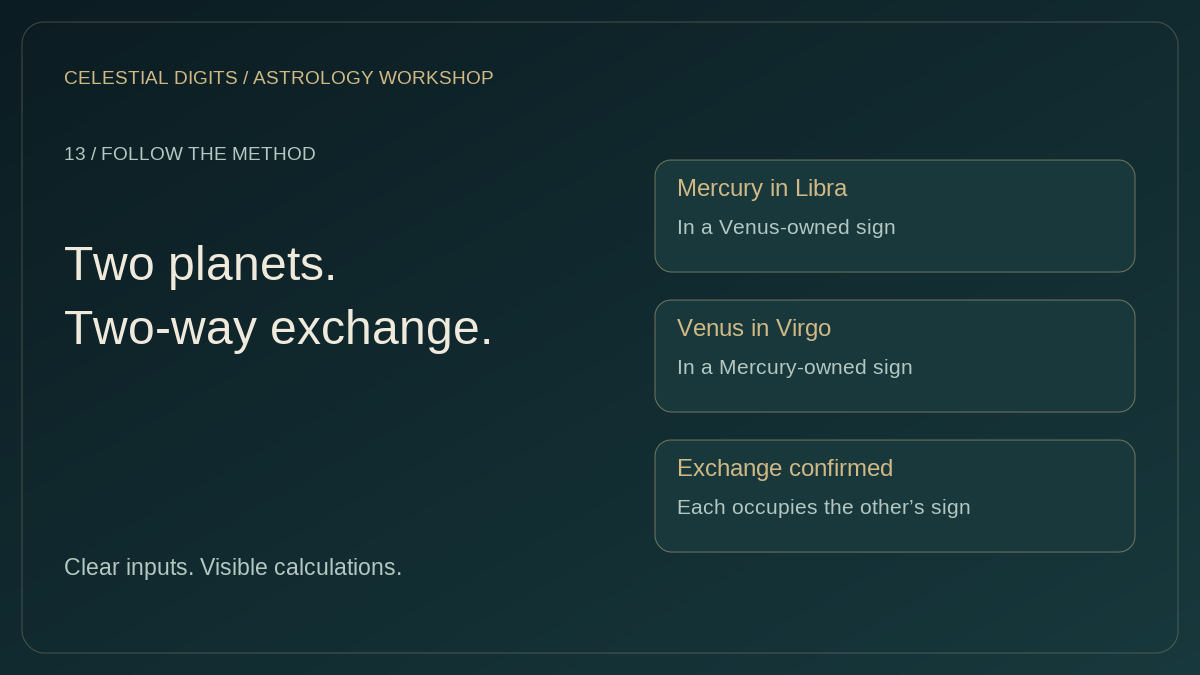
Take a fictional Virgo ascendant with Mercury in Libra and Venus in Virgo. Libra belongs to Venus, while Virgo belongs to Mercury. Mercury is therefore in Venus's sign, and Venus in Mercury's sign.
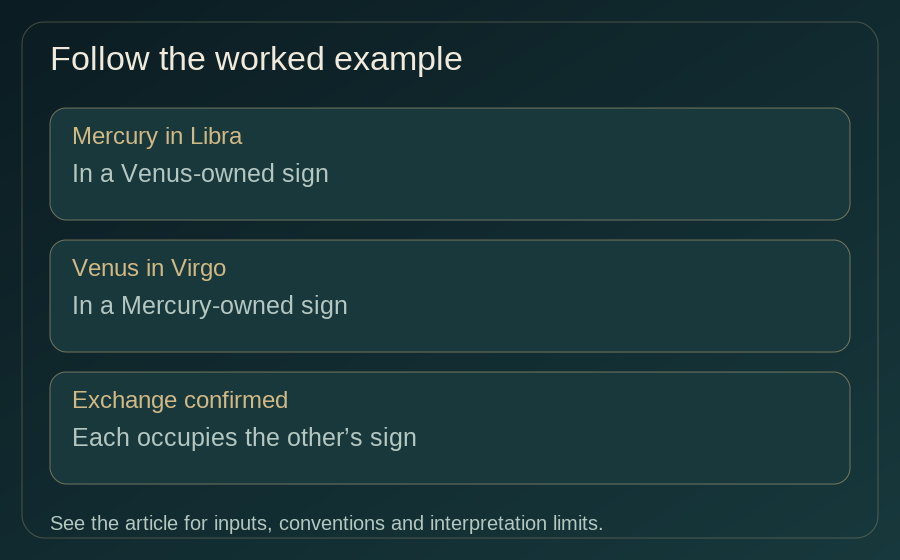
The loop is complete: Mercury → Venus → Mercury. The planets do not need to occupy the same sign. In this example they occupy adjacent signs, so calling their exchange a conjunction would be incorrect.
What the ascendant adds#
For Virgo rising, Virgo is the first house and Libra the second. The two occupied signs therefore form a first/second-house exchange. Mercury additionally owns Gemini, the tenth house; Venus additionally owns Taurus, the ninth.
| Planet | Occupied sign and house | Signs owned | Houses owned |
|---|---|---|---|
| Mercury | Libra, second | Gemini and Virgo | Tenth and first |
| Venus | Virgo, first | Taurus and Libra | Ninth and second |
Do not describe this as four planets or four separate exchanges. There are two planets and one two-way sign exchange, with additional ownership roles to consider.
Within a traditional reading, the first/second connection may invite questions about self-presentation, speech and resources. The ninth/tenth ownership adds context. None of those associations tells us the person's occupation, earnings or behaviour without further information.
A similar-looking arrangement that is not an exchange#
Now change Venus to Leo while leaving Mercury in Libra. Mercury still points to Venus because it occupies Libra. Venus now points to the Sun because it occupies Leo. The chain is Mercury → Venus → Sun, not Mercury → Venus → Mercury.
A strong-looking relationship remains, but the strict two-way exchange condition has failed. Our dispositor-chain guide shows how to follow such chains without renaming every connection as a yoga.
Does exchange erase a planet's other condition?#
In the first example, Venus occupies Virgo, its sign of debilitation. That fact and the exchange condition can coexist. Do not silently remove one observation because the other sounds more favourable.
Whether a particular cancellation rule applies requires its own complete check. The Neechabhanga guide discusses that separate question. An exchange label alone is not a universal exemption from every difficult condition, nor is debilitation a reason to ignore the exchange.
Keep classifications proportionate to the evidence#
Traditional classifications of exchanges depend on the involved houses and the school being used. Before calling an exchange especially auspicious or difficult, state the occupied houses and all ownerships. A label without that map is difficult to audit.
For your own worksheet, record the two planets, both occupied signs, the two sign owners, the ascendant and the resulting house roles. Verify each arrow independently. Then separate the calculated relationship from any interpretation about timing or life themes.
A sign exchange can be an interesting organizing feature in a chart. It is not evidence that two people will exchange jobs, that a financial outcome is assured, or that a symbolic “swap” will literally occur. The geometry and ownership establish the configuration; they do not establish a specific event.
Related Posts
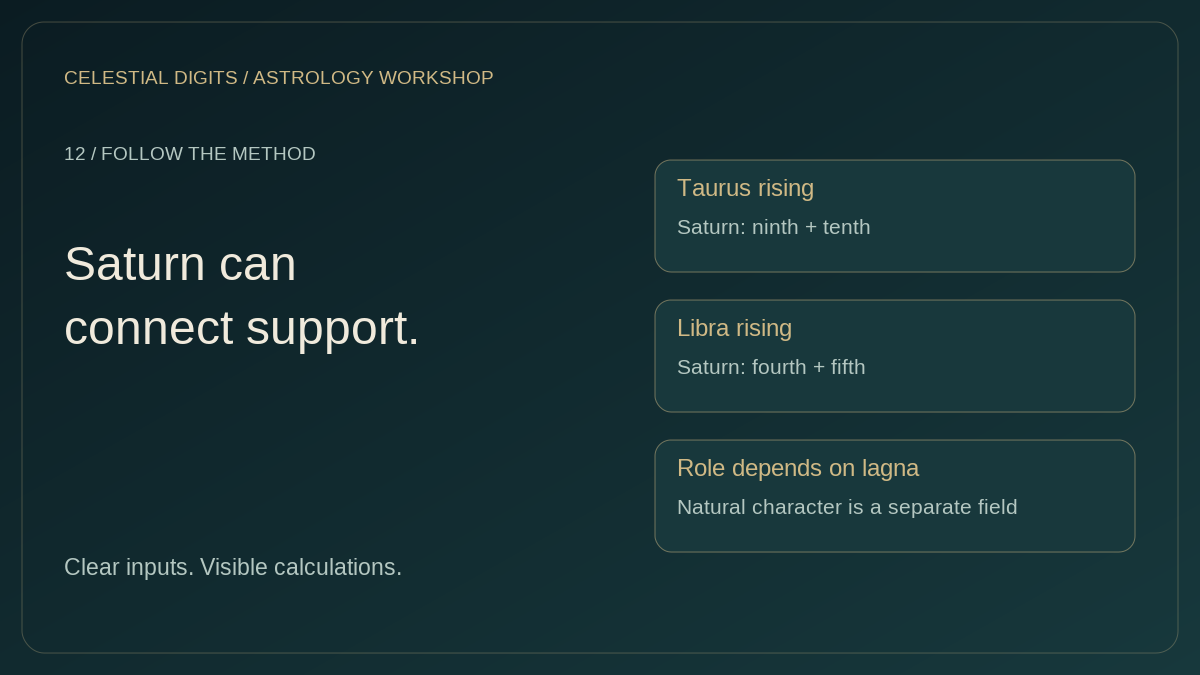
Why Saturn Can Be a Yogakaraka: Follow House Ownership
Map Saturn, Venus and Mars across six ascendants to understand the kendra–trikona role without confusing natural character with guaranteed results.
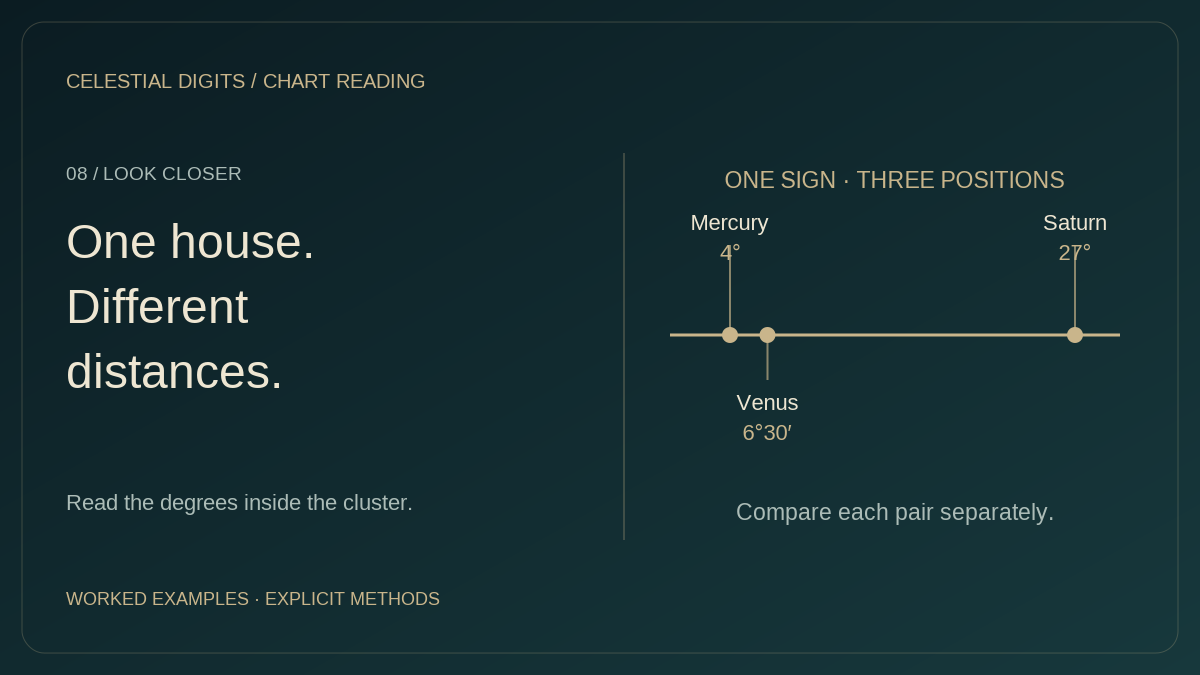
Same House, Different Degrees: How Close Is a Planetary Conjunction?
Compare same-sign conjunctions with actual degree gaps. Work through a three-planet cluster, cross-sign proximity and applying versus separating motion.
Jupiter in the Seventh House: Shared Values and Functional Lordship
Read Jupiter in the seventh without a blanket good-marriage promise, using Gemini, Virgo and Capricorn examples and explicitly counted aspects.
A little more perspective.
Keep discussions respectful. No harassment, hate, sexual content or spam. Comments are reviewed before publication. Report concerns from a comment menu, or contact [email protected].
Checking your session…