
Twins and Numerology: Same Birthday Numbers, Different Lives
Use fictional twins to see which numerology inputs match, which name totals differ and why matching numbers cannot describe a whole life.
Twins offer a useful test of what birthday numerology actually contains. If two people share the same recorded birth date, the day and full-date formulas return the same numbers. Their different lives are a reminder that those formulas are not complete descriptions of a person.
A shared date produces a shared pair#
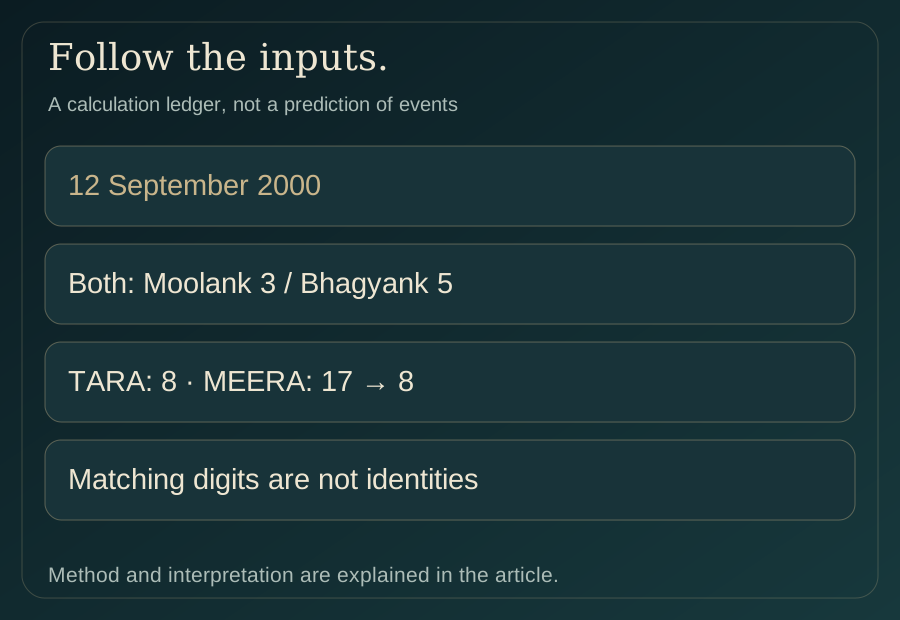
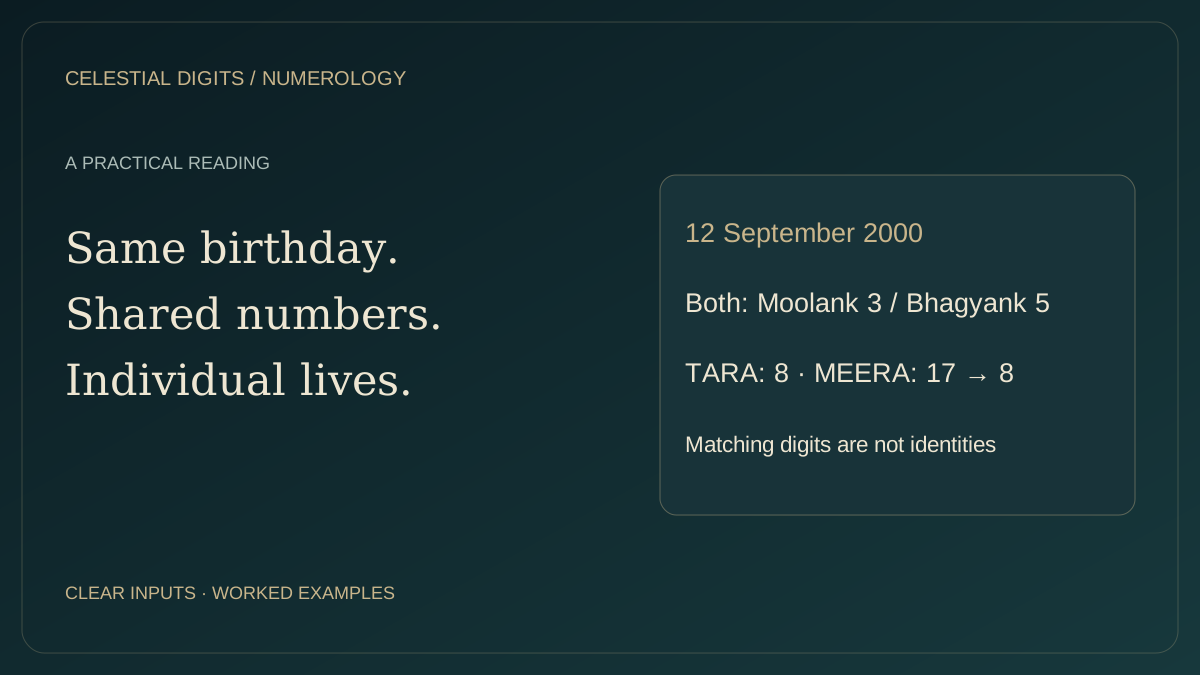
Take fictional twins born on 12 September 2000. Both have Moolank 1 + 2 = 3. Their full-date sum is 1 + 2 + 0 + 9 + 2 + 0 + 0 + 0 = 14 → 5, so both have Bhagyank 5.
Nothing in these two calculations asks about birth order, temperament, education, family roles or later choices. It would be an error to claim those details were individually measured by the shared 3–5 pair.
Different names can change one input#
Suppose their illustrative first names are TARA and MEERA. Under our letter table, TARA = 4 + 1 + 2 + 1 = 8. MEERA = 4 + 5 + 5 + 2 + 1 = 17 → 8. Different spellings have produced the same reduced name number too.
Now compare TARA with KAVYA, whose total is 2 + 1 + 6 + 1 + 1 = 11 → 2. A different name can produce a different result, but it does not have to. These are first-name-only demonstrations; adding a surname would create another input.
| Input | Tara example | Meera example | What matches? |
|---|---|---|---|
| Birth date | 12 September 2000 | 12 September 2000 | Entire date |
| Moolank | 3 | 3 | Day result |
| Bhagyank | 5 | 5 | Full-date result |
| First-name total | 8 | 17 | Totals differ |
| Reduced first-name number | 8 | 8 | Reduced result |
Do not invent a hidden explanation after the fact#
If twins behave differently, it is tempting to search for a spelling, nickname or compound interpretation that explains the difference. Exploring another input is possible, but choosing it only after seeing the outcome makes the claim difficult to test fairly.
A better approach records the method and expectation beforehand. If the numbers match while preferences differ, preserve that observation. It is evidence of the framework's limits, not a failure by either person to live according to a number.
What about their birth charts?#
Birth charts use time and place as well as date, so small time differences can matter for some chart factors. That is a separate calculation and must be checked precisely. Do not assert that every pair of twins has a different ascendant, or use an assumed chart difference to rescue a numerology claim.
The chart versus birthday-number guide explains why these systems ask different questions. Neither should be used to assign permanent family roles such as “the responsible twin” and “the difficult twin.”
A better use for a shared reading#
Give both people the same optional reflection question, then let each answer independently. For a 3–5 example, ask how they prefer to learn and communicate. Their answers may differ in ways the number pair does not predict.
The interesting material is the difference in their own accounts. A useful reading leaves room for that individuality instead of forcing two people into one description.
Related Posts
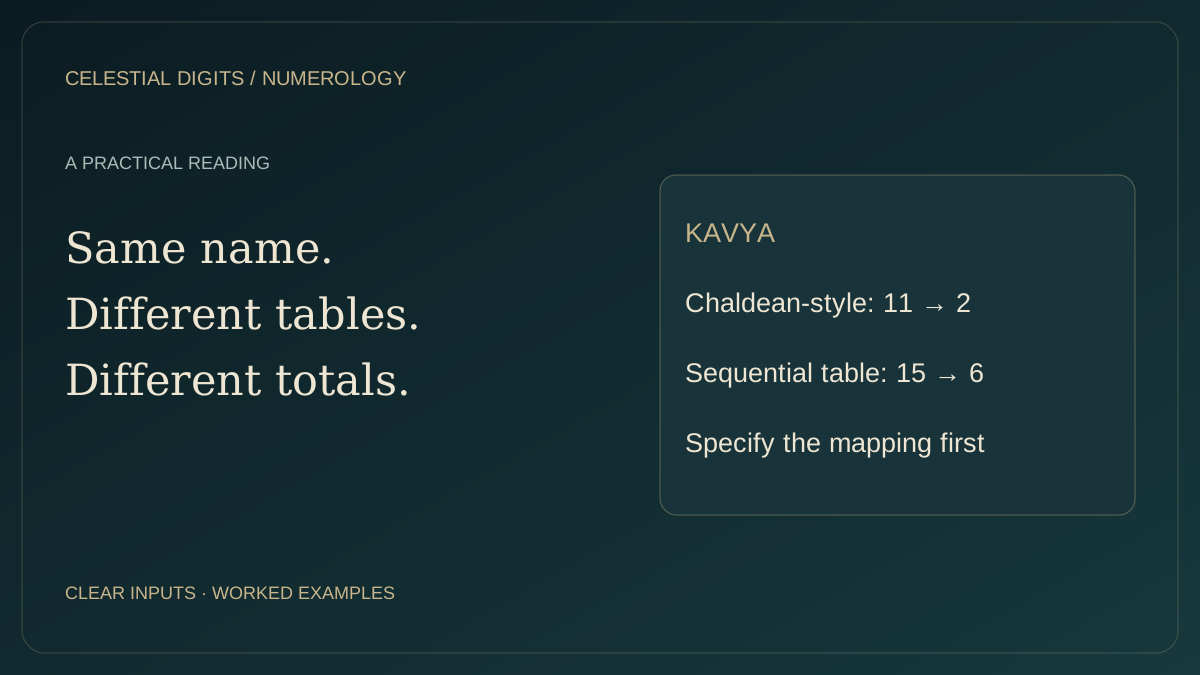
Why Two Name Calculators Disagree: Chaldean and Pythagorean Tables
Compare KAVYA letter by letter under two common tables and see why equal labels can conceal different calculation methods.
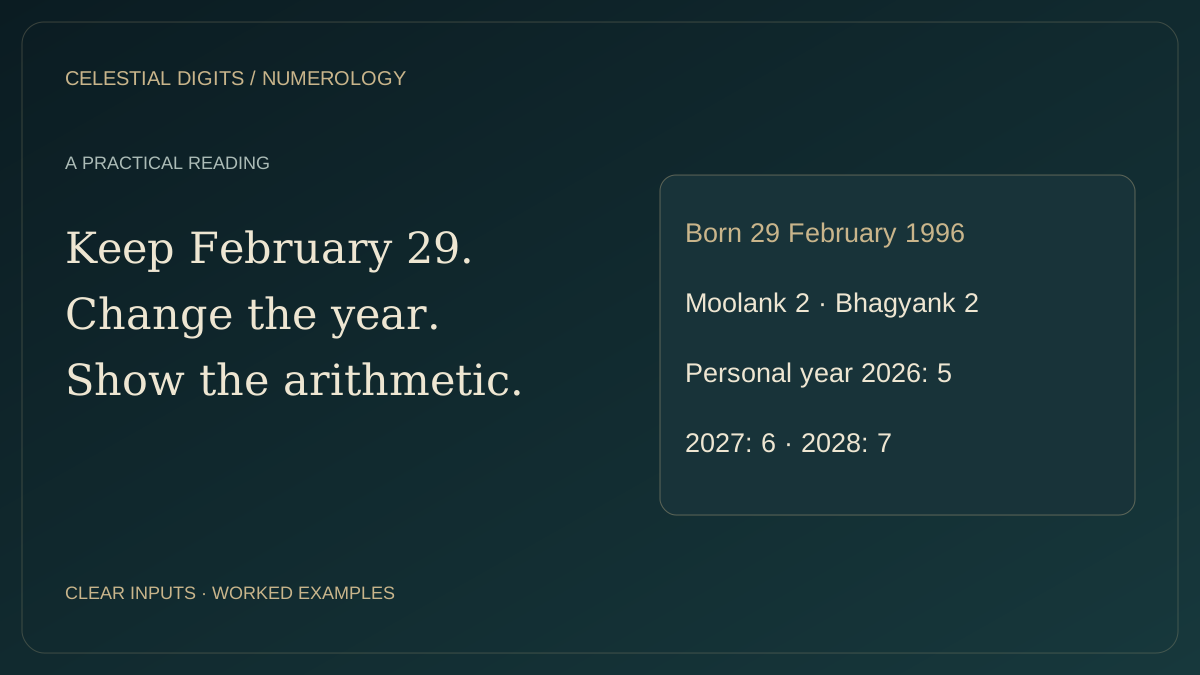
Born on 29 February: Numerology in Leap and Non-Leap Years
Calculate a leap-day Moolank, Bhagyank and personal year without inventing a 29 February date in a non-leap year.
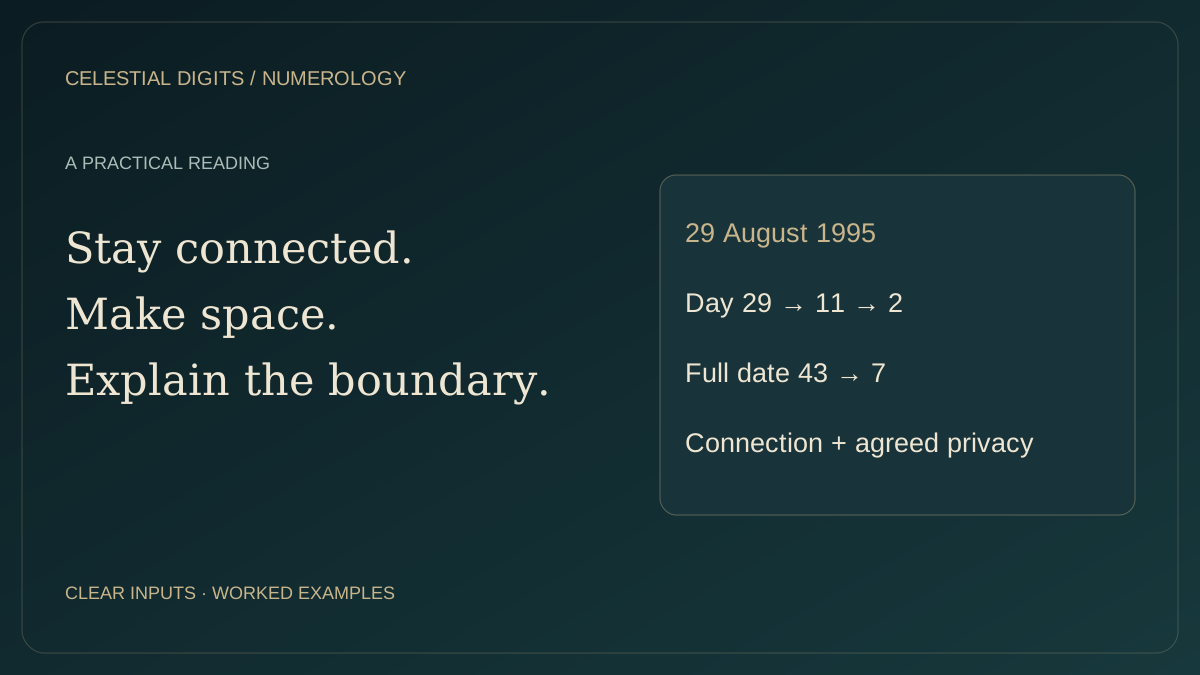
Moolank 2 and Bhagyank 7: Connection without losing privacy
A worked 2–7 calculation and a practical example of asking for space without turning a number pair into a relationship verdict.
A little more perspective.
Keep discussions respectful. No harassment, hate, sexual content or spam. Comments are reviewed before publication. Report concerns from a comment menu, or contact [email protected].
Checking your session…