
Moolank 4 (Rahu): Experimentation without chasing every novelty
Calculate Moolank 4, separate it from Bhagyank and explore Rahu symbolism through a worked situation and practical reflection.
Moolank 4 is the reduced birth-day number for people born on 4, 13, 22, 31. In the modern Indian numerology convention used here, it is associated with Rahu. This guide explores experimentation without chasing every novelty, using a fictional situation rather than treating a birthday as a personality test.
Reproduce the day and full-date calculations#
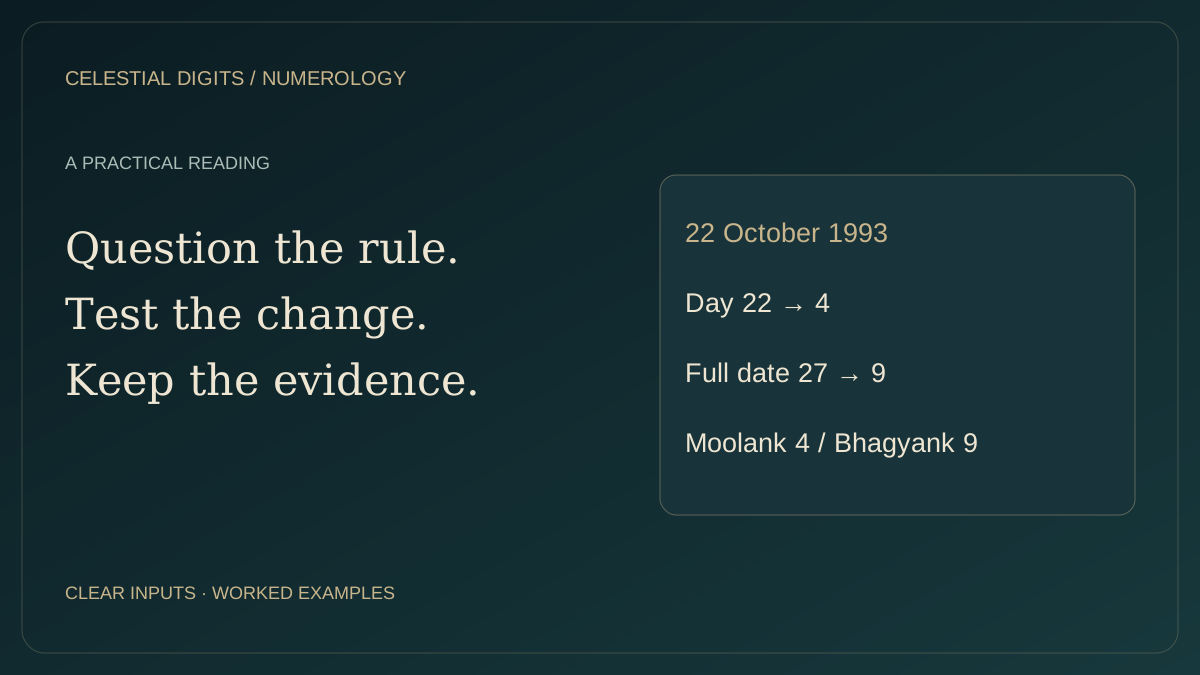
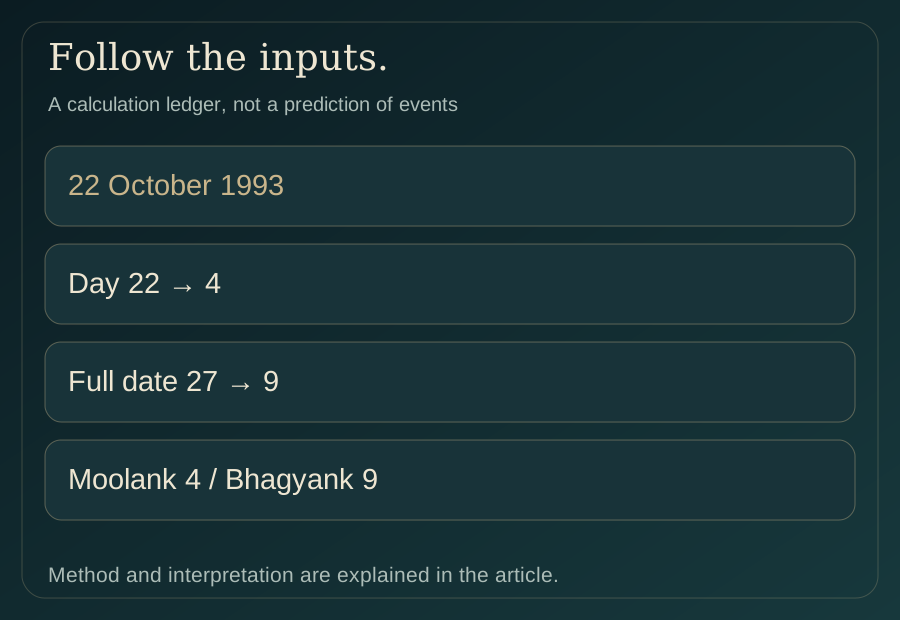
Take the fictional date 22 October 1993. The day 22 reduces to 4. The full-date calculation is 2 + 2 + 1 + 0 + 1 + 9 + 9 + 3 = 27, which reduces to 9. Its profile therefore has Moolank 4 / Bhagyank 9; those labels describe different inputs.
Why the Rahu association needs a stated method#
Our number table associates 4 with Rahu. Other numerology traditions describe 4 through different correspondences, so a shared number does not guarantee a shared interpretation. Here we use Rahu as a symbol for unusual routes, amplification and the attraction of something outside the familiar pattern.
That does not make number 4 people dishonest, unlucky or permanently rebellious. Nor is it an instruction to reject a working method simply because a new one looks more exciting. A useful reading asks what an experiment is trying to solve.
Worked situation: replacing a familiar work process#
Suppose a fictional small team wants to replace a shared spreadsheet with a new planning app. One person is enthusiastic about the possibilities; others worry about losing information. The numerology theme can frame an investigation, but it cannot tell the team which product will work.
Define the problem first: missed deadlines, unclear ownership or difficulty finding old decisions. Then test one representative project. Compare the new process against the old one using the same criteria.
| Question | Evidence worth collecting |
|---|---|
| Does the tool solve the stated problem? | Fewer missed handovers on the trial project |
| What new work does it create? | Time spent entering, checking and moving information |
| Who is excluded or confused? | Feedback from people who use the process least often |
| Can the change be reversed? | A usable export and a clear fallback plan |
Novelty is now a testable proposal rather than a personality badge. The result may be to adopt the tool, revise the trial or keep the spreadsheet. None of those outcomes proves or disproves a person's worth.
How to distinguish curiosity from escalation#
An experiment has a question, a limit and a review point. Escalation often has only a stronger promise: the next purchase, course or redesign will finally solve everything. Write down what would make you stop or change direction before starting.
For a number 4 reflection, ask whether you are exploring because the evidence supports a trial or because the present task has become uncomfortable. Both can feel like a desire for change, but they need different responses.
Twenty-two is the input, four is the reduction#
A birthday on the 22nd reduces to 4 in this site's convention. Some systems preserve 22 as a master number. Neither label by itself demonstrates exceptional power or a burden that must be repaired.
Keeping 22/4 is a transparent way to retain the day while showing the reduction. It does not justify assigning the same experiences to everyone born on that date. The full birth-date sum and the selected name are separate inputs, as the calculation guide shows.
Rahu in a chart is a different calculation#
A Moolank 4 result does not locate Rahu in a house, identify an eclipse or establish Rahu mahadasha. In astrology, Rahu is a lunar node whose longitude must be calculated for an instant. A day-number association does not supply that position.
If the theme you want to explore is change versus structure, use the 4–8 combination worksheet. It keeps symbolic themes separate from the practical evidence needed to approve a change.
A bounded experiment to try#
Choose one small change that addresses a named problem. Record the baseline, the proposed benefit, the time limit and the cost you are willing to accept. Review the result with someone who did not design the trial.
The useful part of the Rahu metaphor is permission to investigate an unfamiliar route. Its limit is that fascination is not proof. Keep the evidence, including the result that tells you to stop.
Continue with your own inputs#
Check the exact date in the numerology report, then compare the day, full-date and name methods. The situations and worksheets on this page are original teaching examples. Number–planet labels follow the site's stated convention; they are not astronomical placements or scientifically established predictions.
Related Posts
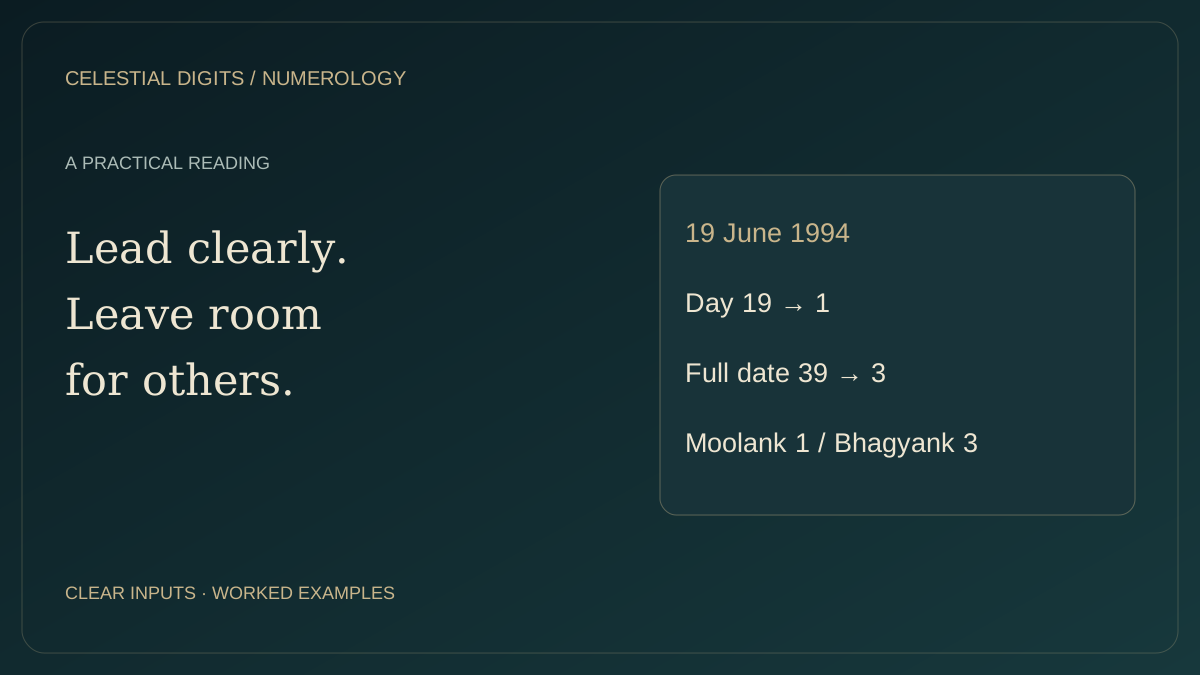
Moolank 1 (Sun): Initiative without taking over
Calculate Moolank 1, separate it from Bhagyank and explore Sun symbolism through a worked situation and practical reflection.
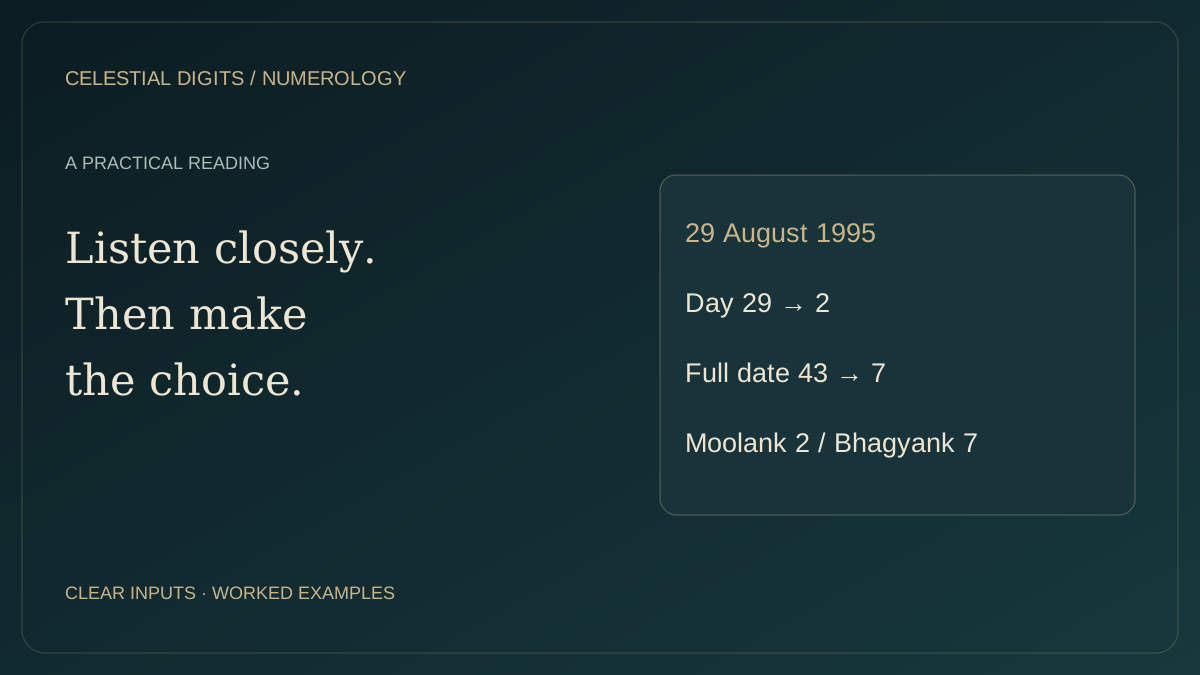
Moolank 2 (Moon): Cooperation with a clear decision
Calculate Moolank 2, separate it from Bhagyank and explore Moon symbolism through a worked situation and practical reflection.
Moolank 3 (Jupiter): Learning that becomes useful teaching
Calculate Moolank 3, separate it from Bhagyank and explore Jupiter symbolism through a worked situation and practical reflection.
A little more perspective.
Keep discussions respectful. No harassment, hate, sexual content or spam. Comments are reviewed before publication. Report concerns from a comment menu, or contact [email protected].
Checking your session…