
Moolank 3 (Jupiter): Learning that becomes useful teaching
Calculate Moolank 3, separate it from Bhagyank and explore Jupiter symbolism through a worked situation and practical reflection.
Moolank 3 is the reduced birth-day number for people born on 3, 12, 21, 30. In the modern Indian numerology convention used here, it is associated with Jupiter. This guide explores learning that becomes useful teaching, using a fictional situation rather than treating a birthday as a personality test.
Reproduce the day and full-date calculations#
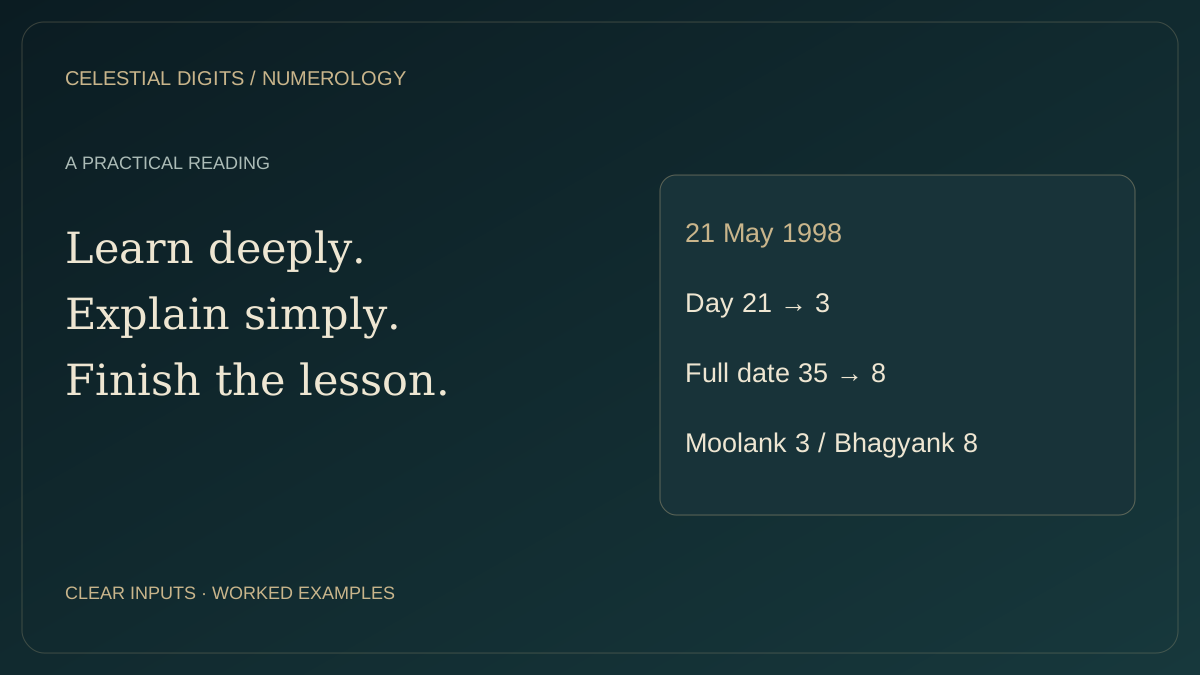
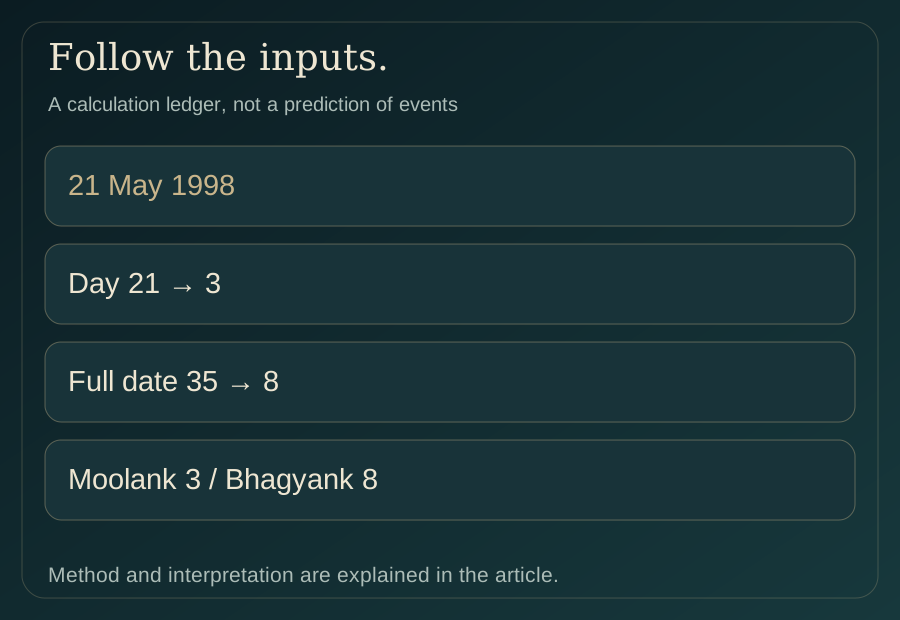
Take the fictional date 21 May 1998. The day 21 reduces to 3. The full-date calculation is 2 + 1 + 0 + 5 + 1 + 9 + 9 + 8 = 35, which reduces to 8. Its profile therefore has Moolank 3 / Bhagyank 8; those labels describe different inputs.
Jupiter adds a question about judgement#
In this numerology convention, 3 is associated with Jupiter. The reading emphasises learning, guidance, principles and the wish to make knowledge useful. It should not be reduced to “creative person” or inflated into a claim that every number 3 is naturally wise.
Knowing a subject and teaching it are different skills. Good judgement includes recognising the limits of what you know, choosing an explanation appropriate to the listener and admitting when an answer needs checking. Confidence without those habits can sound authoritative while leaving the other person confused.
Worked situation: explaining a chart to a beginner#
Imagine a fictional study group where one member has read several astrology books. A newcomer asks what an ascendant is. The experienced member starts listing yogas, divisional charts and exceptions. The information may be interesting, but it does not answer the first question.
A Jupiter-themed reflection asks: what foundation would help this person understand the next step? Start with the reference point, show one simple chart and ask the newcomer to identify it. Only then introduce an additional layer.
| Teaching choice | Check for understanding |
|---|---|
| Define one term | Can the learner explain it in their own words? |
| Show one example | Can they identify the relevant part without prompting? |
| Name one limitation | Do they know what the example does not establish? |
| Offer a next step | Is there a manageable task to practise? |
This is not evidence that the fictional teacher has Moolank 3. It is a way of making the theme of guidance practical without turning it into a claim of expertise.
How enthusiasm becomes unfinished work#
A love of learning can create a crowded reading list. Before treating every new course as expansion, ask what the previous one changed in your understanding or practice. Accumulating explanations is not the same as being able to use them.
Try a completion rule: after each chapter or lesson, write a short account of one idea, work one example and list one unresolved question. That makes progress inspectable. If the material cannot be explained yet, more confident language will not substitute for understanding.
The difference between advice and authority#
Someone asking for your opinion has not necessarily delegated their decision to you. A useful guide presents the reasoning, alternatives and limits. It leaves room for the other person to choose differently.
The number 3 association cannot establish teaching credentials, professional competence or the correctness of a belief. Nor does a Jupiter label tell us the actual strength or placement of natal Jupiter. Those are different kinds of information.
Reading the day alongside the full date#
The worked birth date above supplies two calculations. Moolank retains the day theme; Bhagyank incorporates the rest of the date. Neither number tells us what the fictional person studied or whether their advice has helped anyone.
If you are exploring learning alongside responsibility for others, continue with the 3–6 combination. That worksheet asks how to offer support without turning every interaction into a lesson.
An exercise before you give your next explanation#
Choose something you understand well. Explain it in five sentences, include a small example and name a situation where the explanation would not apply. Ask a listener what remained unclear. Their response is more useful evidence about your teaching than a flattering number profile.
Keep the Jupiter theme as a reason to improve judgement, not a reason to assume it is already perfect. That distinction allows learning to remain open rather than becoming a performance of certainty.
Continue with your own inputs#
Check the exact date in the numerology report, then compare the day, full-date and name methods. The situations and worksheets on this page are original teaching examples. Number–planet labels follow the site's stated convention; they are not astronomical placements or scientifically established predictions.
Related Posts
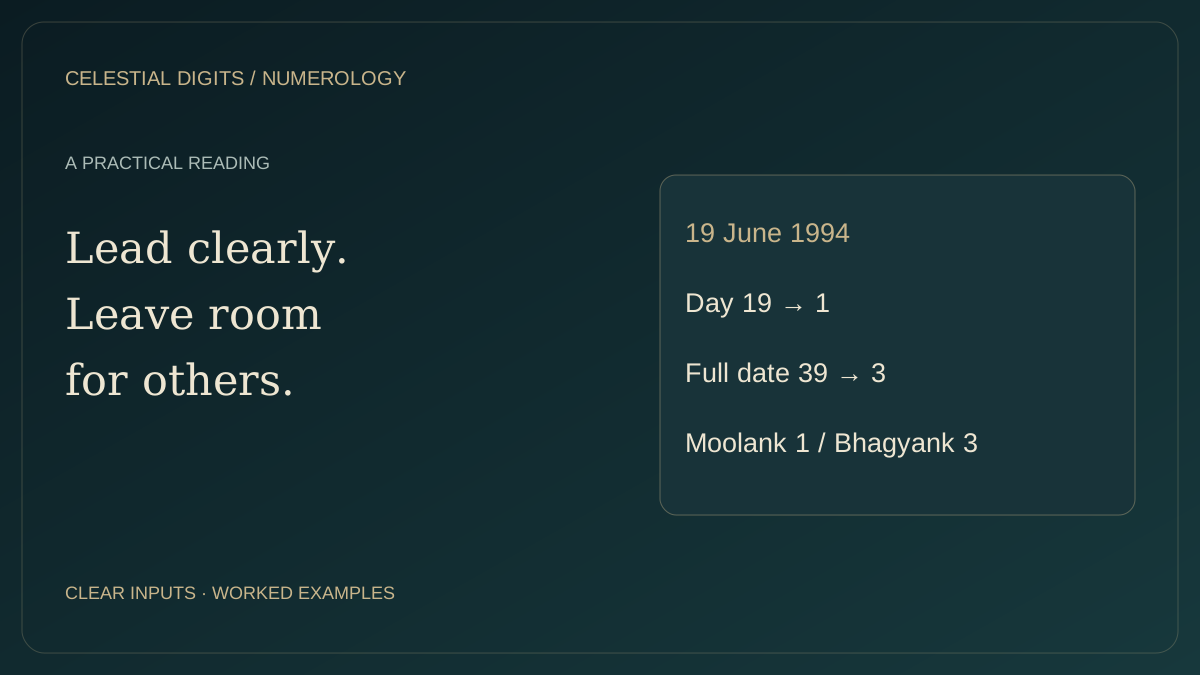
Moolank 1 (Sun): Initiative without taking over
Calculate Moolank 1, separate it from Bhagyank and explore Sun symbolism through a worked situation and practical reflection.
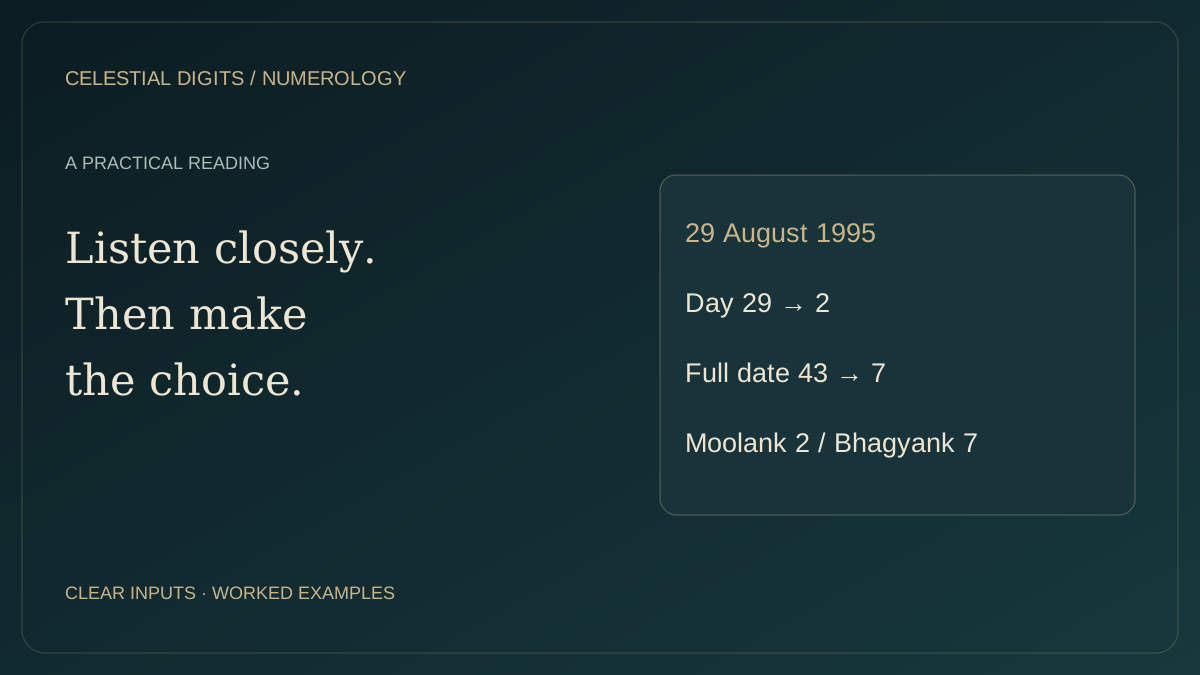
Moolank 2 (Moon): Cooperation with a clear decision
Calculate Moolank 2, separate it from Bhagyank and explore Moon symbolism through a worked situation and practical reflection.
Moolank 4 (Rahu): Experimentation without chasing every novelty
Calculate Moolank 4, separate it from Bhagyank and explore Rahu symbolism through a worked situation and practical reflection.
A little more perspective.
Keep discussions respectful. No harassment, hate, sexual content or spam. Comments are reviewed before publication. Report concerns from a comment menu, or contact [email protected].
Checking your session…