
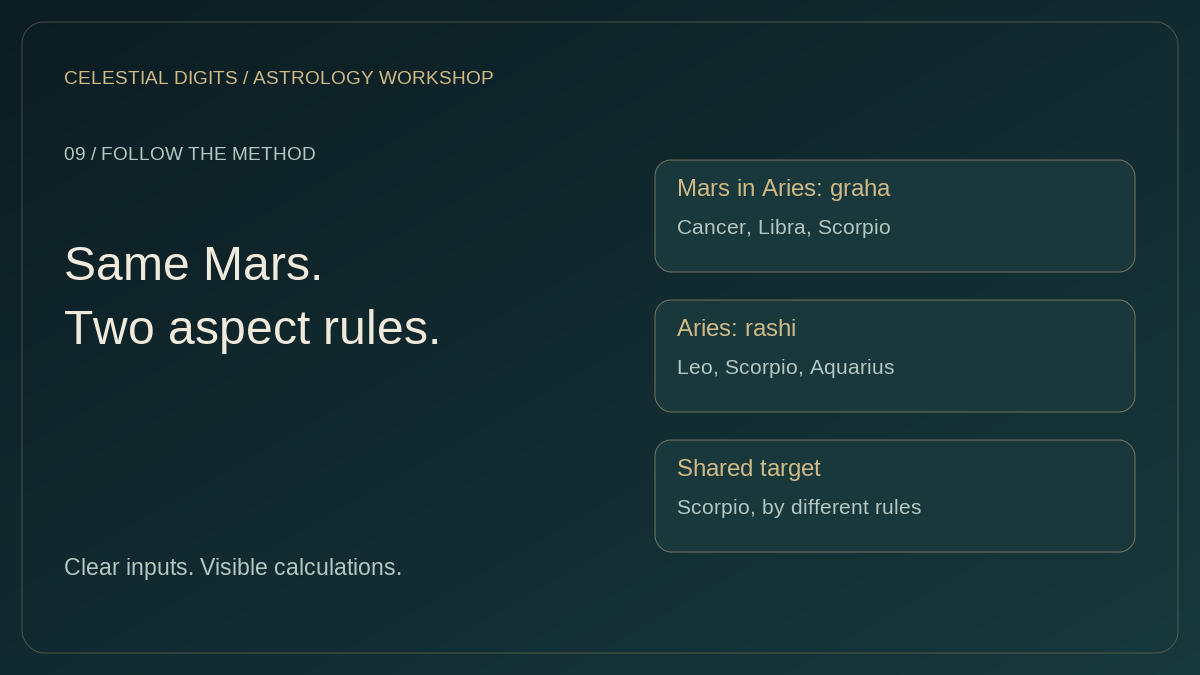
Graha Drishti vs Rashi Drishti: Keep the Aspect Rules Separate
Compare Mars in Aries under planetary and sign-based aspects, and see why combining the two lists without labels creates misleading chart readings.
An aspect list is incomplete unless it names its method. Graha drishti follows planetary aspect rules. Rashi drishti, used in Jaimini-style analysis, follows relationships between signs. Both may appear in a Vedic chart tool, but their outputs should not be merged into one unexplained list.
Take a fictional Mars in Aries. Keeping that placement fixed lets us see what changes when the aspect rule changes.
Count the planetary aspects#
In the standard full-aspect convention used here, Mars aspects the fourth, seventh and eighth positions from itself. Count Aries as one:
| Count from Aries | Target sign |
|---|---|
| Fourth | Cancer |
| Seventh | Libra |
| Eighth | Scorpio |
This is a sign-level teaching list. An exact aspect-strength calculation can also depend on degrees; a full-strength label and a numerical Drik Bala contribution are not interchangeable outputs.
Apply the sign-based rule separately#
For rashi drishti, Aries is movable. Under the convention used by our Jaimini calculation, it aspects the fixed signs except the adjacent fixed sign, Taurus. Its targets are therefore Leo, Scorpio and Aquarius.
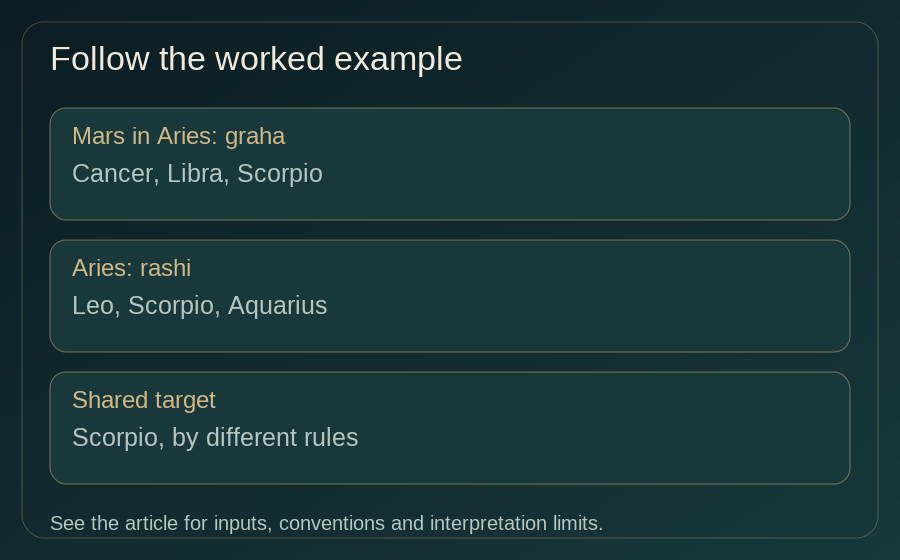
The two methods share Scorpio in this example, but not Cancer, Libra, Leo or Aquarius. That overlap does not make the methods identical. It simply means two different rules reach one common target.
The traditional distinction is discussed in Brihat Parashara Hora Shastra's sign-aspect chapter and strength/aspect discussion. The tables above are our own counted examples.
Add a second planet carefully#
Now place fictional Venus in Leo. Mars reaches Leo through the Aries rashi-drishti rule, but Leo is not one of Mars's fourth, seventh or eighth sign-level graha targets. Saying “Mars aspects Venus” without a method label hides the reason.
Move Venus to Cancer in a separate example. Cancer is a Mars graha target, but not an Aries rashi target. The statement changes again even though Mars has not moved.
This is why a Jaimini panel can legitimately list an association absent from a standard planetary-aspects panel. It becomes a bug only if a panel claims one convention while calculating or labelling the other.
Do not confuse targets with house numbers#
For a Virgo ascendant, Aries is the eighth house. Cancer is the eleventh, Libra the second and Scorpio the third. Those are house labels from the ascendant; fourth, seventh and eighth in Mars's aspect rule were counts from Mars.
Write both references when needed: “Mars in the eighth aspects Cancer, the eleventh house, by its fourth aspect.” This is longer than “Mars aspects four,” but it avoids a common reference-point error.
A useful reading sequence#
First record the planet's sign and degree. Then state the aspect method and list its targets. Only after that identify occupied planets, relevant houses and the question being examined. If using both systems, retain two labelled observations rather than counting a repeated target as two independent proofs of an outcome.
For an example of why exact separation matters, read conjunction degrees. For the broader Jaimini context, see Darakaraka and related indicators. An aspect is a relationship within the chart framework, not a diagnosis of conflict or a promise that a particular event must occur.
Related Posts
Venus and Mars in Marriage: Affection, Initiative and Context
Use a two-ascendant Venus–Mars comparison to separate affection, initiative, house ownership and conjunction distance in a relationship reading.
Mars in Aquarius: Independent Action and Collective Decisions
Explore Mars in Aquarius through Saturn, group commitments and independent initiative, with explicit house ownership and aspect targets.
Mars in Aries: Initiative, Boundaries and Shared Decisions
Read own-sign Mars in Aries through initiative and relationship decisions, with house and aspect examples that avoid equating a strong Mars with aggression.
A little more perspective.
Keep discussions respectful. No harassment, hate, sexual content or spam. Comments are reviewed before publication. Report concerns from a comment menu, or contact [email protected].
Checking your session…