
Gandanta: Check the Water–Fire Boundary Before the Label
Locate the three water–fire junctions, compare distance from the boundary, and distinguish broad pada zones from narrower stated conventions.
A Gandanta label can sound alarming when a report displays it without a degree, a threshold or an explanation. The first useful response is to inspect the boundary being discussed. Not every sign change is a water-to-fire junction, and not every use of the word applies the same width around that junction.
This guide focuses on geometry and method disclosure. It does not infer danger to a child or family from a birth position.
Identify the three junctions#
| Sign transition | Nakshatra transition | Absolute boundary |
|---|---|---|
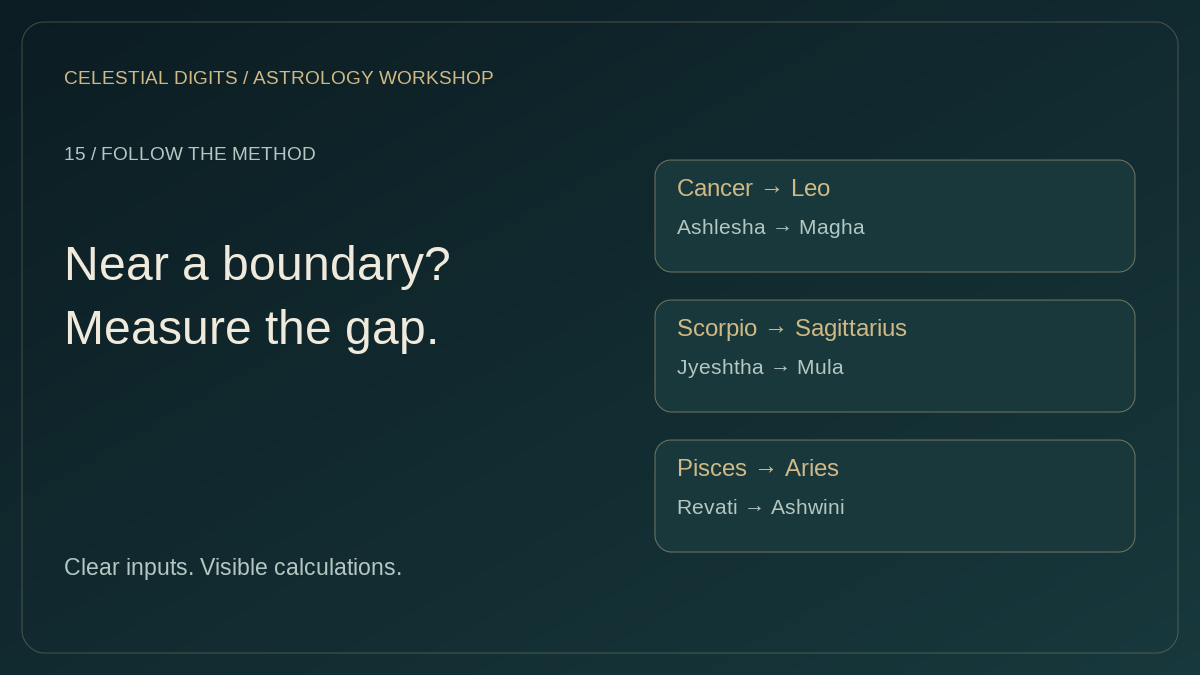
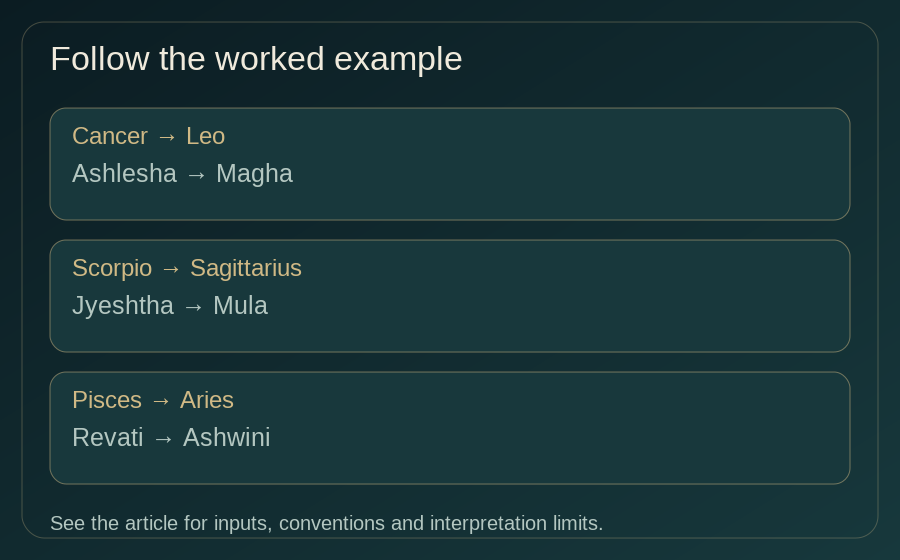
| Cancer to Leo | Ashlesha to Magha | 120° |
| Scorpio to Sagittarius | Jyeshtha to Mula | 240° |
| Pisces to Aries | Revati to Ashwini | 360° / 0° |
These are the three places where the water-sign sequence gives way to fire and the nakshatra sequence also reaches one of the listed junctions. A Taurus-to-Gemini boundary, for example, is not one of them.
Measure the distance rather than using only the sign#
A fictional Moon at 29°40′ Cancer is 20 arcminutes before the Cancer–Leo boundary. A Moon at 0°20′ Leo is 20 arcminutes after it. Both are equally close in angle, though their sign and nakshatra labels differ.
A Moon at 27° Cancer is three degrees before the same boundary. Whether a method flags it depends on that method's stated zone. You cannot resolve the question from the word “Cancer” alone.
Why widths can differ between explanations#
Some contemporary implementations use a broad final/first-pada zone of 3°20′ on either side. Other teachings use narrower definitions or discuss time intervals around a nakshatra ending. These should not be silently treated as equivalent.
For an explicit example of a broad software convention, the xalen-vedic Gandanta documentation states its one-pada angular rule. That is evidence of that implementation's definition, not proof that every school uses it or that the condition predicts harm.
An angular minute and a clock minute are different units. Converting a time interval around a crossing into an angular width requires the relevant motion; do not simply replace one with the other.
A boundary-crossing uncertainty example#
Imagine a recorded longitude rounded to 30° Cancer. That display is ambiguous without the underlying precision: the true value might be just before the boundary, or the chart might need to normalize it to 0° Leo. Use unrounded longitude to classify the interval and round only for presentation.
Similarly, an uncertain birth time may leave a fast-moving reference close to a boundary. Do not turn a rounded screenshot into a confident claim about which side applies. Our zero and twenty-nine degree guide explains why late degree is a position, not automatically a life verdict.
Keep distinct traditional concepts separate#
A nakshatra-based Gandanta discussion, a sign-boundary discussion and a tithi-related use of the term may involve different conditions. Ask which one the report means. The tithi-versus-nakshatra example shows why those two measurements cannot be exchanged.
Also distinguish a planet near a junction from the ascendant near it. They are separate chart points, with different sensitivities to birth-time uncertainty.
What a useful report should show#
It should name the point being checked, its longitude, the nearest junction, the angular or temporal distance, the threshold and the convention. If those fields are absent, ask for them before accepting the label.
Traditional symbolism may frame such junctions as transitions or knots. That is not evidence of a curse, a medical risk or a predetermined family event. A calculation can identify a boundary condition; it cannot justify fear-based claims or pressure to purchase a remedy.
Related Posts
Seventh Lord’s Nakshatra: Sign Lord, Star Lord and Pada Explained
Locate the seventh lord’s nakshatra with a 29° Virgo Venus example, separating Mercury, Mars, Chitra pada 2 and the correct D9 placement.
A Panchanga Reading: Tithi, Vara, Nakshatra, Yoga and Karana
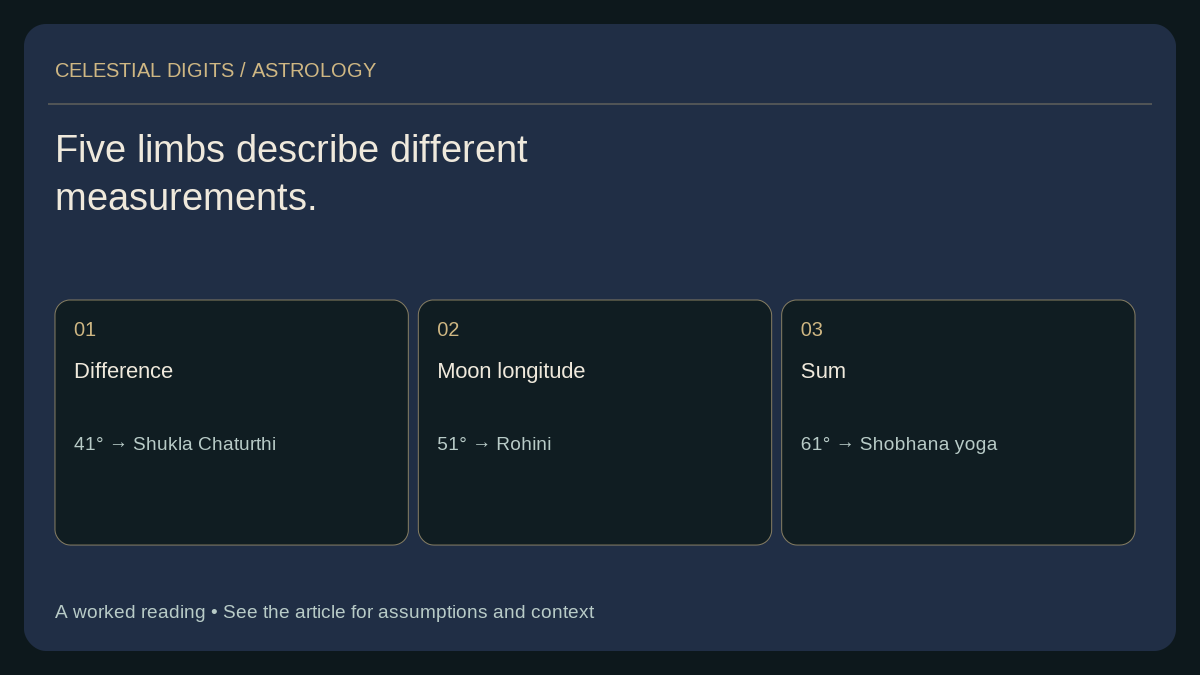
Calculate all five Panchanga limbs from a clearly hypothetical example, and learn why a daily label is not an exact event-time calculation.
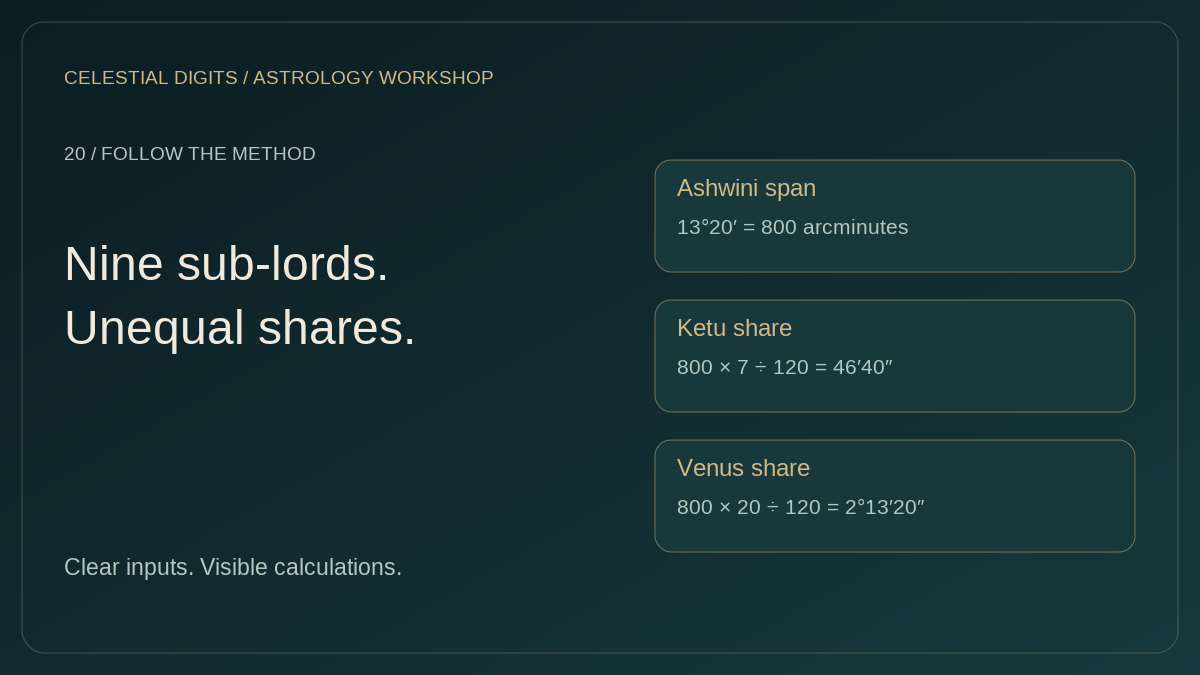
KP Sub-Lords: Why the Nine Divisions Are Unequal
Divide Ashwini’s 800 arcminutes using Vimshottari weights, locate an example longitude, and distinguish KP sub-lords from equal nakshatra padas.
A little more perspective.
Keep discussions respectful. No harassment, hate, sexual content or spam. Comments are reviewed before publication. Report concerns from a comment menu, or contact [email protected].
Checking your session…