
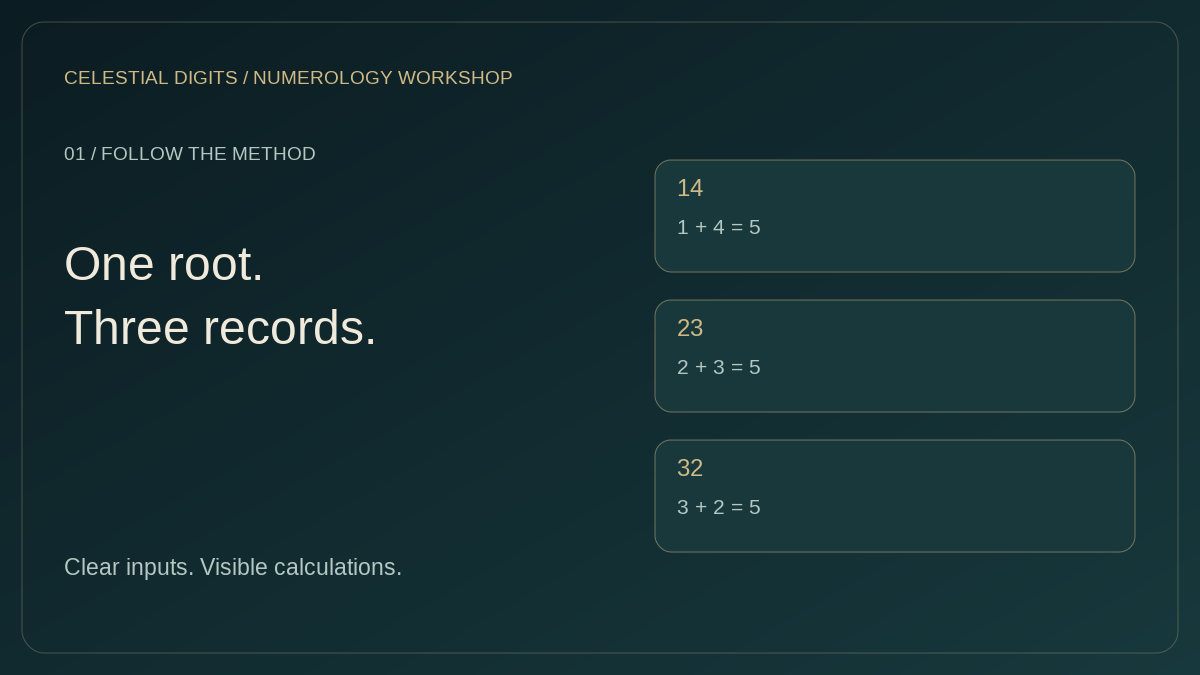
14, 23 and 32: Same Numerology Root, Different Records
See why 14, 23 and 32 all reduce to 5, what the compound preserves, and how to compare readings without turning symbolism into a verdict.
A report can call a name 23/5 while another calls it simply 5. The arithmetic may agree. The longer label preserves the total before reduction, while the shorter label retains only the final digit.
That distinction is useful when comparing calculations. It becomes misleading when someone treats a compound number as a complete biography or uses a frightening interpretation to sell an urgent spelling change. Separate the record of the calculation from the story attached to it.
Follow three paths to five#
| Unreduced total | Reduction | Final root |
|---|---|---|
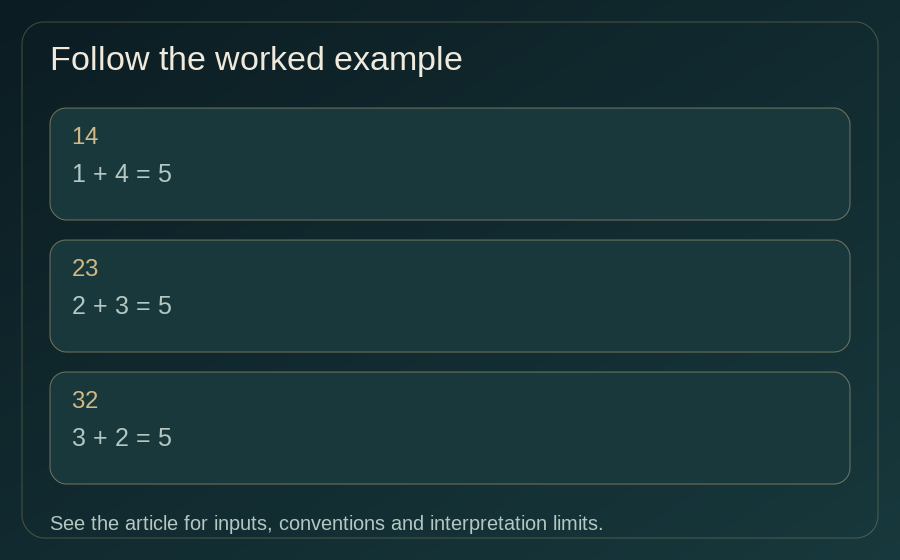
| 14 | 1 + 4 | 5 |
| 23 | 2 + 3 | 5 |
| 32 | 3 + 2 | 5 |
These are three different totals with one shared digital root. The root is a compressed description: it cannot tell you which total produced it. There are many more possibilities, including 41 and 50.
A birth day of 14 and a name total of 14 also have different meanings as inputs. One is a calendar day; the other is a sum of assigned letter values. Even when their printed numbers match, do not silently merge those fields.
What a compound interpretation adds#
Some numerology traditions attach separate symbolic accounts to compound totals. Under such a convention, 14/5 and 23/5 may receive different commentary despite sharing the root. That is an additional interpretive rule, not a second arithmetic discovery.
Our number-table comparison explains why the letter mapping must be recorded first. If one system assigns a name total of 23 and another assigns 32, it is possible for both to end at 5. Agreement at the final digit does not prove the underlying methods are identical.
Before comparing descriptions, write down the actual word, the table used, its individual letter values, the unreduced total and the reduction path. Without those, a compound label cannot be audited.
A name-edit experiment#
Imagine a fictional name with total 23. Adding a letter valued at 1 produces 24, reducing to 6. Adding a letter valued at 9 in a table that permits that value produces 32, still reducing to 5. The two edits have different effects on the compound and root.
This is arithmetic, not a recommendation to change a name. In the Chaldean-style table used by Celestial Digits, no letter is assigned 9. You cannot transfer the second edit to that table without changing the convention. A phrase such as “add one letter to keep your number” is incomplete unless the letter and table are specified.
Read symbolic differences without inventing a hierarchy#
If you use numerology for reflection, you might compare how different compound descriptions frame the same broad theme. Record where an account is useful, where it is vague and where it plainly fails to describe your experience. Do not turn disagreement into evidence that you calculated your own life incorrectly.
No arithmetic here establishes that one person deserves more trust or has a better future than another. A compound described as challenging does not prove a debt, curse or character defect. The karmic-debt discussion should likewise be read as a discussion of a belief system.
Keep both columns when sharing a report#
A useful export says “name total 23, reduced number 5, named letter table.” A useful birth-date export separately says “day 14, Moolank 5.” Keeping the original inputs makes later corrections straightforward.
If your report only shows 5, calculate and preserve the original total before trying to compare compound meanings. For the broader symbolic association of this root, continue with Moolank 5. The extra detail should clarify the method, not create a new reason to worry about an otherwise ordinary name or birthday.
Related Posts
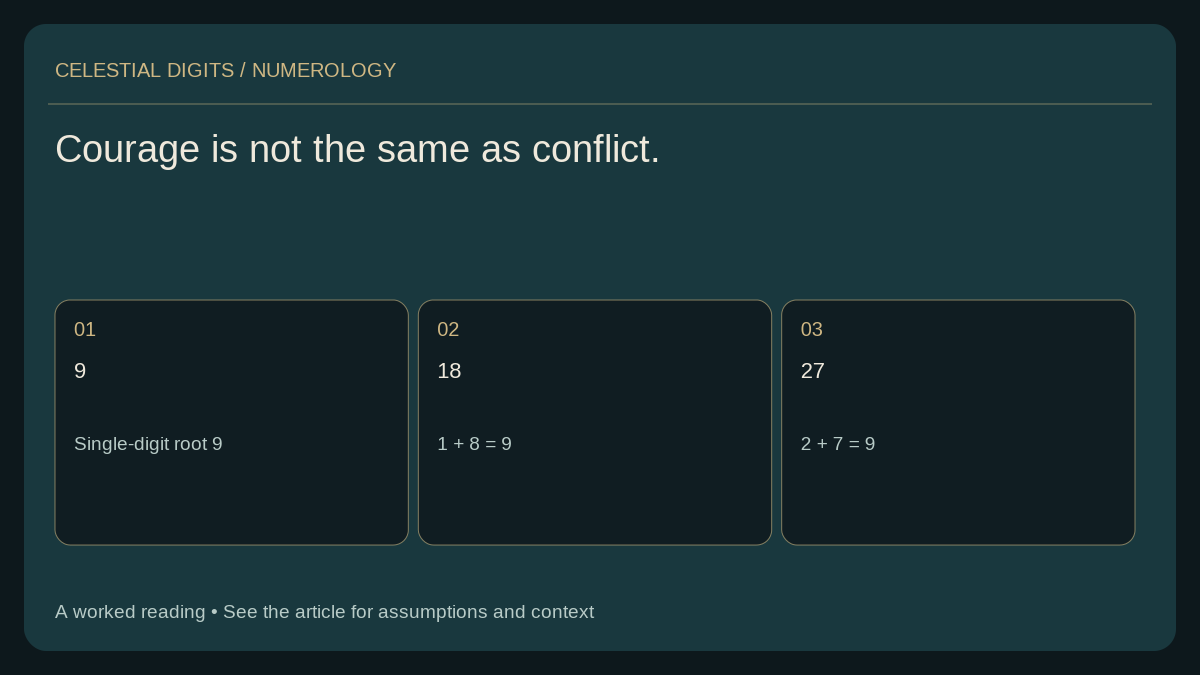
Born on the 9th, 18th or 27th: Comparing Mars-Number Birthdays
Compare three root 9 birthdays through arithmetic, historical compound symbolism and an example about assertiveness and responsibility.
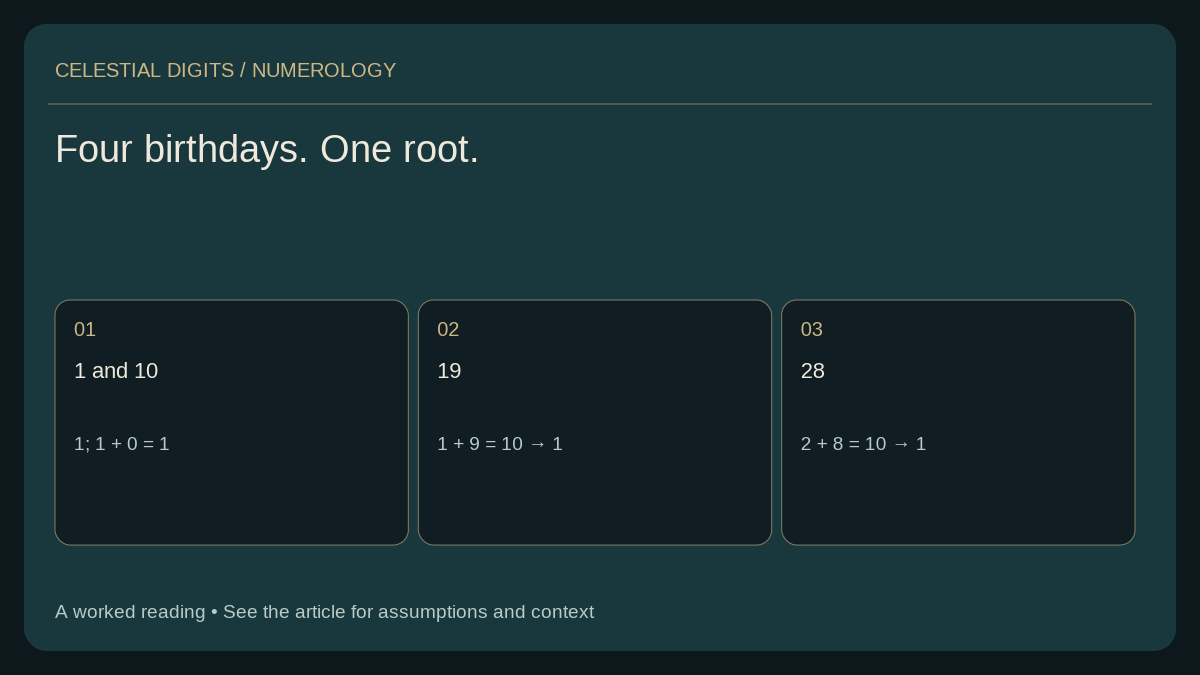
Born on the 1st, 10th, 19th or 28th: What Changes Beyond Root 1?
Compare four Sun-number birthdays, distinguish root arithmetic from compound symbolism, and avoid turning old warnings into predictions.
Born on the 2nd, 11th, 20th or 29th: Four Moon-Number Birthdays
Compare root 2 birthdays, understand why 11 may be treated differently across systems, and keep emotional labels out of the arithmetic.
A little more perspective.
Keep discussions respectful. No harassment, hate, sexual content or spam. Comments are reviewed before publication. Report concerns from a comment menu, or contact [email protected].
Checking your session…