
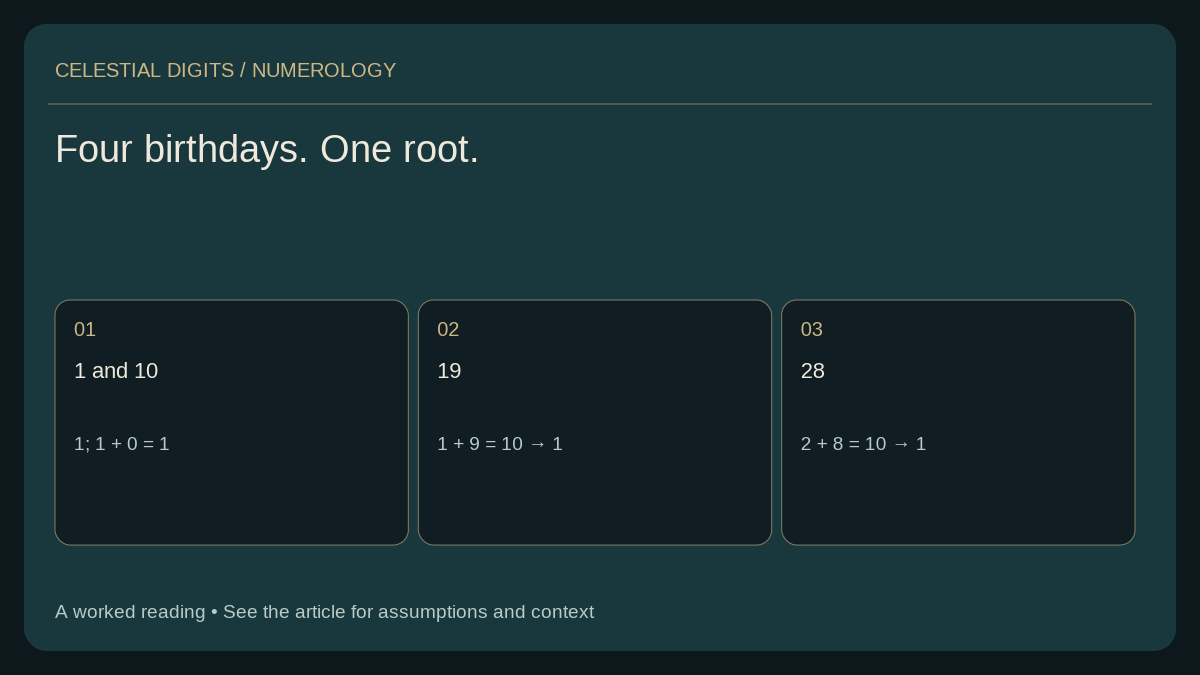
Born on the 1st, 10th, 19th or 28th: What Changes Beyond Root 1?
Compare four Sun-number birthdays, distinguish root arithmetic from compound symbolism, and avoid turning old warnings into predictions.
The 1st, 10th, 19th and 28th all reduce to Moolank 1. That shared result is exact arithmetic. Whether the original compound receives an additional meaning depends on the numerology tradition you follow.
A careful comparison keeps those two statements apart. It does not claim that the person born on the 19th must succeed while the person born on the 28th must lose everything.
Keep both the original day and the root#
| Birthday | Reduction | Record to retain |
|---|---|---|
| 1st | Already single digit | 1 |
| 10th | 1 + 0 = 1 | 10/1 |
| 19th | 1 + 9 = 10; 1 + 0 = 1 | 19/1 |
| 28th | 2 + 8 = 10; 1 + 0 = 1 | 28/1 |
The slash is a record-keeping convention, not division. It preserves the original compound beside the final root. No birth month, year or name has been included in this calculation.
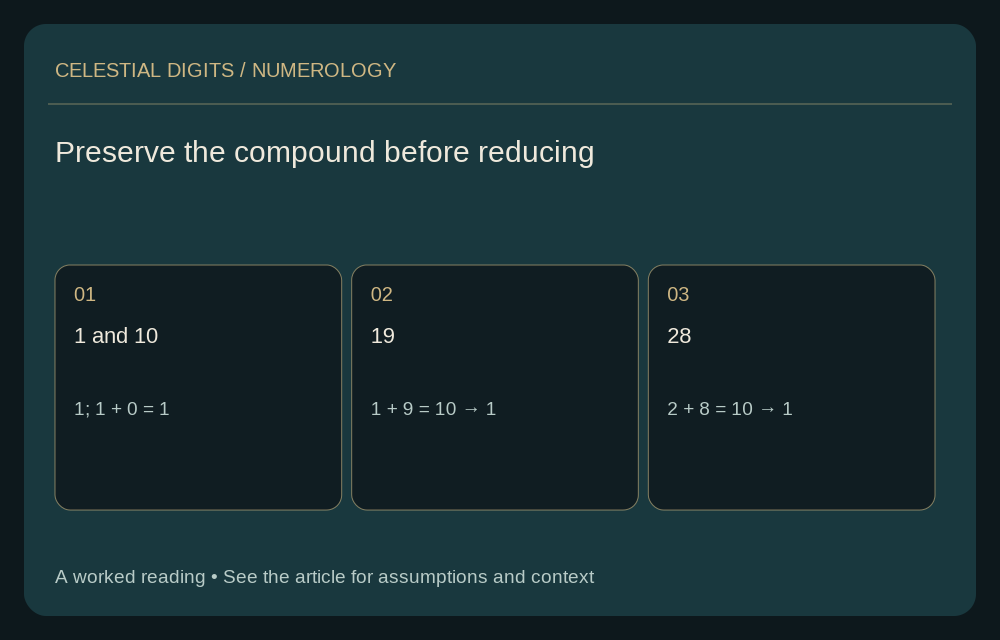
What the shared Sun association contributes#
In the Indian planetary-number convention used across our Moolank guides, root 1 is associated with the Sun. Initiative, visibility and responsibility can become useful themes for reflection. They do not establish that a person is extroverted, suited to management or incapable of teamwork.
Consider four volunteers taking turns to coordinate a small event. All need to make decisions, communicate them and accept feedback. Their common root can suggest a shared discussion topic, but it cannot tell us which volunteer will organise the event best.
What a compound-number tradition adds#
Cheiro's historical compound-number descriptions distinguish these totals. His entry for 10 emphasises changing fortune and recognition; 19 is described favourably; 28 carries cautions about reliance on others and protecting plans. These are claims within his occult system, not demonstrated facts about people born on those dates.
Do not quietly combine that table with another author's system and call the result a single universal Vedic rule. A report should name the source of its compound interpretation, especially when it introduces frightening language absent from the root-number reading.
Turn symbolism into questions, not labels#
For the event example, the common Sun theme could produce one question: “How do I take responsibility without taking over?” A compound lens could then invite reflection on handling recognition, overconfidence or delegation. Those prompts are available to every participant; the birthday does not prove who has which problem.
Useful observations might include whether an organiser clarifies responsibilities, shares credit and checks agreements. Record what actually happens. Do not reinterpret every success as evidence for 19 and every ordinary setback as evidence against 28.
What the comparison leaves out#
Bhagyank needs the complete date. Namank needs a stated spelling and letter table. A natal Sun analysis needs birth-chart inputs. None can be recovered from the day number alone.
Two people born on the 28th can therefore have different full-date and name numbers, as well as entirely different circumstances. Treating the compound as a complete identity discards that information.
For the historical entries, see chapters XII–XIII of Cheiro's Book of Numbers. Our volunteer example is an original reflection exercise. Continue with Moolank 1 in practice and same root, different compound records before comparing complete profiles.
Related Posts
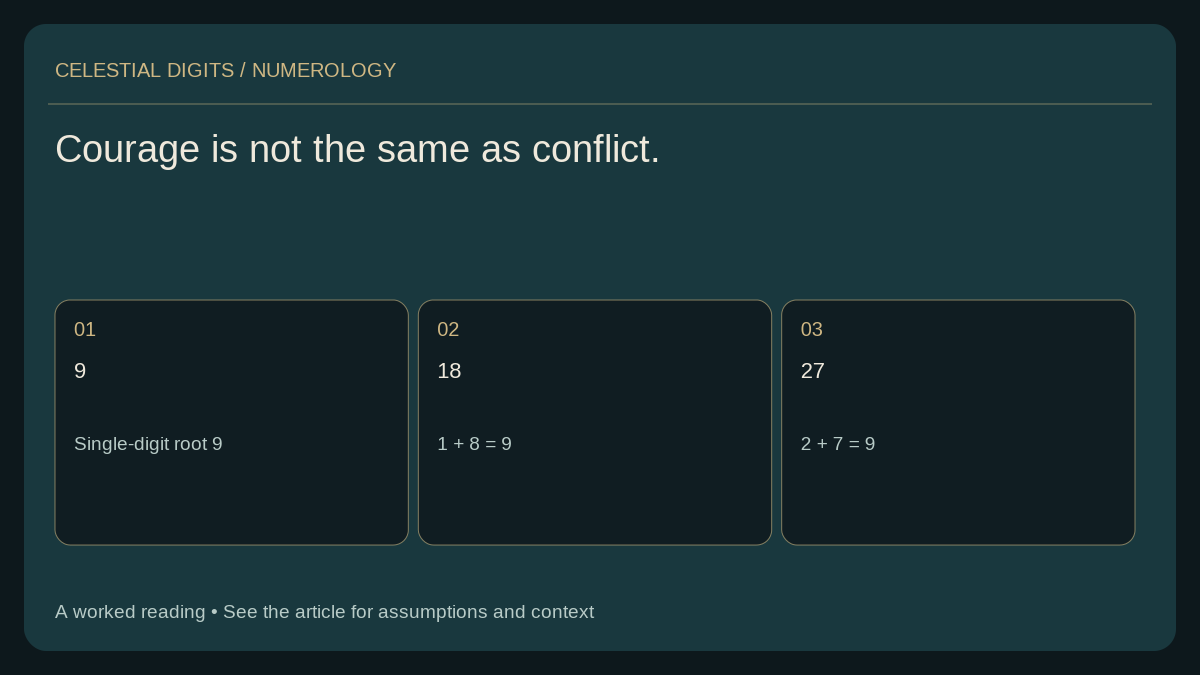
Born on the 9th, 18th or 27th: Comparing Mars-Number Birthdays
Compare three root 9 birthdays through arithmetic, historical compound symbolism and an example about assertiveness and responsibility.
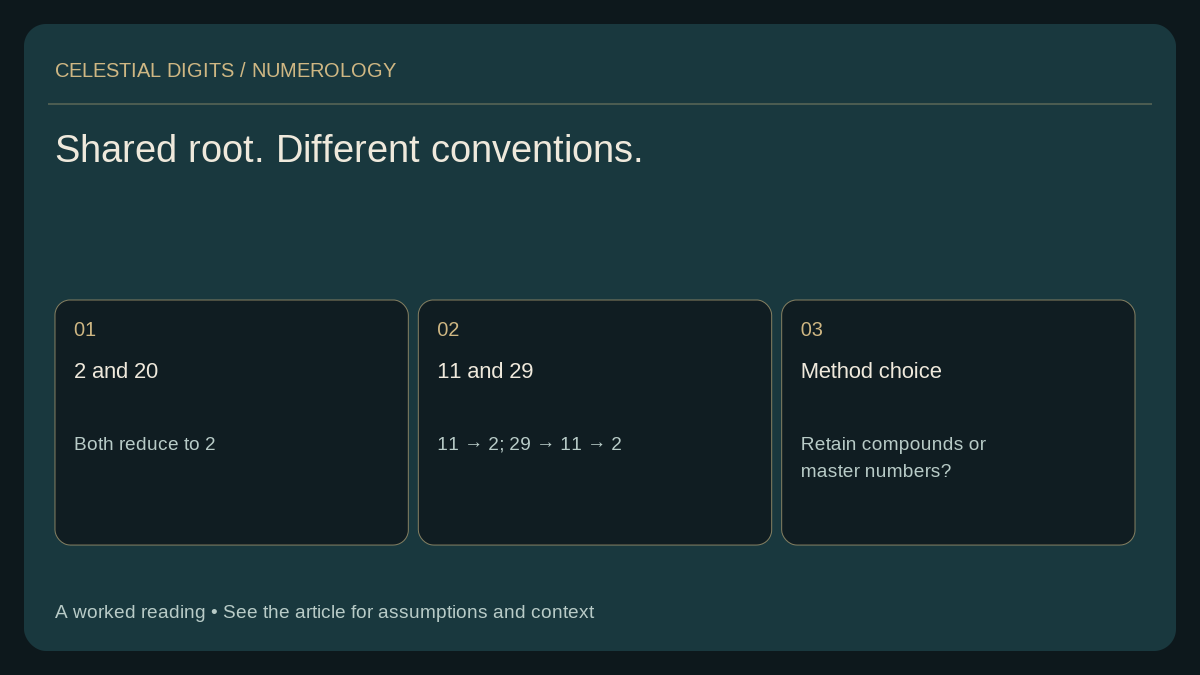
Born on the 2nd, 11th, 20th or 29th: Four Moon-Number Birthdays
Compare root 2 birthdays, understand why 11 may be treated differently across systems, and keep emotional labels out of the arithmetic.
Born on the 6th, 15th or 24th: Comparing Venus-Number Birthdays
Compare three root 6 birthdays through compound symbolism and a practical example about care, commitments and shared costs.
A little more perspective.
Keep discussions respectful. No harassment, hate, sexual content or spam. Comments are reviewed before publication. Report concerns from a comment menu, or contact [email protected].
Checking your session…