
Born on the 2nd, 11th, 20th or 29th: Four Moon-Number Birthdays
Compare root 2 birthdays, understand why 11 may be treated differently across systems, and keep emotional labels out of the arithmetic.
Someone born on the 11th may receive a Moolank 2 report from one website and a master-number reading from another. The first question should be which reduction convention each site follows, not which description sounds more flattering.
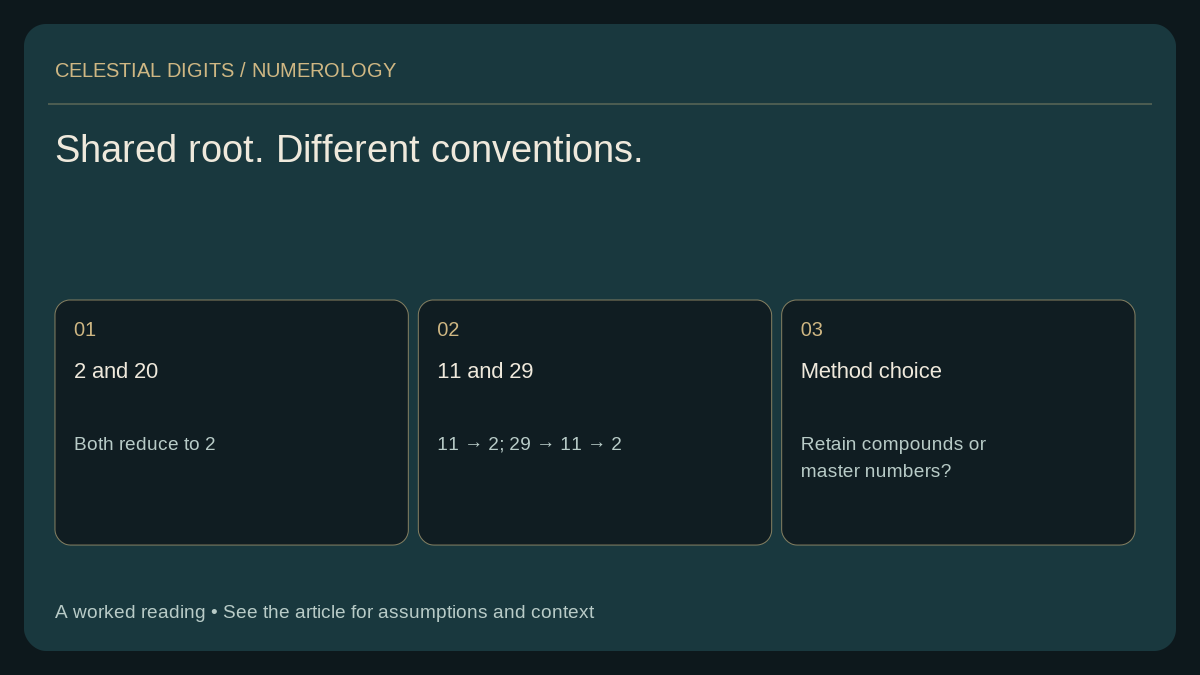
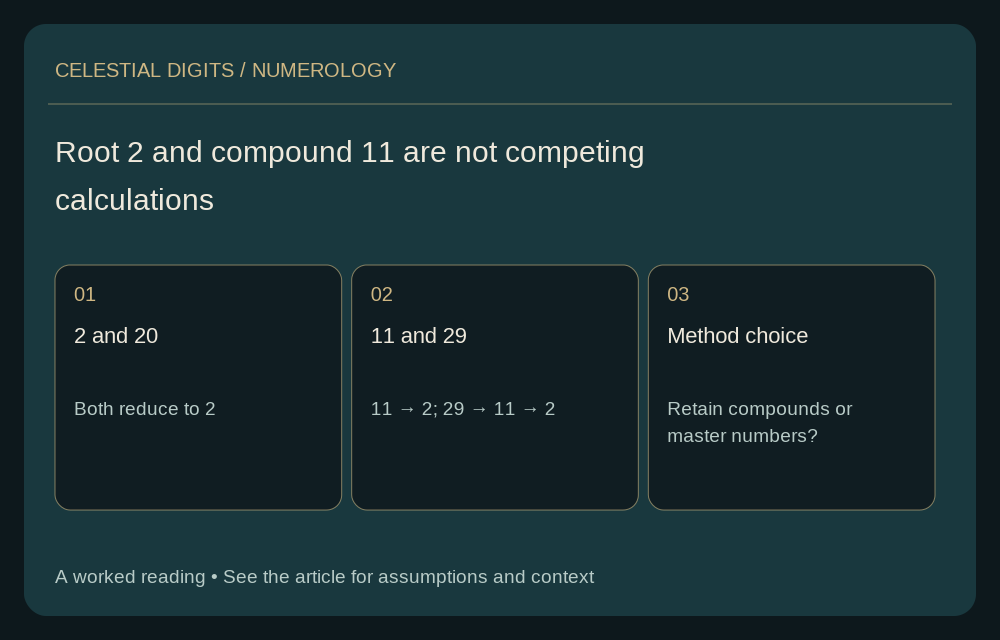
The 2nd, 11th, 20th and 29th share root 2 under single-digit reduction. Their original day records remain different. Whether those compounds receive further meanings is a separate interpretive choice.
Follow the arithmetic all the way#
| Birthday | Single-digit reduction | Preserved record |
|---|---|---|
| 2nd | 2 | 2 |
| 11th | 1 + 1 = 2 | 11/2 |
| 20th | 2 + 0 = 2 | 20/2 |
| 29th | 2 + 9 = 11; 1 + 1 = 2 | 29/2, with intermediate 11 |
The intermediate 11 in the last row is real. It does not make 29 and 11 the same original birthday. A method that retains selected master numbers must explain whether it applies that rule to the birthday, full-date calculation, name total or all three.
Read the Moon association carefully#
Indian planetary numerology links root 2 with the Moon. Responsiveness, cooperation and changing feelings are common symbolic themes. They are not diagnoses, and they do not establish that someone is weak, unreliable or unable to lead.
A useful group-work example concerns how a person responds when a colleague changes a plan. Do they ask what changed, absorb everyone's discomfort or avoid stating their own preference? Those are observable behaviours. The number provides a reflective vocabulary, not an answer in advance.
Why compound descriptions can sound very different#
In Cheiro's compound table, 11 and 29 receive warning-oriented descriptions, while 20 concerns awakening and renewed purpose. Some modern master-number systems instead give 11 a strongly aspirational description. These are different interpretive frameworks, not two arithmetic results that can be settled by adding the digits again.
Reading the old warnings as a literal forecast of betrayal can damage trust without providing evidence. If a relationship concern exists, discuss the actual behaviour and agreement rather than using a birth date to identify an unreliable person.
A comparison exercise that does not manufacture differences#
Ask two people sharing root 2 to describe a recent disagreement. Record what each wanted, what they said and what happened afterwards. Then compare the accounts before reading either compound description.
Perhaps one person was direct and the other avoided conflict. That difference does not require assigning hidden traits to their compounds after the fact. Experience, confidence, responsibilities and the relationship itself offer important context.
If a particular interpretation does not fit, preserve that mismatch in your notes. Otherwise the exercise becomes a way of confirming the description regardless of the evidence.
What belongs in a complete report#
A good report identifies the original birthday, reduction convention and any additional compound source. It calculates Bhagyank separately and states the exact name input if Namank is included. It does not use “Moon number” as a substitute for the natal Moon's sign, nakshatra or phase.
For the historical compound distinctions, consult Cheiro's Book of Numbers, chapters XII–XIII. For our practical approach, continue with Moolank 2 and conflicting birthday and name themes. The comparison is about method and reflection, not ranking birthdays as fortunate or defective.
Related Posts
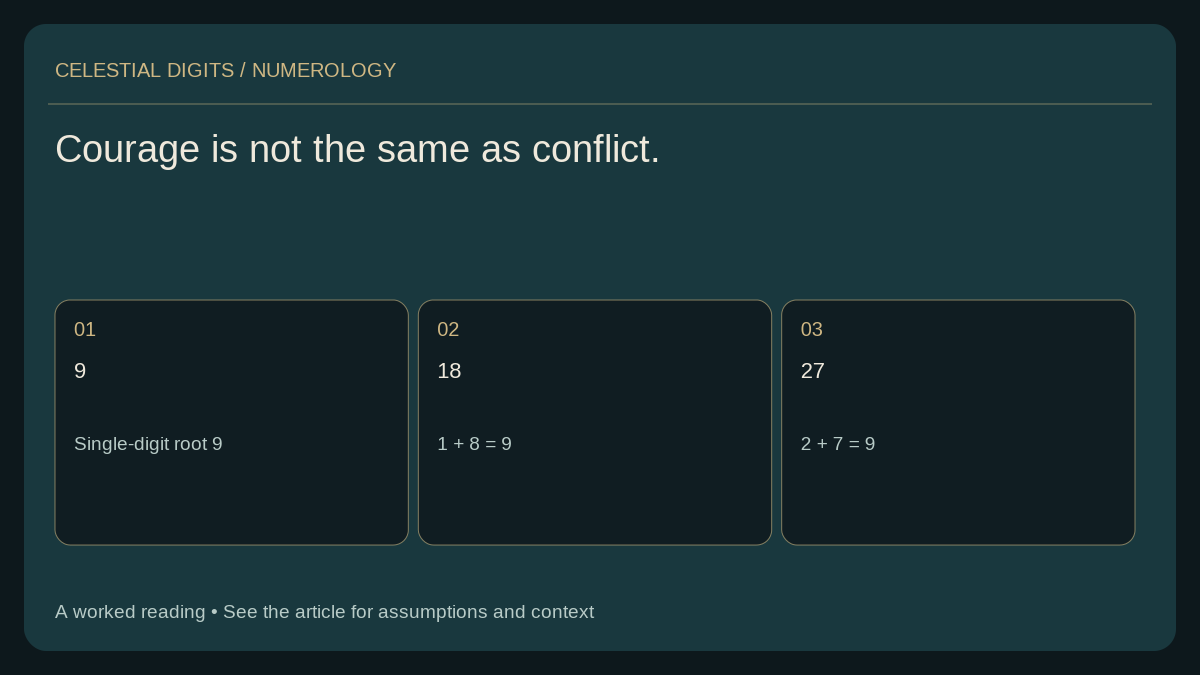
Born on the 9th, 18th or 27th: Comparing Mars-Number Birthdays
Compare three root 9 birthdays through arithmetic, historical compound symbolism and an example about assertiveness and responsibility.
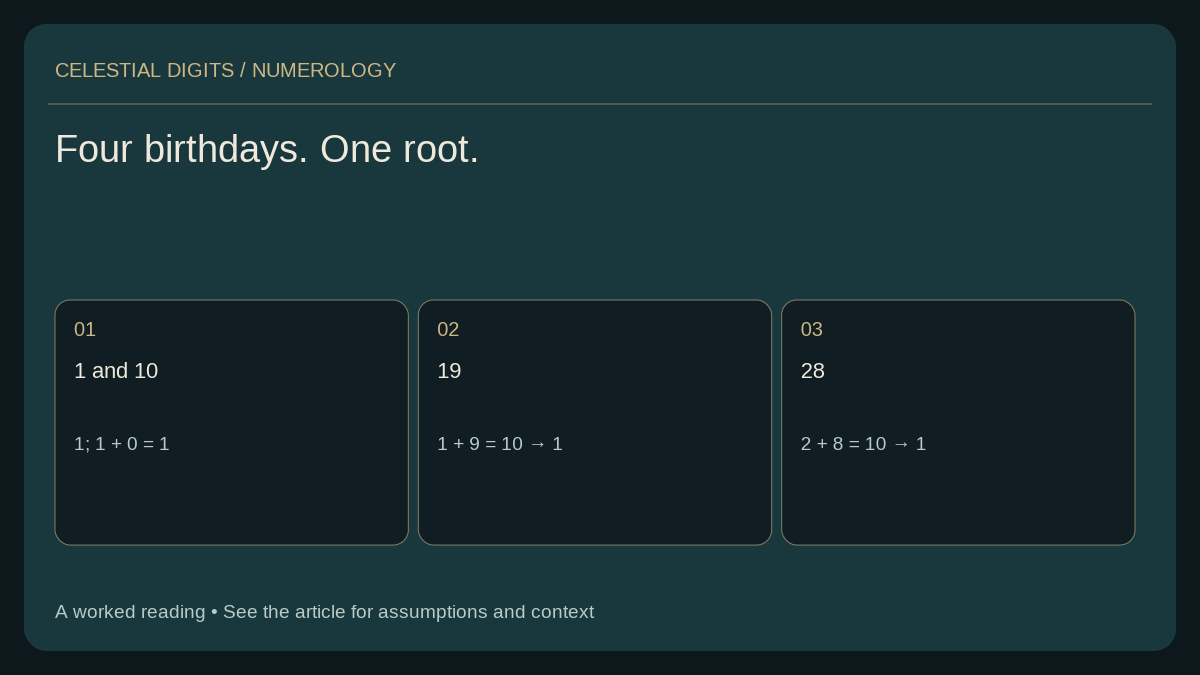
Born on the 1st, 10th, 19th or 28th: What Changes Beyond Root 1?
Compare four Sun-number birthdays, distinguish root arithmetic from compound symbolism, and avoid turning old warnings into predictions.
Born on the 6th, 15th or 24th: Comparing Venus-Number Birthdays
Compare three root 6 birthdays through compound symbolism and a practical example about care, commitments and shared costs.
A little more perspective.
Keep discussions respectful. No harassment, hate, sexual content or spam. Comments are reviewed before publication. Report concerns from a comment menu, or contact [email protected].
Checking your session…