
Bhavat Bhavam: Count Houses from Houses Without Getting Lost
Use inclusive counting to locate the third from the third and tenth from the seventh, with a Virgo example and limits on derived-house readings.
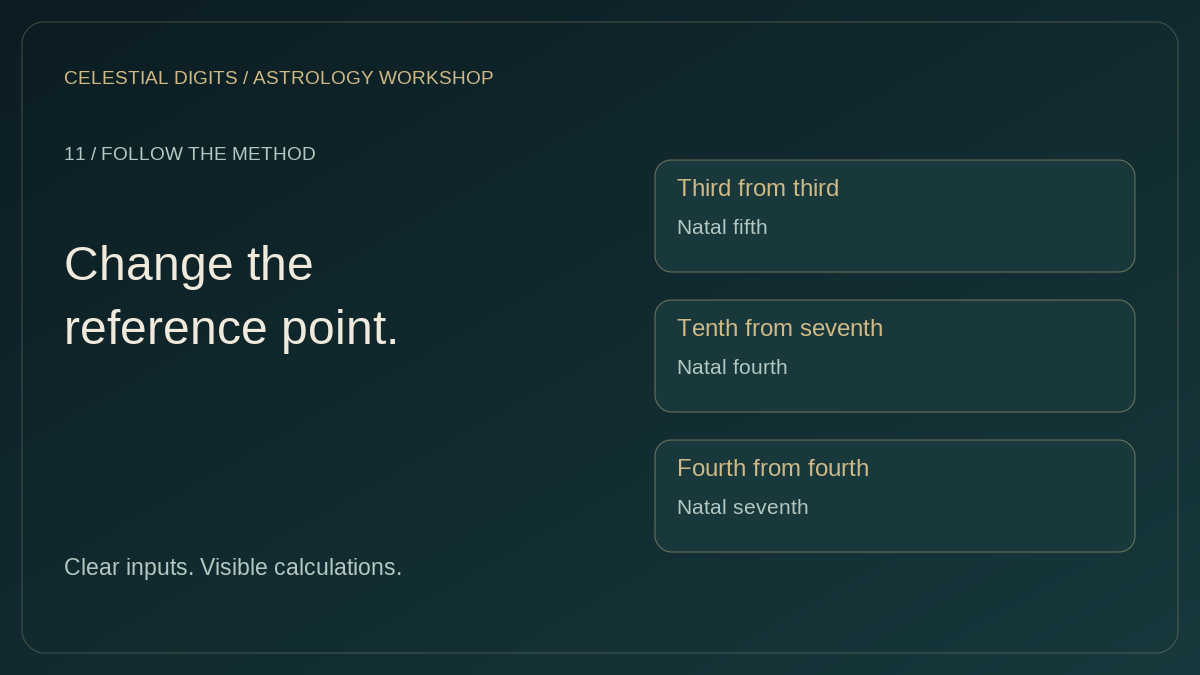
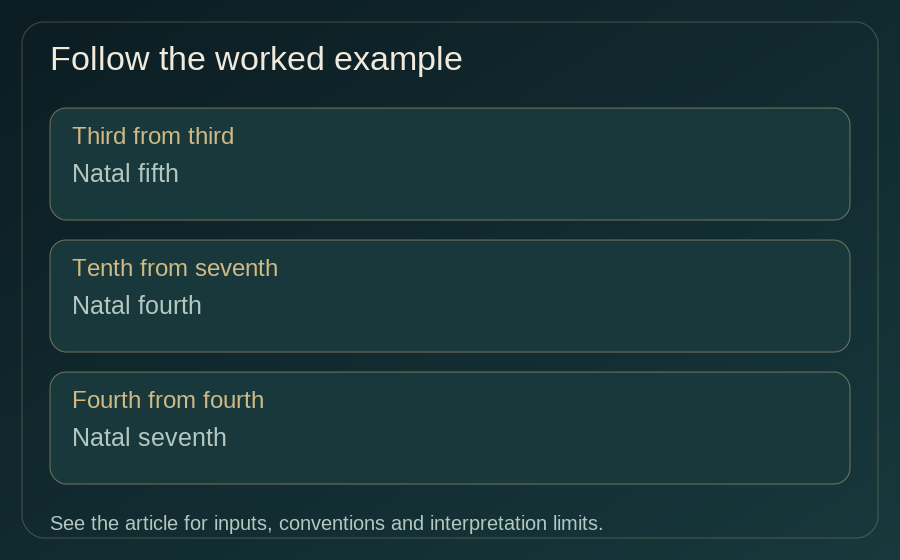
“Third from the third” does not mean add three to three and call the sixth house. Traditional house counting includes the starting house as one. The third from the third is therefore the fifth.
Bhavat bhavam and related derived-house techniques change the reference point inside a chart. They can organize a traditional inquiry, but they also create opportunities for counting mistakes and overextended stories. This guide isolates the counting before considering what it might mean.
Count inclusively#
Start at the natal third house. Call it one, the fourth house two, and the fifth house three. The result is the natal fifth.
For the fourth from the fourth, count fourth, fifth, sixth, seventh. For the seventh from the seventh, count seventh through twelfth and then first. The result is the ascendant, not a thirteenth house.
| Starting house | Relative count | Natal house reached |
|---|---|---|
| Third | Third | Fifth |
| Fourth | Fourth | Seventh |
| Seventh | Seventh | First |
| Seventh | Tenth | Fourth |
A compact check is ((starting house + relative count − 2) remainder 12) + 1. The subtraction accounts for counting the starting house as one, and the remainder wraps the circle.
Use an actual sign sequence#
For a fictional Virgo ascendant with whole-sign houses, the seventh house is Pisces. Counting ten signs from Pisces gives Pisces, Aries, Taurus, Gemini, Cancer, Leo, Virgo, Libra, Scorpio, Sagittarius. Sagittarius is the natal fourth house.
Thus “tenth from the seventh” lands in the fourth. In a traditional spouse-related inquiry, an astrologer may examine this derived point as one contextual indicator concerning the spouse's work. That does not convert it into the spouse's complete birth chart.
The natal fourth still retains its own meanings in the native's chart. A derived reference adds a question; it does not delete the original house or transfer ownership of the whole chart to someone else.
Distinguish repetition from derivation more broadly#
“Third from the third” repeats a house number and is a familiar bhavat-bhavam construction. “Tenth from the seventh” uses the broader derived-house idea without repeating the same number. Naming that distinction keeps a worksheet clearer than calling every possible house count the same technique.
When moving between references, write the starting house and the relative count every time. An unlabeled “fourth-house indicator” can otherwise mean the native's fourth, the fourth from the Moon, or the fourth from a relationship reference.
Avoid unlimited chains#
It is mathematically possible to keep deriving houses indefinitely: a relative of a relative's career, home or resources. Each additional interpretive step adds assumptions. A precise final number does not make those assumptions reliable.
For questions about another person, their own verified chart and their actual circumstances are preferable to an elaborate chain from yours. Do not use derived houses to accuse someone, assert hidden behaviour or claim knowledge of private facts.
Build a small, auditable worksheet#
Write the question, starting reference, count, reached natal house, its sign and lord. Then keep the inference separate: “This is the house reached by the chosen rule,” followed by the traditional meaning being considered.
For practice, verify that the second from the seventh reaches the eighth, while the eleventh from the seventh reaches the fifth. Both follow the same inclusive arithmetic. Our chart reference-point guide explains why the reference should remain visible throughout a reading. The income and savings example shows how to define the question before adding more house relationships.
Related Posts

Jupiter in the Seventh House: Shared Values and Functional Lordship
Read Jupiter in the seventh without a blanket good-marriage promise, using Gemini, Virgo and Capricorn examples and explicitly counted aspects.

Mars–Mercury in Relationships: Speech, Action and Chart Context
Work through Mars–Mercury in Gemini for Gemini and Sagittarius ascendants, checking degrees, aspect directions and the difference between decisiveness and disagreement.

Mars Synastry: Initiative, Pace and Boundaries in Two Charts
Measure Mars contacts across two charts, check a cross-sign boundary example and distinguish house overlays from attraction, consent and compatibility claims.
A little more perspective.
Keep discussions respectful. No harassment, hate, sexual content or spam. Comments are reviewed before publication. Report concerns from a comment menu, or contact [email protected].
Checking your session…