
Chandra, Tara and the Birth of Budha: The Conflict Behind Mercury
The story of Chandra, Tara and Budha: a celestial conflict, the birth of Mercury, and what its symbolism says about emotion, wisdom and clear thinking.
Stories Behind the Grahas · Chapter 1
The conflict · Budha's birth · Did Jupiter accept Mercury? · Astrological meaning
Before Budha became the planet associated with intelligence and speech, his birth was the subject of a dispute that divided the heavens.
At its centre were Chandra, the Moon; Tara, the wife of Brihaspati; and Brihaspati himself, the teacher of the gods, associated with Jupiter. Desire became defiance. A household conflict drew in celestial armies. And when the fighting stopped, the birth of a child reopened the argument.
This is the story behind Budha, Mercury. It is also an unusually uncomfortable story about who gets to speak, who claims authority, and what happens when people use intelligence to defend what they already want.
First, which version are we telling?#
These are Puranic narratives within the wider Hindu tradition. Calling them “Vedic lore” is common in astrology, but this particular retelling draws on the Puranas, not a quoted Vedic hymn.
The versions differ in an important way. The Devi Bhagavata Purana, Book 1, Chapter 11 describes mutual attraction between Tara and Chandra. The Bhagavata Purana, 9.14.4–14 describes Chandra taking Tara by force. Reducing both to a glamorous affair would erase that difference.
Our main narrative follows the Devi Bhagavata account. The astrological reflections later in the article are interpretations, not additional events from the story.
When Chandra would not let go#
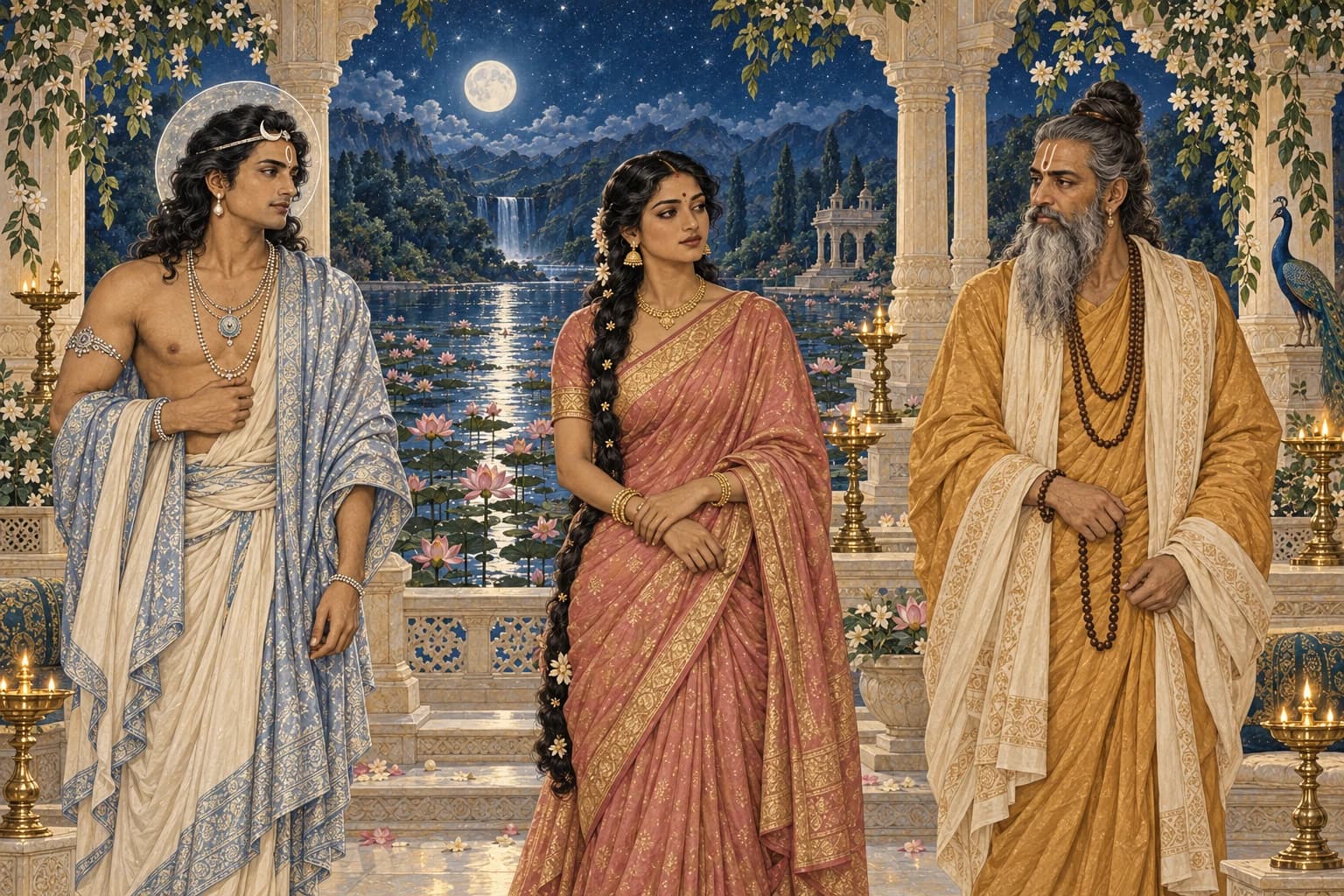
In the Devi Bhagavata, Tara visits Chandra's home. Brihaspati serves as Chandra's priest, so this is already a relationship with obligations: the Moon is not a stranger to her husband.
Tara and Chandra become attracted to each other, and she stays. When Brihaspati sends a pupil to bring her home, she does not return. Repeated messages fail. Eventually, Brihaspati goes himself.
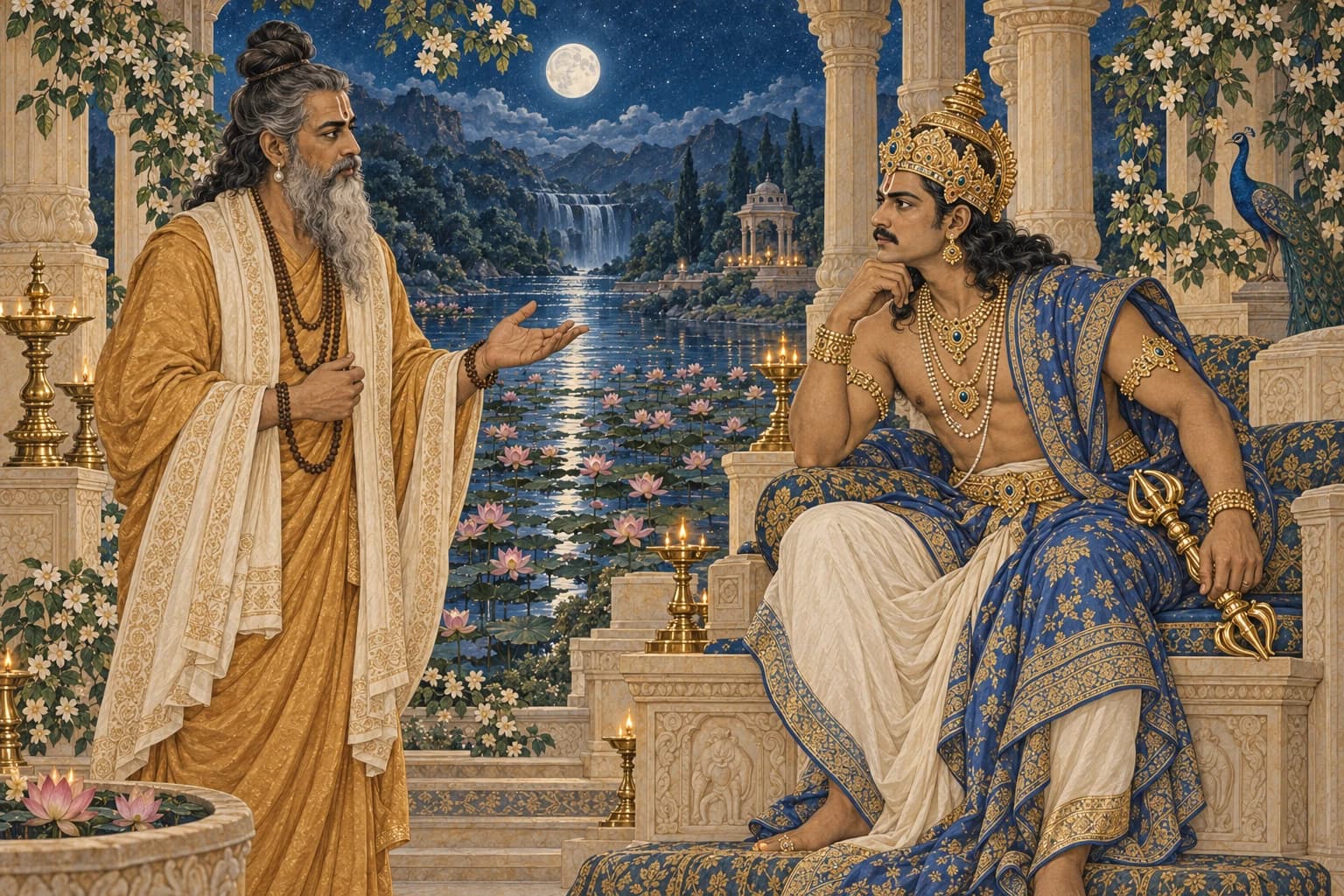
He confronts Chandra with the breach of trust. How can someone disregard the very teacher whose guidance he receives? Chandra refuses to yield. He argues, delays and turns Brihaspati's own learning against him. His speeches mix claims about Tara's wishes with insults and assertions of power.
That is part of what makes the episode compelling. Chandra can find words for his position. Having an argument, however, does not make him fair. His eloquence keeps the conflict alive.
Brihaspati is wounded and furious. When a later attempt to enter Chandra's home is blocked, he appeals to Indra. The dispute has now crossed the threshold of the household.
A private conflict becomes a celestial war#
Indra is the king of the devas, and Brihaspati is their teacher. His appeal therefore carries both personal pain and a challenge to the authority of their guru. Indra first sends a messenger. Chandra still refuses to return Tara.
Old rivalries then enter the picture. Shukra, the teacher associated with Venus, supports Chandra out of hostility towards Brihaspati. Shiva joins the gods' side. What began between a few people becomes a battle involving the devas and asuras.
The enlargement of the conflict feels familiar even without its celestial scale. People take sides for reasons that have little to do with resolving the original injury. An old opponent appears; an alliance becomes a matter of pride; backing down becomes harder than continuing.
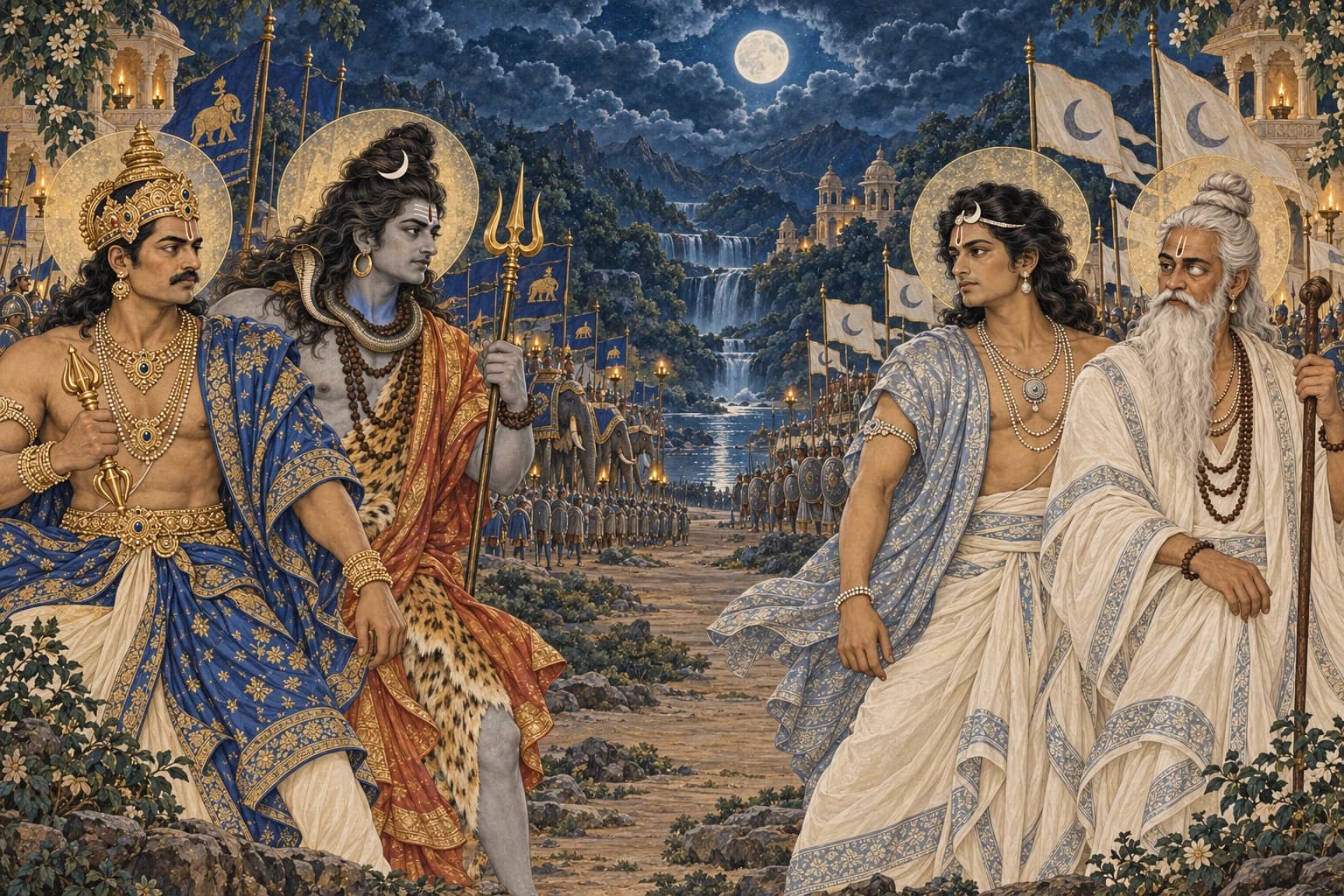
In the story, Brahma intervenes after the fighting has caused destruction. His role here is that of the creator bringing the warring parties to order. He presses for peace, and Chandra finally returns Tara to Brihaspati. The armies disperse.
But Tara is pregnant. The next dispute is already waiting.
The child both men claimed#
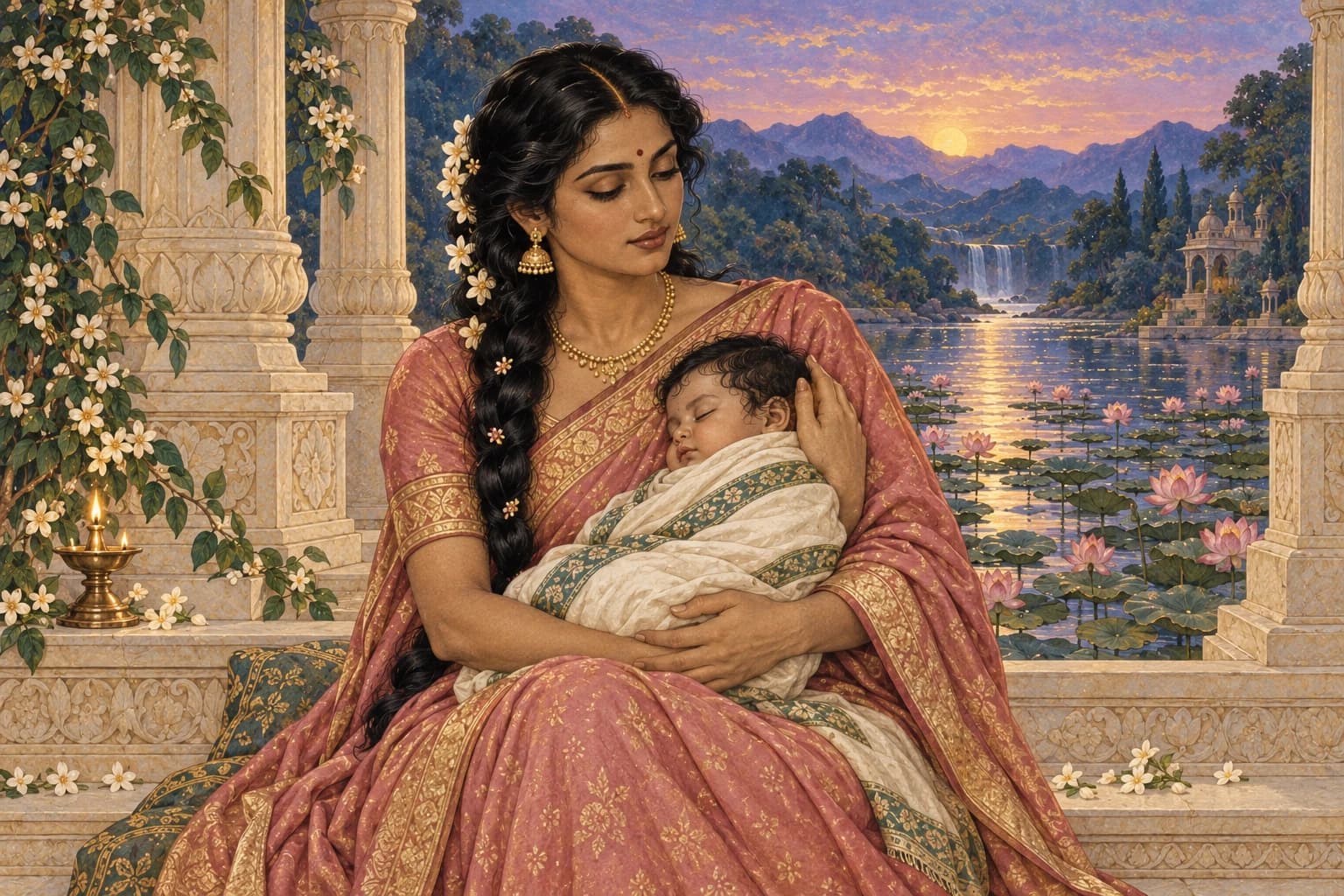
Tara gives birth to a son. In the Devi Bhagavata, Brihaspati gladly performs the child's birth ceremonies. That detail matters: his first response to the newborn is a ritual welcome, not simply rejection.
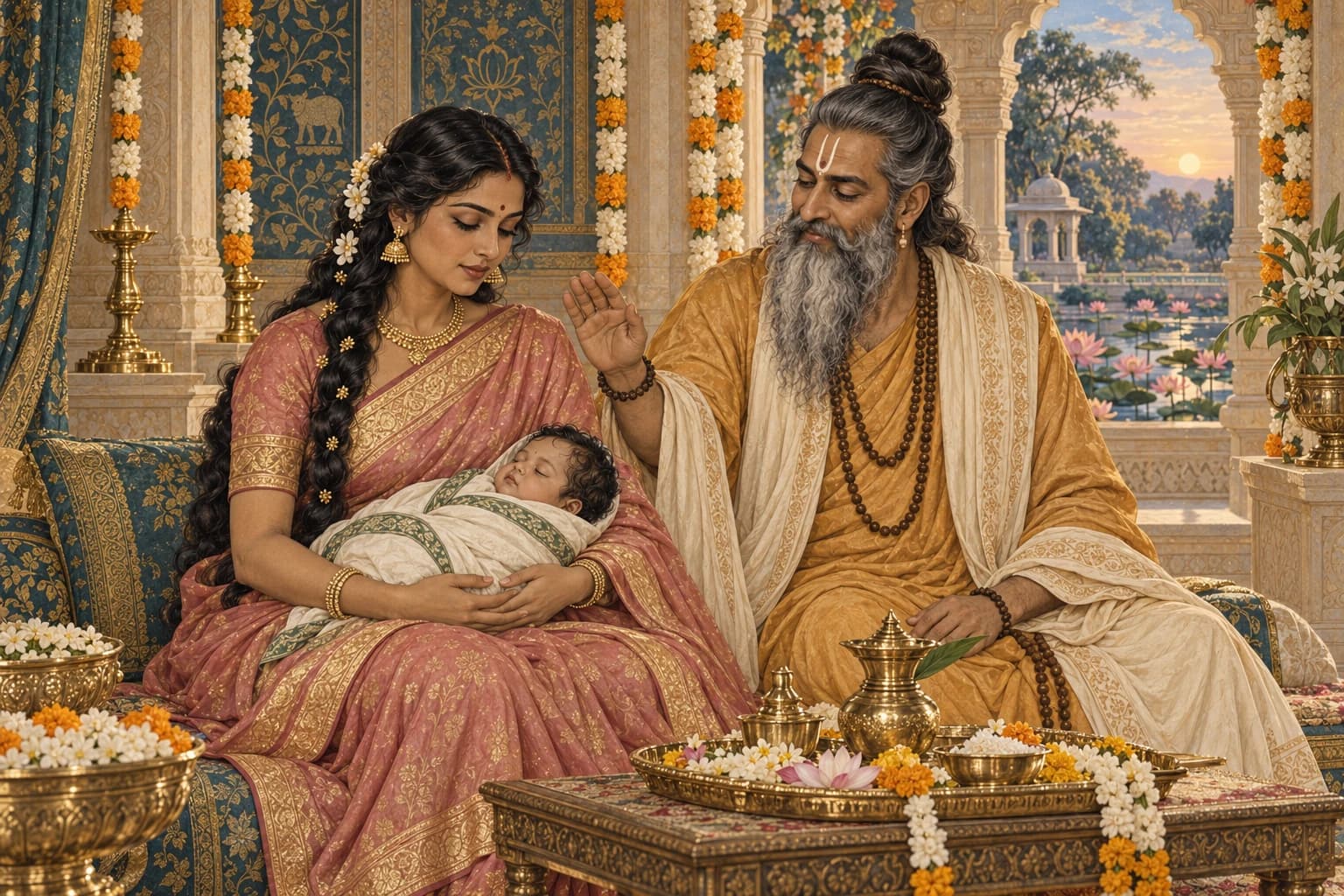
When Chandra hears, he sends a message claiming the child as his own. Brihaspati rejects the claim, and the rival camps gather again.
Brahma intervenes a second time. This time, the question is put to Tara. She identifies Chandra as the father.
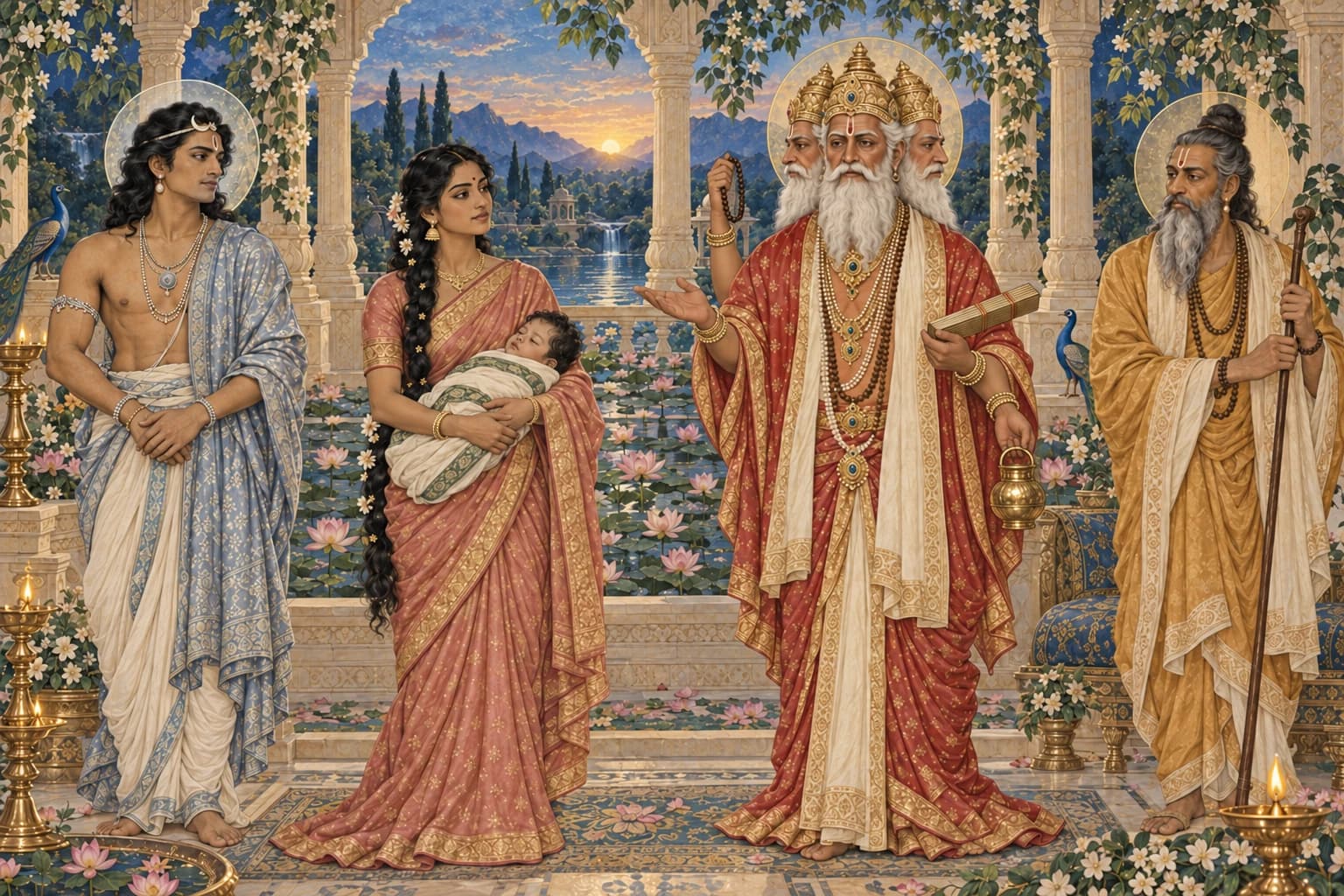
In the Devi Bhagavata account, Chandra names the child Budha and takes him home. The Bhagavata Purana gives the naming to Brahma and explicitly connects the name with the child's intelligence. Both accounts identify Tara and Chandra as his parents, but the small differences deserve to remain visible.
Did Brihaspati accept Budha as his son?#
Initially, he welcomes and claims the child in the Devi Bhagavata account. A lasting adoption after the truth is disclosed is not established by that passage. Those are different questions, and compressing them into “Jupiter rejected Mercury” or “Jupiter raised Mercury” loses the sequence.
Before Tara identifies the father#
Brihaspati performs the birth rites with gladness. When Chandra claims the boy, Brihaspati insists that the child is his. The Devi Bhagavata's birth chapter therefore gives him an active place in Budha's earliest story: he receives the newborn into a ritual and familial setting and contests the claim to fatherhood.
The Vishnu Purana, Book 4, Chapter 6, also describes both men wanting to claim the radiant child. Neither account supports a simple picture of Brihaspati being indifferent to Budha from the moment of birth.
After Tara says the child is Chandra's#
The Devi Bhagavata ends the episode with Chandra naming Budha and carrying him home. It does not then describe Brihaspati adopting him, educating him or becoming his lifelong mentor. Nor does its ending give us a later scene of Brihaspati explicitly rejecting him.
So the careful answer to “Did Jupiter ever accept Mercury?” is: there is an initial welcome and paternal claim; these passages do not settle the question of a later relationship after Chandra's paternity is acknowledged.
Was Jupiter important in Mercury's life?#
Brihaspati is essential to the birth narrative. His relationship with Tara, appeal to Indra, performance of the birth rites and claim to the child all shape its events. That is a substantial role, but it is not the same as a documented account of Budha's upbringing.
You may encounter retellings in which Brihaspati raises Budha and teaches him wisdom. The chapters cited here do not establish that continuation. The appealing idea that Mercury combines the Moon's sensitivity with Jupiter's education should be identified as an interpretation or tied to a specific additional source, rather than quietly added to this version.
What happened to Budha afterward?#
The Vishnu Purana moves from the birth dispute to Budha's connection with Ila and their son Pururavas, carrying the narrative into the lunar dynasty. Budha therefore has a place in the larger genealogical story beyond being the child over whom two men argued. Vishnu Purana, Book 4, Chapter 6.
The text's next concern is lineage, not a detailed childhood biography. That gap is worth leaving visible: we can explain Budha's later importance without filling his early years with unverified scenes of schooling or reconciliation.
Do not lose Tara in a story named after Mercury#
It is easy to retell this as a contest between the Moon and Jupiter, then hurry towards Mercury's astrological meaning. That leaves Tara as little more than the cause of someone else's drama.
Yet the disagreement cannot be resolved by the men's claims alone. Her answer settles the question of parentage. A modern reader can notice how much of the narrative is occupied by people speaking about her before that decisive moment.
The texts also contain possessive language and harsh judgments. Those belong to the narratives and their characters; repeating them as advice for relationships today would be a different choice. Tara's story calls for attention to agency and power, especially when moving between the mutual-attraction and abduction versions.
Why this story matters in astrology#
In Jyotisha, the Moon, Mercury and Jupiter carry different sets of associations. Phaladeepika, Chapter 2, verses 2, 4 and 5, links the Moon with mental tranquillity and nurture-related matters, Mercury with learning and speech, and Jupiter with knowledge, teaching and wisdom.
For this story, those traditional associations give us three useful questions:
| Graha | Traditional themes relevant here | A question for reflection |
|---|---|---|
| Chandra · Moon | Mind, emotional ease, nourishment | What am I feeling and wanting? |
| Brihaspati · Jupiter | Teaching, knowledge, wisdom | What principles should guide my response? |
| Budha · Mercury | Learning, intelligence, expression | What do I actually know, and how can I say it clearly? |
The questions are our way of applying the symbolism. They are not translated verses or a claim that the myth establishes how planets affect human behaviour.
Feeling can give rise to thought without deciding its conclusion#
Budha's birth from Chandra offers a memorable image: thought emerging from a situation charged with feeling.
Consider an unanswered message. The feeling might be hurt. The interpretation might be “they no longer care.” The available fact might only be that no reply has arrived. Distinguishing those three things takes a kind of care we can connect, symbolically, with Mercury's discernment and language.
This does not make emotion the enemy of intelligence. Feelings tell us that something matters. Clear thinking helps us decide what the feeling does—and does not—establish.
Knowing the right words is different from exercising good judgment#
Chandra's arguments do not end the conflict. Several make it worse.
That offers another reading: verbal ability can clarify, but it can also rationalise. Someone may explain a hurtful choice fluently while avoiding responsibility for it. In an everyday disagreement, the useful question is whether our words make the situation clearer or merely make our own position harder to challenge.
Mercury's symbolism becomes more interesting here than “smart person” or “good at business.” It invites attention to what we do with our ability to explain.
A child is more than the circumstances of their birth#
Budha arrives amid competing claims, yet the story remembers him as a significant figure in his own right. As a contemporary reflection, that is a reason to resist reducing anyone to a family conflict they did not choose.
The myth should never become a label for a child, a judgment about parentage, or a way of treating someone else's family history as destiny.
How to explore this in your own chart#
Open your Vedic Birth Chart and find the Moon, Mercury and Jupiter. Note each planet's sign and house separately before moving to conjunctions or aspects.
You can use those placements as prompts for reading: emotional needs for the Moon, communication and learning for Mercury, and values or guidance for Jupiter. Then add the rest of the chart rather than expecting a single combination to retell this myth in your life.
A Moon–Mercury or Moon–Jupiter placement does not establish an affair, disloyalty or disputed parentage. The story is a symbolic lens, not a diagnostic rule. Astrological interpretations are traditional beliefs, not scientifically established predictions of behaviour.
For a more focused next step, read Moon in the twelve houses. If you are still separating the chart's basic layers, start with Moon sign versus ascendant.
Questions readers often ask#
Who are Budha's parents?#
In the two Puranic accounts discussed here, Tara is his mother and Chandra, also called Soma, is his father. Brihaspati is Tara's husband and a central figure in the dispute surrounding Budha's birth.
Is Budha the same as the Buddha?#
No. Budha here refers to Mercury and its deity in the astrological tradition. Buddha refers to the awakened one, most commonly Gautama Buddha. They should not be used interchangeably.
Was Tara abducted, or did she choose Chandra?#
The answer depends on which text you are reading. The Devi Bhagavata describes reciprocal attraction; the Bhagavata Purana describes force. A responsible retelling identifies its source instead of presenting one version as universal.
Does this explain Mercury retrograde?#
No. This is a mythological birth narrative. Apparent retrograde motion is an astronomical observation and is not caused or explained by these events.
Read the sources#
- Devi Bhagavata Purana, Book 1, Chapter 11: On the birth of Budha. Swami Vijnanananda's 1921 English translation; the main source for this retelling.
- Bhagavata Purana, Canto 9, Chapter 14, verses 4–14. A parallel account with important differences concerning Tara and Budha's naming.
- Vishnu Purana, Book 4, Chapter 6. H. H. Wilson's translation; a parallel parentage dispute and the continuation through Ila and Pururavas. The archive's page label says “Chapter IV,” but the chapter heading and text are Book 4, Chapter 6.
- Phaladeepika, Chapter 2. Verses 2, 4 and 5 provide the traditional planetary associations used in the discussion.
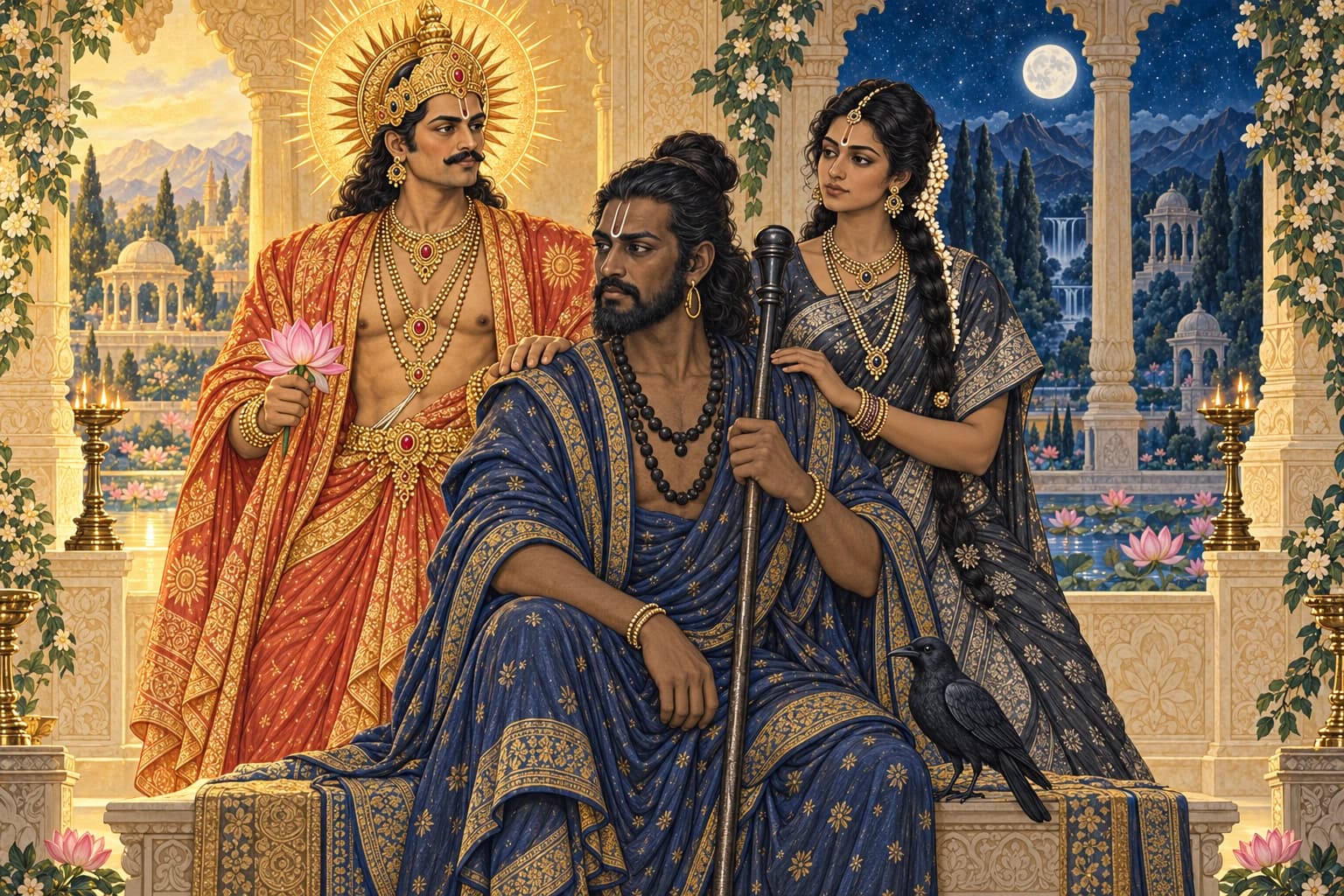
The illustrations are original AI-assisted interpretations, using a shared character and landscape reference for this series. They are not reproductions of historical paintings or claims about a single canonical appearance.
What stayed with you: Chandra's refusal, the way others took sides, or the moment Tara was finally asked? Share your reading in the comments; there is no need to post private birth details.
Next chapter: Chandra, Rohini and Daksha’s Curse.
Read the complete series: Stories Behind the Grahas.
Related Posts
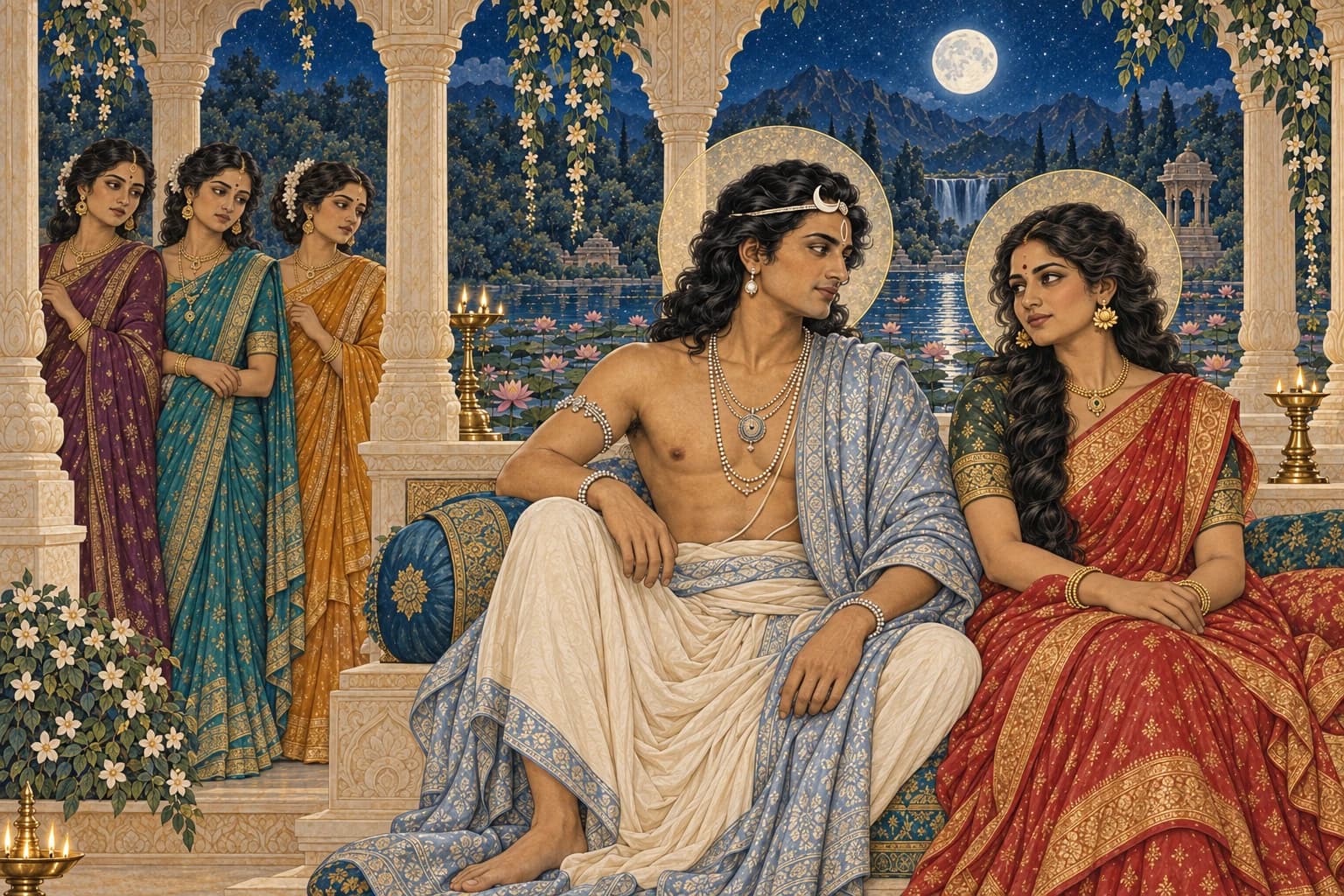
Chandra, Rohini and Daksha’s Curse: Why the Moon Waxes and Wanes
Why did Daksha curse the Moon? Explore Chandra and Rohini’s story, the renewal at Prabhasa, the Somnath tradition, and its meaning in astrology.
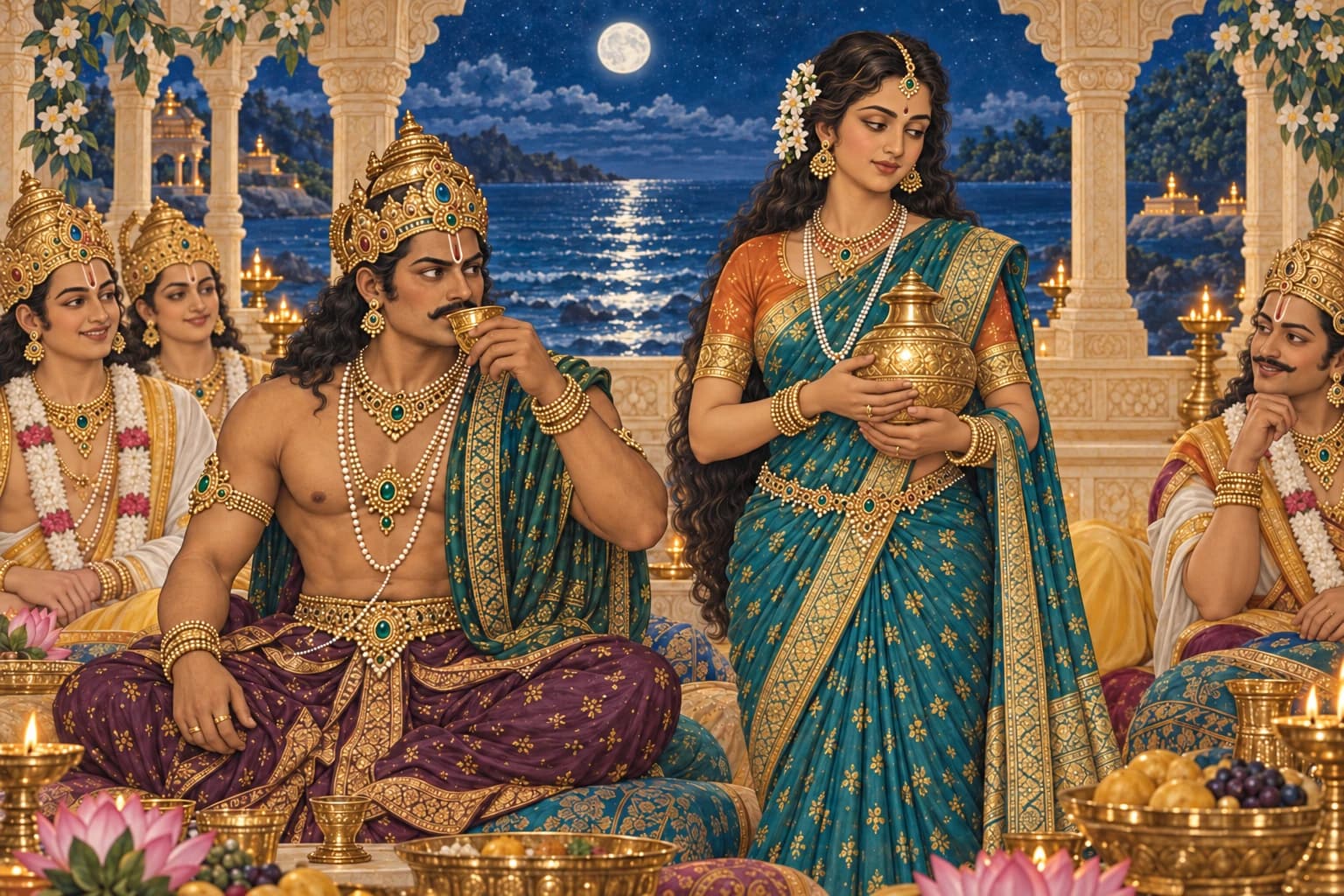
Rahu’s Stolen Immortality: The Story Behind Eclipses
Rahu stole a taste of immortality. Discover the ocean-churning story, why he pursues the Sun and Moon, and what the Rahu–Ketu symbolism means.
Shani, Son of the Sun and Shadow: The Family Story Behind Saturn
Meet Sanjna, Chhaya and Surya in the story of Shani’s birth, and explore Saturn’s symbolism of responsibility, limits and recognition without fear.
A little more perspective.
Keep discussions respectful. No harassment, hate, sexual content or spam. Comments are reviewed before publication. Report concerns from a comment menu, or contact [email protected].
Checking your session…