
Chandra, Rohini and Daksha’s Curse: Why the Moon Waxes and Wanes
Why did Daksha curse the Moon? Explore Chandra and Rohini’s story, the renewal at Prabhasa, the Somnath tradition, and its meaning in astrology.
Stories Behind the Grahas · Chapter 2
The neglected sisters · The curse · Shiva and Somnath · Rohini in your chart
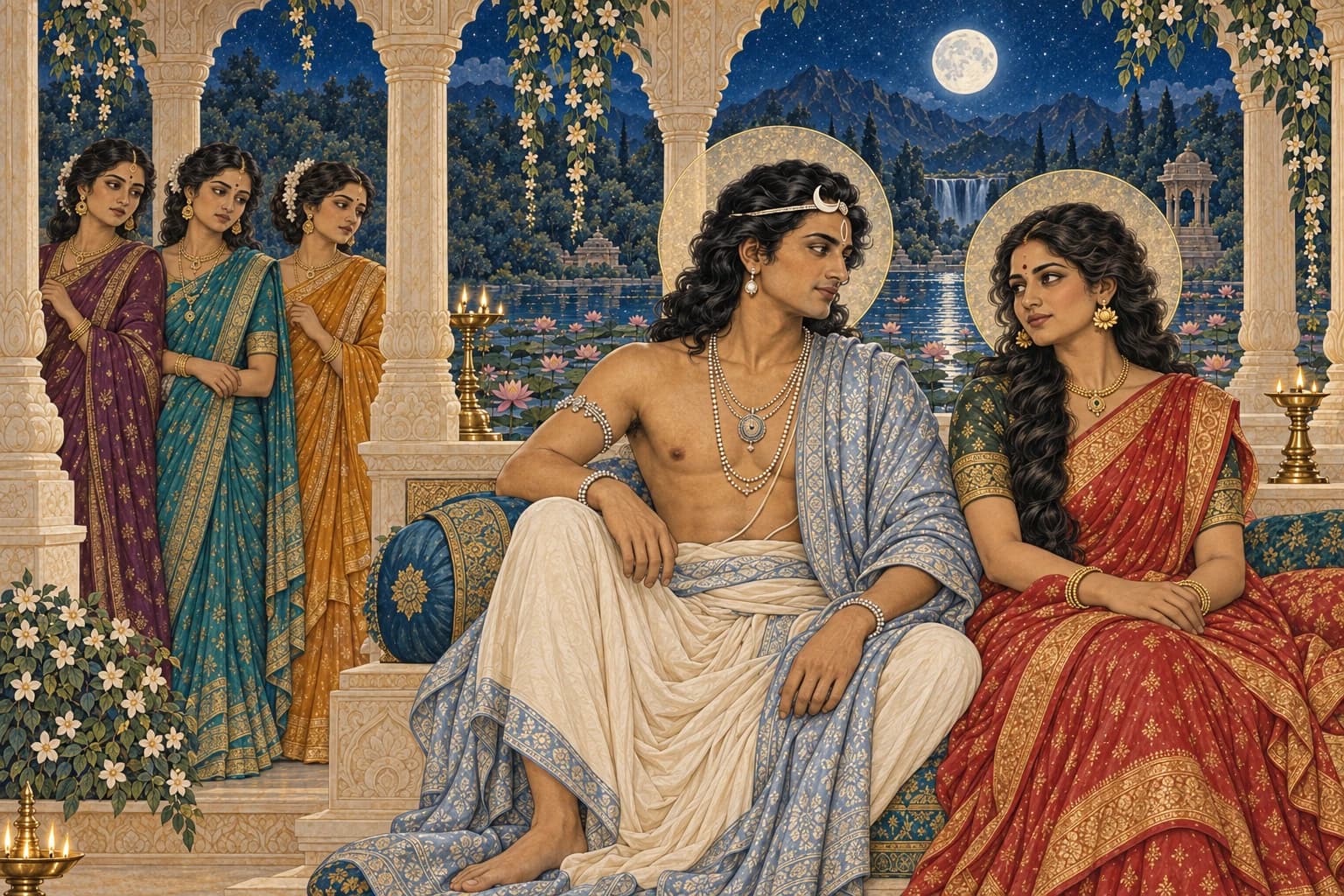
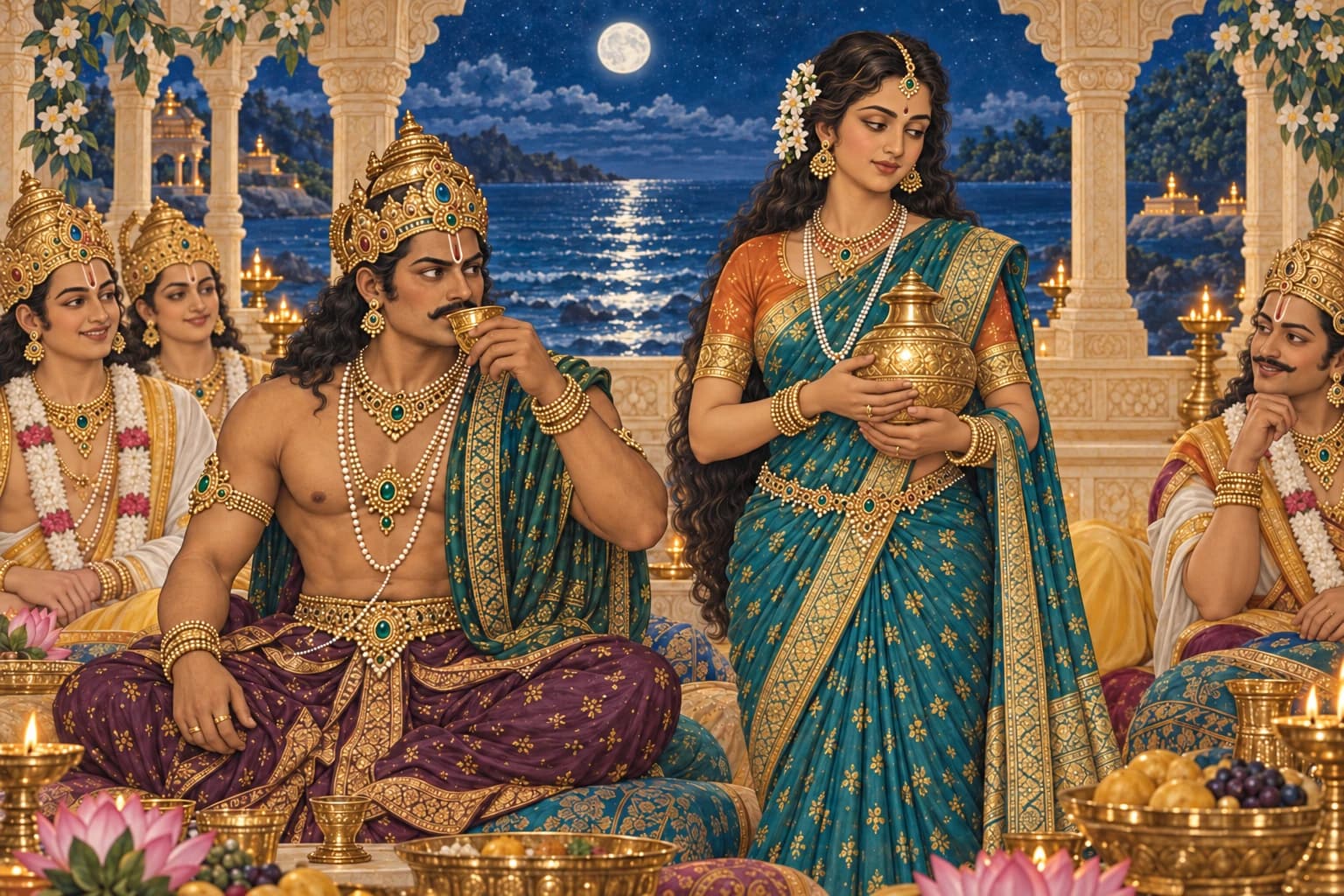
The Moon had twenty-seven wives. He kept returning to one.
Her name was Rohini. Chandra found her so captivating that the others became almost invisible to him. They asked their father to intervene. He warned Chandra. The Moon carried on.
Then the light began to leave him.
This is the story of Daksha’s curse: a tale in which affection becomes neglect, a private failure unsettles the world, and recovery arrives with a condition. The Moon can shine again. He cannot stay full forever.
If you read our Chandra, Tara and Budha story, you have already met a Moon whose desires outrun his judgement. Here, another narrative asks what happens when the being who nourishes others refuses to share his attention.
Twenty-seven wives, one favourite#
Our main retelling follows the Mahabharata, Shalya Parva, section 35, where the story explains the sacred place Prabhasa during Balarama’s pilgrimage. A related Shiva Purana account gives the ending a different emphasis; we will come to that separately. These are epic and Puranic traditions, rather than a single quoted Vedic hymn.
Daksha gives his twenty-seven daughters in marriage to Soma, another name for Chandra. The text connects them with the constellations used to reckon time. Rohini is especially beautiful, and Chandra delights in her company.
The trouble is what happens to everyone else.
His other wives are left without his companionship. They go to Daksha and say they would rather remain with their father. Daksha tells Chandra to treat them equally, then sends his daughters home with the assurance that the Moon will listen.
He does not. The women return. Daksha warns him again. Chandra continues to stay with Rohini. The story repeats the appeal and the warning before it reaches the curse. The injury has been named, and he has been given opportunities to change. Read the Mahabharata account, translated by K. M. Ganguli.
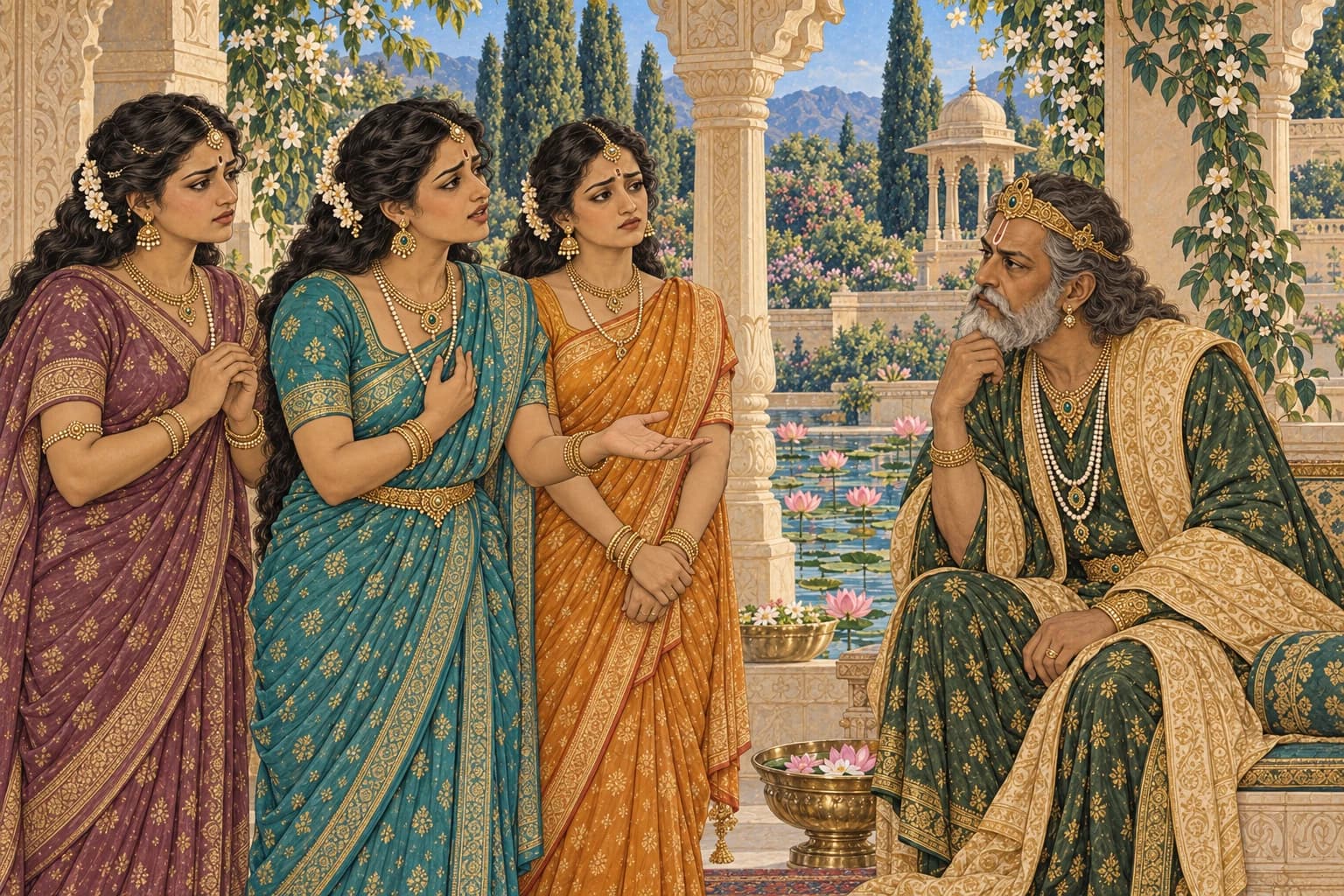
It is easy to retell this as a story of jealous sisters. That misses their complaint. They are asking for a place in a relationship to which Chandra has already committed himself.
Nor does the episode need Rohini to become a villain. Chandra is responsible for his conduct. Being loved most is not the same as choosing to neglect everyone else.
When the Moon began to disappear#
At last, Daksha curses Chandra with a wasting affliction. His radiance fades; he grows weaker day by day. He attempts sacrifices, but they do not release him.
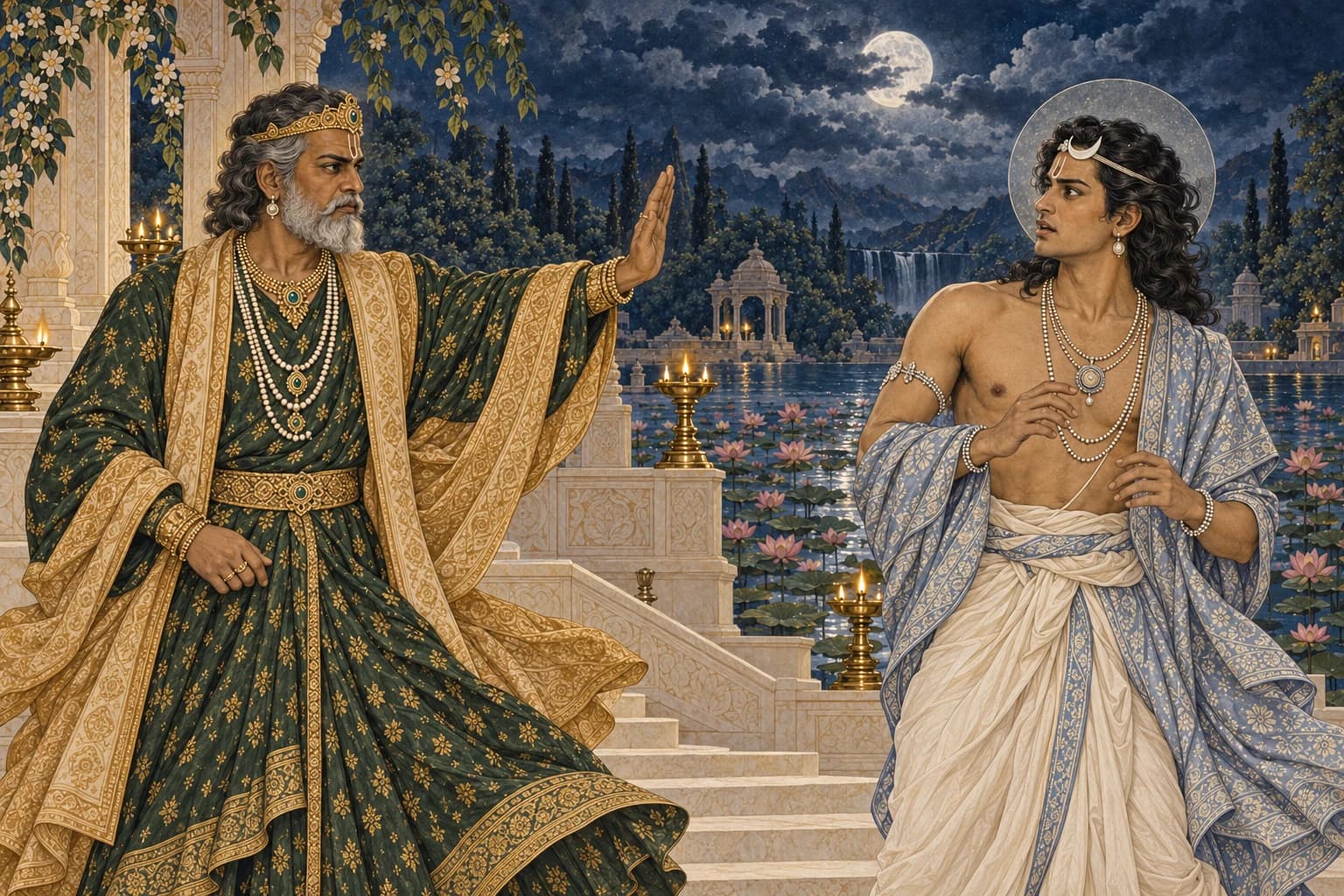
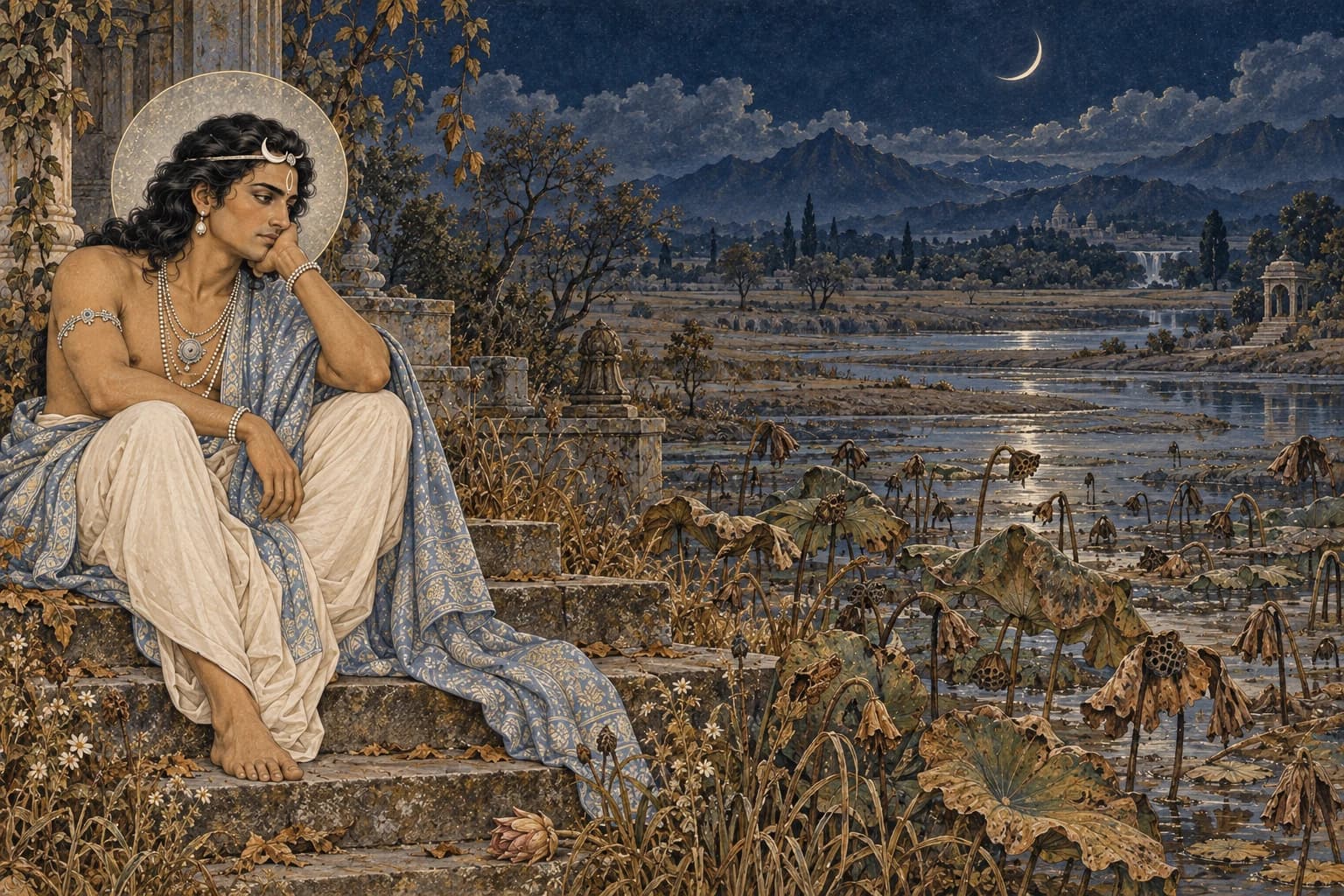
Then the consequences spread beyond the family. In the epic’s sacred cosmology, herbs lose their vitality as Soma wanes. Living beings weaken. The gods themselves suffer, and they come to ask what has happened.
The Moon explains. Now the gods appeal to Daksha: if Soma keeps declining, the harm will reach everything that depends upon him.
This is one of the story’s most striking turns. Chandra has neglected the needs of others; his own loss of vitality reveals how much life depends on nourishment. The narrative makes that dependence visible in the fading landscape. It is a mythic account of the world’s interconnection, not a medical or botanical explanation.
Recovery at Prabhasa#
Daksha does not simply erase his words. He offers a way for the decline to become a cycle: the Moon will diminish for one half of the month and grow again during the other.
There is also an instruction that can disappear from shortened retellings: Chandra must treat his wives equally. The remedy concerns his conduct as well as his light.
Daksha directs him to the place where the Sarasvati meets the western ocean, to bathe and worship Mahadeva. Chandra reaches Prabhasa and bathes there at the new moon. His cool rays return. The restored Moon goes back to Daksha, who receives him with pleasure and again tells him not to disregard women. Chandra returns home, and living beings rejoice.
The passage ends by connecting the recurring new moon with Soma’s renewal at Prabhasa. It gives the lunar cycle a sacred geography: a place to return to when the light has run low. Mahabharata, Shalya Parva 35.
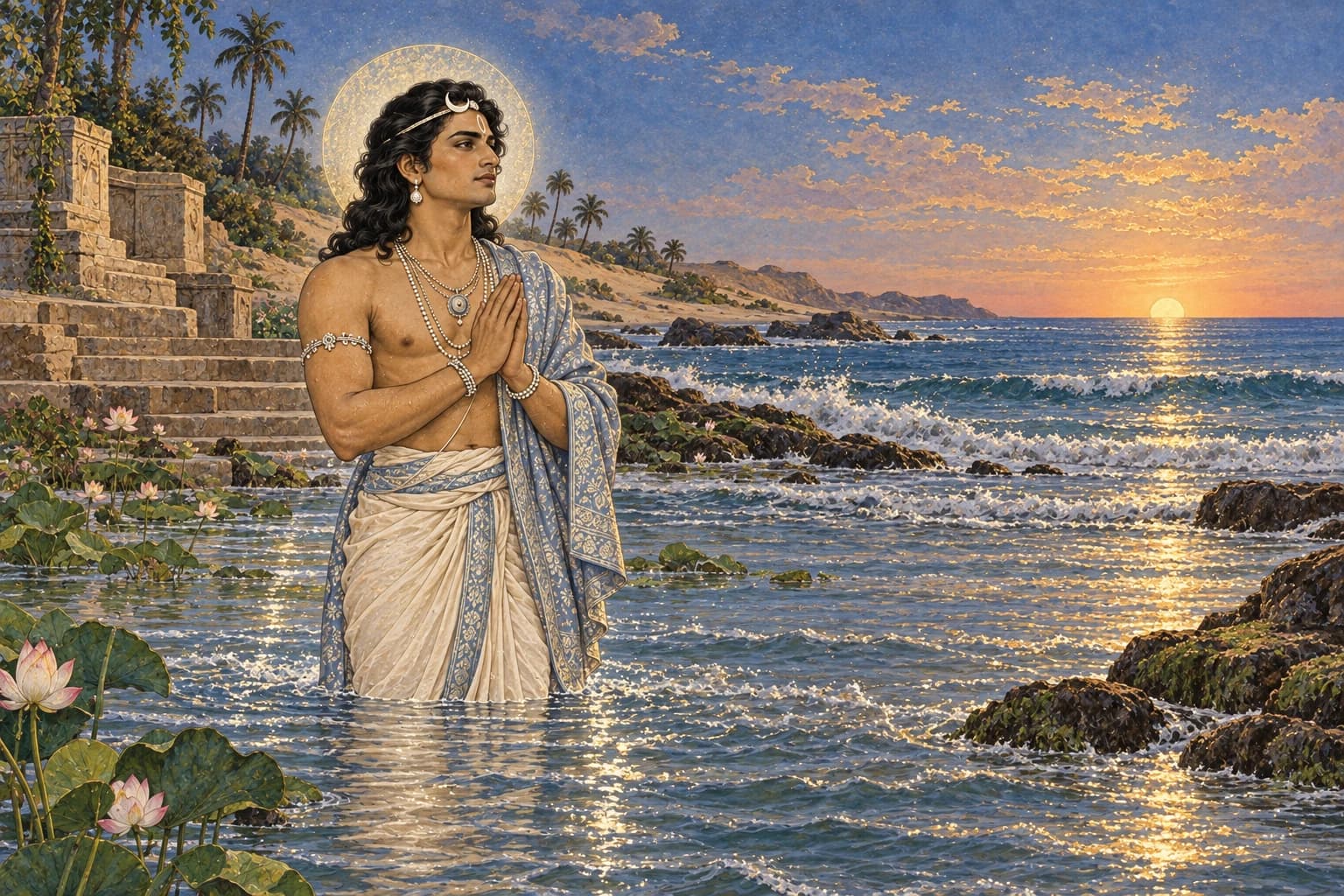
Did he become a fair husband afterwards? This passage records the instruction, his welcome and his return. It does not give us a detailed account of his later household. We can recognise the lesson without inventing a perfect reconciliation that the text does not narrate.
Where Shiva and Somnath enter the story#
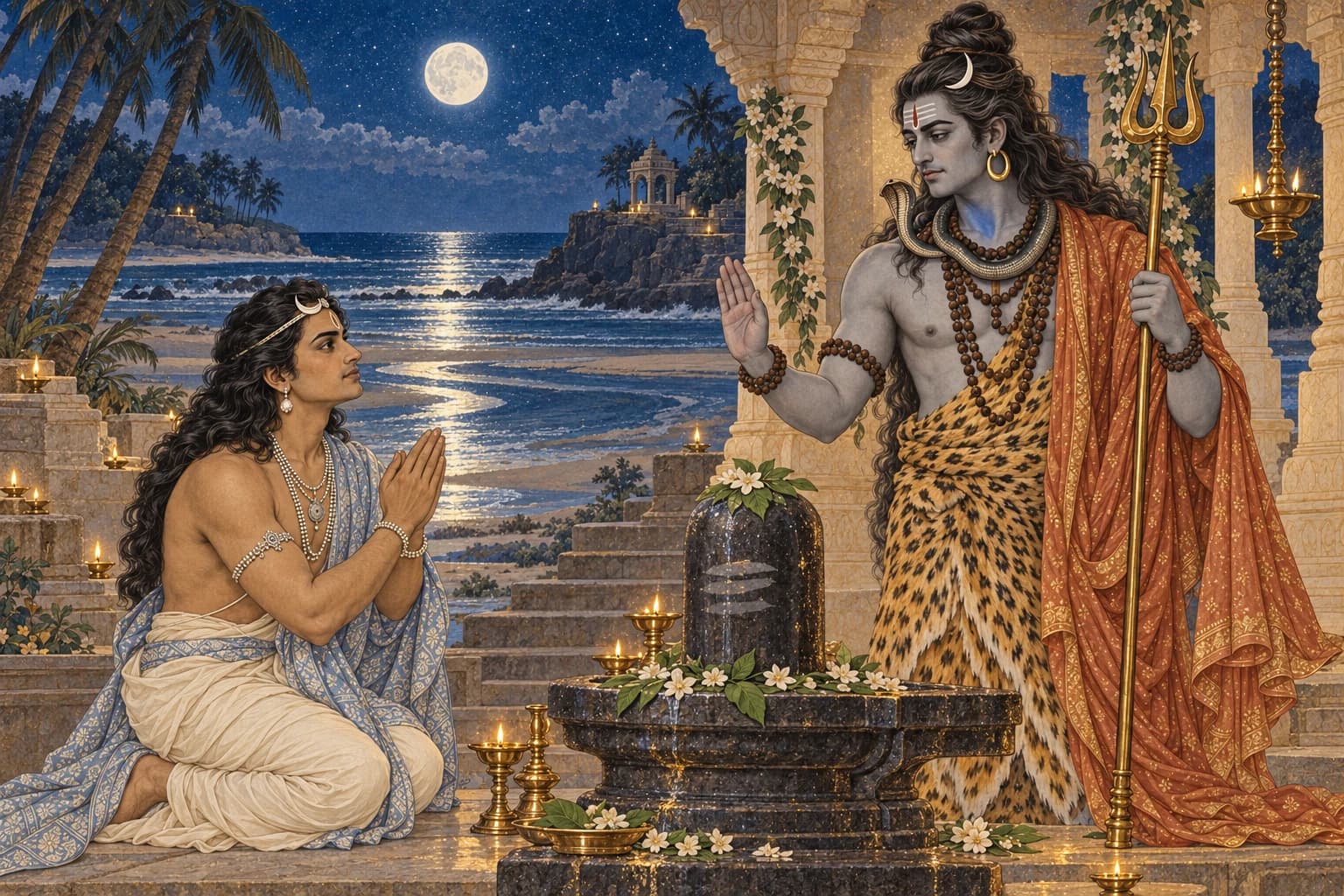
The Shiva Purana, Kotirudra Samhita, chapter 14, tells a related version. Brahma advises Chandra to worship Shiva at Prabhasa. Following prolonged devotion, Shiva appears and grants alternating decline and growth. At the gods’ request, Shiva remains there as Someshvara, associated with Somnath. Read the Shiva Purana chapter.
The Mahabharata also directs Chandra to worship Mahadeva. The distinction is who announces the lunar cycle: Daksha in that account; Shiva in the Purana’s boon. Both belong in the telling, with their sources kept visible.
Why twenty-seven wives, but a longer lunar month?#
The twenty-seven wives connect the story with the nakshatras, the lunar mansions of Jyotisha. But the Moon’s journey among the stars and its cycle of visible phases measure different things.
| What you are tracking | What changes |
|---|---|
| Nakshatra position | Where the Moon lies along the stellar zodiac |
| Lunar phase | How much of the Moon’s sunlit side we see from Earth |
The Moon takes roughly 27.3 days to orbit Earth relative to the stars, while a cycle from one new moon to the next takes about 29.5 days. During that time, Earth and the Moon also move around the Sun, so the same phase takes longer to return. Phases come from our changing view of the illuminated half of the Moon; Earth’s shadow causes lunar eclipses, not the ordinary monthly phases. NASA explains the Moon’s phases.
The story gives the cycle a human and sacred meaning. Astronomy describes the geometry. We do not need to confuse the two to appreciate either.
What does Rohini mean in your chart?#
In the sidereal zodiac used by our chart tools, Rohini spans 10°00′ to 23°20′ of Taurus. It is one nakshatra within that sign. A person can therefore have their Moon in both Taurus and Rohini: those labels describe different layers of the same position.
There are also different kinds of “lord”, which should not be mixed together:
| For a Moon placed in Rohini | The relevant name |
|---|---|
| Zodiac sign | Taurus |
| Sign lord | Venus |
| Nakshatra | Rohini |
| Nakshatra’s planetary lord | Moon |
| Nakshatra deity | Prajapati |
Venus ruling Taurus does not make Venus the planetary lord of Rohini. And a nakshatra’s deity is a separate category from its planetary ruler. Our Rohini nakshatra guide explores these details and the placement’s traditional symbolism.
The tale’s attraction to beauty can help explain why Rohini is often discussed through themes of growth, appeal and the wish to cultivate something precious. But a story is not a diagnosis of the person whose chart contains that nakshatra.
Having Rohini prominent does not mean someone will be unfaithful, possessive or destined for a love triangle. Nor does another nakshatra make a person one of the “neglected wives”. Characters in a narrative are not personality verdicts assigned at birth.
What this story invites us to notice#
Traditional Jyotisha associates the Moon with the mind and emotional experience; for example, Phaladeepika 2.2 includes the mind among the Moon’s significations. The reflections below use that symbolic framework. They are not scientifically established predictions about behaviour.
Attention is part of affection#
Chandra’s failure is visible in where he spends his time. In ordinary life, something similar can happen when one relationship, ambition or source of comfort receives all our attention while other responsibilities quietly go unattended.
The useful question is not “Who is my Rohini?” It is: who or what keeps asking for care that I keep postponing?
A repeated complaint deserves a different response#
Daksha’s warnings are not heard just once. The story gives Chandra several chances to recognise the same injury. Reassurance without changed behaviour sends the sisters back to where they began.
That makes this a story about listening as much as desire. If the same concern keeps returning in a relationship, explaining our intentions may be less useful than changing what the other person actually experiences.
Renewal does not require permanent fullness#
Chandra’s light returns in a rhythm. Read symbolically, the ending leaves room for recovery without demanding uninterrupted brightness.
Human energy also changes, though this story does not establish that lunar phases cause any particular mood. Its gentler insight is that a quieter period need not mean the capacity to shine has gone forever. Rest, repair and renewed attention belong in a life too.
Explore your Moon without reducing yourself to it#
To start with your own chart, identify the Moon’s sign, nakshatra and house separately. Then consider the rest of the chart rather than turning one placement into the whole explanation of a person.
You can open your birth chart, read our Moon in the twelve houses guide, or explore the complete nakshatra series.
Chandra’s story endures because beauty and care are not always the same thing. He can illuminate the heavens and still fail to notice the people nearest him. The path back asks for more than renewed radiance. It asks him to pay attention.
This illustrated series retells Hindu epic and Puranic narratives, with sources identified where accounts differ. The images are original artistic interpretations. Chapter order is editorial, not a claim that every tradition places these events in the same chronology.
Previous chapter: Chandra, Tara and the Birth of Budha.
Next chapter: Rahu’s Stolen Immortality.
Read the complete series: Stories Behind the Grahas.
Related Posts
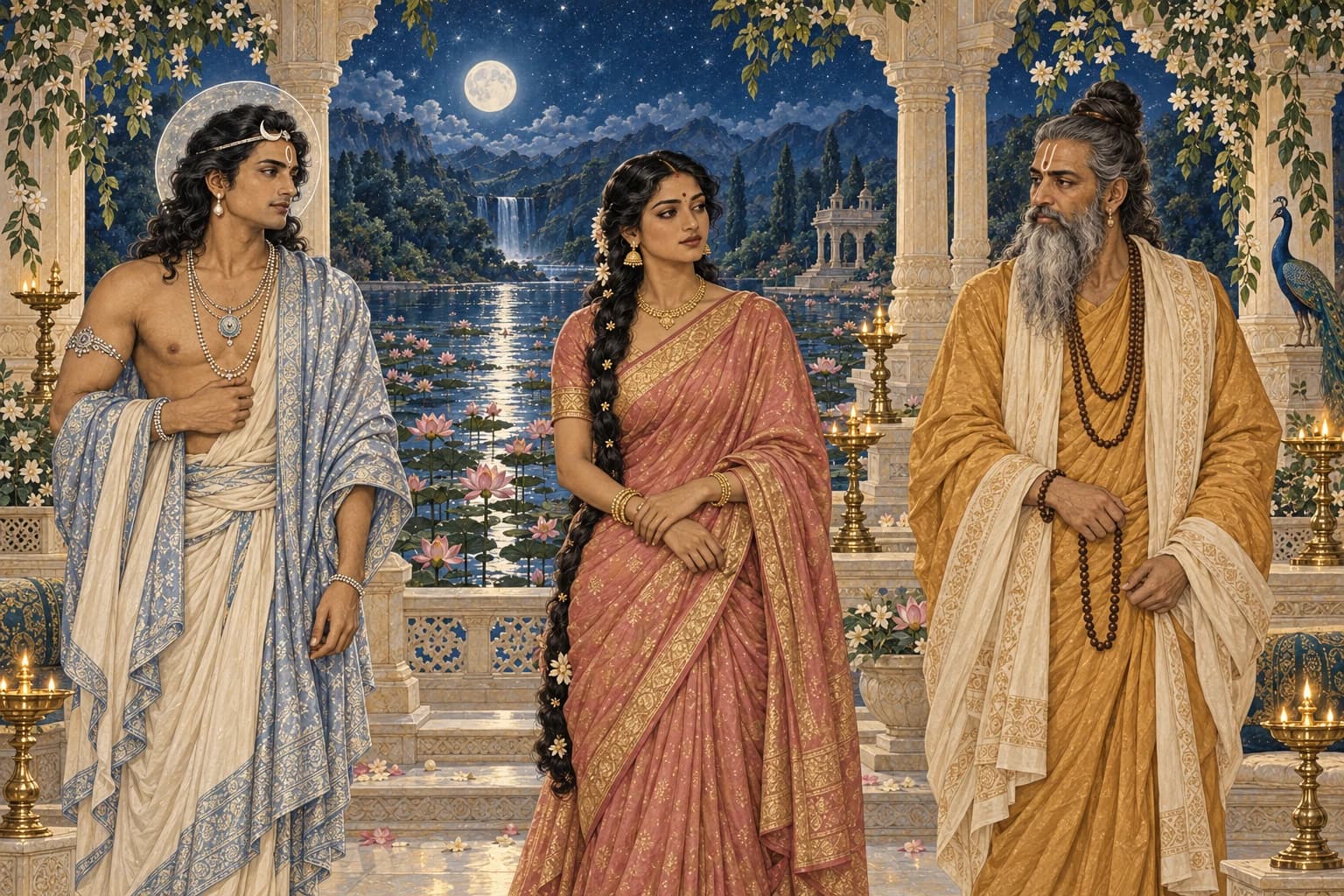
Chandra, Tara and the Birth of Budha: The Conflict Behind Mercury
The story of Chandra, Tara and Budha: a celestial conflict, the birth of Mercury, and what its symbolism says about emotion, wisdom and clear thinking.
Rohini Nakshatra: Traits, Ascendant Behavior, and House Effects
Strictly Vedic guide to Rohini nakshatra covering its deity, ruler, ascendant behavior, and house-wise effects from Lagna.
Rahu’s Stolen Immortality: The Story Behind Eclipses
Rahu stole a taste of immortality. Discover the ocean-churning story, why he pursues the Sun and Moon, and what the Rahu–Ketu symbolism means.
A little more perspective.
Keep discussions respectful. No harassment, hate, sexual content or spam. Comments are reviewed before publication. Report concerns from a comment menu, or contact [email protected].
Checking your session…