
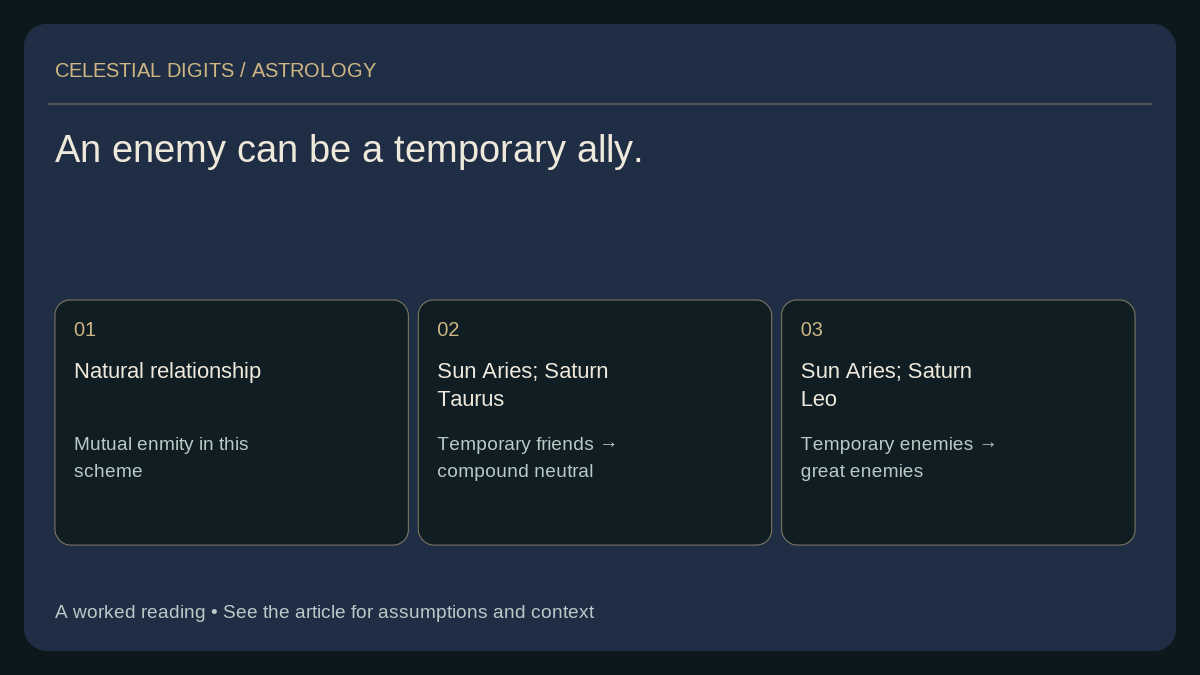
Planetary Friendship: Natural, Temporary and Compound Relationships
Work through Sun and Saturn in two sign configurations to see how natural and temporary relationships combine.
When an astrology table calls two planets friends, it may refer to a fixed natural relationship, a temporary relationship in the particular chart, or a compound result. Those are three different labels. A useful report tells you which one it is displaying.
We will use the Sun and Saturn because their natural relationship is straightforward in the common Parashari table. The example concerns chart classification, not a judgement about fathers, employers or older relatives.
Natural friendship does not depend on today's placement#
In the scheme used here, the Sun and Saturn are mutual natural enemies. That classification remains the same whether they occupy adjacent signs or are widely separated. Other planetary relationships can be asymmetric, so do not assume every row of a friendship table mirrors the reverse row.
Natural friendship is also different from functional beneficence. A planet's house ownership depends on the ascendant; its natural friendship table is a different part of the method.
Temporary friendship follows relative positions#
The cited Parashari rule treats planets in the second, third, fourth, tenth, eleventh or twelfth from one another as temporary friends. The remaining relative positions produce temporary enmity. Count the starting sign as one.
Example A: Sun in Aries, Saturn in Taurus. Taurus is second from Aries; Aries is twelfth from Taurus. Both positions belong to the temporary-friend group.
Example B: Sun in Aries, Saturn in Leo. Leo is fifth from Aries; Aries is ninth from Leo. Neither is in that group, so the temporary relationship is hostile.
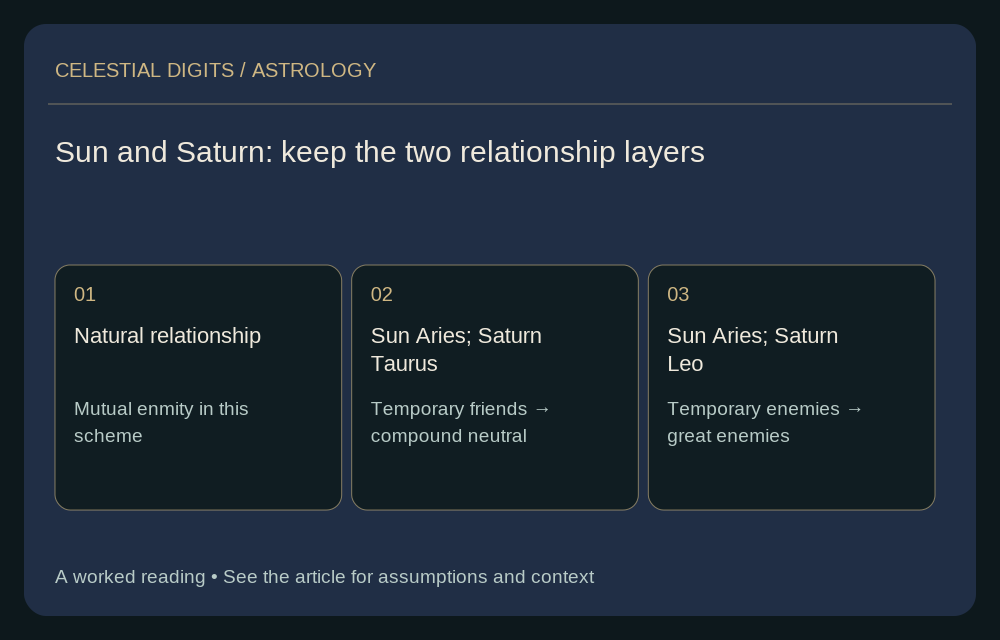
These are schematic placements selected to demonstrate counting. They are not dated astronomical configurations or personal predictions.
Combine the two layers#
| Natural relation | Temporary relation | Compound classification |
|---|---|---|
| Friend | Friend | Great friend |
| Friend | Enemy | Neutral |
| Neutral | Friend | Friend |
| Neutral | Enemy | Enemy |
| Enemy | Friend | Neutral |
| Enemy | Enemy | Great enemy |
Our first Sun–Saturn example combines natural enmity with temporary friendship, giving a neutral compound result. The second combines both kinds of enmity, giving great enmity in this classification.
The word “great” describes the category. It is not a measured intensity of an interpersonal conflict and should not be used to frighten someone about a family relationship.
Why two reports can display different labels#
One application may display natural friendship while another displays compound friendship. Both could be using their stated rules correctly. A third might calculate a dignity score from the planet's relationship with its sign lord rather than directly show a planet-pair table.
Ask what the field represents before declaring that the calculation is inconsistent. Also check whether the software applies a different convention in a divisional chart.
Use the result as one ingredient#
Friendship contributes to a discussion of dignity and planetary cooperation, but it does not replace house ownership, exact conjunction distance, aspects or timing. Two planets called enemies can still participate in an important house connection. A friendly classification does not make every result effortless.
The natural, temporary and compound rules are given in chapter 3, verses 55–58, of Brihat Parashara Hora Shastra. Continue with dispositor chains and own sign, Moolatrikona and exaltation to see where this relationship table fits within a larger reading.
Related Posts
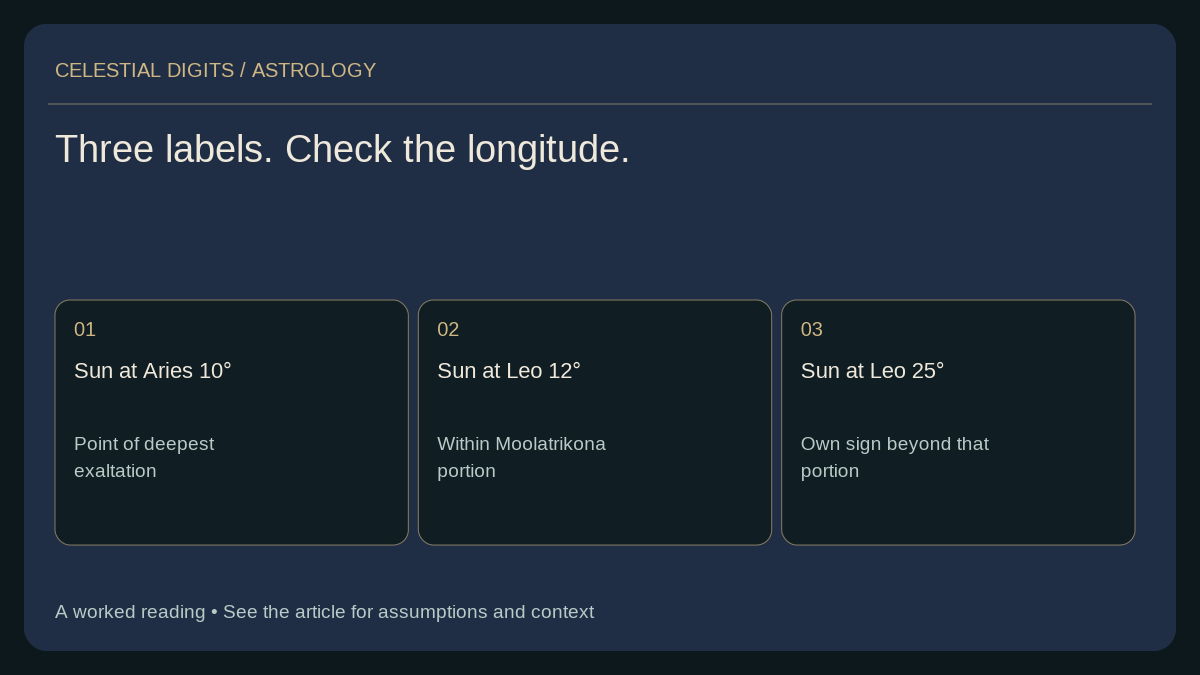
Own Sign, Moolatrikona and Exaltation: Three Dignity Labels Explained
Use the Sun at three longitudes to distinguish own sign, Moolatrikona and exaltation without confusing sign and degree.
Jupiter in the Seventh House: Shared Values and Functional Lordship
Read Jupiter in the seventh without a blanket good-marriage promise, using Gemini, Virgo and Capricorn examples and explicitly counted aspects.
Mars–Mercury in Relationships: Speech, Action and Chart Context
Work through Mars–Mercury in Gemini for Gemini and Sagittarius ascendants, checking degrees, aspect directions and the difference between decisiveness and disagreement.
A little more perspective.
Keep discussions respectful. No harassment, hate, sexual content or spam. Comments are reviewed before publication. Report concerns from a comment menu, or contact [email protected].
Checking your session…