
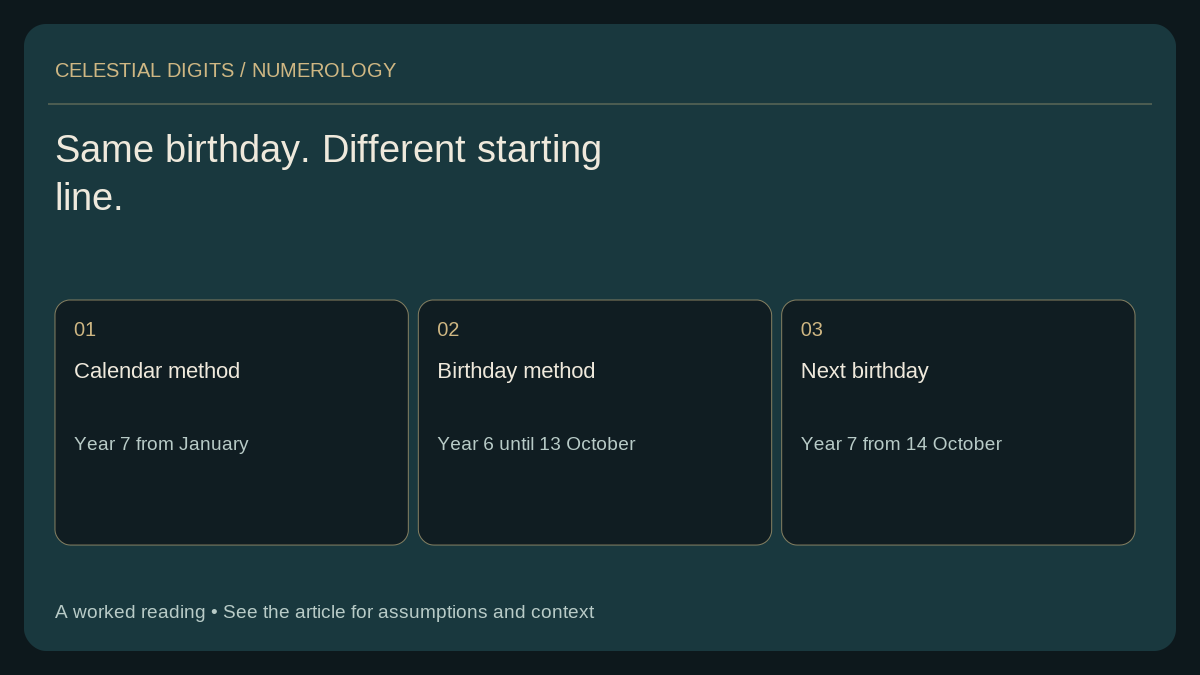
Personal Years: January-to-December or Birthday-to-Birthday?
Calculate both Personal Year conventions for the same birthday and see why reports can disagree without making an arithmetic mistake.
Two numerology reports can give different Personal Years on the same date even when both add correctly. One may use the calendar year from January through December. Another may begin a cycle on the person's birthday.
Before asking which result fits your life, establish which convention each report follows. Otherwise you are comparing two different definitions of “current.”
Calculate a shared example#
Use a fictional birthday of 14 October. Reduce the day to 5 and the month to 1. For this demonstration, every final total is reduced to a single digit; no master-number exception is applied.
The universal year for 2026 is 2 + 0 + 2 + 6 = 10 → 1. Adding the birth-day root, birth-month root and year root gives 5 + 1 + 1 = 7.
For 2025, the year root is 9. The same birthday gives 5 + 1 + 9 = 15 → 6. The birth year itself is not used in this Personal Year calculation.
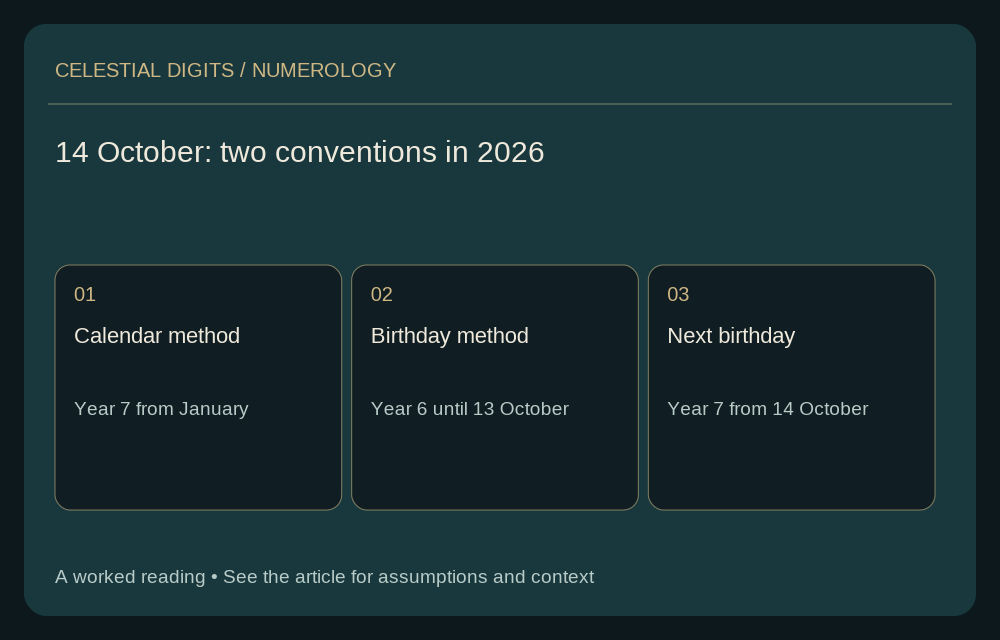
Put the two answers on a calendar#
| Date in 2026 | Calendar-year convention | Birthday-anchored convention |
|---|---|---|
| 1 January | 7 | 6 |
| 1 June | 7 | 6 |
| 14 October | 7 | 7 |
| 31 December | 7 | 7 |
In the birthday-anchored version shown here, the cycle beginning on 14 October 2025 uses 2025 in its arithmetic. It continues until the next birthday. A report that uses a different anchoring rule must explain that rule separately.
What practitioners actually disagree about#
World Numerology presents calendar-year cycles. Flawless Numerology explicitly describes a birthday-to-birthday calculation anchored to the year of that birthday. These are examples of published practitioner conventions, not scientific evidence that one boundary governs events.
Some readers also describe an influence becoming stronger near a birthday or fading gradually. That interpretive language is not an extra calculation. Keep the numerical boundary separate from any claimed transition period so that the method remains reproducible.
Do not select the method after seeing events#
Suppose you associate 6 with responsibility and 7 with study. A busy family month could be fitted to 6; a quiet learning month could be fitted to 7. Switching methods whenever the other description sounds better makes it difficult to judge either approach honestly.
Choose a convention before keeping a journal. Record what you expected, what happened and what did not fit. Include ordinary explanations such as exams, caregiving schedules or workplace deadlines.
What a clear report should show#
A useful report includes the birthday, target year, addition, reduction rule and explicit start/end dates. “Personal Year 7” alone leaves too much unstated. Timezone-level precision is generally unnecessary for this symbolic calendar convention and should not be invented to make it sound astronomical.
Read master-number reduction conventions and reviewing a 9-to-1 transition.
Sources and scope#
Compare the methods described by World Numerology and Flawless Numerology. The worked table is original. Personal Years are interpretive numerology cycles, not established predictors of real-world outcomes.
Related Posts
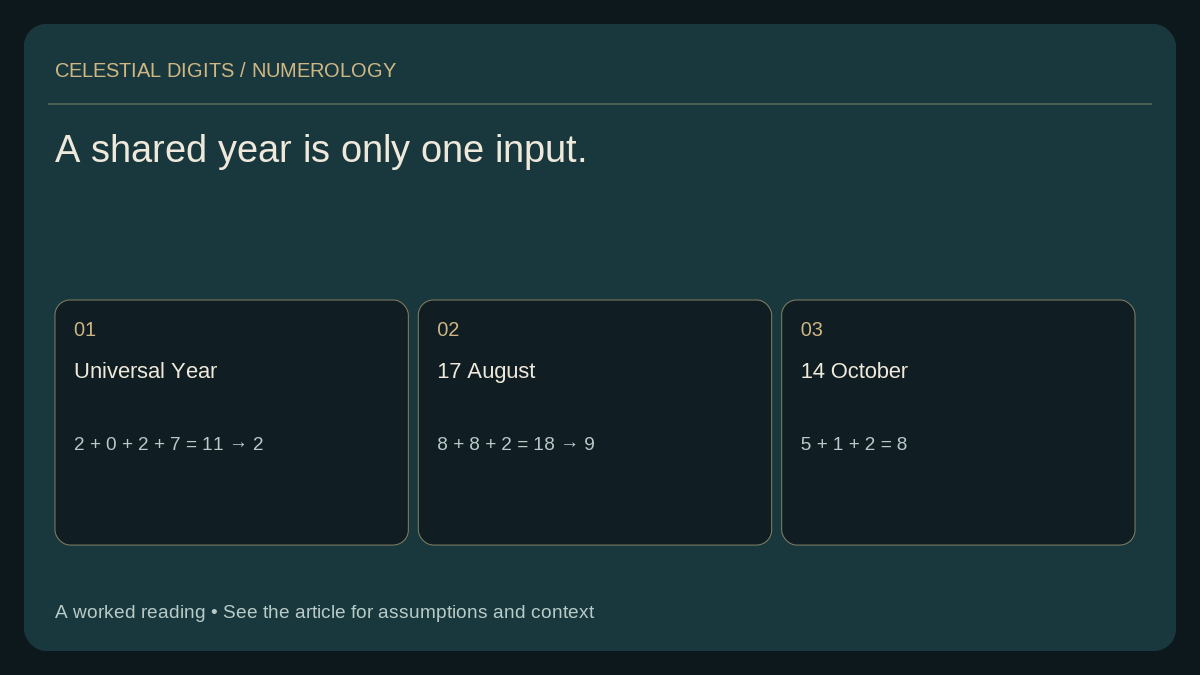
Universal Year vs Personal Year: One Year, Different Interpretations
Calculate the shared year root and two Personal Years to understand what each number describes and why they should not be treated as competing forecasts.
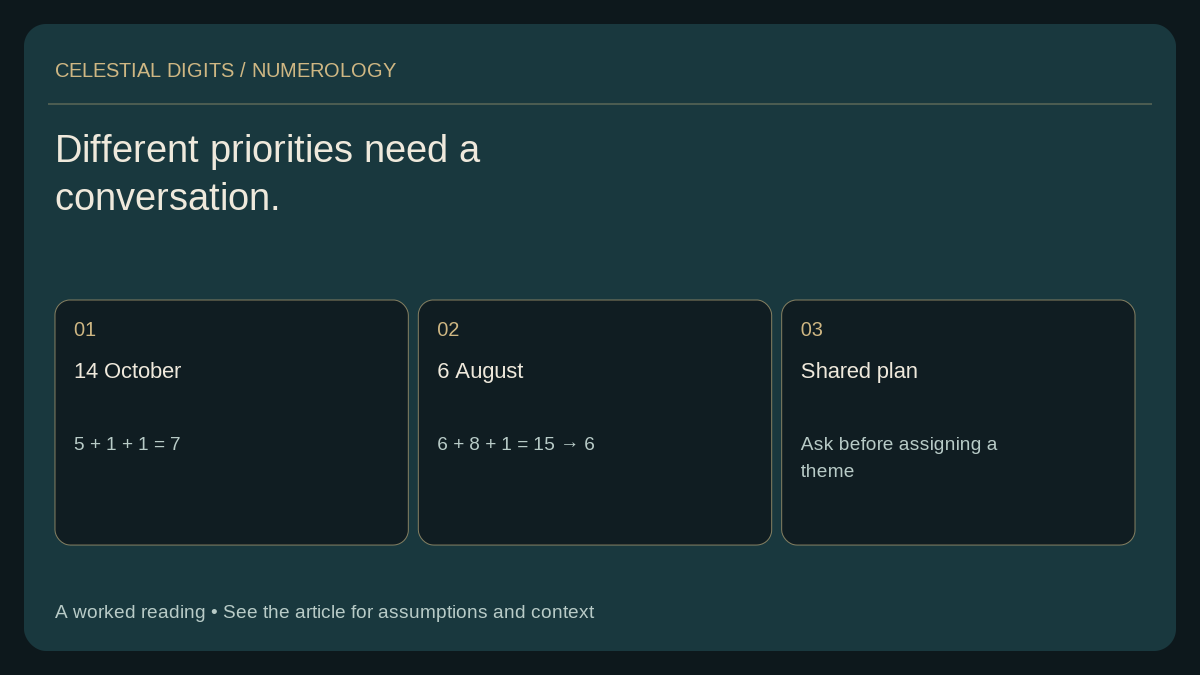
Partners in Different Personal Years: Discussing Different Priorities
Calculate two partners’ Personal Years and turn contrasting symbolic themes into a practical conversation about time, responsibilities and shared plans.
Personal Day Number: Calculate It Without Confusing Weekdays
Work through a personal-day calculation for 18 November 2026 and distinguish the chosen numerology convention from weekday and lunar timing.
A little more perspective.
Keep discussions respectful. No harassment, hate, sexual content or spam. Comments are reviewed before publication. Report concerns from a comment menu, or contact [email protected].
Checking your session…