
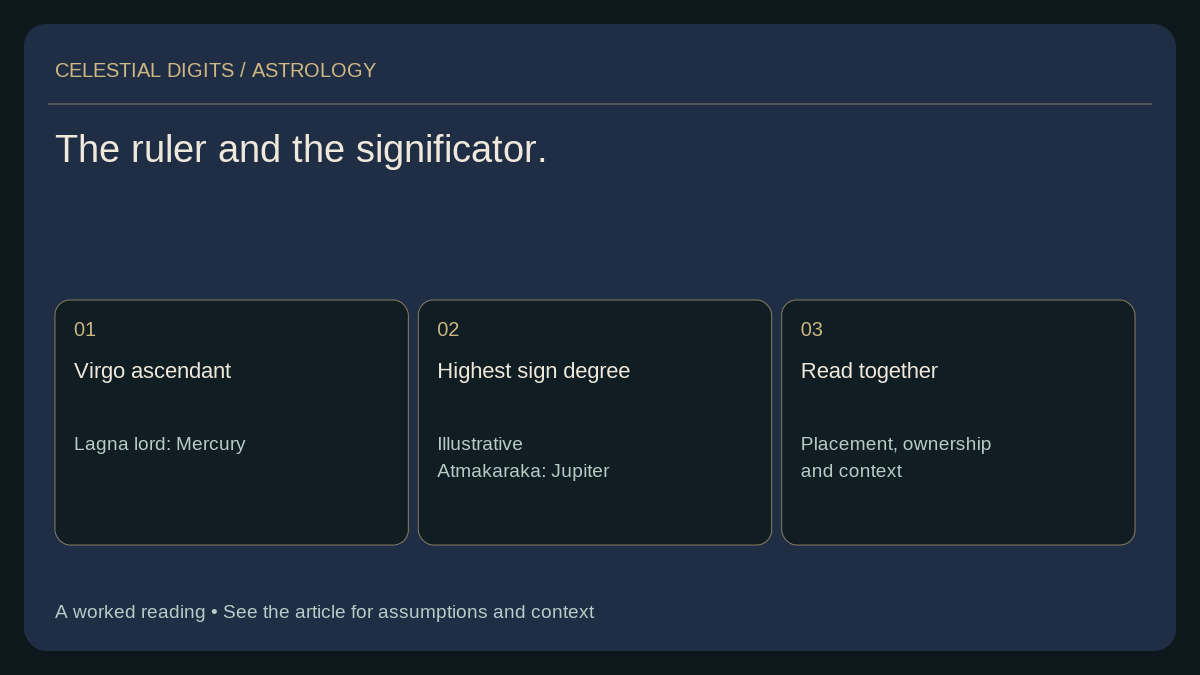
Lagna Lord vs Atmakaraka: When Two Chart Indicators Differ
Identify the ascendant ruler and Atmakaraka separately, then combine them through a hypothetical Virgo-ascendant example.
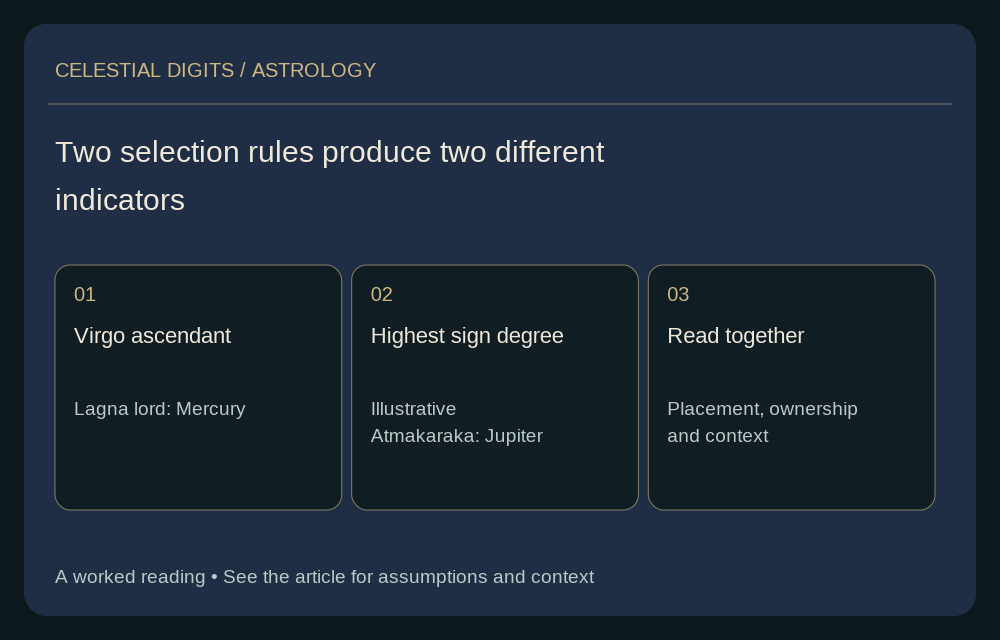
The Lagna lord is selected by the ascendant sign. Atmakaraka is selected through a degree-ranking convention. They can be the same planet, but there is no requirement that they match. Confusion begins when both are casually described as “your main planet” and their different selection rules disappear.
A useful reading first identifies each planet correctly, then explains how their chart relationships contribute to the question being asked.
Identify the Lagna lord#
For Virgo ascendant, Mercury rules the first house and is the Lagna lord. It also rules Gemini, the tenth sign from Virgo. That ownership connects self-direction and work within a whole-sign reading.
Mercury remains the Lagna lord whether it has travelled 2° or 28° through its current sign. Its degree affects other calculations, but the ascendant-rulership rule does not rank planets by degree.
Our Lagna lord guide covers how its placement changes the house emphasis.
Identify Atmakaraka using an explicit convention#
In the seven-karaka convention, compare the degrees travelled within each sign by the Sun, Moon, Mars, Mercury, Jupiter, Venus and Saturn. The highest becomes Atmakaraka. Do not compare their absolute zodiac longitudes: a planet in Pisces is not automatically ahead of a planet in Aries for this purpose.
| Planet in a fictional degree table | Degree within its sign |
|---|---|
| Sun | 12° |
| Moon | 18° |
| Mars | 5° |
| Mercury | 22° |
| Jupiter | 28° |
| Venus | 9° |
| Saturn | 16° |
Jupiter is Atmakaraka in this illustrative table. An eight-karaka method introduces Rahu and needs its corresponding reverse-degree convention. Mixing the two methods halfway through a reading can change the assigned roles.
Read the relationship through a question#
Suppose the person asks why their work feels productive but not personally meaningful. Mercury as Virgo's first- and tenth-house ruler directs attention to how they organise work and choose a direction. Jupiter as Atmakaraka introduces another interpretive lens, traditionally associated with the self or soul significator.
A contemporary discussion might ask whether the work offers opportunities to learn, teach or act consistently with personal convictions. That is an interpretive possibility, not proof that Jupiter demands a particular profession.
We would still need the planets' actual signs, houses, aspects and relevant timing. The degree table alone cannot tell us whether the person should become a teacher, leave a job or move abroad. It demonstrates selection, not a complete chart judgement.
What if the two planets seem to disagree?#
Do not solve the tension by declaring one planet universally more important. Ask whether the question concerns basic chart orientation, a specific house, a Jaimini technique or a timing system. Interpret each within its own framework before looking for convergence.
For example, vocational analysis may also involve the tenth house, its occupants, Amatyakaraka and D10. Personal satisfaction can involve other houses and actual circumstances. Atmakaraka does not replace all those checks.
What to request from a chart report#
Ask for the ascendant sign, the Lagna lord, the karaka convention and the complete ranked degree table. If the report supplies only the final name of a planet, it is harder to spot a calculation or convention mismatch.
The Atmakaraka ranking is discussed in chapter 32 of Brihat Parashara Hora Shastra. Our career-satisfaction scenario is an original explanatory application, not a quotation from that text. Continue with Atmakaraka through the houses after checking the underlying assignment.
Related Posts
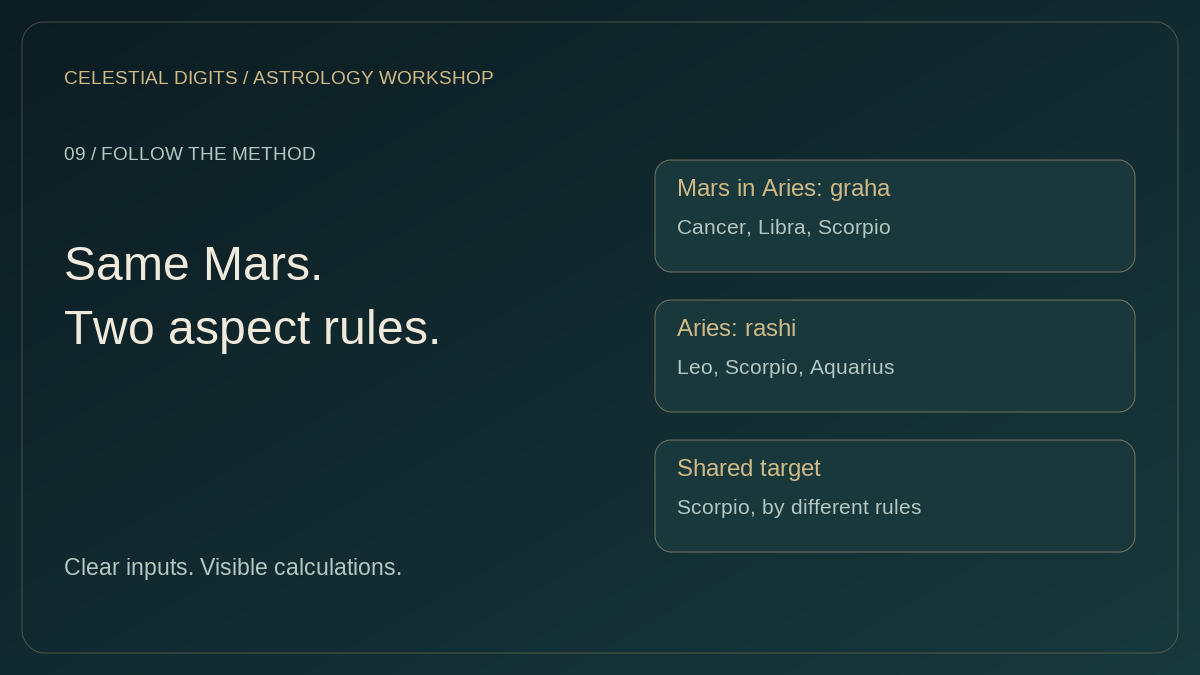
Graha Drishti vs Rashi Drishti: Keep the Aspect Rules Separate
Compare Mars in Aries under planetary and sign-based aspects, and see why combining the two lists without labels creates misleading chart readings.
Darakaraka’s Nakshatra and Dispositor: A Complete Worked Example
Identify Mercury as Darakaraka from an explicit seven-planet table, then trace its Taurus sign, Krittika nakshatra, pada and D9 without mixing roles.
Jupiter in the Seventh House: Shared Values and Functional Lordship
Read Jupiter in the seventh without a blanket good-marriage promise, using Gemini, Virgo and Capricorn examples and explicitly counted aspects.
A little more perspective.
Keep discussions respectful. No harassment, hate, sexual content or spam. Comments are reviewed before publication. Report concerns from a comment menu, or contact [email protected].
Checking your session…