
KP Astrology: Sign Lord, Star Lord and Sub-Lord Explained
Understand KP's sign, star and sub-lords through an exact Aries example, a complete Ashwini sub table, and the difference between planets and cusps.
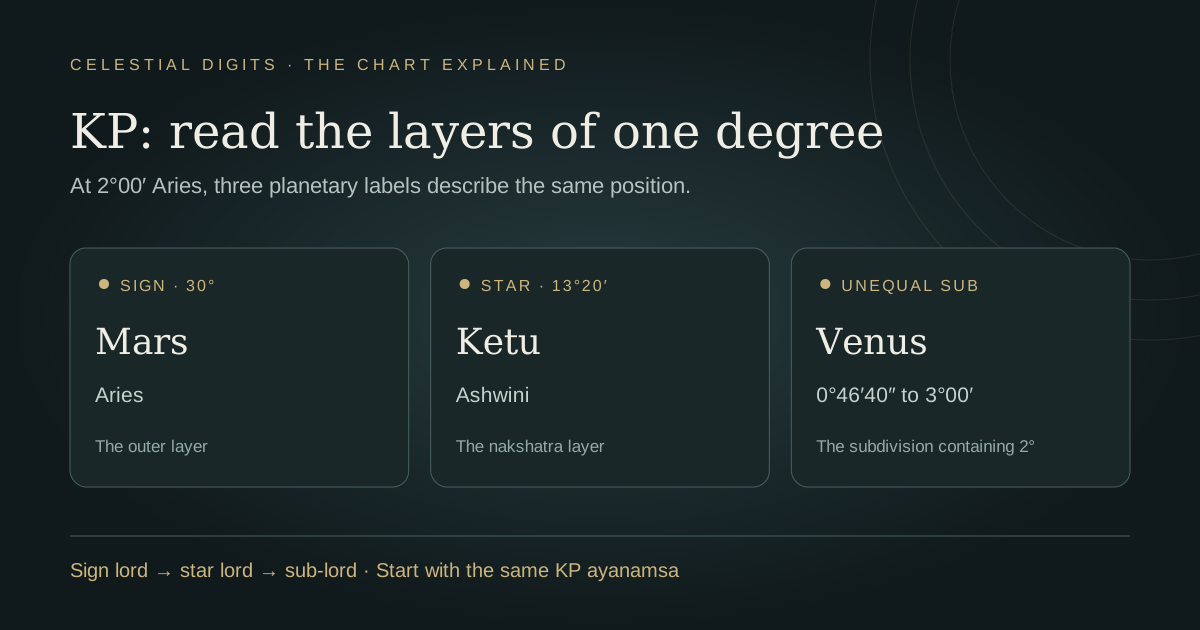
A KP table might describe one position as Mars sign lord, Ketu star lord and Venus sub-lord. That does not mean three planets occupy the same degree.
It means the degree has been located inside three nested divisions: a sign, a nakshatra and a smaller subdivision of that nakshatra. Star lord is another name for nakshatra lord in this context. The sub-lord is an additional planetary assignment used in Krishnamurti Paddhati, or KP.
Once the divisions are clear, a KP table becomes much easier to read—and easier to compare without mixing it with a differently configured chart.
The three layers#
| Layer | Size | What the label identifies |
|---|---|---|
| Zodiac sign | 30° | Sign lord |
| Nakshatra or star | 13°20′ | Star lord |
| Sub | Unequal portion of a nakshatra | Sub-lord |
The nine subs are not equal. Their widths follow the proportions of the nine planetary periods in the 120-year Vimshottari cycle. Within each nakshatra, the first sub belongs to that nakshatra's lord, followed by the usual sequence.
The KP sign–star–sub tables provide a lookup reference. The example below shows the arithmetic so you can understand the result without relying only on a label.
Worked example: 2°00′ Aries#
Assume 2°00′ Aries is already the sidereal longitude under the KP setting you are using. We are not converting a tropical position or transferring a longitude from another ayanamsa.
Aries is ruled by Mars. The first nakshatra, Ashwini, runs from 0°00′ to 13°20′ Aries and is ruled by Ketu. That establishes:
- Sign: Aries.
- Sign lord: Mars.
- Nakshatra: Ashwini.
- Star lord: Ketu.
Now find the sub. Ashwini contains 800 arcminutes. Ketu's seven years out of 120 give the first sub a width of:
800 × 7 ÷ 120 = 46⅔ arcminutes = 0°46′40″.
Venus follows Ketu. Its 20-year share gives a width of 2°13′20″. Added to the end of Ketu's sub, that reaches exactly 3°00′ Aries.
Our 2°00′ position lies inside the Venus interval. Its sub-lord is Venus. If the position belonged to Jupiter, the table would still say “Planet: Jupiter; sign lord: Mars; star lord: Ketu; sub-lord: Venus.” The planet's identity remains Jupiter.
The full Ashwini sub table#
All positions below are within Aries. Each interval includes its start and excludes its end; a point exactly on a boundary belongs to the following interval.
| Sub-lord | Start | End |
|---|---|---|
| Ketu | 0°00′00″ | 0°46′40″ |
| Venus | 0°46′40″ | 3°00′00″ |
| Sun | 3°00′00″ | 3°40′00″ |
| Moon | 3°40′00″ | 4°46′40″ |
| Mars | 4°46′40″ | 5°33′20″ |
| Rahu | 5°33′20″ | 7°33′20″ |
| Jupiter | 7°33′20″ | 9°20′00″ |
| Saturn | 9°20′00″ | 11°26′40″ |
| Mercury | 11°26′40″ | 13°20′00″ |
The next nakshatra, Bharani, starts at 13°20′ Aries with Venus as star lord and Venus as its first sub-lord. You cannot reuse the Ashwini order unchanged for every nakshatra.
These intervals can be subdivided again to assign a sub-sub-lord. That is another layer, not a second nakshatra lord.
Why a sub is not a pada#
A nakshatra has four equal padas, each 3°20′ wide. KP uses nine unequal subs. They partition the same nakshatra in different ways.
At 2°00′ Aries, the point is in Ashwini pada 1 and Venus sub. Moving to 3°10′ Aries keeps it in pada 1 but changes its sub-lord to Sun. No inconsistency is involved.
This is a useful test when reading a report: if a tool calls each of the four padas a KP sub, it is mixing two systems.
A planet's sub-lord and a cusp's sub-lord#
A planetary position and a house cusp can each be assigned sign, star and sub-lords from their longitude. But they are different points, so their values need not match.
KP practitioners give particular interpretive importance to cuspal sub-lords and the house significations of planets. That does not turn one sub-lord name into a complete prediction. House occupation, ownership, stellar connections, timing and the chosen KP rules still need to be considered.
“Venus is the seventh cusp's sub-lord” is not the same statement as “Venus occupies the seventh house”. Copying the row heading along with the values prevents this common mistake.
Why your KP chart can differ from your regular chart#
Celestial Digits' KP calculation uses a Krishnamurti ayanamsa and Placidus cusps. Its main Vedic chart uses a different calculation context. Close to a boundary, the ayanamsa difference can change a star or sub assignment; a cusp-based house assignment can also differ from a whole-sign house.
The safe comparison is between two reports with matching settings. Do not take a rounded longitude from a Lahiri chart, look it up in a KP table, and assume you have reproduced the KP report's calculation.
Accurate birth time and location matter especially for cusps. If the birth time is uncertain, inspect how the cusps change across that interval. Fine subdivisions cannot turn uncertain input into certainty.
How to use the report#
Open your birth chart, choose KP Astrology, and begin with one planetary row. Read the planet name first, then its sign, star and sub. After that, examine house cusps as a separate table.
Keep the calculation settings with any exported data. When asking about a result, include whether the value belongs to a planet or cusp and avoid rounding away the position before checking a boundary.
For the broader vocabulary, read nakshatra lord vs sign lord vs deity. For cross-site comparisons, see why kundlis differ.
KP provides a structured traditional method. Mathematical precision in its subdivisions is not proof that it can predict a person's future with certainty.
Method note: the table is calculated from exact Vimshottari proportions. Examples are hypothetical longitudes, not a reading of a user's private chart.
Related Posts
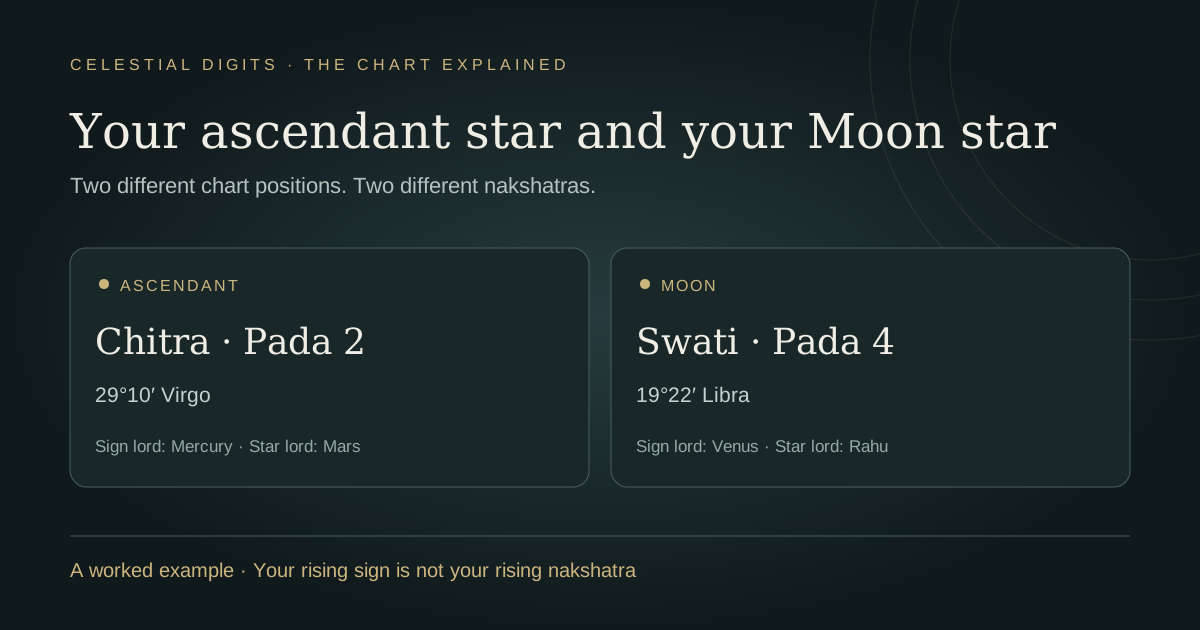
Ascendant Nakshatra vs Moon Nakshatra: Why Both Matter
Learn why your ascendant and Moon can have different nakshatras, how to find both, and which one sets your birth star and Vimshottari dasha.
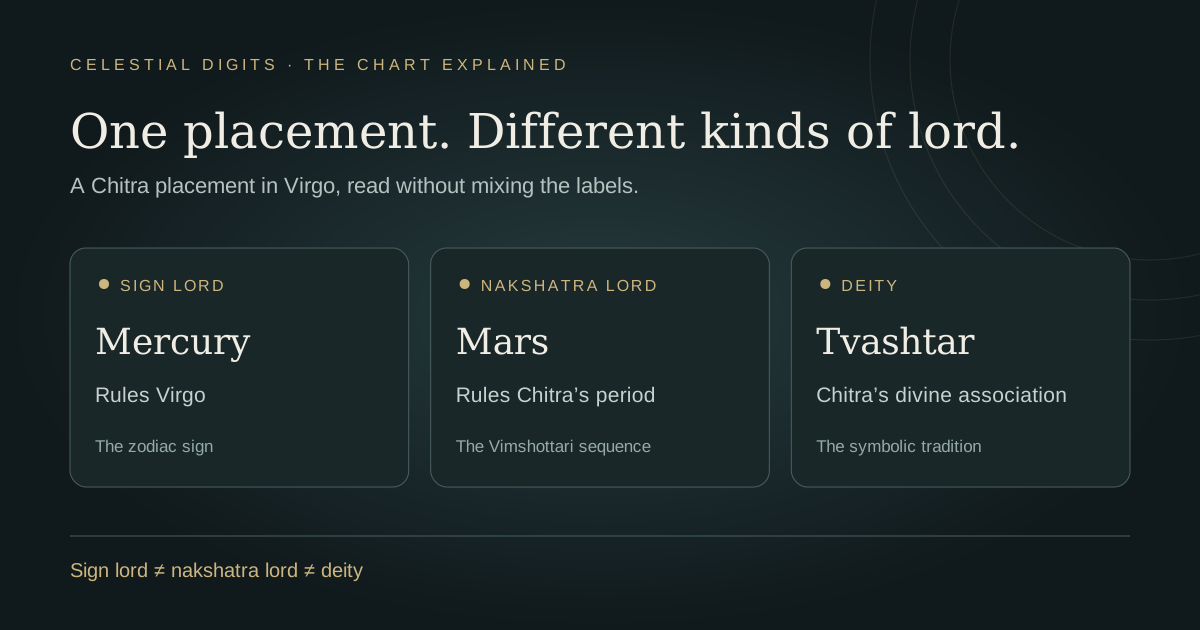
Nakshatra Lord vs Sign Lord vs Deity: Who Rules Your Chart?
Separate sign lord, nakshatra lord and deity with clear examples from Chitra, Revati and Krittika, plus a practical way to read your own chart.
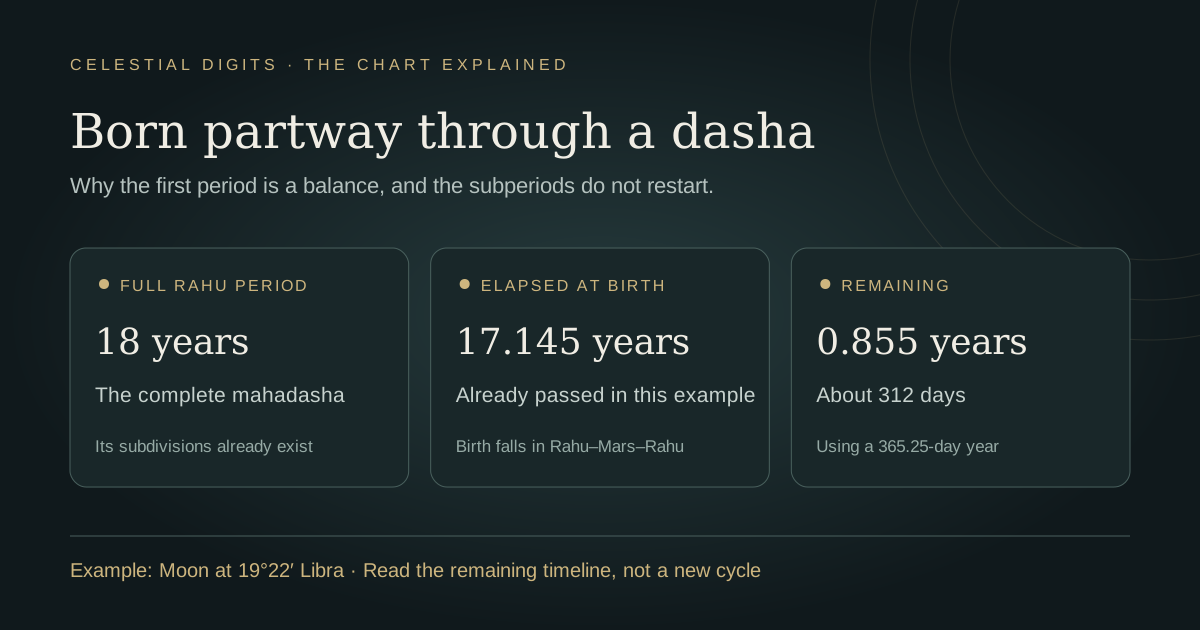
Why Was My First Mahadasha So Short? Dasha Balance at Birth
Calculate the remaining mahadasha at birth from the Moon's nakshatra, and see why the first antardasha must not restart from the mahadasha lord.
A little more perspective.
Keep discussions respectful. No harassment, hate, sexual content or spam. Comments are reviewed before publication. Report concerns from a comment menu, or contact [email protected].
Checking your session…