
D4 Chaturthamsa: Property and Residence Through a Worked Example
Calculate a D4 placement from four 7°30′ divisions, then see how Chaturthamsa adds context to a D1 property or residence reading.
Chaturthamsa, usually written D4, divides each zodiac sign into four parts. In Parashari practice it is used as an additional lens for fortune, property and residence. It does not replace the birth chart, and it should not be treated as a separate horoscope that can answer every housing question on its own.
Its value begins with a reproducible calculation. If the mapping is unclear, a detailed interpretation rests on an uncertain foundation.
Divide the sign into four equal parts#
Each sign spans 30°. Dividing by four gives 7°30′ per part. Under the standard mapping used here, the four parts go to the original sign and the 4th, 7th and 10th signs counted from it.
| Degree within the original sign | Part | Destination counted from that sign |
|---|---|---|
| 0° to before 7°30′ | First | Same sign |
| 7°30′ to before 15° | Second | 4th |
| 15° to before 22°30′ | Third | 7th |
| 22°30′ to before 30° | Fourth | 10th |
The boundaries are included at the start of the new interval. Exactly 15° belongs to the third part, not the second. Use the unrounded longitude when a placement is close to a boundary.
Calculate one placement#
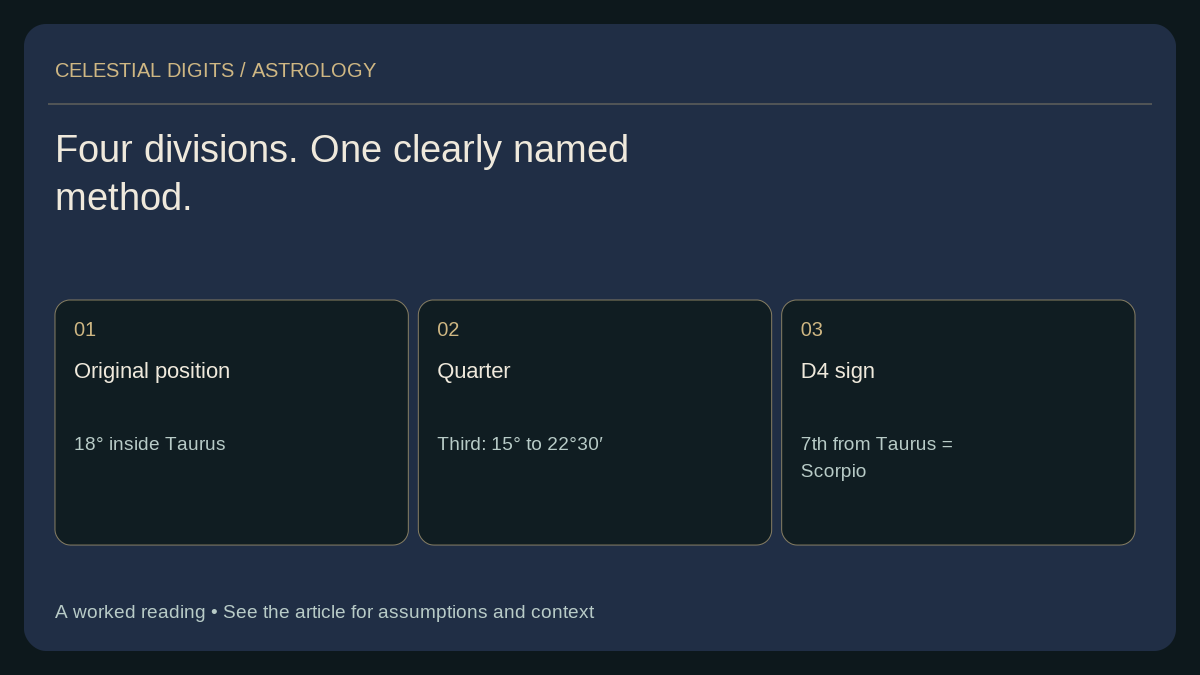
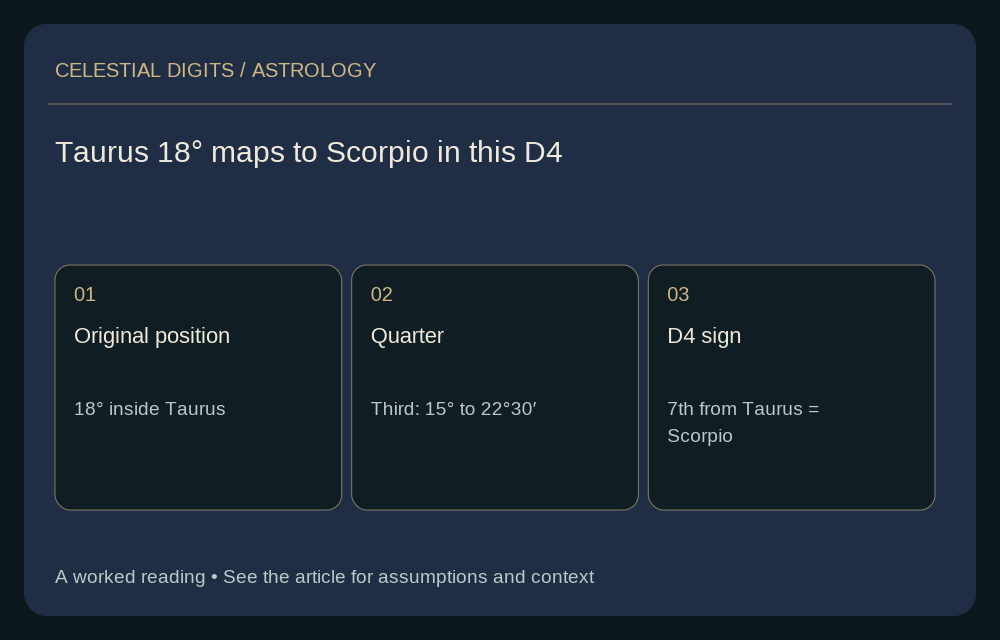
Take a fictional planet at Taurus 18°. It falls in the third quarter, so count seven signs from Taurus inclusively: Taurus, Gemini, Cancer, Leo, Virgo, Libra, Scorpio. Its D4 sign is Scorpio.
For all four Taurus quarters, the destinations are Taurus, Leo, Scorpio and Aquarius. This provides a quick check that the sequence advances through the kendras from the original sign.
A divisional sign is a derived position. It does not mean the physical planet has moved from Taurus to Scorpio in the sky.
Calculate the ascendant separately#
Apply the same mapping to the natal ascendant longitude. In a whole-sign D4 display, that derived ascendant determines the houses. Knowing a planet's D4 sign alone therefore does not tell you its D4 house.
Because the ascendant moves with time, uncertain birth timing can change the divisional ascendant near a boundary. Do not assume that a rounded birth time supports an exact property prediction. Check whether plausible time variation changes the relevant placements.
Read D1 before adding D4#
First define the event: ownership, residence, relocation, renovation or feeling settled. Examine the D1 4th house, its lord and the other factors relevant to that particular question. Then use D4 to refine the pattern under the same declared interpretive approach.
For example, a work-related relocation is not equivalent to a property purchase. Repeated residence themes across D1 and D4 may be worth discussing, but they do not establish legal ownership or the quality of a specific property.
A useful comparison record#
Keep the natal longitude, quarter, derived sign, D4 ascendant and house in one note. Add the birth-time uncertainty and the reason each factor is relevant. This allows another reader to reproduce the calculation rather than relying on an attractive chart image.
If two tools disagree, compare ayanamsa, source longitudes, boundary rounding and the selected D4 method before debating the interpretation.
Read buying versus moving and D2 method differences.
Traditional source#
The four-part mapping is described in the divisional-chart chapter of Brihat Parashara Hora Shastra. The Taurus calculation is our original worked example. D4 remains a traditional interpretive tool, not a substitute for practical property checks.
Related Posts
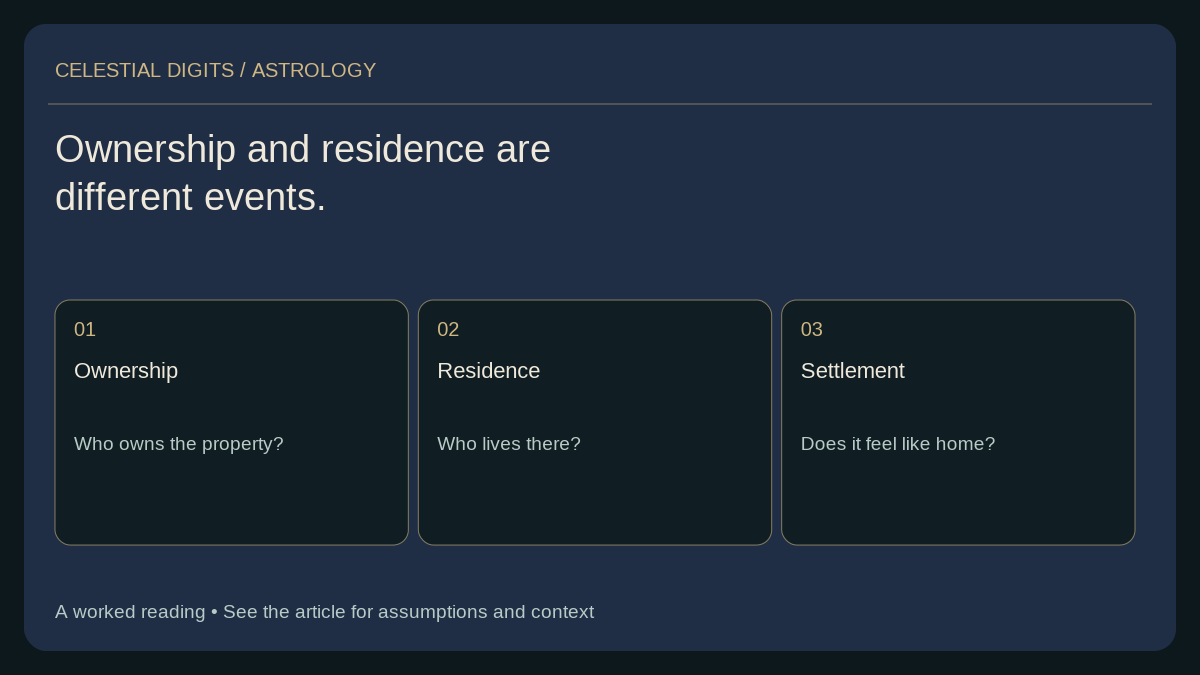
Buying a Home vs Moving into One: Different Questions for the 4th House
Separate ownership, residence and feeling settled before interpreting property indicators, with a fictional whole-sign chart example.
Jupiter in the Seventh House: Shared Values and Functional Lordship
Read Jupiter in the seventh without a blanket good-marriage promise, using Gemini, Virgo and Capricorn examples and explicitly counted aspects.
Mars–Mercury in Relationships: Speech, Action and Chart Context
Work through Mars–Mercury in Gemini for Gemini and Sagittarius ascendants, checking degrees, aspect directions and the difference between decisiveness and disagreement.
A little more perspective.
Keep discussions respectful. No harassment, hate, sexual content or spam. Comments are reviewed before publication. Report concerns from a comment menu, or contact [email protected].
Checking your session…