
D2 Hora: Why Different Methods Produce Different Charts
Compare Sun/Moon Hora and Parivritti Dwaya using the same longitudes, and learn what to check before interpreting a D2 disagreement.
If every planet in one D2 chart appears in Cancer or Leo, that is not automatically a broken chart. The common Sun/Moon Hora mapping intentionally uses those two signs. Another tool may use a twelve-sign Hora variation and produce a very different-looking result from the same birth details.
Before comparing interpretations, compare the method names. “D2” describes division into halves; it does not uniquely identify every subsequent mapping convention.
The shared starting point#
Each 30° sign is divided into two halves of 15°. A position from 0° to before 15° belongs to the first half; exactly 15° begins the second half. Sign parity means zodiac order: Aries is odd, Taurus even, Gemini odd, and so on.
In the Sun/Moon convention used here and in the site's current calculation, odd signs assign their first half to the Sun and second to the Moon. Even signs reverse that order. Sun's Hora is displayed in Leo and Moon's Hora in Cancer.
| Original sign type | First half | Second half |
|---|---|---|
| Odd | Leo | Cancer |
| Even | Cancer | Leo |
Follow the same longitude through two methods#
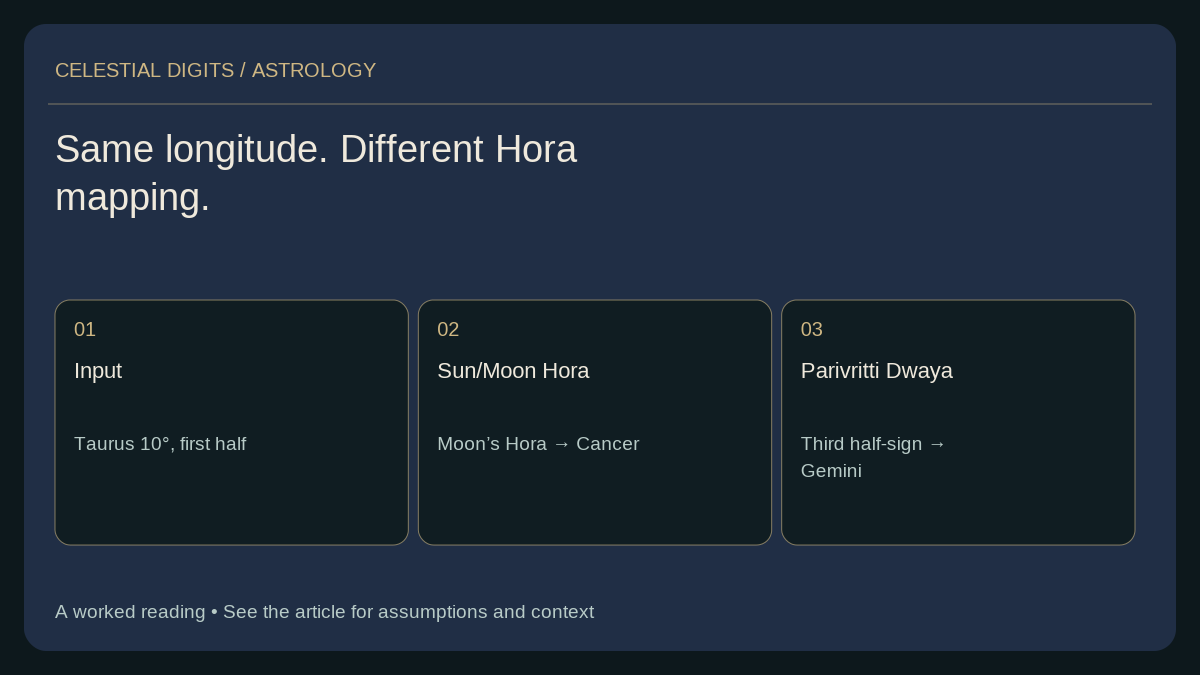
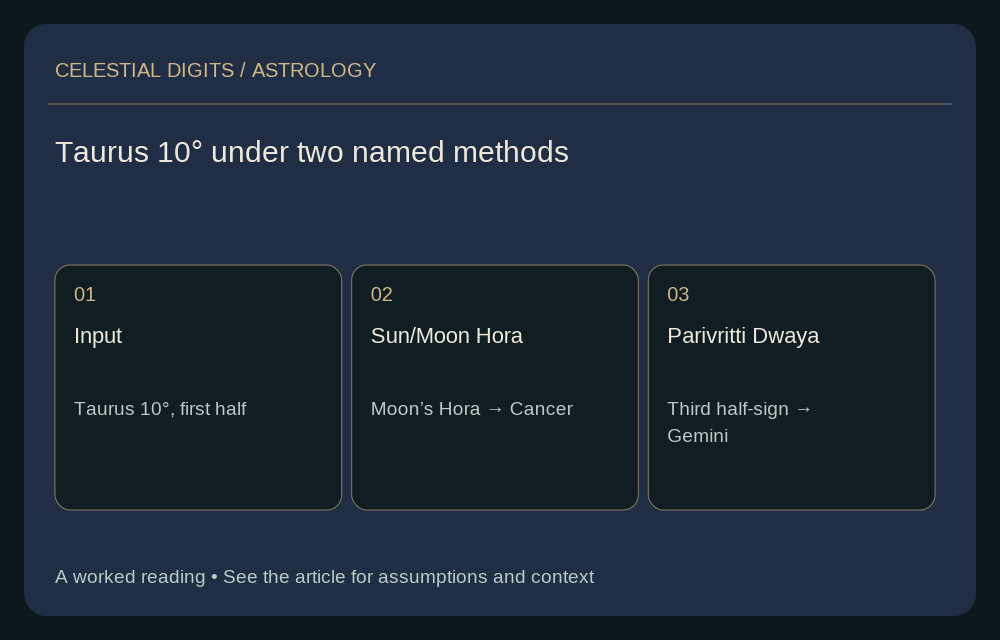
Take a fictional planet at Taurus 10°. Taurus is even and 10° is in its first half, so the Sun/Moon method places it in Cancer.
Parivritti Dwaya instead assigns the 24 half-signs sequentially around the twelve signs twice: Aries halves go to Aries and Taurus; Taurus halves go to Gemini and Cancer; Gemini halves go to Leo and Virgo; and so on. Under that method, Taurus 10° maps to Gemini.
Now try Aries 20°. It belongs to the second half of an odd sign. Sun/Moon Hora gives Cancer, while Parivritti Dwaya gives Taurus. Both results follow their respective rules. A mismatch alone does not identify a software error.
Other Hora traditions exist#
Kashinatha Hora uses another construction tied to day-strong and night-strong signs. P. V. R. Narasimha Rao's published Hora paper discusses this and explicitly contrasts it with the two-sign and cyclical approaches. His interpretive preference should be identified as his school's position, not treated as proof that all other practitioners use the same chart.
The important practical point is consistency: do not calculate one variation and silently apply rules developed for another.
What to compare between tools#
Check the source longitude, ayanamsa, exact half-sign boundary, selected Hora method and derived ascendant. Houses depend on the latter as well as on the planet's derived sign. A screenshot without calculation settings is often insufficient for a meaningful comparison.
Near 15°, displayed rounding can conceal which side of the boundary the original longitude occupies. Use the full value rather than a rounded degree label when reproducing the calculation.
Read the chart within its scope#
Hora is traditionally used in discussions of resources and wealth. A D2 interpretation should be placed beside D1 and the relevant timing framework. It cannot establish the value of an investment, the affordability of a purchase or a person's actual financial position.
Start with a clear question, preserve the method name and distinguish symbolic interpretation from factual records. That makes a disagreement explainable instead of mysterious.
Continue with income versus retained resources and the D4 worked example.
Sources#
See the Hora rules in Brihat Parashara Hora Shastra and Rao's Personal Finances from Hora Chart for a practitioner's comparison of constructions. Our two longitude examples are independently worked calculations.
Related Posts
Jupiter in the Seventh House: Shared Values and Functional Lordship
Read Jupiter in the seventh without a blanket good-marriage promise, using Gemini, Virgo and Capricorn examples and explicitly counted aspects.
Mars–Mercury in Relationships: Speech, Action and Chart Context
Work through Mars–Mercury in Gemini for Gemini and Sagittarius ascendants, checking degrees, aspect directions and the difference between decisiveness and disagreement.
Mars Synastry: Initiative, Pace and Boundaries in Two Charts
Measure Mars contacts across two charts, check a cross-sign boundary example and distinguish house overlays from attraction, consent and compatibility claims.
A little more perspective.
Keep discussions respectful. No harassment, hate, sexual content or spam. Comments are reviewed before publication. Report concerns from a comment menu, or contact [email protected].
Checking your session…