
The 2nd House Beyond Wealth: Speech, Family Culture and Preservation
Explore the 2nd house through speech, inherited habits and what a person preserves, with a fictional chart example and practical reading questions.
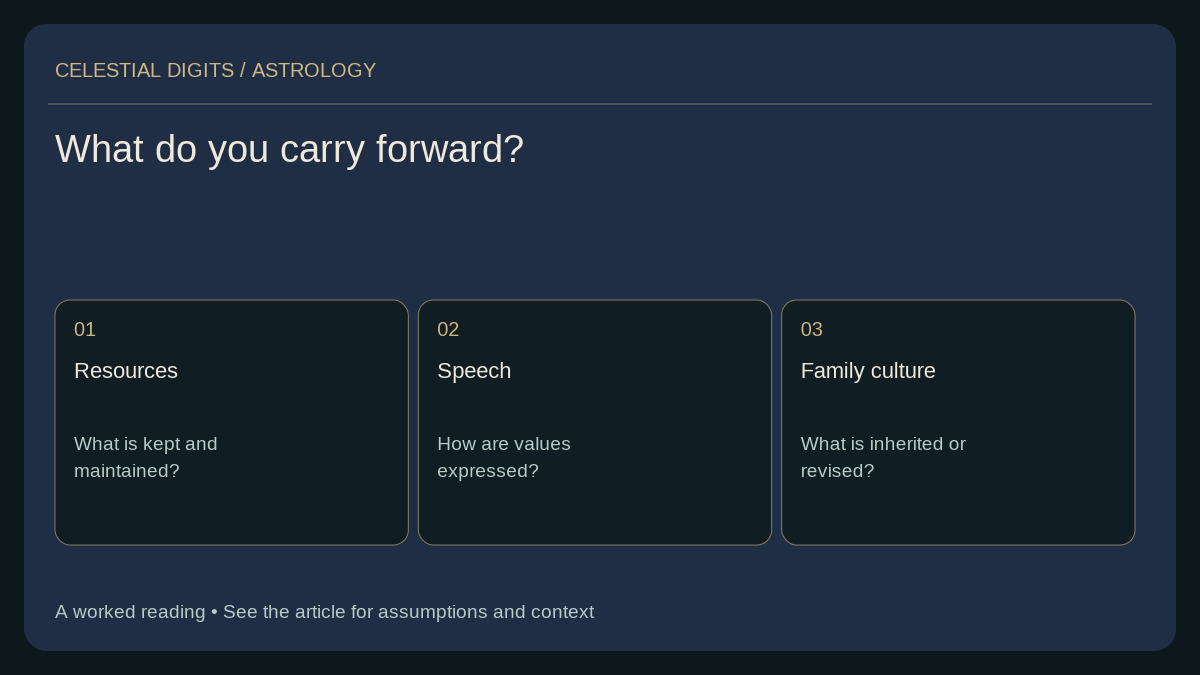
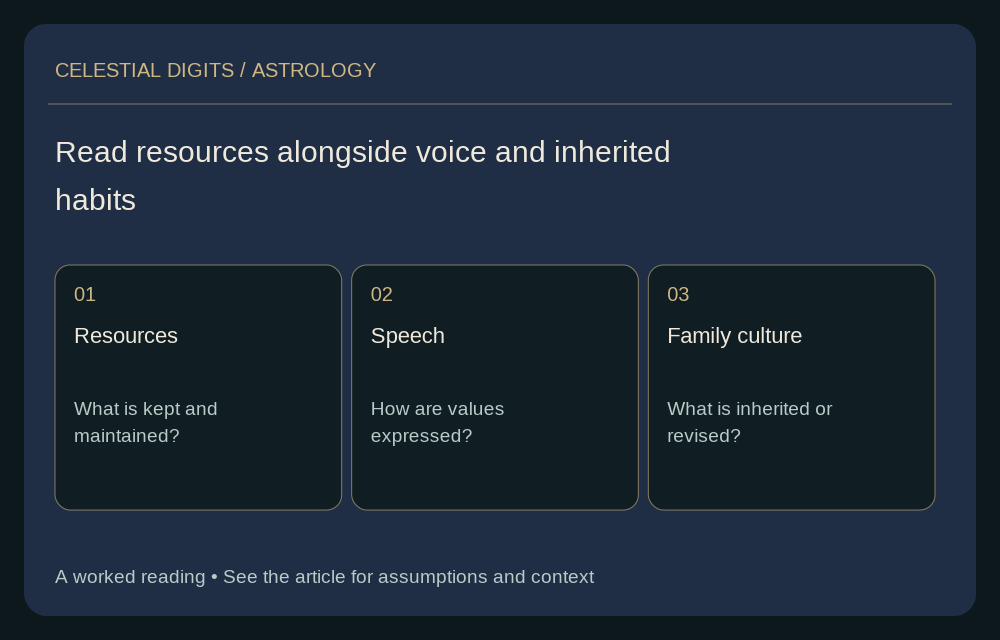
The 2nd house is often reduced to bank balances. Traditional readings also associate it with speech, family and the resources a person carries forward. These subjects share a useful theme: what is stored, maintained and expressed from an established base.
That does not mean every family habit or spoken sentence can be explained by one placement. It means a wealth-only reading may overlook important parts of the house's symbolism.
Separate the subjects before combining them#
A question about savings is different from a question about speaking confidently. A question about family expectations is different again. Start with the person's actual concern, then select the relevant factors.
For speech, Mercury and the condition of the 2nd house and its lord may be considered within the traditional framework. For resources, the 11th and 12th may also matter. Do not add every possible indicator without explaining its relevance.
A fictional Cancer-ascendant example#
Cancer rising gives Leo as the 2nd house, ruled by the Sun. Suppose the Sun is in Virgo in the 3rd in an illustrative chart. The 2nd lord then occupies the 3rd, connecting 2nd-house subjects with communication, initiative or practice.
One possible reading question is whether a person's voice develops through repeated use: writing regularly, presenting familiar material or learning to state needs clearly. The placement does not prove eloquence, a particular occupation or a strained family relationship.
Only the ascendant and one placement have been supplied. The Sun's full condition, other influences and the wider chart would be needed for a more developed interpretation.
Look at family culture without judging people#
Imagine someone grew up in a household where disagreement was avoided at the dinner table. As an adult, they find it difficult to express a different preference. That is an observed pattern to discuss, not something to infer automatically from a planet.
The 2nd-house framework can prompt questions about what was learned and what the person wants to retain or revise. Perhaps they value the family's courtesy while wanting more direct communication. Both can be true.
| Theme | Question worth asking |
|---|---|
| Speech | Can I say what I mean without unnecessary harshness? |
| Family culture | Which inherited habits still serve me? |
| Preservation | What needs maintenance rather than accumulation? |
| Values | Does my daily behaviour match what I say matters? |
Avoid reading character from a single planet#
A difficult traditional indication should not become an accusation that someone lies, speaks cruelly or comes from a bad family. Behaviour must be understood from what the person actually does and the context in which it occurs.
The same caution applies to flattering claims. A favourable placement does not guarantee honesty or excuse careless communication. Interpretive language should invite reflection rather than assign a permanent moral identity.
What preservation can mean in practice#
Preserving something may involve maintaining a family recipe, keeping records, caring for an object or passing on a skill. It can also involve deciding what not to carry forward. The theme is broader than simply acquiring more possessions.
A practical exercise is to choose one thing you want to maintain and one inherited habit you want to examine. Describe the action in ordinary terms before connecting it to the chart discussion.
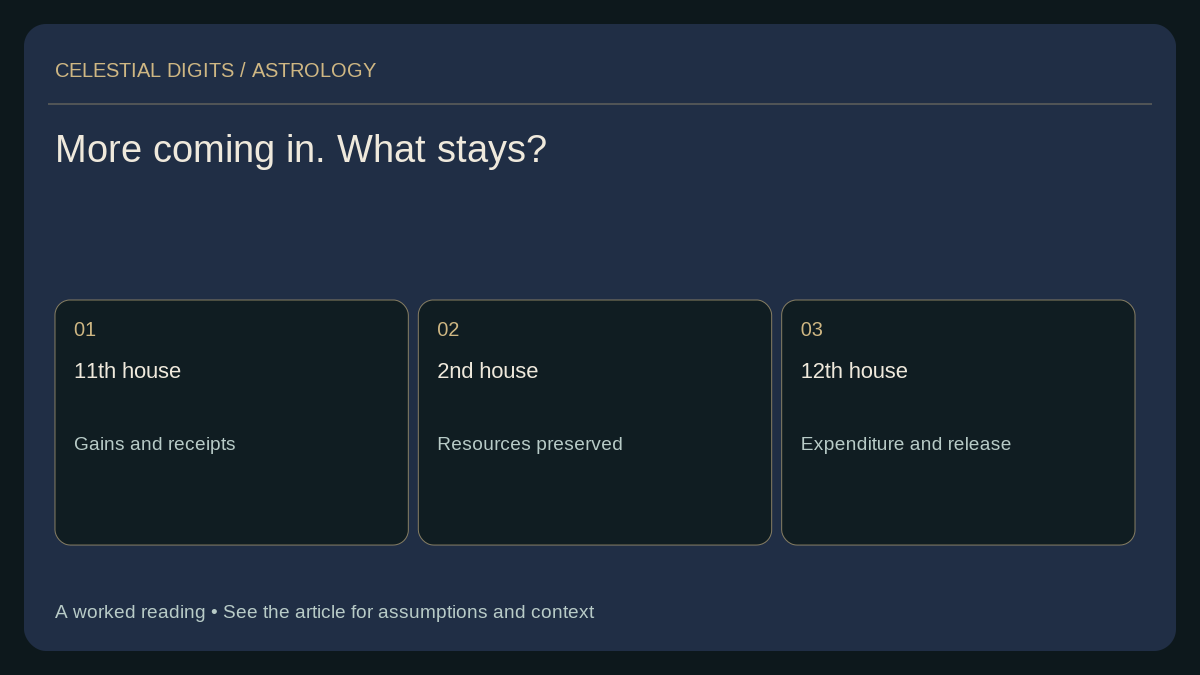
Read the 11th house beyond money and income versus retained resources.
Traditional basis#
The house subjects follow the framework of Brihat Parashara Hora Shastra. The family example and reflection exercise are original, fictional teaching material. A birth chart is not evidence about someone's character or family history.
Related Posts
A Pay Rise Without Better Savings: Income vs Wealth Retention
Distinguish gains, stored resources and expenditure in a chart reading, with a fictional example showing why higher income need not mean more savings.
Jupiter in the Seventh House: Shared Values and Functional Lordship
Read Jupiter in the seventh without a blanket good-marriage promise, using Gemini, Virgo and Capricorn examples and explicitly counted aspects.

Mars–Mercury in Relationships: Speech, Action and Chart Context
Work through Mars–Mercury in Gemini for Gemini and Sagittarius ascendants, checking degrees, aspect directions and the difference between decisiveness and disagreement.
A little more perspective.
Keep discussions respectful. No harassment, hate, sexual content or spam. Comments are reviewed before publication. Report concerns from a comment menu, or contact [email protected].
Checking your session…