
Kavya or Kaavya? Name Numerology Across Indian Spellings
Follow Kavya, Kaavya and Kavya Rao through the name-number table. Understand transliteration, initials and compound totals before comparing results.
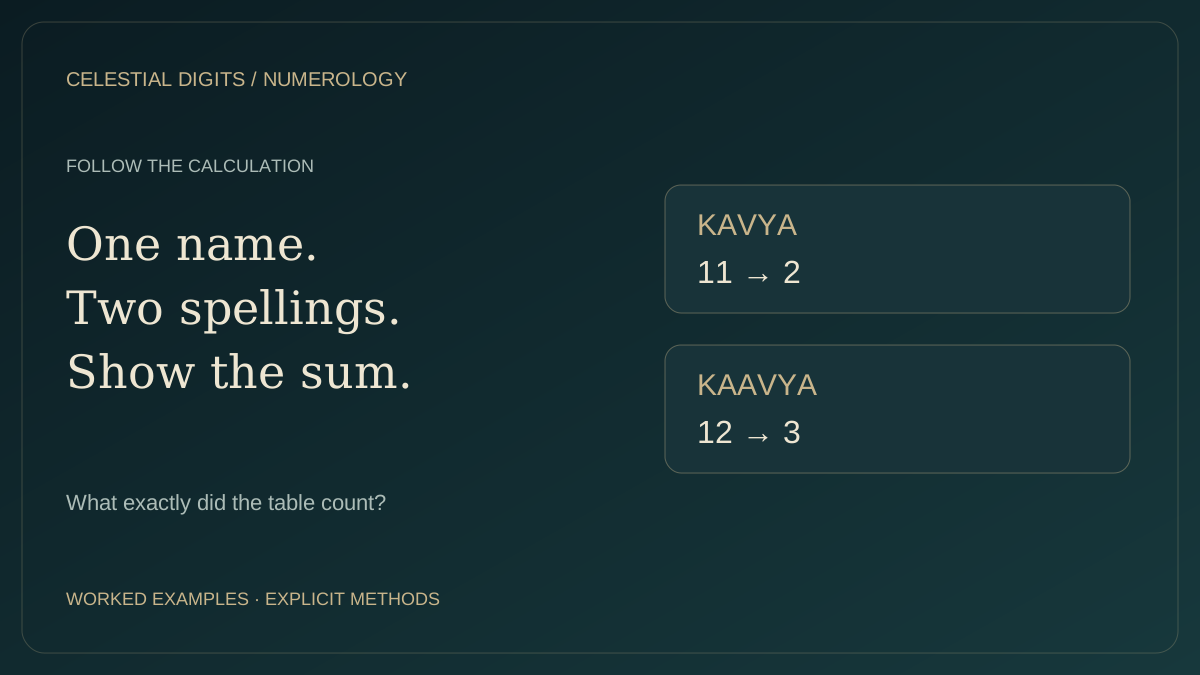
A person can have one name spoken at home and several ways of writing it in English. Kavya and Kaavya produce different name-number totals in the table used by Celestial Digits. That shows that the input changed. It does not establish that one spelling is more authentic, more fortunate or a better expression of the person.
This guide follows one spelling comparison all the way through. Kavya is a fictional example, not a recommendation to rename anyone. The aim is to make a name-number report reproducible, especially when a name is also written in Hindi, Marathi, Kannada or another Indian language.
The letter table comes before the interpretation#
Our Namank calculation uses this Chaldean-style Latin-letter table. It is not the sequential A=1 to I=9 Pythagorean table.
| Value | Letters |
|---|---|
| 1 | A, I, J, Q, Y |
| 2 | B, K, R |
| 3 | C, G, L, S |
| 4 | D, M, T |
| 5 | E, H, N, X |
| 6 | U, V, W |
| 7 | O, Z |
| 8 | F, P |
The table assigns values to written letters, not directly to Sanskrit sounds or native-script characters. It has no letter row for 9, but a sum can still equal or reduce to 9. Spaces, hyphens and other punctuation do not add values under this convention.
Work through Kavya and Kaavya#
For KAVYA, take K(2) + A(1) + V(6) + Y(1) + A(1). The total is 11, which reduces to 2 in our single-digit convention.
For KAAVYA, the extra A adds 1: K(2) + A(1) + A(1) + V(6) + Y(1) + A(1) = 12, reducing to 3.
The difference is one letter and one point in the compound total. If a report jumps immediately from that change to a promise of success or improved relationships, it has moved from arithmetic into a claim the sum cannot establish.
Adding the surname changes the question#
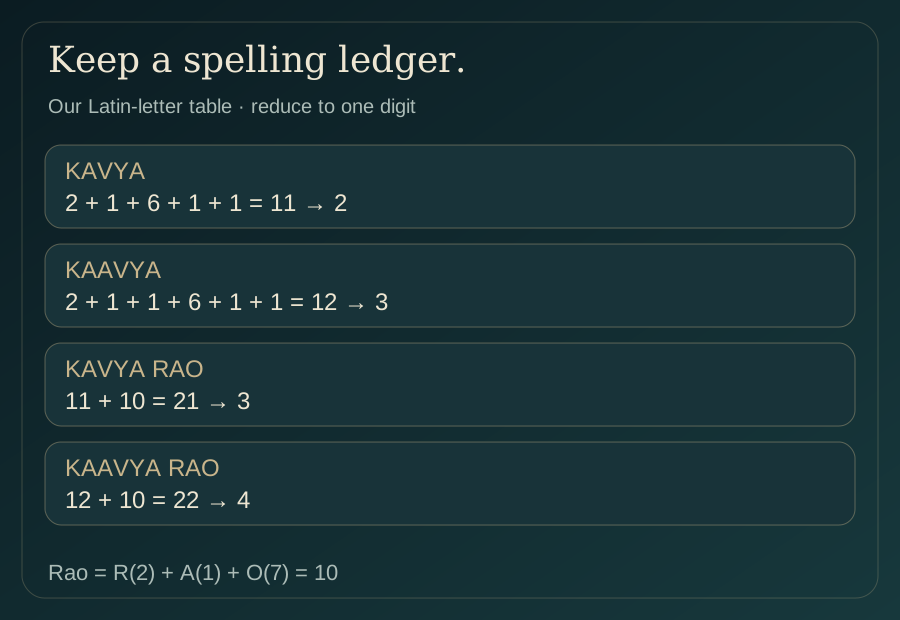
Now add RAO: R(2) + A(1) + O(7) = 10. The full-name calculations become:
| Input recorded | Calculation | Compound / reduced |
|---|---|---|
| Kavya | 2 + 1 + 6 + 1 + 1 | 11 / 2 |
| Kaavya | 2 + 1 + 1 + 6 + 1 + 1 | 12 / 3 |
| Kavya Rao | 11 + 10 | 21 / 3 |
| Kaavya Rao | 12 + 10 | 22 / 4 |
| K. Rao | 2 + 10 | 12 / 3 |
“Kavya Rao” and “K. Rao” both reduce to 3, but they have different compound totals. A calculator has not secretly expanded the initial K into Kavya. It counted the letters supplied. Likewise, two different inputs landing on the same reduced number do not prove that the spellings are equivalent.
There is no universally binding answer to “must I use my legal name or my everyday name?” for every numerological school. State the chosen convention. If comparing a professional name with a legal name, calculate and label both rather than changing the input halfway through the discussion.
Transliteration is an input decision#
Writing a name in another script is not the same operation as assigning it a number. A family's preferred English spelling, a passport spelling and a formal transliteration can differ. They may preserve different distinctions in pronunciation.
The Latin table above cannot settle which spelling is linguistically correct. It also cannot assign a complete native-script value merely by ignoring characters outside its table. If a calculator silently drops letters it does not recognise, the resulting total is not a valid calculation of the whole name.
For a name ordinarily written in Devanagari or Kannada, choose an agreed Latin spelling for this table and record that choice. Do not claim that an English spelling with a more attractive total proves anything about the original-language name. If using a separate native-script system, state its actual mapping and keep its results distinct.
Four checks when two calculators disagree#
First, compare the exact input. Did one use Kavya and the other Kavya Rao? Was an initial expanded? Is there a doubled vowel or a missing surname?
Second, compare the letter values. A different assignment for V or K is enough to change the sum. A shared label such as “Vedic numerology” does not guarantee that two tools use the same table.
Third, compare reduction rules. Here, 11 becomes 2 and 22 becomes 4. A tool preserving master numbers may display 11 or 22 instead. That is a convention difference, not necessarily an arithmetic mistake.
Fourth, inspect the full calculation. Keep the compound total. A final single digit conceals which letters were counted and can make different mistakes appear to agree by coincidence.
The calculation guide supplies the broader method. For a personal check, enter the recorded spelling in the numerology report and compare the sum before reading its description.
Would you actually want the new spelling?#
If a fictional Kavya is considering Kaavya for professional use, the number comparison is only one symbolic exercise. She still has to decide whether the spelling reflects her identity, is easy for colleagues to recognise, and can be used consistently across records. The calculator cannot make that choice for her.
A spelling change does not change her birth date, Moolank or Bhagyank. It does not rearrange planets or restart a mahadasha. It may affect how people search for or address her, but those are ordinary practical consequences, not proof of a changed destiny.
Before changing anything, save a small comparison sheet: spelling, purpose, letter table, total, reduced digit and practical trade-offs. Read why name correction does not always work and names and business comparisons for the decision side.
Method note: every sum above was checked against the current Celestial Digits Latin-letter mapping. This article documents the table's scope; it does not claim a universal Indian-language numerology algorithm or verified benefits from renaming.
Related Posts
How to Calculate Your Vedic Numerology Numbers in 5 Minutes
Step-by-step guide to calculating your Moolank, Bhagyank, and Namank using Vedic numerology. Learn the Chaldean system with examples and free calculator method.
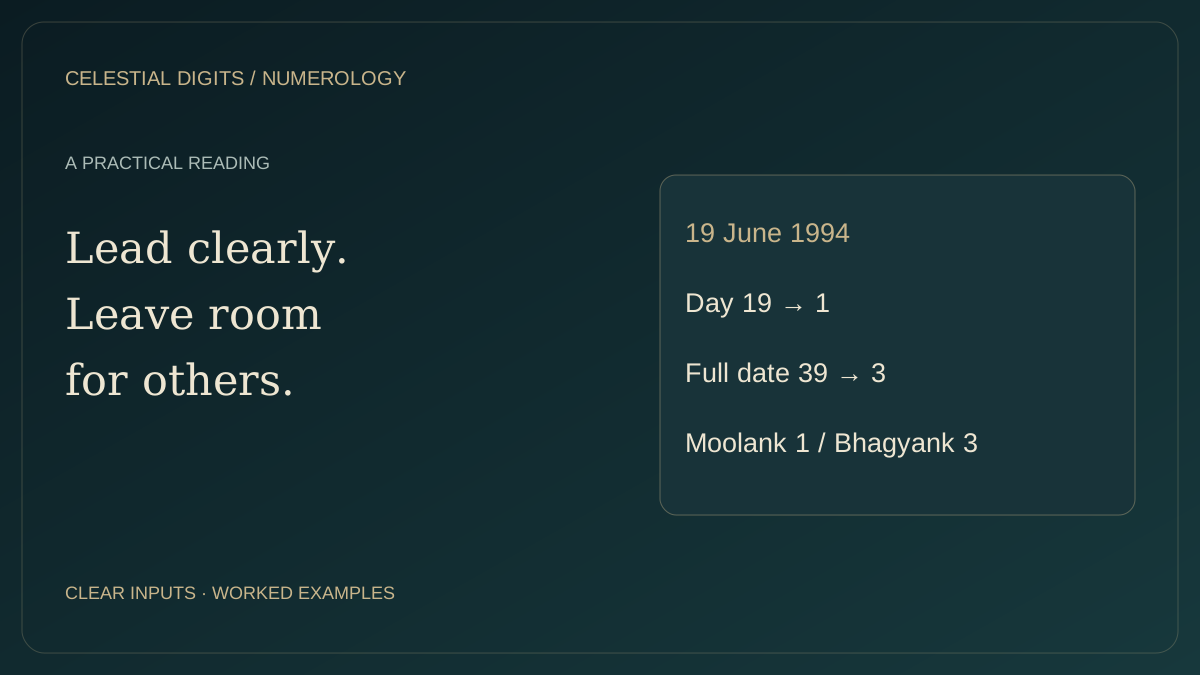
Moolank 1 (Sun): Initiative without taking over
Calculate Moolank 1, separate it from Bhagyank and explore Sun symbolism through a worked situation and practical reflection.
Moolank 2 (Moon): Cooperation with a clear decision
Calculate Moolank 2, separate it from Bhagyank and explore Moon symbolism through a worked situation and practical reflection.
A little more perspective.
Keep discussions respectful. No harassment, hate, sexual content or spam. Comments are reviewed before publication. Report concerns from a comment menu, or contact [email protected].
Checking your session…