
Kartikeya and the Six Mothers: The Story Behind the Krittikas
Discover Kartikeya's six nurses in the Ramayana, the fire and care behind the story, and how Krittika's deity differs from its planetary lord.
Before Kartikeya becomes a commander, he is a child who needs care.
That is easy to miss in images of the youthful warrior. His story is filled with radiance, divine purpose and extraordinary power. Yet one of its most memorable scenes concerns six nurses, each treating him as her own son.
Their name stays with him: Kartikeya, the child of the Krittikas. The connection opens a gentler side of a nakshatra often introduced only through flames, knives and sharpness.
Which version are we following?#
This article follows the Ramayana's Bala Kanda, chapter 37, in the account presented by Hari Prasad Shastri. Chapter numbering can vary between editions. It tells the episode through Agni, Ganga and the Krittikas.
Other traditions describe Kartikeya's birth differently, including accounts involving Shiva's sparks and a more prominent role for Parvati. We are not combining those scenes into a single supposedly universal chronology. A reader familiar with another telling need not discard it to understand the one used here.
A radiance too great to carry#
The gods seek a leader. Brahma directs them toward a child associated with Agni and Ganga. The divine radiance Ganga carries becomes unbearable, and Agni tells her to place it near the Himalayas. The surroundings shine with the splendour from which the child emerges.
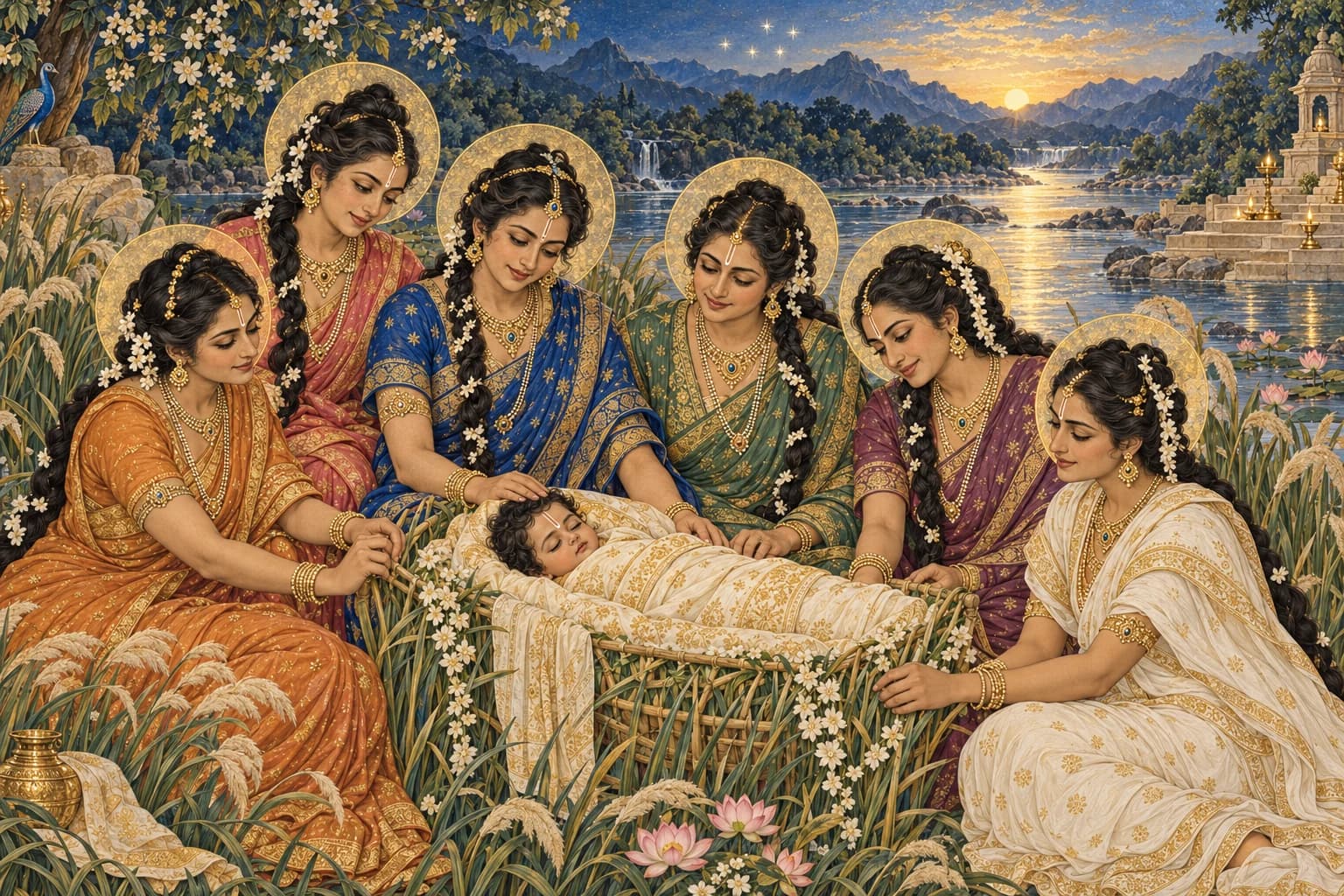
The gods arrange for the Krittikas to nurse him. All six regard him as their son. The child receives their milk with six mouths and grows in extraordinary power. He is named Kartikeya and Skanda, and the gods appoint him their commander. Read the Ramayana account.

The short narrative contains an interesting change of scale. It begins with a problem concerning the gods, passes through an overwhelming force, and arrives at the intimate work of feeding a child. Cosmic purpose still requires nurture.
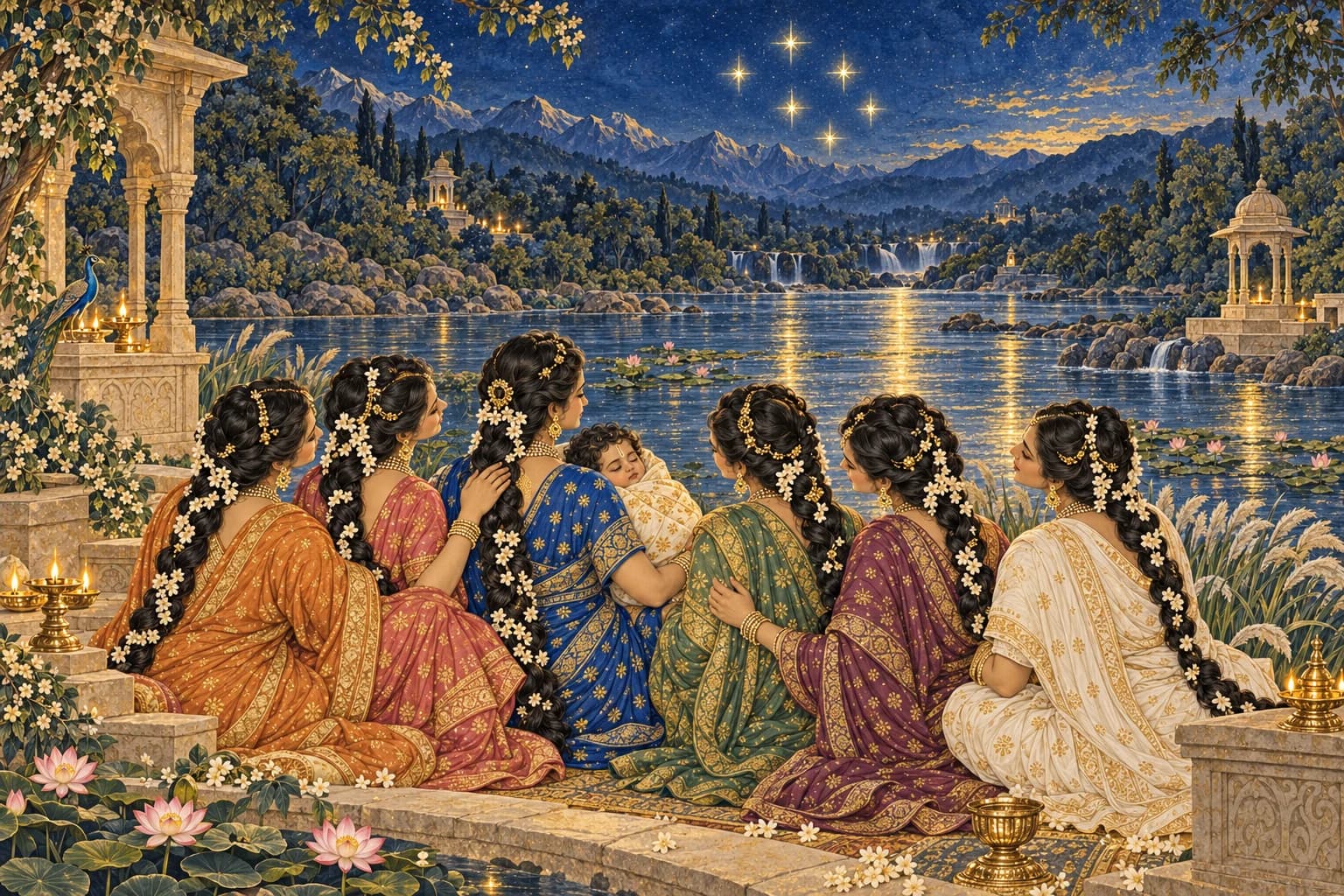
Our illustrations show one visible infant face in the scenes of shared care. They are selective artistic interpretations, not literal diagrams of the six-mouthed form described in the text.
Six mothers, not six rivals#
The six nurses do not have to be arranged into a competition for one exclusive claim. The child receives nourishment from all of them. Read as an image, the scene makes room for several relationships to matter at once.
That is an editorial reflection, not an instruction that everyone with Krittika in a chart must have a particular family structure. Nothing in a nakshatra label lets us infer someone's adoption history, parentage or experience of care.
What the image does offer is a useful question: when we celebrate someone's strength, do we remember the people who made it possible? A visible achievement may rest on patient work that never appears in the final portrait.
A teacher correcting a student's technique, a relative providing stability, or a team protecting time for a difficult task can all be examples of care that is practical rather than sentimental. The comparison is ours; the ancient narrative is not a modern management manual.
Krittika, Agni and the Sun are different labels#
The story's Krittikas, the nakshatra's deity and its planetary lord are related parts of a tradition, but they should not be merged into one identity.
| Term | What it means here |
|---|---|
| Krittikas in the story | The six nurses associated with Kartikeya |
| Krittika nakshatra | The zodiacal sector from 26°40′ Aries to 10°00′ Taurus |
| Nakshatra deity | Agni |
| Nakshatra lord in Vimshottari | Sun |
| Sign lord | Mars for its Aries portion; Venus for its Taurus portion |
Kartikeya's association with the Krittikas does not replace Agni in the standard deity listing. Nor does Agni replace the Sun in the Vimshottari lord sequence.
If your report shows the Sun as nakshatra lord while an article discusses Agni, check the labels before assuming a contradiction. See nakshatra lord vs sign lord vs deity.
Fire can prepare as well as destroy#
Krittika is often interpreted through fire and cutting imagery. A shallow reading can turn that into “you are harsh” or “you destroy things”. The story of the nurses makes that reading feel incomplete.
Within traditional symbolism, fire can also prepare, clarify and transform. Cutting can remove what obstructs growth. Those images become useful only when we ask what the action serves.
Consider the difference between precise feedback and humiliation. Both can feel sharp to the receiver; only one is concerned with helping the person improve. The relevant question is not how forcefully a correction is delivered, but whether it is accurate, proportionate and useful.
Likewise, protecting a boundary can be an act of care without requiring contempt for the person outside it. These are practical reflections on the imagery, not effects that a nakshatra has been shown to cause.
The stars and the chart sector#
The Krittikas are traditionally associated with the Pleiades, a star cluster. A cluster seen in the sky and a 13°20′ sector used in a chart are not identical kinds of thing.
The standard nakshatra framework divides the ecliptic into equal sectors. The actual stars form irregular groupings. Counting how many Pleiades you can see is therefore not a way to calculate someone's Krittika pada.
Reading Krittika without turning it into a verdict#
First identify what occupies Krittika: the Moon, ascendant or another planet. Then check its sign portion and pada. A point at 28° Aries has Mars as sign lord; a point at 5° Taurus has Venus as sign lord. Both have the Sun as Krittika's nakshatra lord.
The four padas correspond to Sagittarius, Capricorn, Aquarius and Pisces navamsas in order. Those are mathematical subdivisions; they should not be confused with the sign containing the D1 position.
For the placement framework, continue with our Krittika guide. To find your own placements, open the birth-chart report.
The story offers more than an image of a future warrior. It remembers the child before the command, and the shared care before the strength.
Source: Ramayana, Bala Kanda 37, Hari Prasad Shastri translation, linked above. The narrative summary follows that account; the reflections and chart examples are separate editorial interpretation. Original AI-assisted artwork is not a claim of canonical iconography or scientific prediction.
Previous: The Ashwini Twins and Chyavana · Next: Vamana and King Bali · All illustrated stories
Related Posts
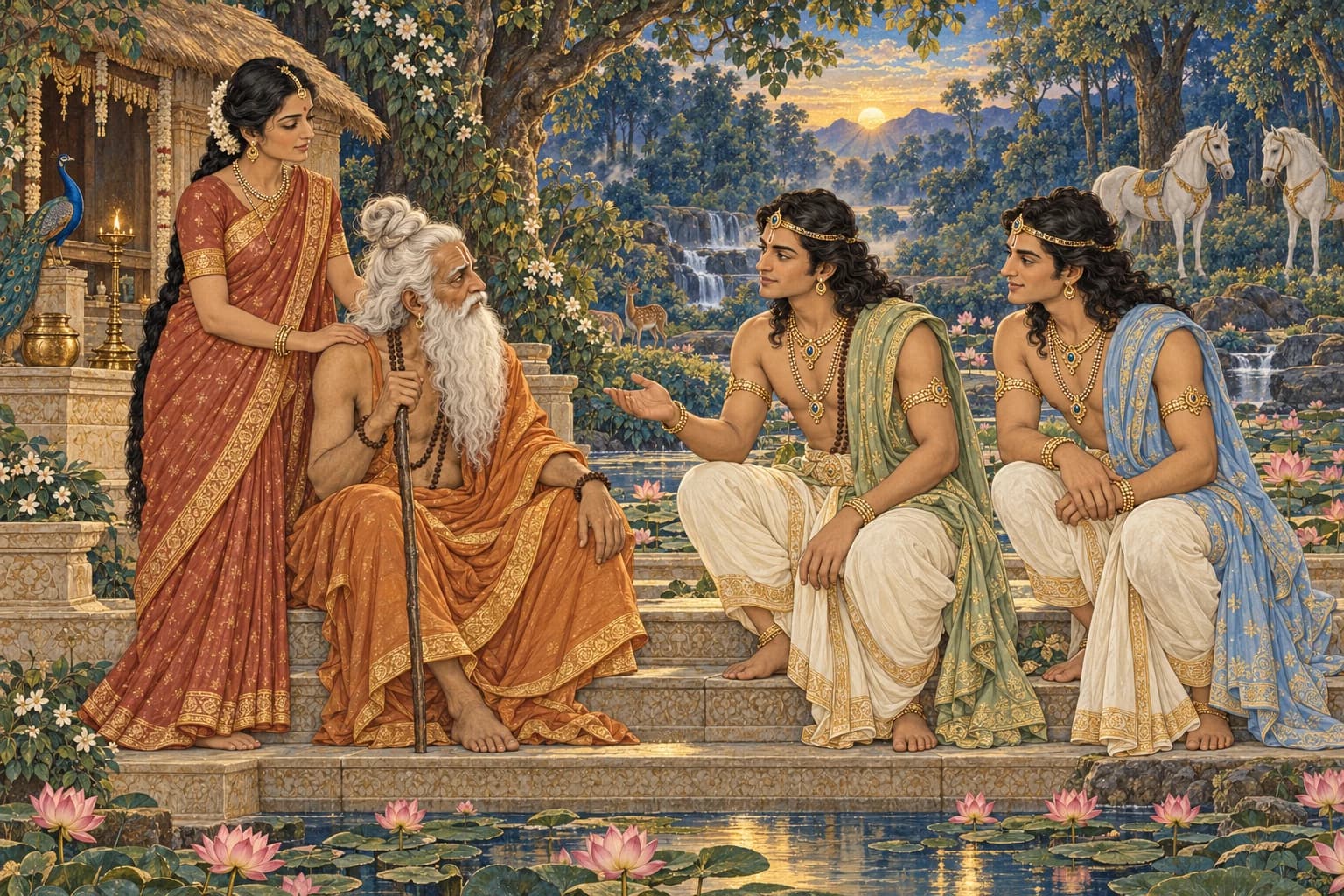
The Ashwini Twins and the Sage Who Became Young Again
Chyavana regains his youth, Sukanya faces three identical men, and Indra refuses the healers a place. Discover the lore behind Ashwini nakshatra.
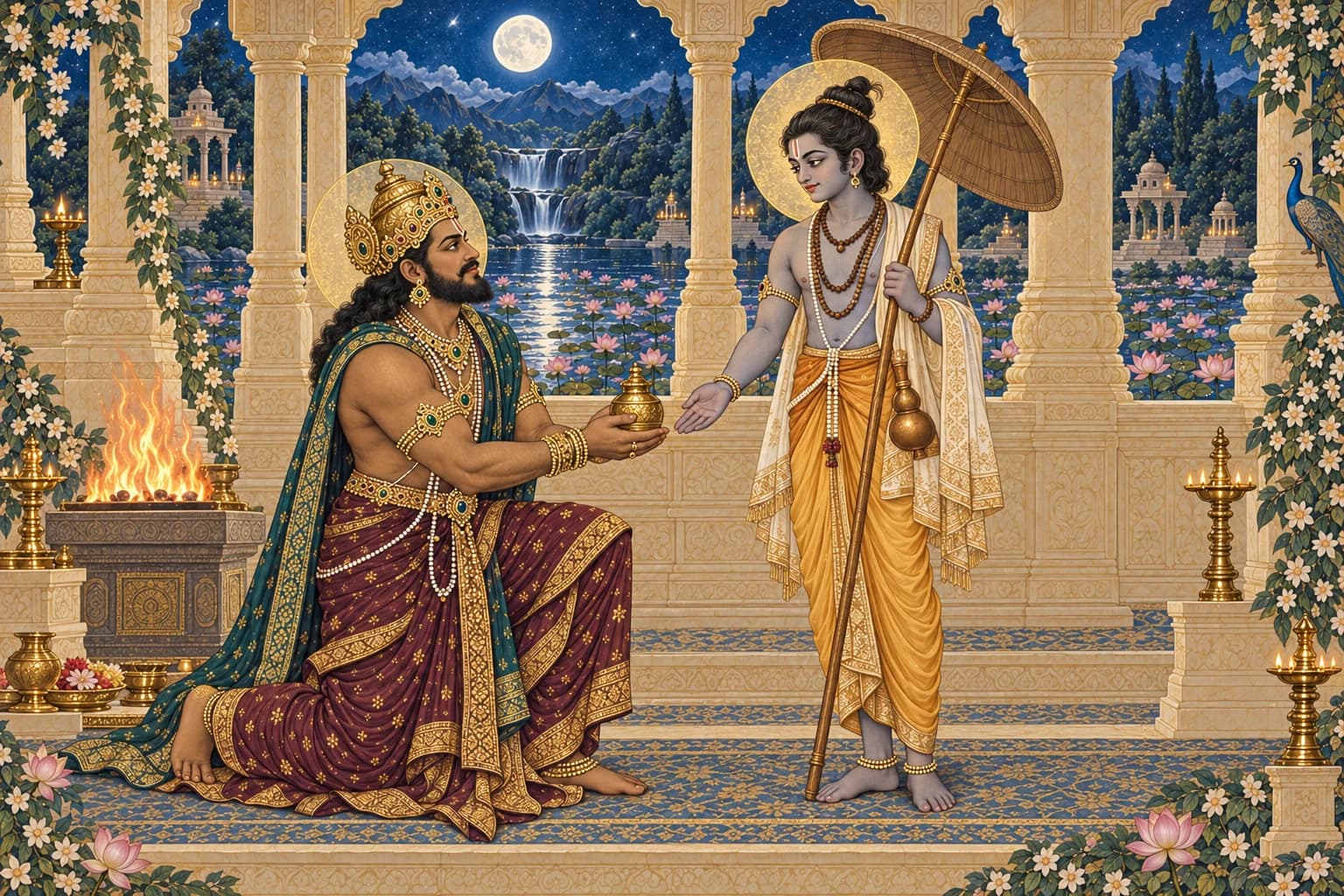
Three Steps That Changed the Universe: Vamana and King Bali
Vamana asks Bali for three steps of land. Explore Shukra's warning, Vishnu's cosmic form, Bali's fate and the story's connection with Shravana.
Stories Behind the Grahas: Eight Planet and Nakshatra Lores
Explore eight illustrated planetary and nakshatra stories, from Chandra and Rahu to the Ashwini twins, Kartikeya and Vamana, with source notes.
A little more perspective.
Keep discussions respectful. No harassment, hate, sexual content or spam. Comments are reviewed before publication. Report concerns from a comment menu, or contact [email protected].
Checking your session…