
Hindi, Marathi and Kannada Names: Transliteration Before Numerology
See why two Roman spellings of an Indian name can produce different totals, and how to record the script, spelling and letter table accurately.
If a name is written in Hindi, Marathi or Kannada, an English-letter numerology calculator needs an additional decision before it can calculate anything: how will that name be represented in Roman letters?
This is not a minor formatting detail. An English letter table counts the characters supplied to it. It does not automatically understand the sound, cultural meaning or original script of a name.
Transliteration is a separate operation#
Hindi and Marathi commonly use Devanagari; Kannada uses its own script. Romanization systems can use diacritics, while everyday English spellings often use combinations of letters instead. The Library of Congress publishes separate language tables and explains the difference between technical and conventional romanization.
That reference helps document spelling. It does not endorse numerology or establish which spelling is spiritually correct.
A small example with a large numerical difference#
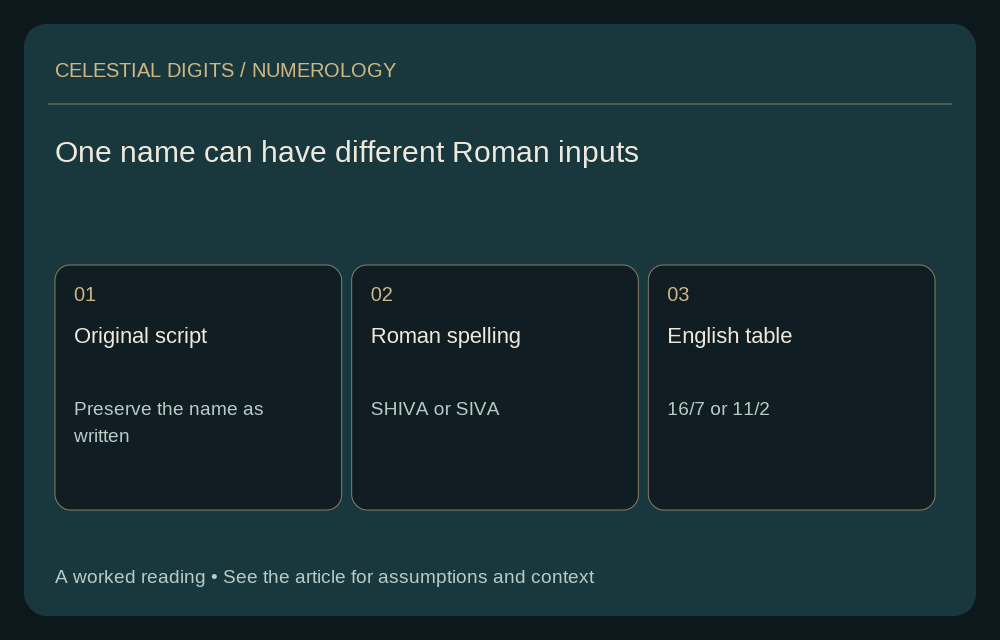
Consider the Roman inputs SHIVA and SIVA, spellings encountered when Indian names are represented in English. This comparison does not claim that every regional pronunciation or transliteration convention treats them identically.
Using the Chaldean-style English table:
| Input | Letter addition | Total and root |
|---|---|---|
| SHIVA | 3 + 5 + 1 + 6 + 1 | 16 → 7 |
| SIVA | 3 + 1 + 6 + 1 | 11 → 2 |
The extra H contributes 5. The change is completely explained by the input and table; it is not evidence that a person's underlying character changed when somebody typed their name differently.
Why sounds and letters cannot be silently mixed#
In an English-letter calculation, SH is counted as S plus H. A method that assigns a value to a sound or a character in another script is a different system and needs its own documented mapping.
Similarly, a diacritic-bearing letter such as ś is not one of the plain A–Z entries. A tool must explain whether it rejects, preserves or normalises that character. Quietly dropping unfamiliar characters can produce a result that looks precise but is based on incomplete input.
Keep a four-part record#
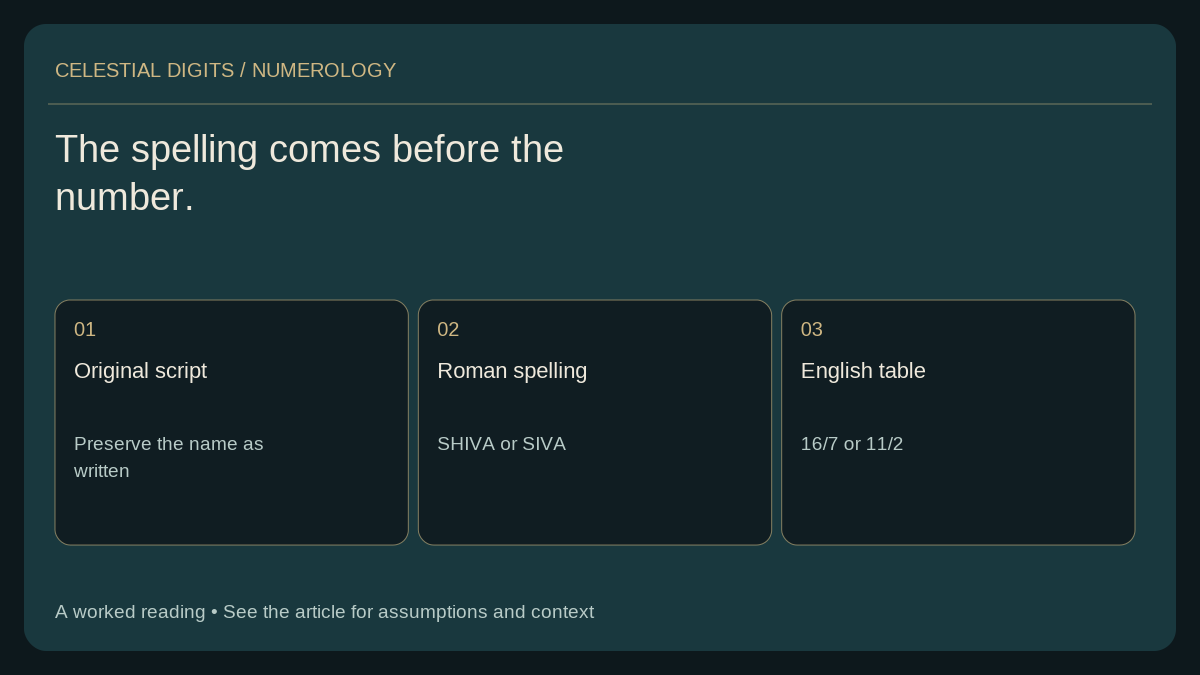
First preserve the person's name in its original script. Second record the Roman spelling actually used in the calculation. Third name the letter table. Fourth state whether spaces, punctuation, initials and diacritics are included or normalised.
For an everyday-name study, the person's usual English spelling may be the most relevant input. For a scholarly comparison, a stated transliteration convention may be preferable. Those are choices about the study's purpose, not competing proofs of destiny.
A useful check before comparing reports#
Ask both calculators to display their letter-by-letter additions. If one uses SHIVA and another SIVA, compare the inputs before interpreting the difference. If they use identical inputs but different tables, compare those tables next.
Do not alter a meaningful family name merely to obtain an appealing root. Pronunciation, identity, accessibility and personal preference remain important regardless of symbolic arithmetic.
Continue with which name to calculate and a complete middle-name calculation.
Sources and scope#
Romanization context comes from the Library of Congress language guide. Letter values follow Cheiro's English table. The comparison is original; numerology is a symbolic practice, not a validated language or personality test.
Related Posts
Choosing a Baby Name: Numerology, Pronunciation and Family Meaning
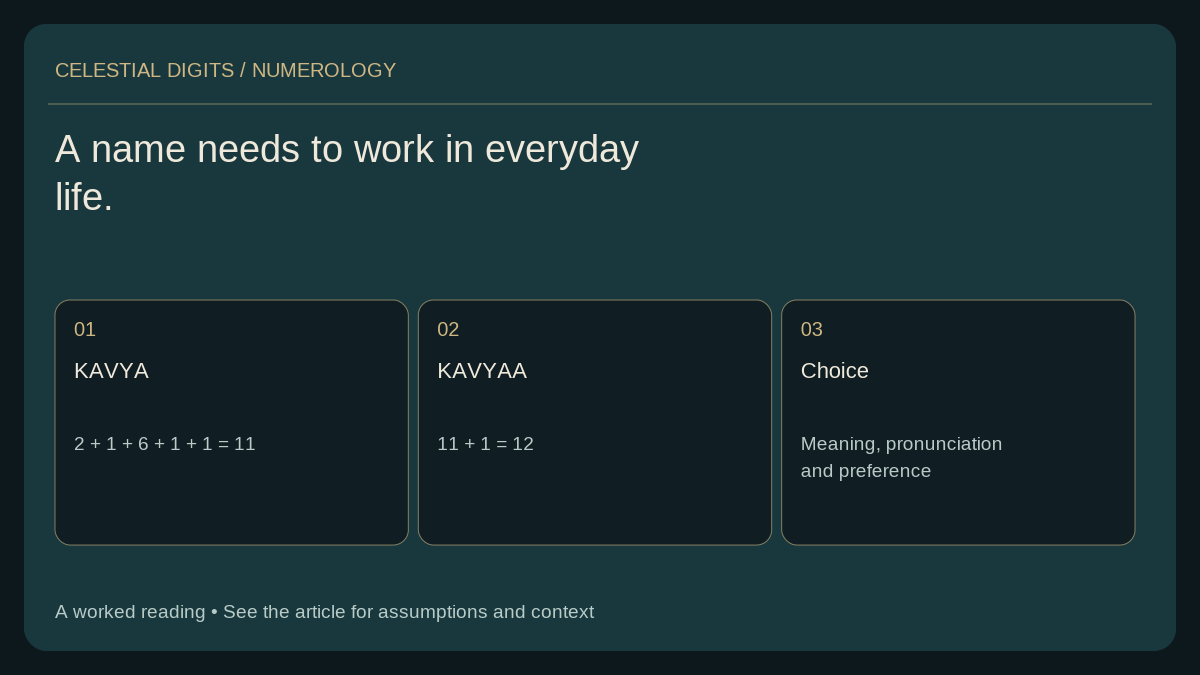
Work through two spelling totals and compare them with pronunciation, cultural meaning and everyday use before choosing a name.
Birth Name, Legal Name or Everyday Name: Which Should You Calculate?
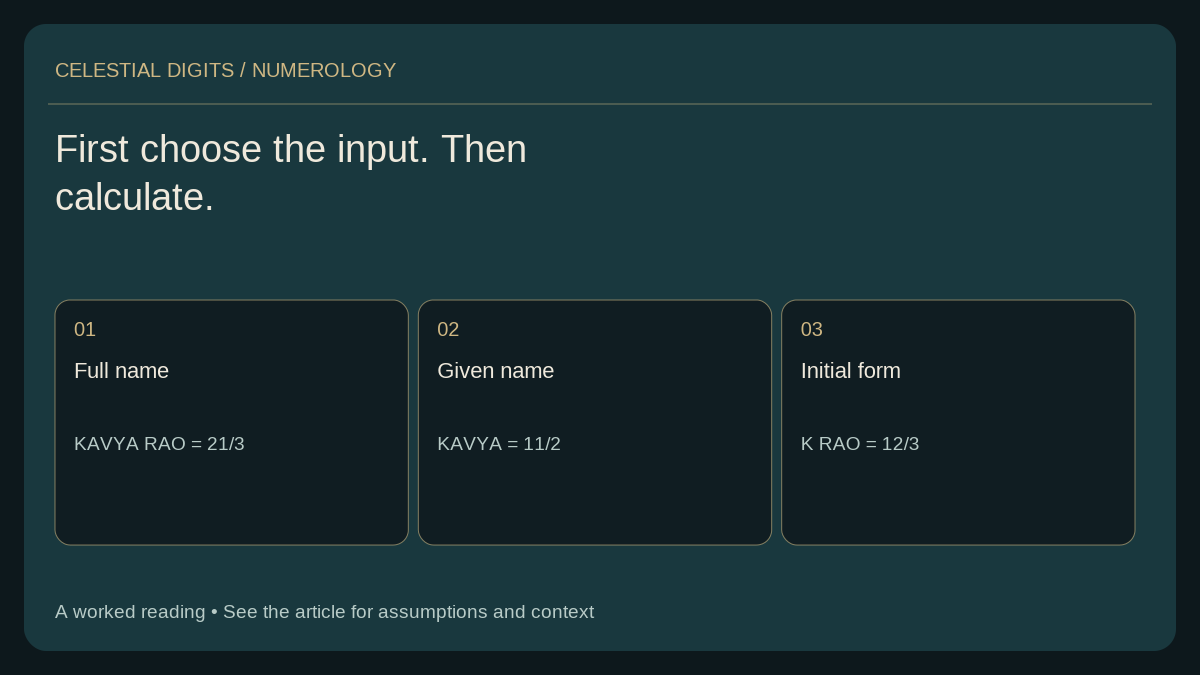
Compare three name inputs under one letter table and learn how to record the purpose, spelling and result without choosing a total after the fact.
Build a Complete Numerology Reading: Inputs to Interpretation
Follow one fictional profile through Moolank, Bhagyank, Namank and Personal Year, with explicit arithmetic and a balanced interpretation.
A little more perspective.
Keep discussions respectful. No harassment, hate, sexual content or spam. Comments are reviewed before publication. Report concerns from a comment menu, or contact [email protected].
Checking your session…